@mcuban@costplusdrugs I believe most of this is coming from Bumetanide and Isosorbide Dinitrate, which have been too high for too long. Thanks for fixing!
6/
Bottom line: this study does not show that statins cause dementia. Its design can’t separate a drug effect from these biases, and better evidence points the other way.
1/
1/
A new study is being read as “statins double dementia risk.” It doesn’t show that. It found more dementia diagnoses among statin users in two health databases, and its design can’t tell you why. Here’s what goes wrong in studies like this 🧵
https://t.co/pxKNqpFTle
5/
The tell: a doubled risk conflicts with randomized trials and genetic studies, which don’t show this harm. Big effects and dose-response patterns can come from bias too. Stronger tests would compare against another drug, check outcomes statins shouldn’t affect, and fix the entry timing.
A fully and rapidly reusable rocket will fundamentally change how humanity accesses outer space. “The Holy Grail of Rocketry” continues the ongoing Starship series with a look back at the scrappy days of SpaceX engineers proving reuse was possible and takes you onboard a high-seas race to recover a floating Starship
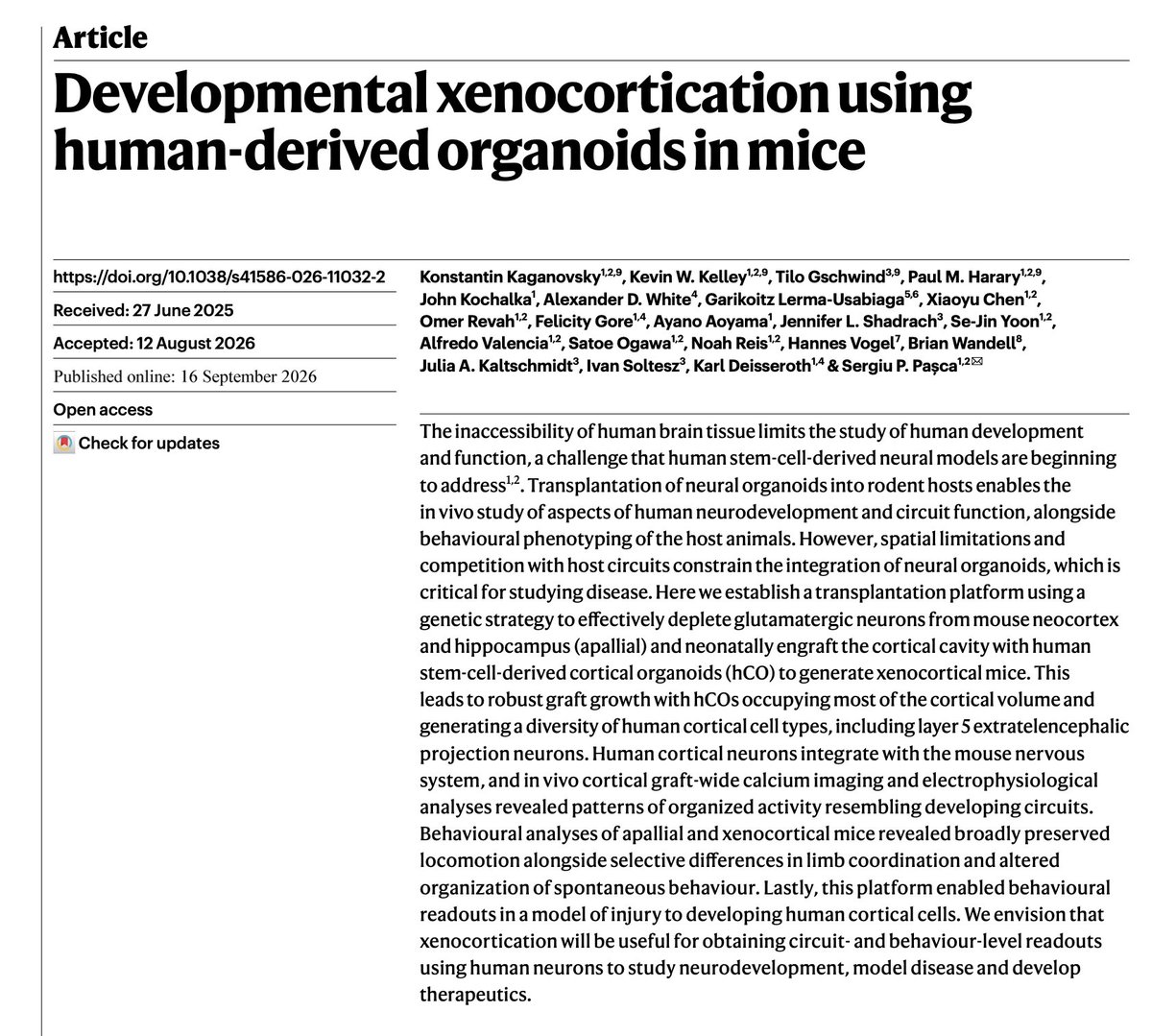
An extraordinary @Nature paper has just landed from the lab of @Sergiu_P_Pasca at @Stanford - led by Konstantin Kaganovsky. They have found a way to create "xenocortical mice" which have ~92% of their cortex occupied by a cortical organoid derived from human stem cells. This human-derived cortical graft integrates deeply with the host nervous system, supporting organised neural activity and behaviour.
This study is a milestone in synthetic biology and chimera research. It has the potential to generate multiple medical breakthroughs by providing an enhanced biological model of human brain tissue that allows behavioural as well as neural and genetic assays.
The Stanford team have been exceptionally thorough and proactive in addressing ethical concerns that comes from this frontier work. But their pioneering work nonetheless raises many open questions: are the xenocortical mice conscious? Do they have any human-like properties of consciousness or cognition?
@NitaFarahany and I will be addressing some of these questions in a forthcoming commentary - where we'll also offer an ethically-informed roadmap to guide this important research as it progresses. In this context, "pacing the frontier" really does make sense 😉
Read the Stanford @nature paper here, and buckle up. It's wild. https://t.co/Ky9HFb9nYI
@Farzad_MD To be fair…delivery side doesn’t seem interested. I can’t remember a VBC entity ever putting an RFP out for optimizing clinical outcomes or prioritizing care.
Ready for launch, ready to change how we view the cosmos.
After years of careful planning, testing, and construction, @NASARoman is ready for liftoff tomorrow, Aug. 30.
@chrissyfarr Refills aren't there just to be a nusance. They are mechanism for getting patients to reengage in preventive care, and to understand the reality of adherence. If a perscribing clinician wants, there are plenty of ways of nearly automating refills already.
@EricTopol@AnnalsofIM The term was created to clearly designate who could establish a care relationship and prescribe. Clinician is a better term in general but it loses this useful sieve. Perhaps we need something like “attending clinician” :)