The Clickbait Trap of Extreme Price Targets (November 19, 2026)
Extreme price targets—whether sky-high or crash-low—are usually marketing, not analysis. In retrospect they almost never happen, yet they keep circulating because they drive clicks and engagement.
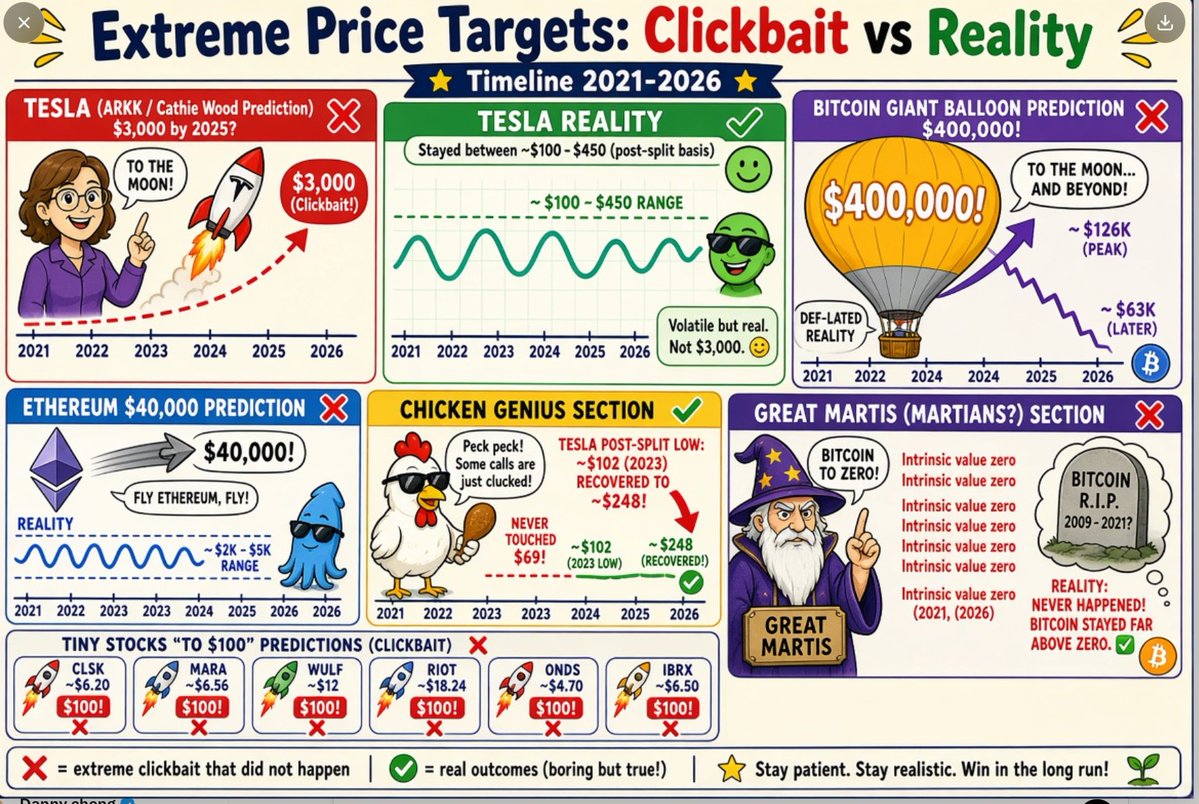
Cathie Wood’s ARK Invest, for example, set a $3,000 $TSLA target by 2025 back in March 2021 (when the stock was roughly $650, pre-split). That target was never approached. $TSLA closed 2025 around $450 after peaking near $490 and was trading near $384 in mid-November 2026; ARK later shifted its longer-term number to about $2,600 by 2029.
On the crypto side, a wave of optimistic calls (including the fake furu Tom Lee and many “big” accounts) suggested Bitcoin at least $400,000 and Ethereum $40,000 by 2025. Bitcoin’s all-time high was roughly $126,000 in late 2025; it finished that year in the high $80,000s and was around $63,000 by mid-November 2026. Ethereum peaked near $4,950 in 2025, ended the year near $3,000, and traded around $1,770 in November 2026.
Most TA guys and influencers also repeatedly called for $CLSK, $MARA, $WULF, $RIOT, $ONDS, and $IBRX to hit $100. As of mid-November 2026, those names were trading well below that level (CLSK ~$6.20, MARA ~$6.56, WULF ~$12.00, RIOT ~$18.24, ONDS ~$4.70, IBRX ~$6.50), never having come close.
Bearish extremes fared no better: Chicken Genius called for $TSLA to fall to $69 around 2022. The stock’s post-split low was roughly $102 in early 2023; it never reached $69, recovered sharply through 2023 (ending the year near $248), and did not revisit those depths. Likewise, The Great Martis has repeatedly claimed Bitcoin is heading to zero or has an intrinsic value of zero (explicit calls date back to at least 2021, with further statements in 2025–2026 that a breach of levels such as $30k would send it “near zero”). He has also called market tops at least 30 times over the past few years; none of the zero or catastrophic-collapse predictions have materialized.
To be honest, 99% of the retail investors lack the multi-year patience and risk tolerance these forecasts implicitly require. Stocks and tokens often suffer long, painful plummet before any sustained move higher; those drawdowns shake out the majority of holders. Extreme targets therefore function mainly as engagement bait. Nobody—retail, whales, or institutions—knows the future with that kind of precision.
The practical takeaway is simple: treat outrageous price targets as entertainment, not guidance, and base decisions on process, position sizing, and fundamentals rather than someone else’s headline number.
@cantonmeow@chad_ventures@gabz_investing@Jimmy_tesla_01@niker8202@tonylee80@sheslee@Hapee_00@starship_ride@HeidingOut
Cutting a $4M Loss Let Me Build 10x and 20x Winners. (November 16, 2026)
We all make mistakes in trading and investing — no one is perfect. I made a particularly painful one with a $4 million loss in $TSLA during 2021–2022. What changed everything was the decision to cut those losses completely rather than hope for a recovery. That single choice preserved capital and gave me a clean slate to rebuild.
With that capital freed up, I began building a new $NVDA position in January 2023 around $15.2, which later delivered roughly a 10x gain. I started accumulating $PLTR in May 2023 near $8.8, and that position went on to produce 20x returns. These outcomes came from identifying high-conviction opportunities through fundamental and technical work, then sizing aggressively when those names traded at substantial discounts, amid retail fear and skepticism.
In February 2025 I trimmed 40% of the $NVDA and shared the move with my Patreon community. The sale dropped the average cost on the remaining shares below $0.01 and freed capital that I rotated into $AMD starting around $110 in May 2025— at a time when many retail investors were skeptical. Some Patreon members even unsubscribed, convinced the move was a mistake.
That same process still guides the portfolio today. I continue to hold $PLTR, $AMD, $NVDA, and $TSLA. With pure speculative small stocks (lottery tickets) I take only a single position and do not keep adding.
The willingness to admit mistakes, cut losses, and redeploy into higher-conviction ideas has proven far more powerful than trying to be right on every trade or waiting for luck to bail me out.
@cantonmeow
Elliott Wave analysts target $AMD at around $300, while most Wall Street analysts have price targets in the $600–$700 range. Which do you think is possible?
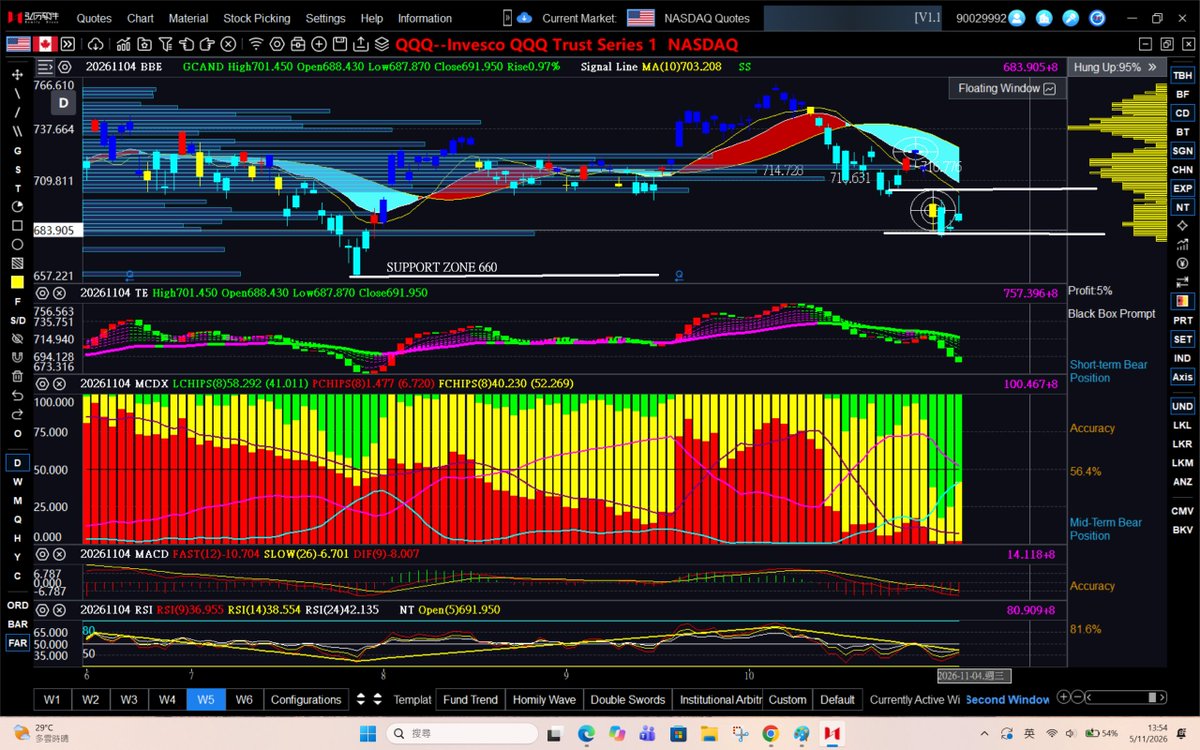
$QQQ (November 5, 2026-Daily Chart)
Can $QQQ hold the last volatility hole and launch another leg higher, or will it break below the lower boundary and test the next support zone near $660?
@cantonmeow
Real wealth is a marathon of endurance, clear vision, and disciplined preparation—not a sprint (November 5, 2026)
Most retail investors expect the market to deliver a smooth, uninterrupted climb with almost no volatility—up every day, every month, forever. Reality is different. Markets move in both directions, and even the strongest stocks can go sideways for a year or longer as they consolidate.
This has played out clearly in several of the best names:
1. $PLTR topped out in November 2025 and has since spent more than half a year forming a base.
2. $NVDA spent a full year (June 2024 to June 2025) unable to break and hold above the $140 level.
3. $AMD traded in a tight range between roughly $190 and $230 for about six months, even while many Elliott Wave analysts were calling for a drop toward $120.
4. $OSCR spent more than a year and a half (June 2024 to April 2026) chopping between $14 and $20 before finally breaking out.
In high-quality stocks, these periods of consolidation and temporary drawdowns are not reasons for pessimism. They are accumulation windows. The opportunity is to build a position gradually while the majority lose patience and lack conviction!
Wealth is almost never created in a few months or even a single year. It is built over multi-year cycles—typically 3 to 10 years. If that timeframe feels too long or too uncomfortable, simply go to the casino and try your luck instead.
There is no luck in the stock market. Real wealth is a marathon of endurance, clear vision, and disciplined preparation—not a sprint.
@cantonmeow@chad_ventures@gabz_investing@HeidingOut@Jimmy_tesla_01@niker8202
@Hiteshp99
@sheslee
From $4M loss to 14–22x. (October 28, 2026)
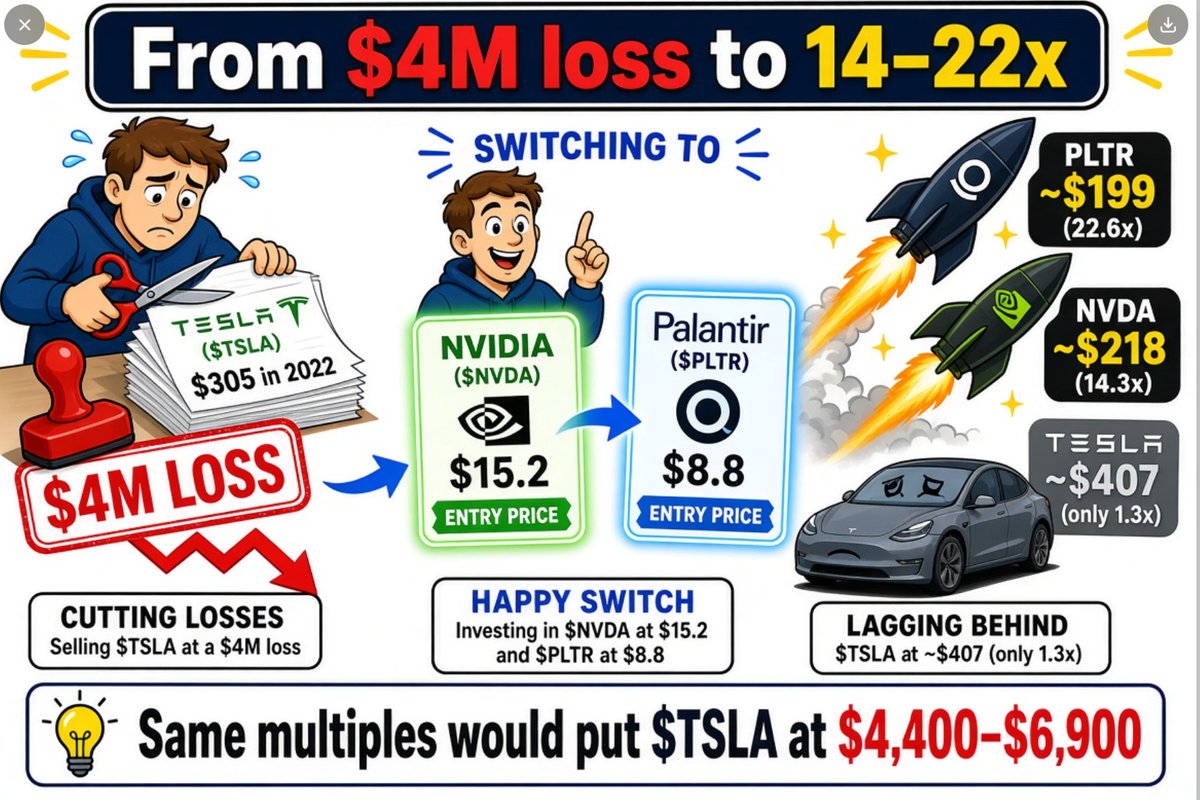
Sold more than 55k $TSLA at $305 in 2022 (~$4M loss).
Bought $NVDA @ $15.2 (Jan 2023) + $PLTR @ $8.8 (May 2023)
Today: $PLTR ~$199 (22.6x), $NVDA ~$218 (14.3x).
To match those multiples from my previous $305 TSLA exit, $TSLA would need to be around $4,400–$6,900. It’s at ~$407 (~1.3x).
@cantonmeow@sheslee@Jimmy_tesla_01@HeidingOut@niker8202
@Hiteshp99
@tonylee80@PLTRs_Palantir@PalantirHotline@amitisinvesting
I’ve been bullish since January 2023 and have not turned bearish once — not during any small crash, minor pullback, or temporary weakness. The reason I can stay invested is that I’ve done proper research on both the fundamentals and technicals of the companies I’ve been sizing up aggressively.
Every selloff brings the same tweets: “I warned you before,” “the top is in,” and a few recycled examples. Then, once the market rebounds, the same people suddenly switch to “I bought the bottom” or “I told you to buy,” again with cherry-picked examples.
These periods of weakness make it clear who actually has conviction versus the professional flip-floppers who only sound confident after the fact — bearish on the way down and bullish once prices have already recovered.