A roadmap for restoring shareholder trust at #Metaplanet
Prepared for the Board of Directors and management of Metaplanet Inc. by a shareholder @gerovich@DylanLeClair@Shinpei3350
In the spirit of a more constructive dialogue (and at the advice of a friend and fellow shareholder), below is a roadmap on how to handle the situation for the benefit of all stakeholders.
Summary
Metaplanet has built the second-largest corporate bitcoin treasury in the world in twenty-eight months. After the ¥96bn of debt and preferred that stand ahead of the common, the equity's claim on that treasury is worth ¥425bn, about 35K BTC, and the market prices it at ¥338bn: 0.80x the claim. The discount is not about bitcoin, and it is not about execution. It is the market's price for a compensation instrument that grew with every share the company sold, for the related-party record around it, and for the fact that shareholders had to reconstruct both from the filings themselves.
The 18 August amendment fixed the pool at 319,464,000 shares. It did not fix the problem, because 319,464,000 is the problem. The pool shareholders approved in Feb 2023 was 46M. The clause added 273,464,000 shares, a claim on roughly 7,200 bitcoin, and the amendment made that number permanent.
Trust is restored by returning what was not earned and by making a recurrence structurally impossible. The below roadmap sets out how, in four phases over ninety days: return first, redesign second, explain last. Every step is an action the company can take and disclose.
Phase 0 — This week: stop the clock
1. Suspend further exercise of the 10th-series SARs, by board resolution, with the written consent of each holder recorded and disclosed, pending the outcome of the review. The August exercise took 64 million shares out of the pool while the review was open. That is not a signal of a serious review.
2. Suspend any transfer of units into the incentive vehicle until the vehicle's full terms are published. Moving the units first and disclosing the terms later is the pattern that produced this situation.
3. Publish a one-page notice, in English and Japanese on the same day, stating what is under review, who is conducting it, and the date by which conclusions will be filed. Name the independent directors leading it and the outside counsel and compensation consultant retained. The date should fall within sixty days.
4. Resolve the MMXX contradiction. The company's securities reports for FY2023 through FY2025 state that the chief executive "indirectly holds a majority of the voting rights" in MMXX Ventures. MMXX's own large-holding report No. 26, filed 7 September 2026, states that he does not hold a majority, is not an officer, and has no role in its decisions. Both cannot be true. State which is correct. If the securities reports were wrong, file the correction; if MMXX's report is wrong, say so.
Phase 1 — Within 30 days: return what was not earned
The arithmetic is simple and the company should publish it rather than leave it to shareholders.
5. Publish the baseline. The split-adjusted pool contemplated when shareholders voted is 46M shares. If the board believes a different baseline is defensible, for instance the pool as it stood on 8 April 2024 when the bitcoin strategy began, it should state the number, the method and the difference from 319,464,000. What it should not do is leave the baseline unstated.
6. Holders surrender the excess. Under the Companies Act the holders may waive their rights, or the company may acquire the units by agreement without consideration and cancel them.
7. Address the 64,032,000 shares already exercised. The excess portion, the shares attributable to the clause rather than the original grant, should either be returned to the company without consideration and cancelled, or be made subject to a binding undertaking that they are locked, carry no vote, and will be tendered into any future buyback at ¥10. Publish which route was chosen and why.
8. Cancel, do not retain. Treasury shares that result from steps 6 and 7 should be cancelled so that the count falls and stays down.
9. Publish the before-and-after. The same notice should show the fully diluted share count and bitcoin per fully diluted share before and after the return. The pool imposed a permanent twenty per cent haircut on bitcoin per share; the market should see that haircut shrinking in the company's own numbers.
Phase 2 — Within 90 days: replace the instrument
10. Withdraw the incentive-vehicle plan as drafted.
11. Design a new long-term incentive plan from a blank sheet with an independent compensation consultant and the independent directors, and put it to shareholders at an extraordinary general meeting. The plan should carry: a fixed share count that does not move with issuance, expressed as a percentage of shares outstanding at grant and capped within the range proxy advisers support for the whole plan across all employees; a performance condition measured on bitcoin per fully diluted share, net of senior obligations, against a published hurdle, with bitcoin itself as the hurdle rate; three-to-five-year vesting; a strike at the market price on the grant date; and clawback. Strive's published framework, built with Mercer and benchmarked at the fiftieth percentile, is the nearest public template in the sector and cost its entire team under one per cent of equity value a year.
This should be applied retroactively for the efforts and work that got us from pivot to where we are today. And management should be very well compensated for the performance they produced against the appropriate KPIs.
12. Publish the full terms bilingually and simultaneously, with a worked example: if the company issues X shares and acquires Y bitcoin, management receives Z. A shareholder should be able to check the number with a calculator.
Phase 3 — Within 90 days: close the related-party ledger
14. Disclose the lending rate on the 30,000,000 shares MMXX Ventures has lent to EVO FUND since June 2025. The October 2024 loan disclosed a rate of 10.0 per cent; the subsequent loans withheld it "at MMXX's request." A fee paid by the company's financing counterparty to a vehicle the company describes as controlled by its chief executive is a related-party flow and belongs in the securities report.
15. Explain two transactions already on the record. In October 2024, 1,715,180 lapsed rights were allocated to MMXX and to the chief executive, on the company's own account of him having found the takers "himself"; the strike was ¥55.5 against a market of ¥100–120, and MMXX sold twelve million of the resulting shares within two weeks. On 18 April 2025, MMXX sold 1,439,100 shares to the chief executive off-market at ¥300 against a ¥353 close. If either was priced by a method, publish it. If neither was, say what the board will do.
16. Disclose payments to advisors' affiliates. State the consideration paid for the Bitcoin Magazine Japan licence and any other payment to BTC Media, UTXO Management or affiliates of the company's advisors and directors. The 19th-series options granted to advisors at ¥105 were described in the May 2025 filing as their compensation; the license fee deserves the same transparency.
17. Confirm who holds the pool. State whether any executive who joined after February 2023 holds, or has been promised, 10th-series units, and if so how they were acquired.
Phase 4 — Standing: the disclosure standard
18. Simultaneous bilingual filing. Every TDnet notice and every securities report published in English and Japanese on the day of filing. The English translations of the 2023 documents describing the pool reached OTC Markets in November 2024 and the company's own English site in July 2025. That gap is where the word "hidden" came from.
19. A monthly fully-diluted bridge in every bitcoin purchase notice: opening count, shares issued by instrument, adjustments by series, closing count. No reader should have to reconstruct the pool.
20. A quarterly compensation valuation showing the intrinsic value of all management equity instruments at the quarter-end price, in yen, dollars and bitcoin. If the number is uncomfortable, the remedy is the number, not the section.
21. Independence that means something. The compensation and audit committees should consist of directors with no commercial relationship to the company's advisors, its financing counterparties, or the chief executive's vehicles. A director who is a partner of an advisor holding company options is not independent for this purpose, whatever the listing rules permit.
What not to do
Do not publish a letter explaining that the clause was disclosed. It was, and disclosure did not prevent this. Do not compare the pool to founder equity at Strategy or Strive; the comparison has been tested in public and did not survive. Do not describe the August amendment as the fix; the company's own notice describes it as fixing the number at 319,464,000, which is the number in dispute. Do not fund the incentive vehicle with existing units at undisclosed consideration. Do not allow further exercises while the review is open. Do not answer through advisors.
The team built something remarkable over the past 2.5 years, and this is only the beginning. Now is the time to step up and fill the shoes of a true leader. Despite my many critical posts over the past week, I am rooting for you to win.
$MPJPY $MTPLF $DN3
I'm sharing my thoughts on the 10th Series situation
I've tried to analyze the whole process as thoroughly as I can, within the limits of my knowledge and abilities. I hope it helps clarify the issue and shows that things aren't necessarily as bad as they're being portrayed
And, ultimately, why in my view, nobody robbed anybody
The 10th Series: They may have earned it, but the mechanism didn't make them
The debate has been stuck on the wrong question. Almost everyone is arguing about the amount. Was ~$500M too much for the team? I went through the filings and the math, and I came out somewhere different: the amount was plausibly deserved. What was indefensible wasn't the size of the reward; it was the mechanism that delivered it. Management reached a figure they might well have earned automatically, by issuing shares, instead of earning it through measurable value creation. That distinction is the whole story
A note on the numbers: throughout, I use Metaplanet's own "Effective Diluted" share basis, the one it uses for BTC Yield, which excludes warrants whose cash hasn't been paid in. It's the honest measure of the pool's real claim on today's treasury, and it's the one that cuts against the company (it makes the pool's claim larger, not smaller). All per-quarter figures come from the company's own BTC-per-diluted-share table in its Q1 2026 earnings materials, plus Q2 2026 disclosures. More on the share basis at the end
Part 1: The team genuinely deserved a large, growing stake
The starting point (2022): Metaplanet wasn't Metaplanet. It was Red Planet Japan, a hotel chain gutted by the pandemic, carrying a going-concern warning (the accountant's flag that the company might not survive)
That's when the 10th Series was created
These weren't free grants: the team bought the options with their own money (¥18 per unit plus a ¥10 strike), with a three-year waiting period before they could exercise. The expected outcome wasn't a multi-hundred-percent return; it was liquidation
They risked cash and three years of their careers reviving a corpse
A 20% stake for the management team taking on a turnaround like that is textbook, and it should have been allowed to grow as they succeeded. Here's why freezing it would have been wrong:
The lemonade example. You start a lemonade chain and own 20%. But the business plan is to keep bringing in new investors to open more stands: that's the strategy, not an accident. Every new investor shrinks your percentage. You execute perfectly, grow the stands ~8x, and your 20% has become ~2.5%. You did everything right and your stake nearly vanished
Nobody signs that on day one, and it creates a perverse incentive: stop opening stands to protect your slice, the opposite of what the company needs
That's the position of a founder in a Bitcoin Treasury Company: the strategy IS to issue shares relentlessly to buy BTC. So a growing, meaningful stake for the team is legitimate; they should not be written out of the value they're building
In other words: the team could well have deserved a stake worth several hundred million
That premise, I accept
The fight isn't over whether they deserved a lot. It's over how that stake was allowed to grow
Part 2: The mechanism was the sin: automatic, not earned
There are two ways a stake can grow. It can grow because you create value, meaning you earn more. Or it can grow automatically, mechanically, regardless of whether you created anything. The 10th Series used the second, and that is the entire problem. Three flaws, each pointing at the same thing:
Paid for issuing, not for performing. The pool grew every time shares were issued, regardless of who created the value. It's like paying a fund manager a bonus every time a new client's money walks in the door, whether or not he invests it well. He's paid for gathering assets, not for generating returns. That is the core defect: the reward tracked the size of the denominator, not the creation of value
The chef version. A chef owns 20% of a restaurant and grows by franchising. It's fair his stake grows as the chain grows, but it should grow because the new franchises make money, because he's creating value
The 10th Series grew his slice with every new location regardless of whether it was profitable. Growing with value creation: legitimate. Growing automatically with expansion: not
No fixed ceiling. It targeted 20% of the fully-diluted company and recalculated upward with every new issuance, with no absolute cap on the share count that anyone had agreed to up front. There was no fixed, absolute worst-case number a shareholder could point to
A compensation scheme with no defined worst case has the same defect the whole story is about: the outcome is set by mechanics, not by earning
Management controls the tap. And it's the chef himself who decides when to open new restaurants; he decides the very action that enlarges his slice. The ordinary shareholder gets no vote and gets diluted; management decides and doesn't. When the party being paid controls the lever that pays them, "automatic" becomes a conflict of interest
The clearest single case: the September 2025 international offering (IO)
What it was (official figures): 385M new shares at ¥553. Gross offer price ¥212.9bn (~$1.44bn); amount paid in ¥205.4bn; net proceeds ~¥204bn. Per the company, ¥183.7bn went to buy BTC (the treasury rose from 20,136 to 30,823 BTC, +53%) and ¥20.4bn to the options-income business
It was upsized from 180M to 385M on strong demand. The 9.93% discount (¥553 vs the ¥614 close) is a normal mechanism for placing a very large block quickly with institutions, not a giveaway, and the price was still above the implied BTC-per-share value, so the raise was accretive
Here is the mechanism laid bare. The offering issued shares to investors, and the ratchet automatically minted 96.25M additional shares for the pool: zero additional BTC, zero additional value created
That is a pure dilution of 96.25M / 1,434.4M ≈ 6.7% of BTC-per-share: every existing shareholder's Bitcoin-per-share ended ~6.7% lower than it would have been without the ratchet, whatever the treasury balance
This number needs no assumptions; it's exact
And there's a second way to see the same wound, one we'll use again later: measure how many times its own BTC-NAV the machine captured per new share it issued that quarter. Without the ratchet shares, the answer is about 2.1x. With them, 1.78x. The ratchet took one of the least efficient issuance quarters of the whole bitcoin era and made it materially worse, while paying management for it. That's "paid for issuing, not performing" in one number
Part 3: What "earning it" would have looked like
If the team could have deserved a lot, the right structure is one that makes them earn a lot, with a defined ceiling. There's no need to invent this; it's how the financial industry aligns managers with investors: a fixed component for taking the risk, plus a performance component tied to value created, with mechanisms that stop managers being paid merely for gathering capital (hedge funds: incentive fee with a high-water mark; private equity: carry above a hurdle)
Applied here, a defensible design has three layers:
Layer 1: Turnaround award (fixed, hard-capped)
A fixed grant for the 2022 risk, capped in absolute shares: say 3x the original pool (138M), reached regardless of how much capital the company later raises. This pays for the bet they took when the company might have died
Layer 2: Performance pool (earned, not automatic)
Paid on growth in BTC-per-share above a hurdle, with a high-water mark and, crucially, a benchmark on the mNAV premium. Not on BTC's price: BTC-per-share is a quantity metric, independent of price
What you strip out is the "easy" accretion a high premium hands you, the part of the yield that any issuer would have harvested mechanically just by selling stock above NAV. That isolates skill from a favorable environment
Layer 3: An absolute lifetime cap
A hard ceiling on the total pool, with no automatic increase merely because shares are issued. This is the single most important fix, because the ratchet's fundamental defect was precisely that shareholders had no fixed upper bound
And this is exactly what the amendment did: it fixed the pool at 319,464,000 shares and killed the auto-increase. The company's remedy converges on the key protection a proper design needs. Plus long deferral (e.g., half locked three years, half five)
Part 4: Pricing the earned designs, from strictest to most generous
Now the numbers, all on the Effective Diluted basis. Their job is to locate the ratchet's outcome on the map of what legitimate designs would have paid
A pool's claim on the treasury = (pool shares ÷ total shares) × 43,000 BTC (the balance at 30 June 2026). Non-pool shares: 1,311.5M
First, the value actually created. The base is Metaplanet's own metric, "BTC Gain": the extra BTC the strategy generated for shareholders after stripping out dilution. Summing every quarter from the pivot through 30 June 2026, using the company's own table
- 2024's two quarters at +41.7% and +309.8% on tiny beginning balances
- 2025's four at +95.6%, +129.4%, +33.0%, +11.9%
- In the first half of 2026, +2.84% and +6.6%
About 19,900 BTC of value created, net of dilution (19,940 summing the table without rounding)
Second, the tool Layer 2 demands
Every quarter's BTC Yield decomposes exactly (it's an identity, not a model) into (dilution taken) × (accretion multiple − 1), where the accretion multiple is the BTC added per new diluted share divided by the BTC-NAV per share already there
It answers: how many times its own NAV did the machine capture for each share of dilution it imposed?
Computed straight from the company's table, the bitcoin era splits cleanly in two. The quarters that made this company:
- Q4 2024, +309.8% yield on just 7.2% dilution, a 44x multiple driven by debt, income and small amounts of very expensive stock
- Q1 and Q2 2025 at 7.5x and 5.2x; Q4 2025 at 7.9x
- Q2 2026 at 17.7x, almost no dilution at all
And the quarters that merely got bigger:
- Q3 2024 at 1.84x
- The IO quarter at 1.78x
- Q1 2026 at just 1.28x, where nearly every satoshi of the yield was mechanical
The benchmark then asks one question per quarter:
How much yield would a no-skill issuer have handed shareholders by placing the same shares at a normal premium, call it 2x NAV? Only the gain above that line is earned. Under that test, three quarters of the bitcoin era earn zero performance credit: Q3 2024, Q1 2026, and the IO quarter itself, ratchet and all
The creditable base falls from ~19,900 to ~12,260 BTC. (Move the line and the base moves with it: above a soft 1.5x line, ~14,970 BTC survives; above a strict 3x line, ~10,050)
Now the ladder. Each case is a design someone could actually have signed in 2024, and each is priced with the same two formulas
A share-based award converts to BTC as: pool shares ÷ (1,311.5M non-pool shares + pool shares) × 43,000 BTC. A performance carry is paid directly in BTC: carry rate × creditable BTC Gain. Dollars at ~$80k/BTC
Case 0: the freeze
The team keeps its original 46M shares, period. 46M ÷ 1,357.5M = 3.39% of the treasury; × 43,000 = ~1,457 BTC, ~$117M
This is the floor and, as the lemonade example showed, the deal nobody signs. It's in the ladder only because the popular "$557M extracted" number is measured against it
Case 1: turnaround grant only
The fixed 3x award (138M shares) with no performance component at all. 138M ÷ 1,449.5M = 9.52%; × 43,000 = ~4,094 BTC, ~$328M
This is what "we pay you for 2022 and nothing else" looks like. Every case below starts from this same 4,094 and adds a performance carry on top
Case 2: the strict earned design
Turnaround grant plus a 20% carry on gains above the 3x benchmark, crediting only quarters where the machine beat even a very favorable environment
4,094 + (20% × 10,050) = 4,094 + 2,010 = ~6,100 BTC, ~$488M
Case 3: the central earned design
Turnaround grant plus a 20% to 25% carry above the 2x benchmark. Why 2x? It sits above the ~1.5x the IO itself cleared at (the purest evidence of what merely selling stock captures at scale), around the top of Strategy's era-average premium, and far below the 5x to 44x quarters that made this company. It still credits 62% of everything the machine ever produced as earned
4,094 + (20% to 25% × 12,260) = 4,094 + 2,450 to 3,065 = ~6,550 to ~7,160 BTC, ~$524M to $573M.
Case 4: the light-touch earned design
Turnaround grant plus a 25% to 30% carry above the soft 1.5x benchmark
4,094 + (25% to 30% × 14,970) = 4,094 + 3,740 to 4,490 = ~7,840 to ~8,590 BTC, ~$627M to $687M
Case 5: the most generous conventional design
Turnaround grant plus a flat 20% private-equity carry on every BTC of gain, no benchmark at all, paying full price even for the mechanical part
4,094 + (20% × 19,940) = 4,094 + 3,990 = ~8,080 BTC, ~$646M. (At a flat 25% carry: 4,094 + 4,980 = ~9,080 BTC, more than the ratchet ever took)
Case R: what the ratchet delivered. The amended pool is 319.464M shares
319.464M ÷ 1,630.96M = 19.59% of the treasury; x 43,000 = ~8,420 BTC, ~$674M
Read the ladder and the ratchet's position is precise: above every benchmarked design, essentially on top of the most generous unbenchmarked one, and below only the aggressive flat-25% calibration. The amount sits inside the range a legitimate structure could have paid, at the very top of it
Part 5: Why the "hundreds of millions extracted" framing misses the target
That framing comes from comparing the ratchet to the freeze: 8,420 − 1,457 = ~6,963 BTC ≈ ~$557M. But the freeze is the deal nobody would ever sign (Part 1), so that comparison inflates the "damage" and aims at the wrong target
The honest comparison is against what the team could have earned anyway, and now we can state it with calibration, not with a single flattering number
- Against the most generous conventional design (Case 5), the ratchet overshoots by ~340 BTC, about $27M, or 4%
- Against the central earned design (Case 3), the overshoot is ~$100M to $150M, roughly 20% to 30%
- Against the strict version (Case 2), ~$185M
Notice the direction: the more strictly you define "earned," the worse "automatic" looks. That is not the thesis failing; that is the thesis doing its work. A mechanism that pays for issuance will, by construction, look worst against the yardstick that pays only for skill
But even the strictest conventional calibration puts the excess at ~$185M, and the central one at ~$100M to $150M, not ~$557M
The scandal-sized number only exists relative to a freeze nobody would sign. The real indictment was never the distance between what they took and what they could have earned. It's that nothing in the mechanism made them earn it
Part 6: Why the narrow basis (and what the other one would do)
Every figure above divides by Metaplanet's Effective Diluted count (non-pool 1,311.5M), which excludes ~380M warrants whose cash hasn't been paid in
That's the honest measure of the pool's claim on today's treasury: those warrants haven't bought a single satoshi, so counting them in the denominator would spread today's 43,000 BTC across phantom shares and understate the pool's real claim. It's also the harsher choice: it makes the pool's claim larger (8,420, versus ~6,830 if you counted the warrants)
I use it precisely because it's the number that cuts against the company, not the one that flatters it. On the wider basis every figure here shrinks proportionally, including every overshoot
Conclusion
The team genuinely deserved a large, growing stake. The turnaround risk was real, they paid for the options, and freezing their percentage would have been unfair and counterproductive. They may well have deserved compensation worth several hundred million dollars
The indefensible part was never the amount; it was the mechanism. It paid them for issuing shares rather than for creating value; it had no fixed ceiling; and the people it paid controlled the lever that paid them. The quarter-by-quarter record makes it concrete: the machine's great quarters created BTC at 5x, 8x, even 44x its own NAV per share of dilution (genuine, extraordinary execution), and the mechanism paid exactly the same way in the quarters that ran at 1.3x, where the yield was mechanical. It even paid for the ratchet's own dilution in the IO quarter, one of the least efficient of the era
And here is the tell that matters most, stated honestly in both directions. The mechanism was uncapped: an unbounded, unchecked claim, and nothing stopped them from pushing it far past fair. With that licence in hand, they could have ended up anywhere
Where did they actually end up?
Go back to the ladder
The ratchet paid ~$674M. That is more than Case 3, the design I'd defend (~$524M to $573M); they took roughly $100M to $150M above it. But it is only ~$27M above Case 5, the most generous structure the industry would recognize (~$646M), and below the flat-25% calibration (~$726M)
In plain terms: the ratchet landed at the top of the fair range, not outside it. They never used the licence to reach multiples of fair; they also didn't land in the middle of fair. Pushed to the edge of defensible, never beyond it; that is the record. The real danger was always what the mechanism could have done, not what it did
And the fix is exactly the lesson. The company removed the ratchet, fixed the pool at an absolute number with no auto-increase, locked the shares for five years, and is moving ~20% into a KPI-based plan
That absolute cap and the shift to earned, performance-linked comp is precisely the design the ratchet lacked
The open question, the one that decides whether this is remembered as a governance stumble that got fixed or as a pattern, is whether the KPI plan comes with the rest of Layer 2: a hurdle, a high-water mark, and a benchmark that refuses to pay for the easy part
Why I'm still bullish, still a shareholder, and still trust this team
After 4,000 words of prosecution, this may sound strange. It shouldn't. Everything above was an argument about a mechanism, and the mechanism is dead. Score what replaced it against the fair designs we just built, and the honest conclusion is that the remedy lands inside the system this post says they should have had all along. Let me walk through it, because each fix maps onto one of the layers from Part 3
The absolute cap is Layer 3, adopted in full. The pool is now 319,464,000 shares: a fixed, absolute number, with the auto-increase abolished. Yes, it was frozen at the top of the fair range, not the middle; nothing was handed back, and I won't pretend otherwise. But recall what the original sin was: shareholders had no worst-case number. Now they have one, forever. The single most important defect in the whole story is the one that got fixed first
More interesting is what the cap does to the future, because it inverts the machine. A fixed share count in a company whose strategy is relentless issuance means the pool now dilutes with every raise. It's the lemonade problem from Part 1, now applied to management itself, after locking in ~19.6%. Under the ratchet, their slice grew automatically; under the amendment, it shrinks automatically
And the shrinking has already begun: just the ~380M warrants outstanding today, once exercised, take the pool from 19.6% to ~15.9% before a single new share is even authorized. If the diluted count doubles from here, their claim falls toward ~10%
Note that this is actually harsher than the earned designs in the ladder: Cases 2 through 5 would have kept paying the team new carry on new value created. The frozen pool earns nothing ever again. From here on, the only way management makes more is the KPI plan; that is, by earning it
The five-year lockup is stricter than what I proposed
My Layer 3 suggested half locked three years, half five; they locked everything for five. Two consequences
The behavioral one: the alignment problem this post documented (a mechanism that rewarded issuance in the very quarters where issuance was mechanical) is replaced by five years of eating exactly the same BTC-per-share as every other shareholder, with no ability to monetize a premium spike
And the economic one, which almost nobody is pricing: locked shares are not worth liquid-share value. Any comp consultant valuing this grant would apply a discount for illiquidity; for a five-year restriction on a stock this volatile, standard discounts run 20% to 30% or more. Apply just 20% to 25% to the ratchet's ~$674M and the package's effective value is ~$505M to $540M
Look back at the ladder: Case 3, the design I said I'd defend, pays $524M to $573M. In economic substance, the lockup did the work the clawback didn't: it converted a top-of-range nominal award into a center-of-range effective one. They took the ceiling, then locked themselves out of it for five years
The 1.01x mNAV floor closes the perversity loophole. Under the old mechanism, issuing below NAV, destroying BTC-per-share, would still have grown the pool. That is no longer possible twice over: the pool can't grow, and the current issuance programs suspend below 1.01x mNAV. I'll be precise about what this is and isn't: 1.01x is a do-no-harm floor written into the instruments, not the 2x earn-it benchmark, and it lives in the securities rather than the articles. A 1.3x quarter is still possible and still wouldn't impress anyone. But the worst case, being paid to dilute you at a discount, is structurally gone
Then there's the evidence of behavior, which for me weighs as much as the structure. The ratchet was an unbounded licence, and the record shows it was never pushed past the edge of the defensible range; the overshoot against the most generous conventional design was ~4%. And when the pressure came, this team's response was not to defend the mechanism. It was to kill it: cap the pool, lock the shares, floor the issuance, move future comp toward KPIs. Compare that to the standard corporate playbook, a comms offensive defending the plan, and the difference is the tell. People who intended to abuse an unbounded claim do not voluntarily convert it into a fixed, frozen, five-year-locked one
And beneath all of it sits the machine itself, which this whole controversy never touched. The quarter-by-quarter record in Part 4 is the bull case: a team that created ~19,900 BTC of value net of dilution in eight quarters, that in its best stretches captured 5x, 8x, even 44x NAV per share of dilution, that built the premium everyone else merely harvested. My criticism was that the compensation didn't distinguish their brilliant quarters from their mechanical ones; it was never that the brilliant quarters weren't real. The governance failed; the execution didn't. You sell a stock when the execution fails
So my position is trust, but verified and priced. The remedy converges, piece by piece, on the fair system this post defined: the cap is Layer 3, the lockup exceeds my deferral, the floor kills the perverse case, and the effective value after illiquidity sits in the range I called defensible
What remains open is Layer 2: whether the KPI plan arrives with a hurdle, a high-water mark, and a benchmark that refuses to pay for the easy part. That's my line in the sand, stated in advance. If it arrives intact, this episode goes down as the moment Metaplanet's governance caught up with its execution, and I'll still be here. If another uncapped, automatic claim ever appears, you'll read a very different post
Until then: still bullish and still a shareholder
Übrigens, wenn die Haltefrist für Krypto/Bitcoin fällt, ist die Chance groß, dass sie demnächst auch für Gold fällt.
Man muss ja rechtliche Chancengleichheit herstellen…
Also sollten auch Gold-Besitzer diese Petition unterschreiben ✍️ :
https://t.co/vuNG66XsI2
Du willst nicht, dass die einjährige Haltefrist fällt?
Dann kannst du heute etwas dagegen tun, und es
dauert zwei Minuten.👇
https://t.co/uI6x8nErLw
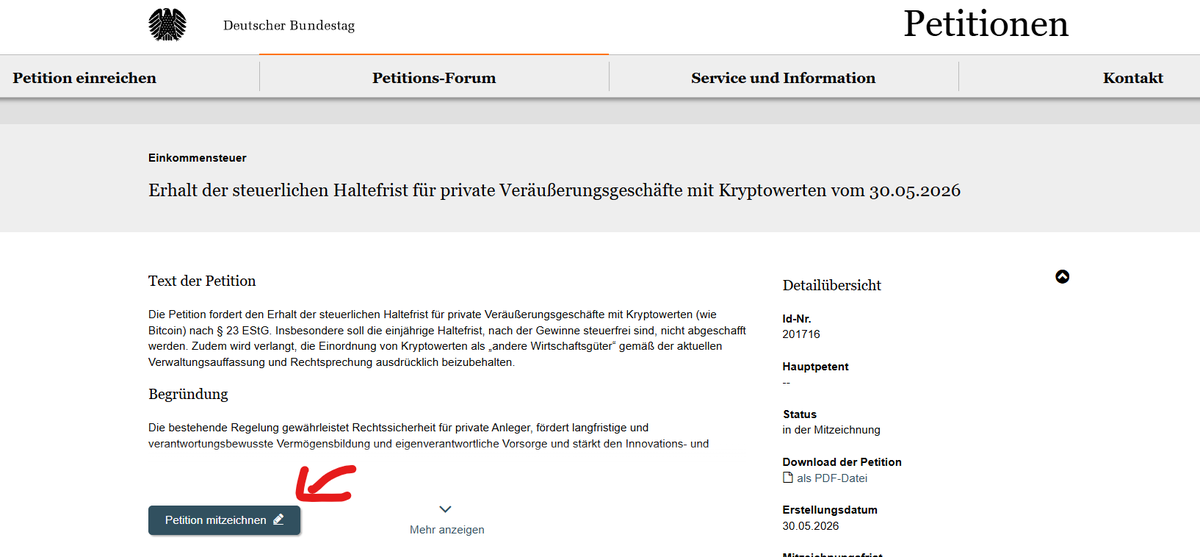
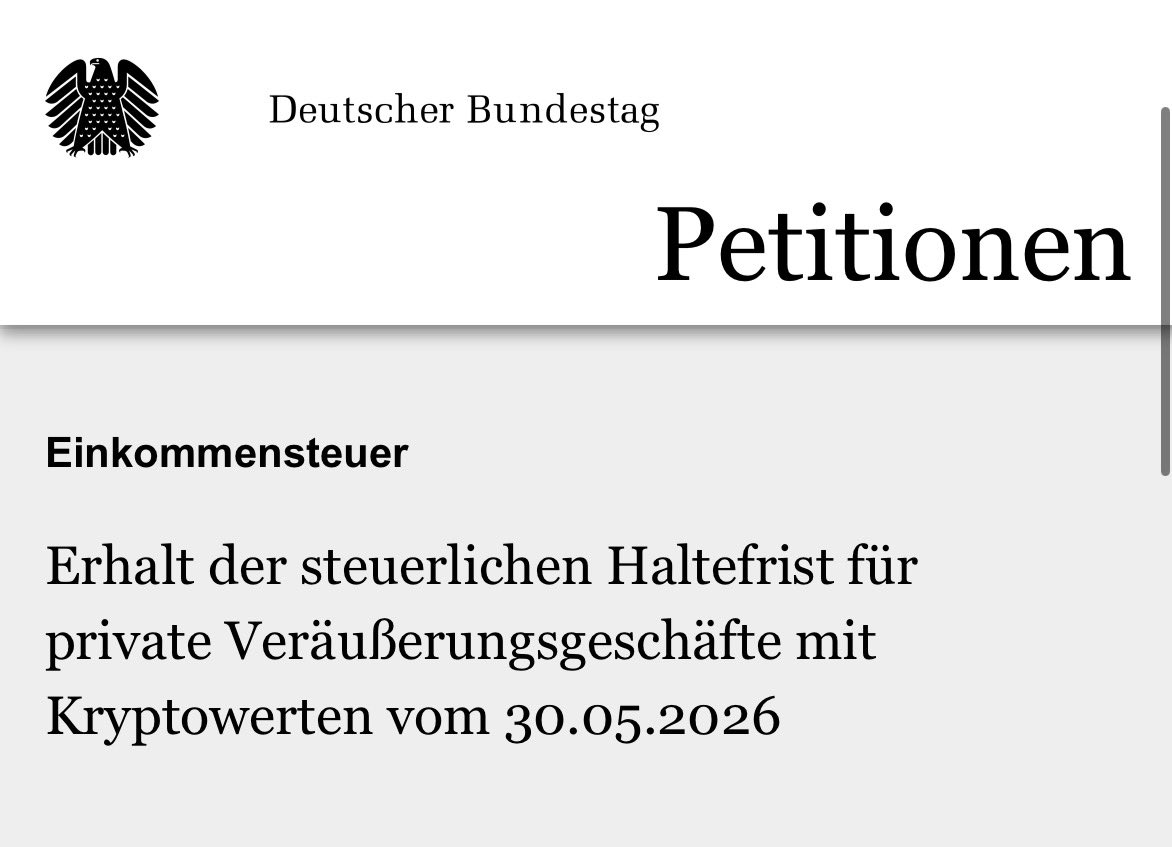
Die Bundestagspetition dazu ist seit gestern
freigeschaltet. Sie fordert, dass Gewinne aus privaten
Krypto-Verkäufen nach einem Jahr Haltedauer
steuerfrei bleiben und Kryptowerte weiterhin als
andere Wirtschaftsgüter nach §23 EStG
eingeordnet werden.
Beschlossen ist nämlich noch nichts. Finanzminister
Klingbeil will Kryptogewinne wie Kapitaleinkünfte
besteuern, aber ein Gesetzentwurf mit Steuersatz,
Stichtag und Übergangsregelung existiert bislang
nicht. Genau in dieser offenen Phase ist Druck von
außen am wirksamsten.
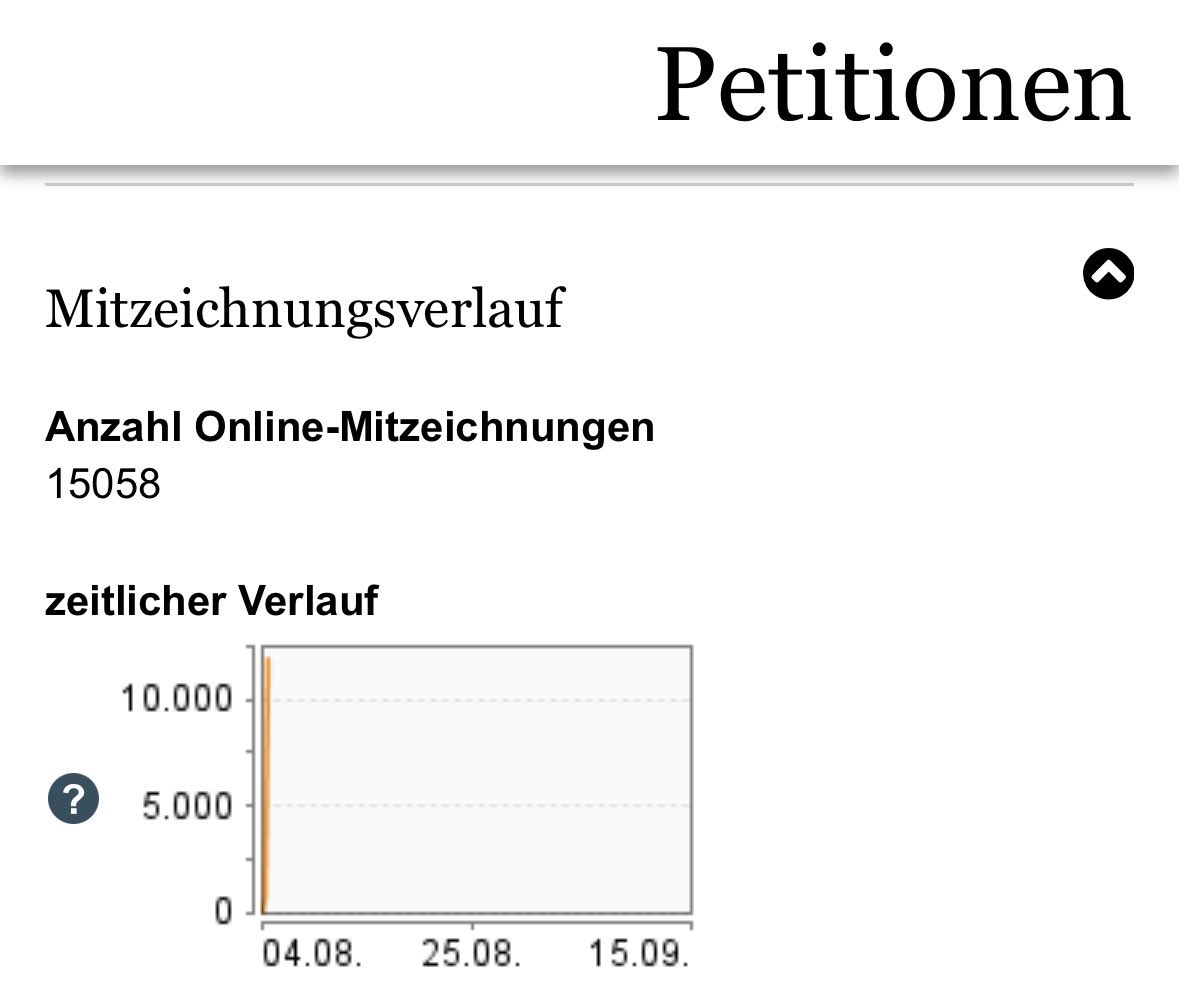
🗓️Bis zum 15. September braucht die Petition 30.000 Mitzeichnungen, damit es zu einer öffentlichen Anhörung im Petitionsausschuss kommt. Mitzeichnen darf übrigens jeder, du brauchst weder deutsche Staatsangehörigkeit noch Wohnsitz in Deutschland.
Petition 201716. Du musst dich einmal registrieren, die
Bestätigungsmail landet gelegentlich im Spam. Wenn
du mitgezeichnet hast, schreib gern ein „Erledigt" in
die Kommentare, damit andere sehen, dass sich hier
etwas bewegt.
Wir sind gut, aber wir können noch mehr!
Jetzt Petition unterschreiben!
Der Staat nimmt uns aus wie eine Weihnachtsgans.
Es reicht!
Wer Geld langfristig anlegt und für sein Alter vorsorgt, sollte keine Steuern auf den Gewinn zahlen müssen.
hier:➡️https://t.co/QLsf7ld9uJ
🚨 📢 ENDLICH! - Die Petition zum Erhalt der steuerlichen Haltefrist bei Kryptowährungen ist jetzt online!
Jetzt kommt es auf uns alle an!
Wer langfristig investiert, Verantwortung übernimmt und auf verlässliche Regeln setzt, darf jetzt nicht schweigen.
Nehmt euch zwei Minuten und zeichnet die Bundestagspetition mit. Jede einzelne Stimme erhöht den politischen Druck und zeigt: Diese Regelung ist vielen Menschen wichtig.
Nicht abwarten. Mitzeichnen. Weiterleiten. Freunde, Familie und Bekannte informieren.
Je mehr Menschen jetzt handeln, desto schwerer kann dieses Anliegen ignoriert werden. 👇🏽
https://t.co/zMq0jUFctb
Danke an ALLE UNterstützer und diejenigen, die diese Petition ermöglicht haben! 🙏
Wer möchte, dass die Haltefrist bei Bitcoin und Krypto bestehen bleibt, kann jetzt die Petition unterzeichnen.
Teilt gerne den Beitrag oder Link, damit noch mehr Leute auf die Petition aufmerksam werden. 🙏🏽
https://t.co/scx0sZkeXR
An alle meine deutschen Bitcoin-Kollegen🇩🇪:
Natürlich unterstütze ich auch mit meiner Reichweite euer Vorhaben, gegen die geplante Änderung der Bitcoin-Haltefrist vorzugehen. Deshalb teile ich gerne eure Petition. Jede Unterschrift zählt. Ich wünsche euch viel Erfolg!
https://t.co/egcwLxJil4
1/ The world's largest sovereign wealth fund ($2T) has a bigger percentage bet on Metaplanet than on any other Bitcoin treasury company on earth.
Including Strategy.
Almost nobody is talking about this. A thread 👇
1/ There's a pattern in every successful Bitcoin treasury company.
Most investors miss it. By the time they catch on, the stock has already re-rated.
A framework on the 5 phases of a BTC treasury company and where Metaplanet sits today.
Thread 👇
1/ Most analysts don't know how much @gerovich personally owns of Metaplanet.
The number is in EDINET filings. Most miss it.
A thread on the founder ownership that explains everything 👇
Breaking down our latest raise. Our single KPI is Bitcoin per share. Every capital decision we make gets measured against that. After our last institutional offering, we heard from shareholders that they wanted us to think differently about how we raise capital. The demand was still clear: more Bitcoin. So here's what we did.
Japanese PIPEs typically price at a ~10% discount to market. We sold shares at a 2% premium to market and packaged our equity vol into fixed-strike warrants at a 10% premium. The company gets immediate capital to grow the Bitcoin balance sheet. If the stock goes higher and warrants are exercised, we receive additional capital at a price above today's market. The investors get to express a view on volatility. This isn't zero-sum. Both sides can win.
This is the same playbook MSTR pioneered with convertible bonds. A 0% coupon convert was a bond and an embedded call option packaged into one security. The coupon was zero because the embedded option on a levered BTC vehicle was so valuable it replaced the coupon entirely. The bondholder wasn't lending for free. They were paying for vol. Saylor understood this before anyone else in BTC and it unlocked a new paradigm for Bitcoin treasury capital formation.
Same principle, different wrapper. We used stock plus warrants instead of converts, so there's no debt, no maturity risk, no overhang, no ongoing dividend or interest payments. The capital structure stays clean with no debt sitting above equity holders, and that's by design. When we issue preferred shares, the balance sheet underneath needs to be pristine. Every Bitcoin we add strengthens that foundation. The bigger the base, the more credible the credit. We are intentionally building this to become the dominant issuer of Bitcoin backed fixed income instruments in Japan.
And finally, we run one of the most active BTC derivatives books in the world. Every scenario here has been stress tested and is being managed, including the tail risk on future warrant exercise. We built this company around Bitcoin volatility and BTC Yield. This is what we do.
This is permanent capital with no ongoing cost. The proceeds go to Bitcoin. ~$255M now. Up to ~$531M on exercise. March toward 210,000 BTC continues.
why do so many early bitcoiners (especially those who dabbled in crypto) hate saylor?
because nobody cares about them anymore and it’s their own fucking fault. their entire identity was centered on being opinion leaders in a nascent industry.
but for a whole decade they did nothing but fuck around. minted an infinite multiplicity of grift-tokens to fleece retail. fake and gay exchanges to dump them on retail. fake and gay privacy tokens that aren’t actually private because like 200 people in the world use them and they all post about every transaction on their doxxed twitter accounts.
narrative after invented narrative - anything to support the next grift-dump. circle jerk financial schemes (“defi”) where they all collectively leveraged their fake animal tokens on all of their friends fake animal tokens like some giant financial furry-orgy.
they built nothing useful. nothing enduring. nothing of any value. all they did was enrich themselves - although most would be richer now if they’d just held on to all of their bitcoin.
because that’s what bitcoin was built for. it wasn’t built for replacing visa; it wasn’t built for replacing robin hood; it wasn’t built to shield every transaction from the irs, or to replace banks. It was built to replace MONEY.
and the use case of money is, first and foremost, savings. (that’s why saylor calls it digital capital, because people think “money” = transactions).
bitcoin is just private enough and just liquid enough to replace base layer capital. satoshi, by some insane miracle, got it right the first time. there was nothing to improve upon.
saylor is the main character because he actually understood bitcoin. and because he did, he built something they couldn’t: something actually valuable.
and the irony is, he did exactly what hal and satoshi talked about 16 years ago: he built a bitcoin bank. the idea was sitting there in bitcointalk all along.
Metaplanet has authorized the repurchase of up to 150 million shares of its common stock.
Concurrently, the company has secured a credit facility for use up to $500 million to be utilized at the company’s discretion.
Excellent speech! "There's no room for firewalls!"
Die beeindruckende Rede von @JDVance in München - natürlich ohne jeden Applaus von CDU, CSU, SPD & Grünen - jetzt ansehen und anhören. Mit deutschen Untertiteln! #Sicherheitskonferenz
This morning:
- MicroStrategy buys another 51,780 BTC for $4.6B
- MARA announces $700 million convert to acquire more BTC
- Semler Scientific raises $21mm ATM and acquires 215 BTC
- Metaplanet issues ¥1.75B debt offering to buy more BTC
The corporate Bitcoin race is heating up.