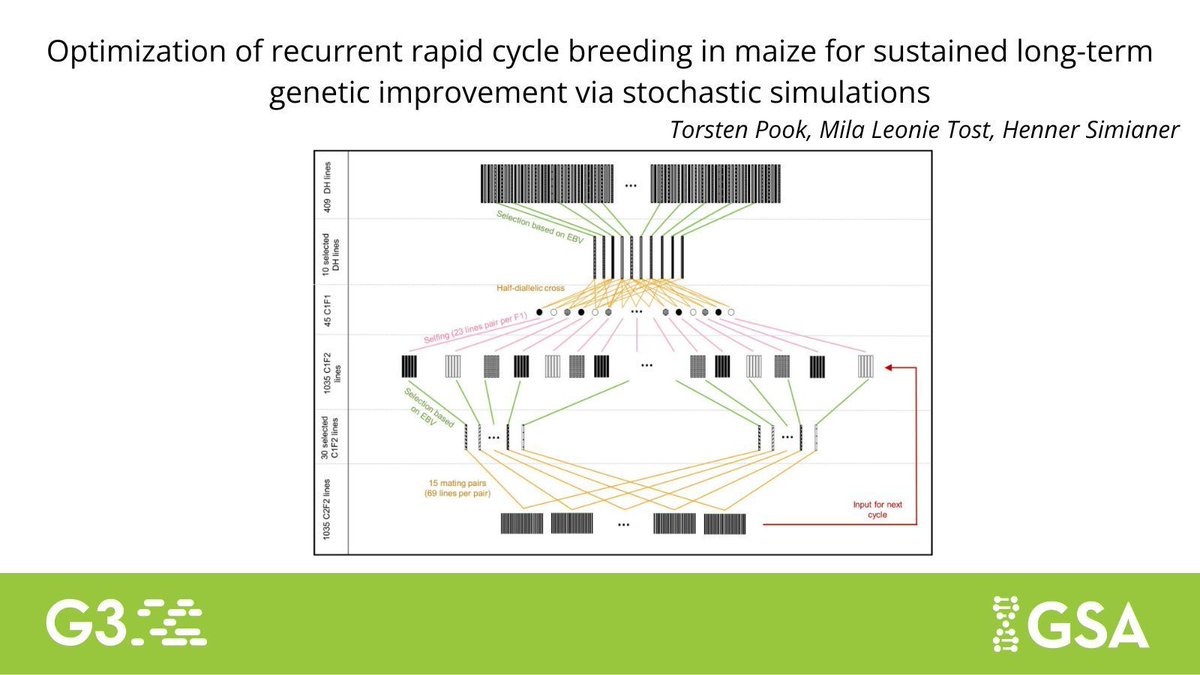
New in #G3journal: @tpook92 et al. used stochastic simulations with MoBPS software to show that rapid cycle breeding has the potential to be a valuable strategy in #maize breeding to achieve substantial genetic gains in a limited time frame. 🌽
Read more: https://t.co/aE1N5uJFMS
Our paper on an evolutionary algorithm for the optimization of breeding programs is finally out as a pre-print https://t.co/J8EU9cebhf . We use MoBPS as the backend stochastic simulator but this can be replaced by other (less efficient 😎) simulators.
Study was led by @hspazii
WHOOP WHOOP!🥳the first paper of my PhD just got published. It's an extension of the usefulness criterion by considering variances not only of offspring but also offspring of offspring https://t.co/U1GdgR74Ji @tpook92@YWientjes@mariocalus@Breed4Food#wur_abg
Check out the recent developments of miraculix, a library for efficient analysis of genomic data using CPUs and #Nvidia GPUs. Research led by Alexander Freudenberg and Martin Schalther (U. Mannheim), in collaboration with @WUR#wur_abg, and @HerdPlus
https://t.co/agEsU6na5C
Beyond Scenarios - Our first paper on the general optimization of breeding program design is now available as a preprint. Analysis is led by @hspazii https://t.co/xZkGi3LkdK
Two weeks till our course on simulation of breeding programs with MoBPS (March 30 & 31). There are still 5 slots remaining. Course will be in-person in Wageningen. Registration at https://t.co/biYq5TmCVt
The proceedings of @wcgalp2022 is now available online & open access. Over 3300 pages technical and species orientated innovations in animal breeding, and the contribution that genetics can make to solving societal challenges.
https://t.co/x584ETnrpf @wcgalp2026@WURlivestock
We are hosting a workshop on the simulation of breeding programs with MoBPS on March 30 & 31 2023 at Wageningen University & Research. Registration at https://t.co/biYq5TEdN1
There's still time to submit abstracts for poster presentations at this year's GRS/GRC in Quantitative Genetics and Genomics! Join us in Ventura this February: https://t.co/4S8XMhKyVq
I am very happy because my first paper of the work I did as a student at @GoPlantBreeding just got published: https://t.co/bXXQstEIFB
It is a comparison of two genotype imputation tools with some optimization of software parameters and imputation strategy.
This is my first tweet 🐣 We welcome @wcgalp2022 participants and those interested in #WCGALP2022 to follow this account @wcgalp2026 where we will discuss all things associated with WCGALP 2026 July 12-17 in Madison, Wisconsin 🇺🇸 https://t.co/FGRDdYiv8n via @YouTube#WCGALP2026
@mila_leonie und ich haben an der @uniGoettingen farbigen Weizen entwickelt. Damit unsere Arbeit weiterlebt, haben wir Linien an die Saatzucht Breun verkauft. Lies hier nach für mehr https://t.co/wKZYawnXV9
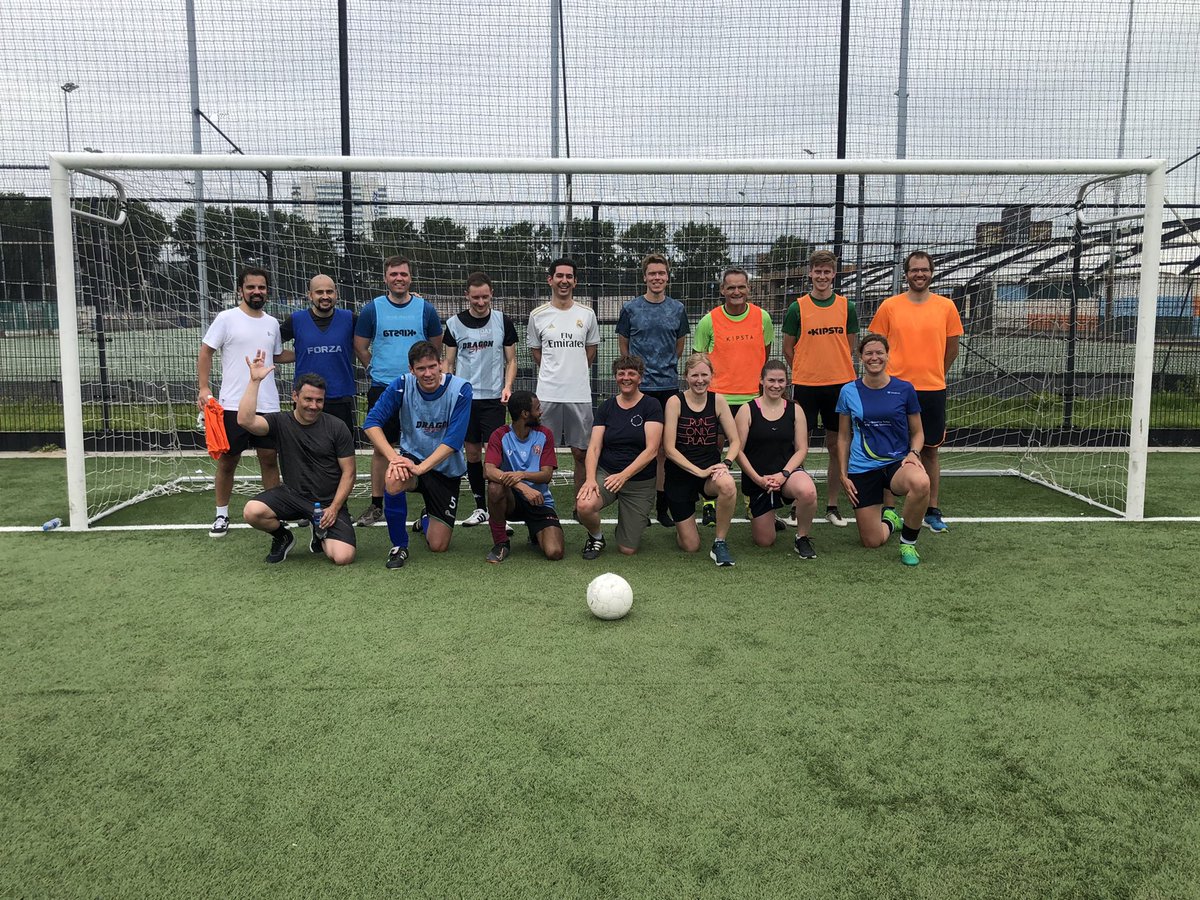
Some impression from the first openly available MoBPS workshop sponsored by GfT and @KWS_Group. It was a pleasure hosting the workshop for such a motivated group and spreading the word on our tool. All material from the 2-day workshop is also available at https://t.co/kSj3g8Tuh6
Our first openly available workshop on the Modular Breeding Program Simulator will take place on March 24 & 25. Thanks to our partner GfT we can offer this without participation fees! The workshop will be virtual – for details see https://t.co/WNz2UV1h6J
I'm very sad to report that Bill Hill (of Hill-Roberston interference), my PhD advisor, has died. He was a very generous and supportive supervisor, and of course a great intellect.
@chrisamiller I got a similar response when trying to submit an Application note style paper a couple of years ago. I contacted the bioRvix team, explained the situation and referred them to my user guidlines including examples, background ect. and they accepted it afterwards.
WCGALP 2022 is starting to approach (https://t.co/HqzVRdifc0).
I will be co-chairing the session on "Statistical genetics: Imputation" with @jeremievdp & Mehdi Sargolzaei.
Looking forward to some interesting contributions!
@wcgalp2022
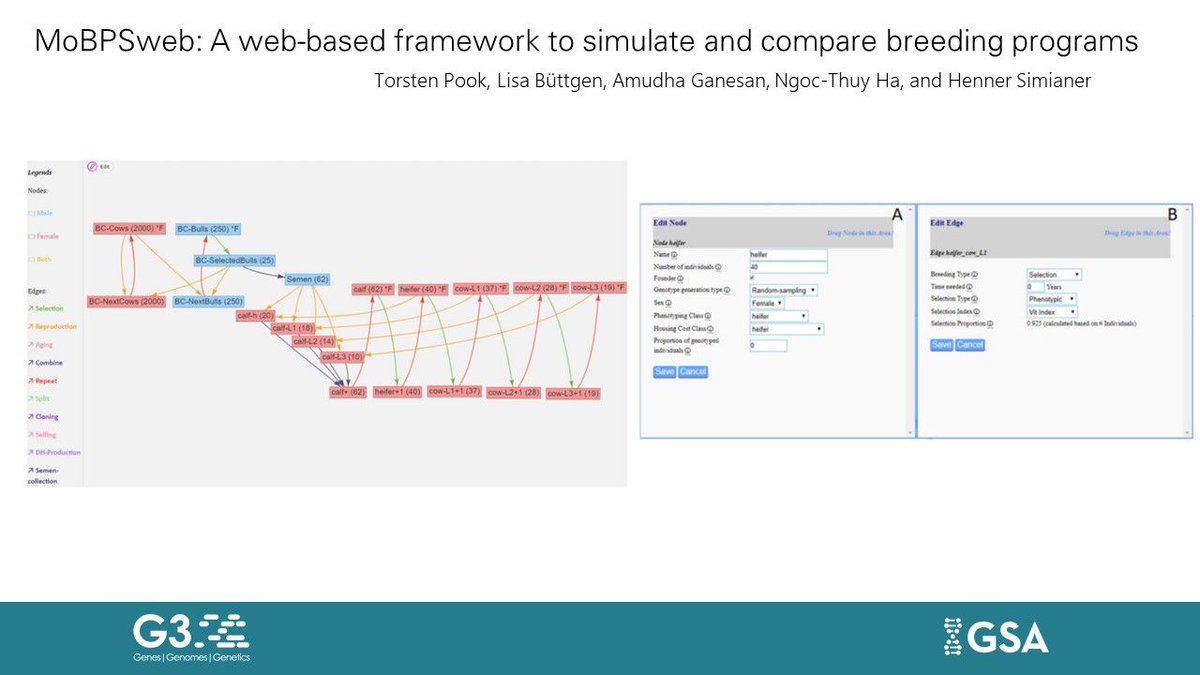
Pook et al. introduce a web-based simulation framework that combines a unified language to describe breeding programs, providing a flexible environment to log, simulate, evaluate, and compare breeding programs. #G3Journal@tpook92 https://t.co/mLWufHCgaE