I remember wanting it so badly that I dug through Archegos (and others’) court filings and Bloomberg’s Archegos trial coverage, trying to uncover details on how large funds and their traders actually operate. That kind of information is usually kept internal and rarely sees the light of day.
Learned a good bit from it. By any means!
@pernasresearch Agreed. Do you have any general framework for cash/capacity preservation? Obviously it depends on the opportunity set, but is there any rule of thumb you follow?
(1/2) Might be irrelevant near term with all the spec trading, but I don’t think $RXT is close to being done fundamentally.
The last few years were ugly: levered legacy managed-cloud name, weak narrative, and persistent customer losses.
But the image is being rehabilitated. RXT is starting to look less like a tired cloud vendor and more like a potential enterprise AI operator layer.
The angle is governed AI. Regulated / sovereign customers cannot just throw sensitive data into public-cloud AI tools. Once AI touches patient records, financial data, sovereign information, or mission-critical workflows, the stack becomes fragmented fast: compute, storage, data residency, access control, security, compliance, resilience, inference, workflow apps, and vendor SLAs all have to work together.
If something breaks, costs spike, compliance risk rises, and every vendor can point at someone else.
RXT is trying to be the accountable operator stitching that stack together and owning the outcome.
People give Warren Buffett credit for his capital allocation, patience, and discipline. But one of his most overlooked strengths is that he is a world-class student of human behavior.
At its core, investing is about understanding people: customers, managers, competitors, employees etc. The best investors will also be the best social scientists.
I’m finally turning back to net-ish long now, using some of the capacity I shored up after staying defensive for a while. I didn’t capitalize on the recent drop through shorts as well as I should have, mostly due to circumstances outside my control. Great technical reset for a lot of names.
Good unwind in hindsight.
Escalation risk has been reduced for now, but duration risk did not really change. Negotiations continuing is constructive, but it can also potentially lend Iran more leverage. Unless we get a full SOH reopening by the end of June, this can still easily play into their hands and turn into a deeper quagmire.
A lot of this hinges on the assumption that Iran is leaning into being a good actor for the long-term benefit of internal reform and better relations with Gulf states. Maybe that proves right, which was largely my stance in early spring. But if not, duration risk remains the issue.
I’ve already made my year with the recent lockout rally and can afford to tolerate any “performance” concerns if the AI trade keeps blowing out while I stay more defensive. I still view downside risk as higher than upside risk in the near term with plenty of capacity shored up.
(1/2) Might be irrelevant near term with all the spec trading, but I don’t think $RXT is close to being done fundamentally.
The last few years were ugly: levered legacy managed-cloud name, weak narrative, and persistent customer losses.
But the image is being rehabilitated. RXT is starting to look less like a tired cloud vendor and more like a potential enterprise AI operator layer.
The angle is governed AI. Regulated / sovereign customers cannot just throw sensitive data into public-cloud AI tools. Once AI touches patient records, financial data, sovereign information, or mission-critical workflows, the stack becomes fragmented fast: compute, storage, data residency, access control, security, compliance, resilience, inference, workflow apps, and vendor SLAs all have to work together.
If something breaks, costs spike, compliance risk rises, and every vendor can point at someone else.
RXT is trying to be the accountable operator stitching that stack together and owning the outcome.
Notably, ex-tech S&P 500 looks solid today. Basically green, with crude oil down 3% as well.
Encouraging breadth under the surface.
Just a nasty downside skew in AI baskets and techs as whole. Greedy levered longs getting blown out.
$RDDT CEO yesterday at the BofA Tech Conference:
"AI ,as we know it, doesn't exist without Reddit, right? Reddit is used pre-training, post-training, grounding, search. So Reddit is an essential player in the modern version of the internet."
At the 64-day (QTD) average price, $RDDT has repurchased $150mm worth of shares this quarter, 15% of their $1Bn buyback authorization, and about 0.5% of S/O.
If $RDDT wants to exhaust its entire remaining buyback authorization, at current prices they could shrink S/O by a further 2.3%.
Management basically telling us they think the stock is a good deal, and that they are serious about turning their rapidly growing cash flow into cold, hard shareholder capital returns.
Purely technical traders always sell too early, because they have no conviction. They don't know what they own. Stock goes up +10-20% & they sell. Stock winds up +100-200% higher months later. The best stock-pickers are contextual: technicals, fundamentals & thematics in unison.
Good unwind in hindsight.
Escalation risk has been reduced for now, but duration risk did not really change. Negotiations continuing is constructive, but it can also potentially lend Iran more leverage. Unless we get a full SOH reopening by the end of June, this can still easily play into their hands and turn into a deeper quagmire.
A lot of this hinges on the assumption that Iran is leaning into being a good actor for the long-term benefit of internal reform and better relations with Gulf states. Maybe that proves right, which was largely my stance in early spring. But if not, duration risk remains the issue.
I’ve already made my year with the recent lockout rally and can afford to tolerate any “performance” concerns if the AI trade keeps blowing out while I stay more defensive. I still view downside risk as higher than upside risk in the near term with plenty of capacity shored up.
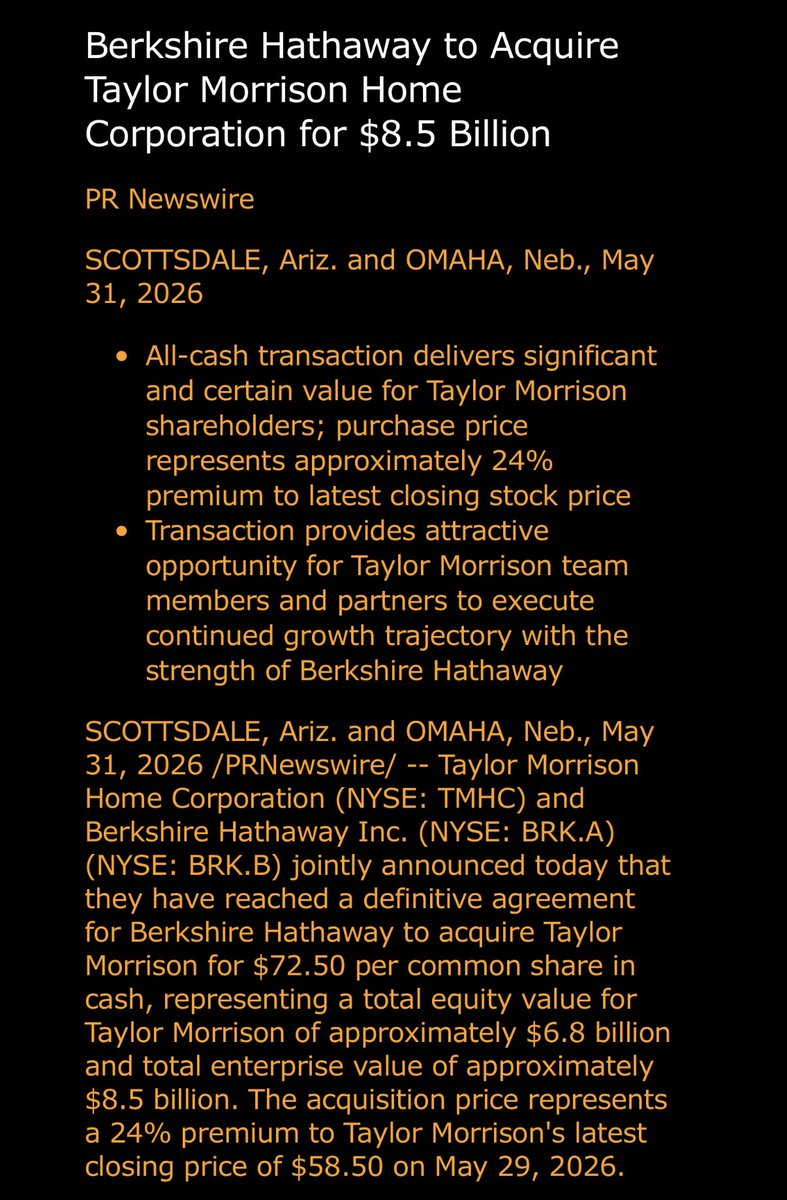
Might be knee jerk reaction from me but I think this move is laughable.
They use the “limited liquidity/opportunity set to move the needle” cop-out excuse for years, only to make an $8.5B acquisition. Drop in the bucket vs cash reserves.
That’s an amount they could easily deploy in many parts of the market.
I get that they put priority on preserving permanence, culture, reputation, and low-risk compounding.
$BRK.B have been acting like it should be private. optimized for institutional permanence over shareholder IRR.
Doesn’t make it a terrible company or terribly run one. But from a public shareholder POV, I’m not seeing the edge versus owning typical long-duration compounders or broader passive exposure.
*BERKSHIRE TO ACQUIRE TAYLOR MORRISON FOR $72.50 A SHARE IN CASH
First $BRK.B acquisition in forever - buying $TMHC for $8.5B all in, or $72.5 / share all cash