Shocking stat of the day:
Nvidia, $NVDA, Micron, $MU, Broadcom, $AVGO, and Applied Materials, $AMAT, are now expected to generate a record $430 billion in combined free cash flow (FCF) over the next 12 months.
That would be more than TRIPLE the FCF they generated just 2 years ago.
At the same time, the combined FCF of Amazon, $AMZN, Alphabet, $GOOGL, Meta, $META, Microsoft, $MSFT, and Oracle, $ORCL, is projected to turn negative for the first time on record.
That would mark a massive reversal from the +$260 billion peak reported by these companies in 2024.
This comes as AI-related CapEx by these 5 companies is estimated to surge to ~$1.8 trillion in 2026 and 2027 combined.
Chipmakers are becoming cash machines, while AI giants are burning record amounts of capital.
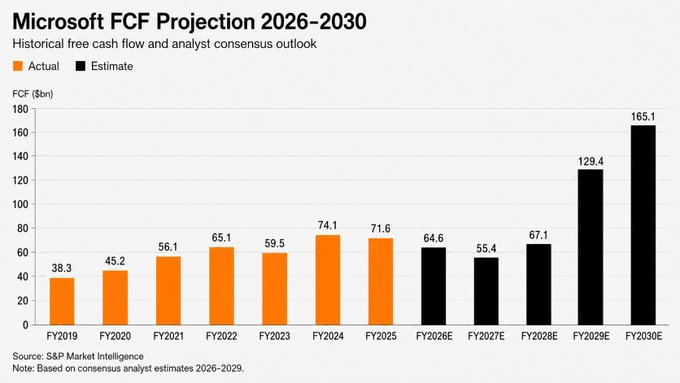
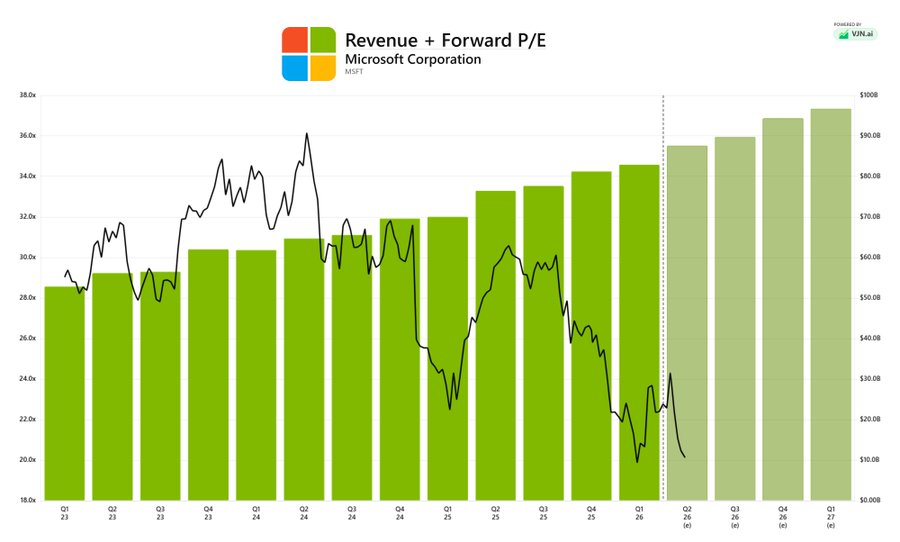
$MSFT FCF is expected to nearly triple from ~$55B in 2027 to ~$165B by 2030 as Copilot scales across its existing enterprise customer base.
That gives Microsoft a clearer path than most hyperscalers to turn heavy AI infrastructure spending into high-margin AI revenue.
$MSFT free cash flow is expected to dip in 2027 and then explode through 2030.
It'll never go negative, and no debt issuance is expected to fund capex, while all other hyperscalers are raising debt.
You have 18 months to buy as much $MSFT as possible.
🚨 Never forget…
Your whole idea of buying every dip through ETF and chill is a 13-year illusion.
100 years of S&P 500 real returns, split into regimes:
– 1928-1948: 0.6% a year
– 1949-1968: 12.7%
– 1969-1984: 0.5%
– 1985-1999: 15.1%
– 2000-2012: -0.8%
– 2013-2025: 11.8%
Notice the rhythm. A golden era, then a dead one.
Feast, famine, feast, famine.
Not one regime in a century simply continued.
The long-term average of 7% real that everyone plans with? Almost no generation actually experienced it. You got 12%, or you got zero.
The average is a fiction made of two extremes.
Everyone who started investing after 2009 has only known the feast. Buy the dip worked every single time. Not because it's a law. Because you happened to live inside the blue bar.
But the current run is already as long and as rich as the two golden eras before it. And every one of them ended the same way: not with a warning, with a decade.
Mean reversion doesn't announce itself. It just stops paying.
The next 0.5% decade will feel impossible right up until it starts. It always has.
Wall Street habla de beneficios.
Los inversores serios miran otra cosa:
- Flujo de caja libre.
Porque una empresa no sobrevive con promesas.
Sobrevive con dinero entrando.
10 Acciones Generando Cantidades Absurdas de Flujo de Caja Libre 🧵
1. Apple $AAPL: $129B
🚨 SPACEX IS REPEATING PALANTIR IN 2020
And it could cost them a fortune.
In 2020, Palantir IPO'd at $10 and exploded to $35.
The media loved it.
Retail couldn't stop buying it.
Everyone was convinced they had found the next trillion-dollar company.
Then Palantir crashed almost 80%.
$35 → $7
That's where most people quit.
That's also where smart money started buying.
What happened next?
$7 → $44+
A life-changing move.
Now look at SpaceX.
IPO near $150.
Pump above $215.
The same hype.
The same headlines.
The same crowd screaming that it's too late.
Now $SPCX has dropped to $165.
And for the first time, weak hands are starting to panic.
Sound familiar?
Because this is exactly how the biggest winners shake people out before the real move begins.
Retail buys excitement.
Institutions buy fear.
Palantir did it.
Amazon did it.
Tesla did it.
And now SpaceX is building the same setup.
My accumulation zone remains:
$145 → $165
My target remains:
$230+
Most people won't buy there.
They'll buy after the headlines return and the easy money is gone.
That's how markets work.
I've spent more than a decade studying market cycles and calling major tops and bottoms before the crowd sees them.
This setup is one of the clearest I've seen all year.
Follow and turn notifications on.
I'll post the exact level where I start buying $SPCX.
Comprar empresas extraordinarias cuando el mercado las castiga es de mis cosas favoritas.
Estas son 10 de las mejores compañías del mundo que más han bajado en el último mes.
1/10 $MSFT
Most valuable company by year:
1980: IBM
1981: IBM
1982: IBM
1983: IBM
1984: IBM
1985: IBM
1986: IBM
1987: IBM
1988: Exxon
1989: Exxon
1990: Exxon
1991: Exxon
1992: Exxon
1993: Exxon
1994: Exxon
1995: General Electric
1996: General Electric
1997: General Electric
1998: General Electric
1999: Microsoft
2000: Microsoft
2001: General Electric
2002: General Electric
2003: Microsoft
2004: General Electric
2005: ExxonMobil
2006: ExxonMobil
2007: ExxonMobil
2008: ExxonMobil
2009: ExxonMobil
2010: ExxonMobil
2011: ExxonMobil
2012: Apple
2013: Apple
2014: Apple
2015: Apple
2016: Apple
2017: Apple
2018: Apple
2019: Microsoft
2020: Apple
2021: Apple
2022: Apple
2023: Apple
2024: Apple
2025: Nvidia
Is there a lesson here?
🚨 WARNING: A MASSIVE BLACK SWAN EVENT IS COMING IN 2026!!
Almost no one is paying attention now…
But this year, a major stress event hits the U.S. economy.
By the time it’s obvious, markets will already be dumping hard.
Here’s the uncomfortable truth you MUST understand:
$9.6 TRILLION of U.S. debt matures in 2026.
That’s over 25% of total U.S. debt - rolling over in a single year.
Here’s what’s really happening:
During 2020–2021, the U.S. funded emergency spending with short-term debt.
Rates were near 0%.
Fast forward to today:
Rates are 3.5–4%.
That creates a problem no one wants to talk about.
Not because the U.S. has to repay the debt…
But because it has to refinance it.
And refinancing at today’s rates explodes interest costs.
By 2026, annual interest payments are projected to exceed $1 TRILLION - the highest in history.
That means:
→ Bigger deficits
→ More budget pressure
→ Less fiscal flexibility
Governments only respond to this situation in ONE way.
They don’t cut spending.
They don’t default.
They cut rates.
Here’s the setup:
1⃣ The U.S. enters a debt-refinancing wall.
High rates make the math impossible long-term.
2⃣ Interest expenses crowd out the budget.
Political pressure becomes unbearable.
3⃣ Inflation cools while the labor market weakens.
The Fed gets cover.
4⃣ Rate cuts become “necessary,” not optional.
And yes - this time is no different.
The next Fed chair takes over in May 2026.
Political pressure is already obvious.
Even the President has said rates should be much lower.
So what happens when rates fall?
→ Liquidity returns
→ Borrowing gets cheaper
→ Risk appetite explodes
And risk-on assets?
They go PARABOLIC.
Crypto.
High-beta equities.
Speculative growth.
But this won’t happen overnight.
Not in a week.
Not in a month.
I’ve seen this cycle before, and I'll publicly call the exact market bottom again.
Ignore this if you want, but don’t act surprised when markets front-run the pivot again.
Follow and turn notifications on before it's too late.
And a lot of people are going to wish they positioned earlier.
🚨 BREAKING: A BIG STORM IS COMING!!!
US Treasury has a massive problem nobody wants to talk about..
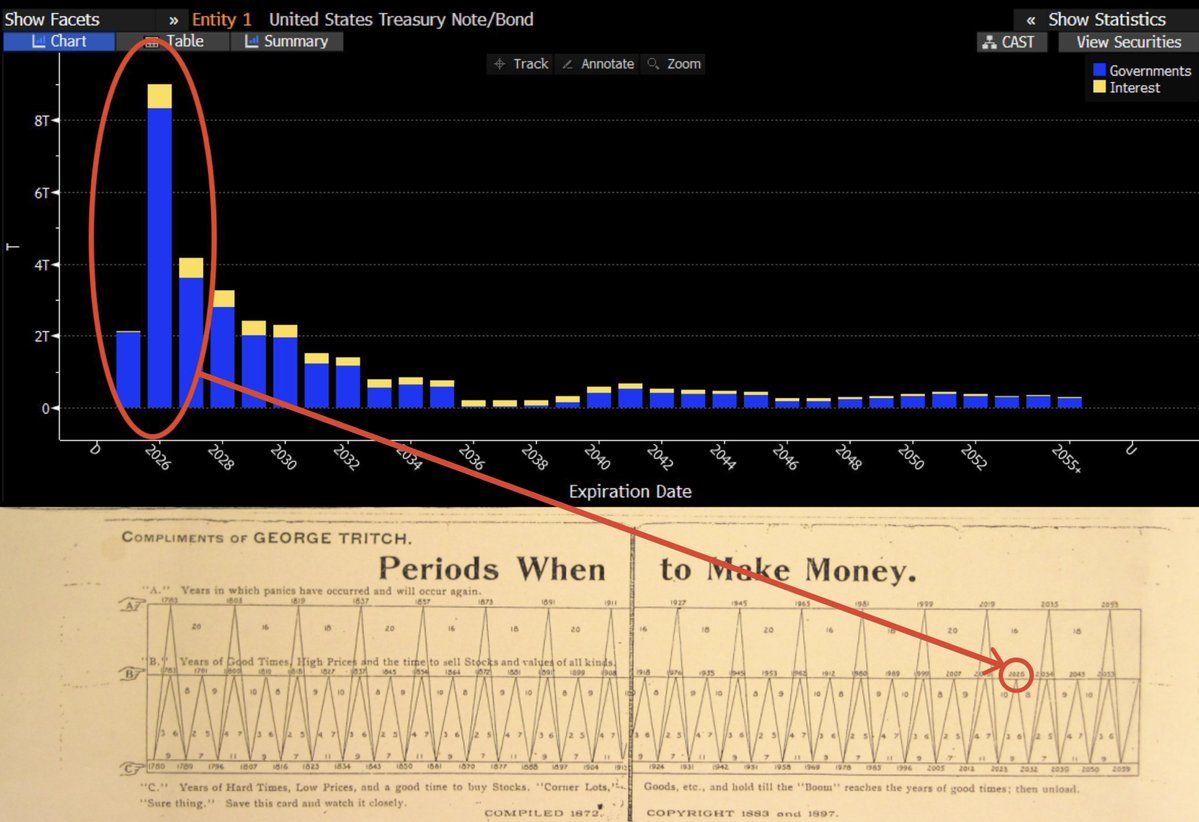
Take a good look at this chart.
That giant blue spike?
Yeah… that’s trillions in U.S. debt that expires in 2026. Not 2030. Not 2040.
2026.
And all of it has to be refinanced at much higher interest rates than the near-zero environment it was originally issued in.
In simple terms:
– The U.S. loaded up on cheap debt.
– That cheap debt now has to be rolled over at expensive rates.
– Interest costs are about to explode.
– Something has to give. Markets, taxes, spending, or the dollar.
This is the kind of structural time bomb that doesn’t hit immediately…
but when it does, it hits everything.
Stocks. Bonds. Housing. Crypto.
No market is immune when a sovereign debt wall this big comes due.
Keep your eyes open because most people will notice this after it’s too late.
I was one of the only people who called the top in October, and I’ll do it again, that’s literally my job. Pay close attention.
If you still haven’t followed me, you’ll regret it.
In 2019, the Fed announced QT would end on August 1st.
The balance sheet of the Fed continued dropping in August despite QT having officially ended because the last round of treasury maturities did not settle until mid August.
Just because QT ends December 1st does not mean the balance sheet immediately starts going up. It might take until early 2026 to notice that.
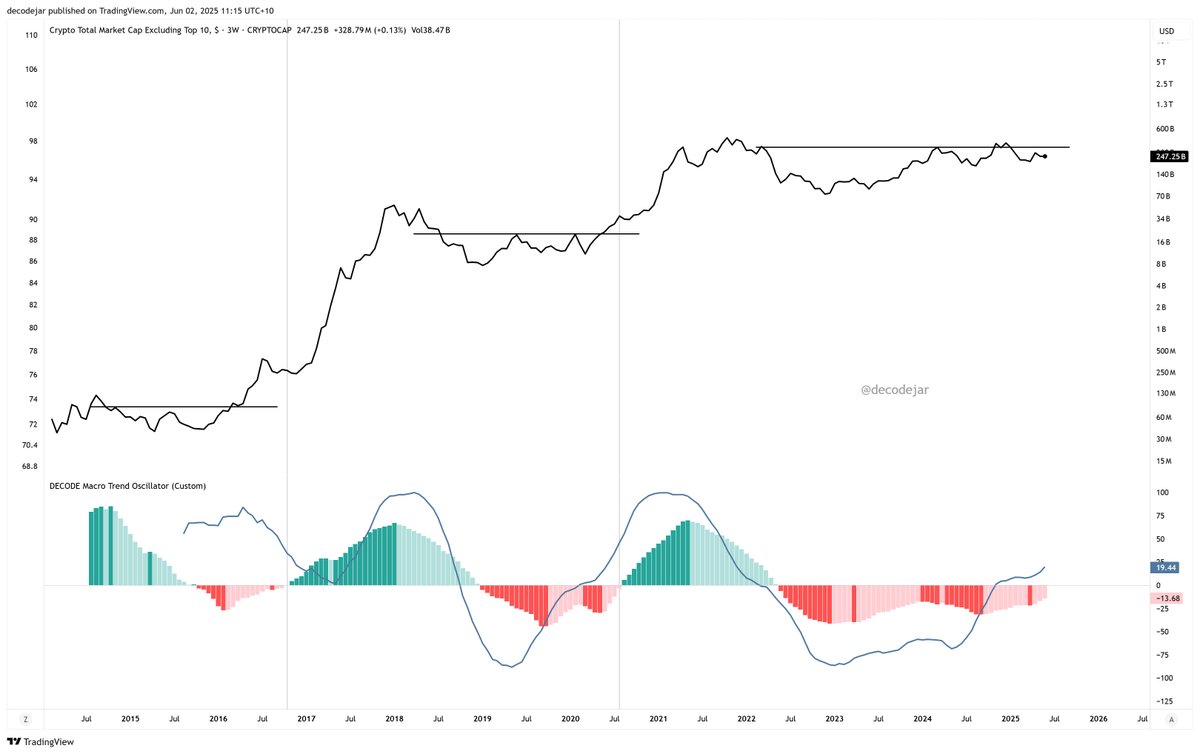
Last cycle, ALT/BTC pairs found a major low at 0.25, which corresponded to the end of QT.
Perhaps, and I know this may sound crazy, ALT/BTC pairs go to 0.25, and then QT ends in December
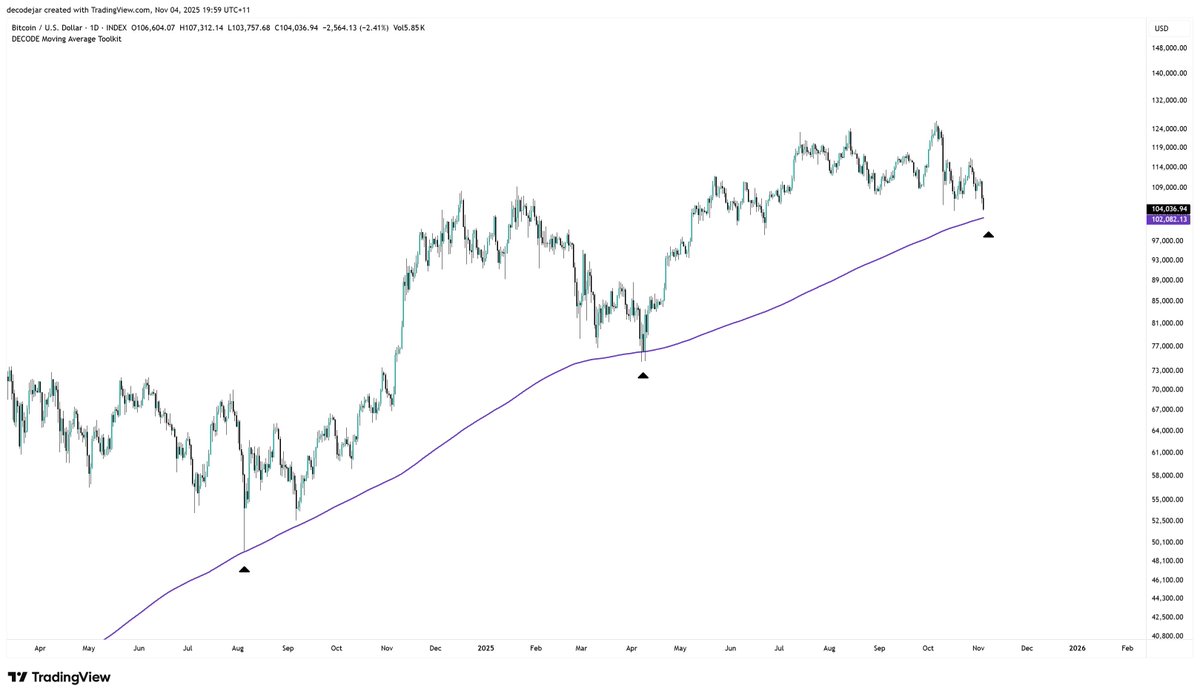
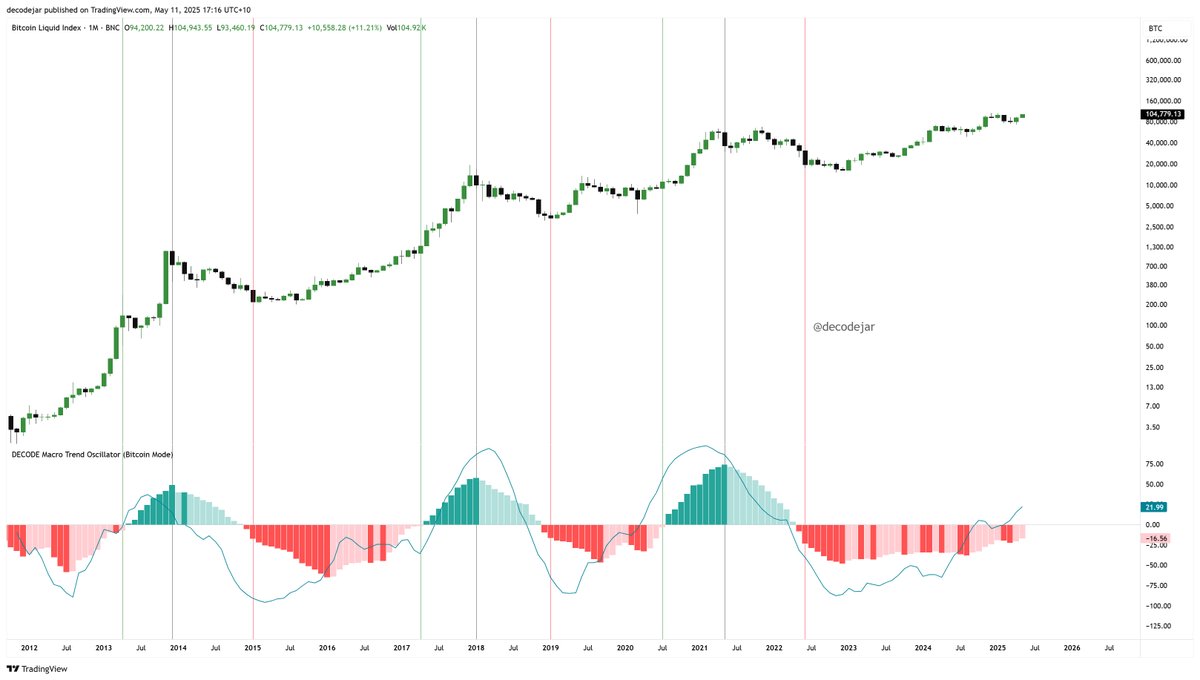
A simple strategy for the Decode Macro Trend Oscillator, would be to start buying Bitcoin when red bars confirm (2nd red), and just keep buying until the bars flip green.
If you're a hodler that just wants more Bitcoin, you can buy exclusivly in red areas, and ignore green. Saving cash during the green areas will mean you can go heavy at capitulation lows.
When green fades to light green, you want to make sure you're out. There should be massive euphoria around that time.
It's not perfect nor finished yet, but building this has been one of the most rewarding project I've worked on in this space.
900 lines of code, 16 leading macroeconomic indicators, 6 major economies, 3 normalisation functions, all fully customisable.
#Bitcoin Bottom to Top vs. 4 & 8 Years Ago
Current Price: $86,253
Price 4 Years Ago: $52,428 (Scaled: $259,391)
Price 8 Years Ago: $1,150 (Scaled: $102,964)
as of 03/08/2025 $BTC #BottomToTop#BitcoinChartBot