We have started a podcast.
We interview the smartest onchain strategy quants, vault curators and DeFi masterminds.
Find episodes here: https://t.co/6RTVWNAEye
Listen on YouTube: https://t.co/aXFC9uy4yS
Listen on Spotify: https://t.co/QQ69shjjJl
CARRY TRADE VAULT BENCHMARK
We list 20 vaults related to carry trades, with $1.3B TVL.
Best carry earns ~20% annualised; the return floor is ~4%.
In traditional cash and carry, a strategy simultaneously buys an asset and sells (or “carries”) a related derivative contract. The most common form is to hold spot and short an equal amount of futures.
The most famous DeFi carry trade product is @ethena, which originally popularised this trade by holding staked ETH, then shorting the equivalent legs on Binance and other centralised exchanges with Copper custody.
Now, carry trade vaults have much more variety, like
- @MoriniCapital: Delta-neutral USD/TRY foreign-exchange arbitrage strategy
- @mtpelerin: market-neutral positions wherever the spread between spot and perpetuals on Hyperliquid, Aster, Lighter
View all carry trade vaults here:
https://t.co/E71Q1hR7XK
LONG-SHORT PORTFOLIO VAULT BENCHMARK
A long-short portfolio is a crypto portfolio with the goal of net exposure (longs/shorts) at zero, meaning total longs and shorts are held in equal dollar amounts. In this case, it doesn't matter whether the overall crypto market moves up quickly or crashes, as the portfolio starts market-neutral, assuming no liquidations or auto-deleveraging events.
Then, you make money by trying to construct your portfolio with longs that keep going higher and shorts that keep going down, usually by trend-following and momentum.
Depending on how good your infrastructure and automation are, you can increase diversification (more open positions), rebalance more frequently (less net-exposure tracking error), and improve execution (lower rebalancing costs by optimising entries/exits with different limit orders).
Good L/S portfolios usually yield ~20% / year with ~5% drawdown.
If you want more yield, you can be more aggressive with leverage, doubling returns and max drawdown for every 2x more leverage you take.
Here is our benchmark of 14 long-short vaults with $15M TVL.
https://t.co/mOwNhJdRbq
Another way to do out-of-sample testing in crypto is cross-venue backtesting.
" Playing the same game with different hands"
Unlike in traditional finance, cryptocurrencies often have the same asset listed across multiple venues, with no primary listing.
All of these venues have their quirks and features, like different candle noise, different funding-rate schedules, and naturally different listed assets, which then gives you different market breadth.
If the strategy works on one exchange but collapses on another, it is likely overfit or contains elements that are not fully understood.
The benefit of this approach is that you can work with a relatively short crypto trading history by increasing your sample size by moving horizontally across exchanges, not vertically through time.
The risk of not doing a longer backtest is that the live record you see, especially on young vaults, only reflects 2026, which has been a particularly unusual market.
When you push the backtest through the 2022 drought and even the March 2020 crash (which could repeat someday), you will find market conditions where the vault slowly loses money. That doesn't mean the strategy is bad overall, but it will likely need some kind of regime filter you cannot see in the vault's equity curve, because the vault hasn't traded through it.
Also, don't assume vault curators are gods; they often screw up, and 85% of Hyperliquid vaults are underwater or blown up. A lot of these vaults had a good run in the 2025 Hyperliquid bull market but quickly died off after the 10/10 crash.
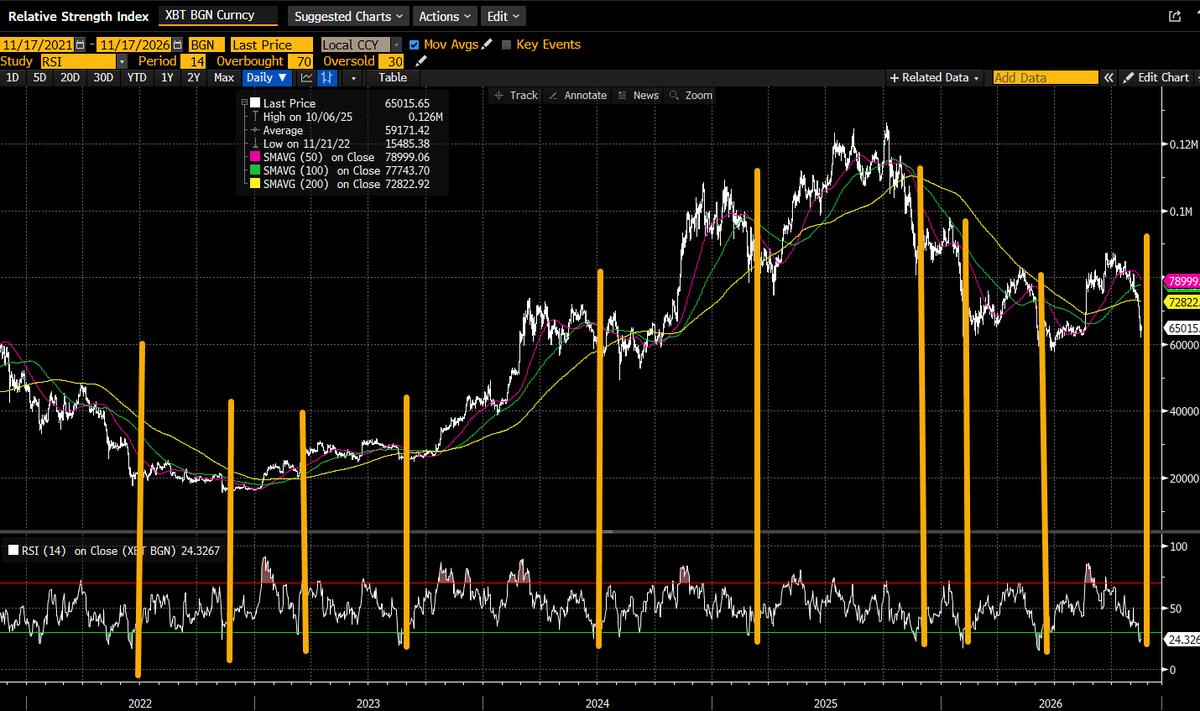
Bitcoin's 14-day relative strength index (RSI) sits in the lowest band.
RSI is an old-school technical indicator for spotting mean-reversion opportunities. Because Bitcoin was in a freefall, mean reversion here would mean a price movement towards the trend line- a steady, low-climbing trend.
As Matthew points out, RSI has worked reliably for BTC recently.
Time for a takeoff? 🫡
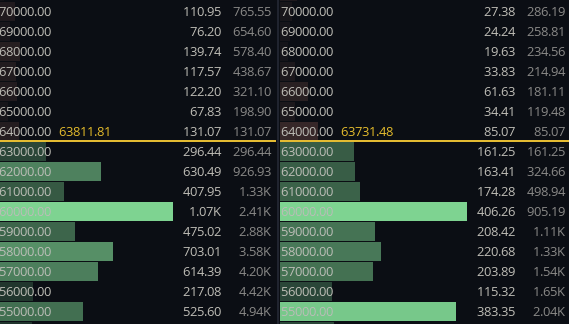
There are officially ZERO asks left
There are no more limit sellers in the market
Anyone left selling is a marginal seller
What does this mean? When they run out of coins the market is going to pump aggressively
This is your FINAL warning to buy $BTC
Looking for vaults with higher profits and more volatile excitement?
Neutral Trade (@TradeNeutral) offers Solana-based vaults for professional algorithmic trading strategies. EVM bridges are available for the composite multi-strategy Autopilot vault.
Categories include e.g. market making, HFT, long/short portfolios and funding rate arbitrage.
Three-month returns range from 20% to minor losses, with Sharpe ratios up to ~5.
Funds are custodied by Copper and Ceffu and trade on the largest cryptocurrency exchanges.
Note that return metrics on our website are fees-inclusive.
https://t.co/WQI2th0NEJ
Managed to decode some of the +convexity vault, a lot of nerding out in here, and then a tradeable (allegedly profitable) signal which was adapted from their rule. Had a lot of fun writing this, enjoy! https://t.co/IeRouU9YW1
+convexity: making money when there is blood on the street
Looking for a vault that profits on the darkest crypto drops like today?
+convexity on Hyperliquid just had one of its best days.
As the name hints, this vault trades positive convexity. Positive convexity strategies seek accelerating gains in large moves but may lose in calm or choppy markets.
+convexity rebalances daily, and trades BTC only.
From the equity curve, you can see the vault has had a few good days, like now, but most of the time it slowly bleeds. This vault yearns for chaos.
https://t.co/quGOCRQmII