Convergence of tradfi/defi happening in real time. Dug into this structure, it’s a bit of a paradox. Investors subscribe to an on-chain feeder that allocates into a traditional private credit fund (senior secured).
The feeder offers liquidity/composability, but at the cost of yield dilution (~2%) due to fee/structure layering. So the core selling point in this context is necessarily 'access' bc the net yield drops to ~7%, offsetting on-chain benefits.
Suspect this is simply an iteration of a long-term game shifting towards native on-chain issuance as distribution/regulatory bottlenecks are gradually solved.
Private credit is now connected to the yield-bearing rails of tokenized Treasuries.
@hamilton_lane’s HLSCOPE fund just gained instant RLUSD liquidity through integration with @vaneck_us’s VBILL.
All onchain, regulated, and 24/7.
The long-run market state here is probably not so great for legacy intermediaries who charge retail investors a 1% management fee and a bunch of other layered fees for 'access' to a brand-name externally managed investment product
volatility buffering as a service (VBAAS) is fee-rich (for private wealth intermediaries) but starting to get rather expensive for the underlying investors (retail)
PRIVATE BDC's are going get MASS REDEMPTIONS unless PUBLIC BDC's prices rebound quickly.
PUBLIC BDC's are trading at a median 20+% discount to NAV. But PRIVATE BDCs are "promised" quarterly liquidity at NAV ..
SUBJECT TO A 5% GATE .. no biggie BREIT gated in '22
HOWEVER ..
Suspect this is inning 1 of @vladtenev's push into private markets that will serve to expand wallet share capture, buffer vol., and diversify revenue.
Think their execution path will be interesting. Most traditional wealth platforms w/ distribution leverage default to 'own the customer = distribution-as-a-service', i.e. slap intermediary fees on branded products with outsourced underlying management. (end market state is then commoditization).
Seems like $hood might deviate from convention and leverage their distribution heft to co-brand/co-manage a proprietary suite of private market products across verticals (PE, credit, RE, and VC).
Primary value drivers w/ this path are: (i) control investor experience via product design and structure, (ii) vastly superior value capture (i.e. long-dated contractual fee flows), (iii) marketing edge, etc.
Distribution is king.
Traditional PE funds are finite life and usually have a hurdle rate of around 8%. Tender funds (retail vehicles) are perpetual life w/ more attractive fee terms for the GP at a 5% hurdle.
So one clever strategy for the Big 5 GPs is to exit assets from institutional funds to retail vehicles. I'd surmise the biggest driver here is to re-rate fee revenue from institutional vehicles (low multiple) to retail vehicles (high multiple) to increase EV...(ancillary drivers: DPI for institutional LPs, timing, resource-efficient flow, etc.).
So, yeah, I guess retail is the exit liq. though one could perhaps counter that these assets are 'compounders' and should be held in a long-term vehicle.
ACRED, a tokenized version of @apolloglobal's Diversified Credit Fund (CRDTX), now has ~$109M in on-chain issuance.
That sounds immaterial for a wall st. behemoth w/ >$750B in AUM but it now constitutes ~7% of CRDTX in a span of just ~5 months. Retail interval funds are a key growth lever for the big 5 alts firms.
I'm not sure this is receiving due attention, expect more players to pile in.
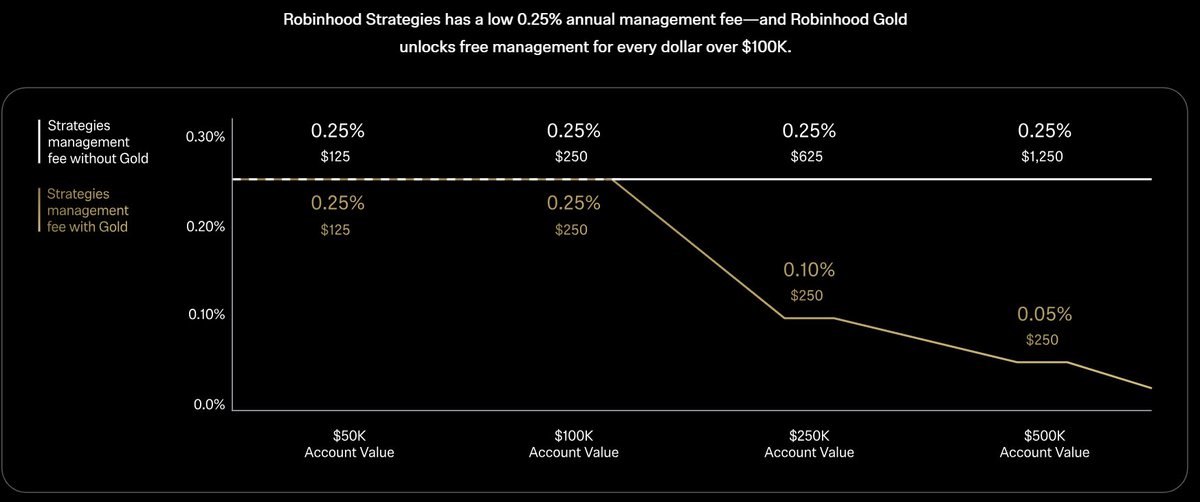
Robinhood's new strategies product has inverted the typical wealth management revenue model by hard capping aum fees at $250/yr. On a $10M portfolio that's 0.0025%.
RIAs typically charge between 0.35-1.25% depending on scale w/ industry fee averages generally compressing over the past few decades.
Despite this, RIAs w/ reasonably scaled books trade between 12-20x EBITDA, which effectively implies the industry is short $hood's ability to meaningfully scale this fee model.
It'll be interesting to see how this plays out over the next few decades.
Crude oil accounts for ~3% of global GDP. One of its first use cases was literally as medicine, which I presume was not particularly effective.
Goes to show that sometimes opportunity is hiding in plain sight for those who experiment and iterate.
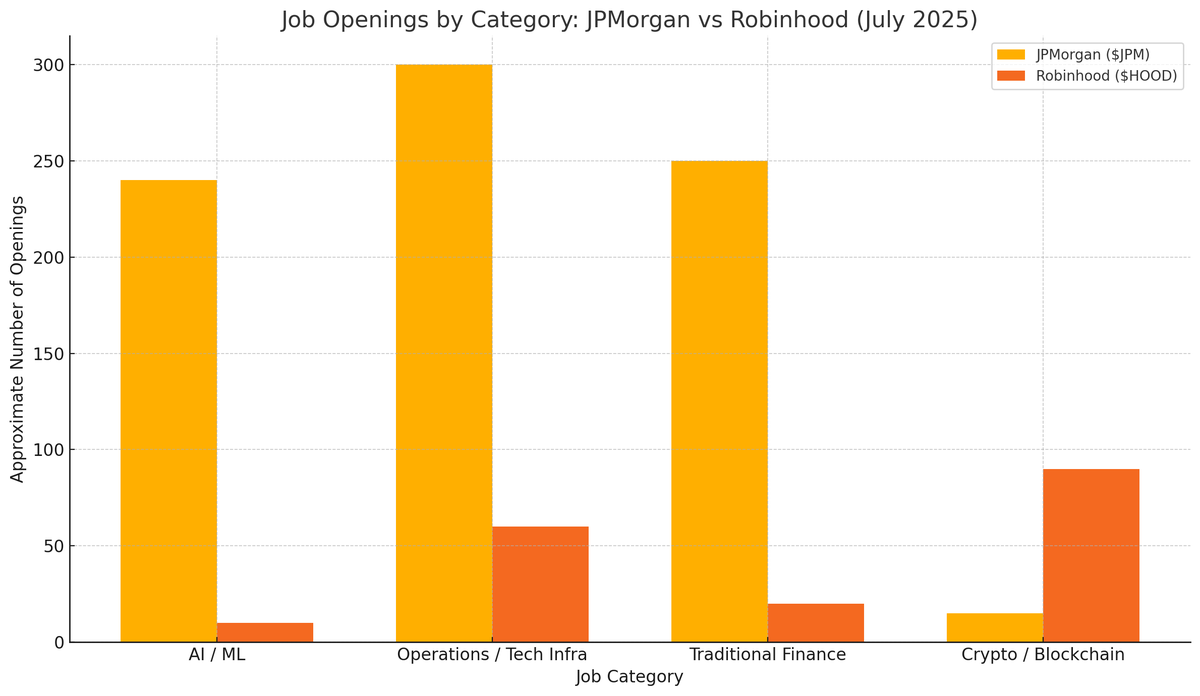
$JPM hiring focus heavily skewed to AI/Ops/Tradfi
$HOOD clearly doubling down on crypto/blockchain
Pick your horse
(*source, data pull from ChatGPT, directional in nature)
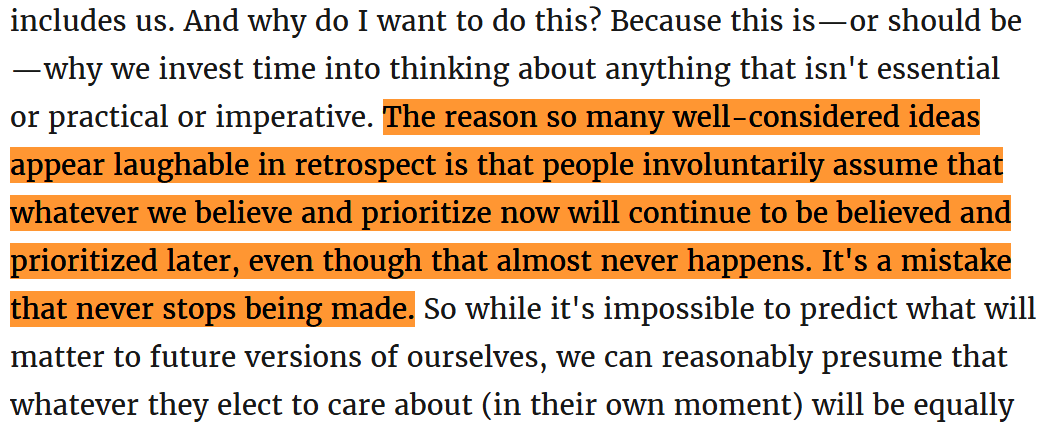
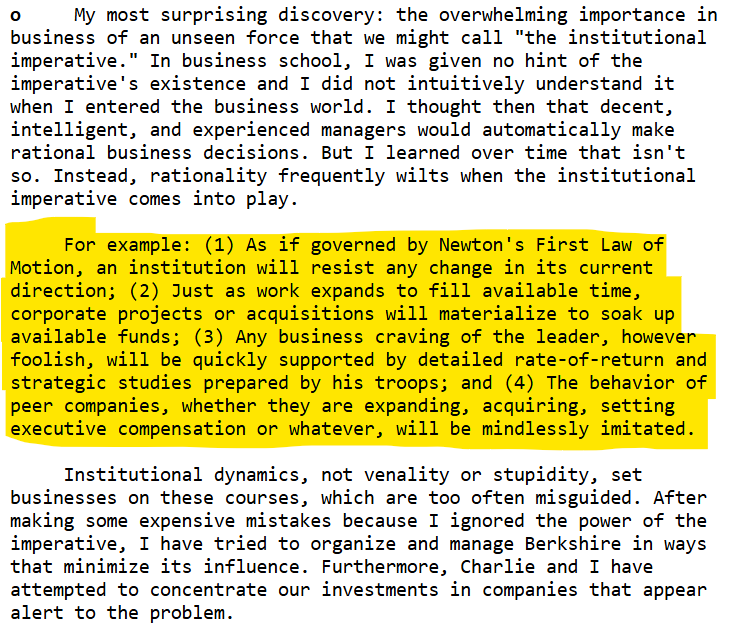
Bureaucracy, proxy thinkers, and cognitive bias are the unseen engines of disruption that VCs should be thanking.
Snip from Berkshire Hathaway's 1989 shareholder letter re 'the institutional imperative.'
Apollo, a wall st. behemoth w/ ~$785B in AUM, recently tokenized its ACRED tender fund via a partnership with @Securitize.
Distribution is still bottlenecked by regulation, but what's interesting here is the broad set of coordinated integrations with on-chain lending protocols.
Hypothetically, an investor could gain exposure to ACRED (~96% senior-secured credit) w/ an ~9% net yield and juice it with leverage to >11% net, almost instantly and w/ minimal friction.
Plenty of risk (duration, liquidity mismatch, gating, etc.) and so I'm not necessarily saying this is a 'good' idea--just that it highlights an instance where defi enables hyper-efficient net new capital markets activity. Long live the free market.
We're in the early innings of the 'Great Collision' (tradfi & defi)...interesting perspective on this pod from @TheOneandOmsy re $hood being a long-term net beneficiary. Certainly worth a listen.
LIVE NOW -- Robinhood vs. Coinbase: Who Wins the Future of Finance?
- Business models
- Growth strategies
- Tokenized asset plays
- Crypto, Equities, and Infrastructure
Will Robinhood’s slick UX and expanding product suite win the next generation? Or will Coinbase’s onchain infra and stablecoin moat prove unbeatable?
@EffortCapital from @BlockworksAdv and @TheOneandOmsy from @dragonflyvc join the show to debate Coinbase vs Robinhood, two companies racing to become the dominant financial super app.
[TIMESTAMPS]
0:00 Intro
2:37 Understanding Coinbase
8:31 Coinbase B2B
13:39 Comparing Revenue, Valuation, & Infrastructure
23:12 Future Growth of Coinbase
28:14 Understanding Robinhood
38:22 Robinhood Competition
45:42 Robinhood 2021 Crisis Explained
48:14 Robinhood Bank
52:02 Tokenized Stocks & L2
55:32 Defending the Coinbase Moat
1:06:19 Forecasting Robinhood’s Future
1:11:08 Forecasting Coinbase’s Future
1:15:31 Closing & Disclaimers
$crcl up 168% on IPO day gently reminding investors of the power of a seductive, consensus narrative.
Pricing seemingly detached from fundamentals but alas where else does one go for pure stablecoin exposure?