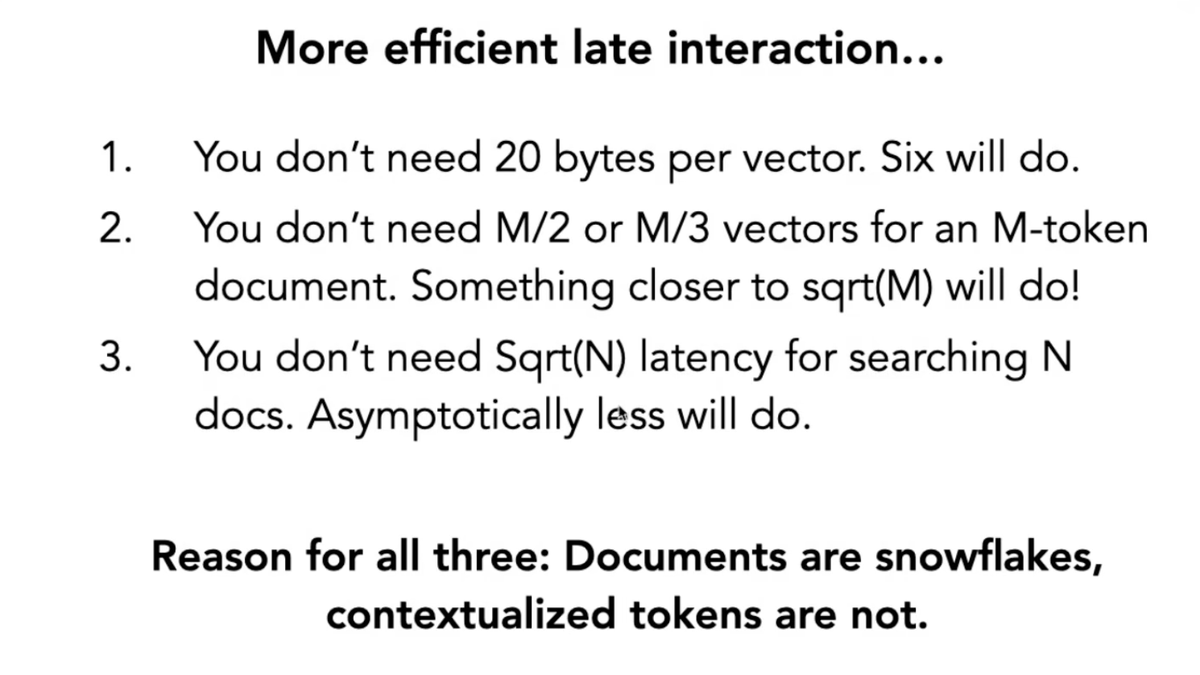
search is absolutely unusable now to surface old tweets so just going to repost: there are two fundamental problems in computing, (ironically) search and compression
@CJHandmer This seems needlessly alarmist when Australia spends roughly half the US on healthcare per capita and robotics in aged care will be transformative.
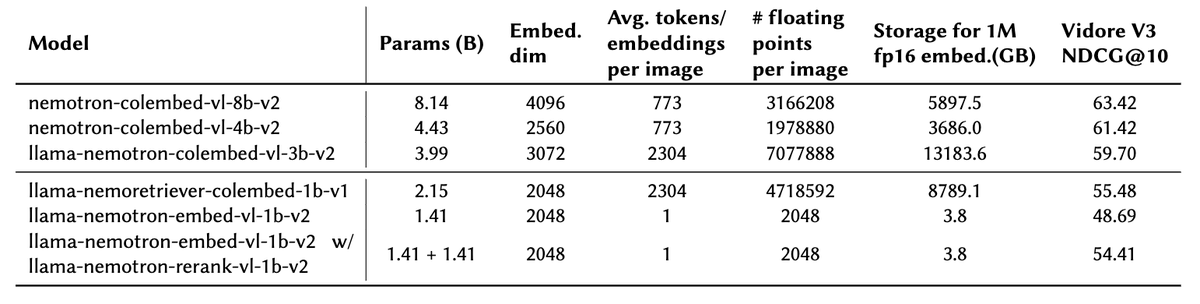
@lateinteraction As an example look at this table on storage efficiency from Nemotron ColEmbed V2. The single vector model uses nearly 1000x less storage. Compression of residuals etc means the factor is less in practice but there is so much efficiency left on the table.
We need to publicly clarify serious issues in Google’s ICLR 2026 paper TurboQuant.
TurboQuant misrepresents RaBitQ in three ways:
1. Avoids acknowledging key methodological similarity (JL transform)
2. Calls our theory “suboptimal” with no evidence
3. Reports results under unfair experimental settings
We have expressed our concerns to the authors before their submission, but they chose not to fix them in their paper submission. The paper was accepted at ICLR 2026 and heavily promoted by Google (tens of millions of views). At that scale, uncorrected claims quickly become “consensus.”
Facts:
1. RaBitQ already proves asymptotic optimality (FOCS’17 bound)
2. TurboQuant uses the same random rotation step but misses stating the connection
3. Their experiments used single-core CPU for RaBitQ vs A100 GPU for TurboQuant
None of these is properly disclosed.
We’ve filed a formal complaint and posted on OpenReview (https://t.co/nDVjmNhATM).
We’ll release a detailed technical report on arXiv.
Our goal is simple: keep the academic record accurate.
Would appreciate people taking a look and sharing.
Hey @bclavie, we primarily were showing memory reduction (80%+) and QPS improvements with the set of MUVERA parameters in the blog post. I agree sometimes you would want to increase projections for less memory reduction and higher recall.
MUVERA demonstrated in the paper it out-performed PLAID in latency controlling for a target recall level. Some datasets achieved 99.8%+ recall some achieved (i.e. SCIDOCs with 57%) much lower. Especially with the more complex MaxSim distance calculation you don't always achieve great ANN index recall with multi-vector models.
Personally I think MUVERA will win over PLAID style approaches for ecosystem reasons. With MUVERA you can adapt any ANN index (HNSW, DiskANN, ScaNN, Faiss, etc) with just the FDE encoding and MaxSim implementation (leveraging everything already done in this area) while PLAID requires a complex 4-stage pruning pipeline.
I really like LEANN but it does require embedding chunks on the fly for each query (for each batch of distance calculations as you navigate the graph). For most use-cases the costs (in API calls, time, or GPUs) of creating embeddings is high enough you don't want to do this. However when paired with static embeddings (like with @minishlab's model2vec) LEANN could be a good solution for storage constrained workloads.
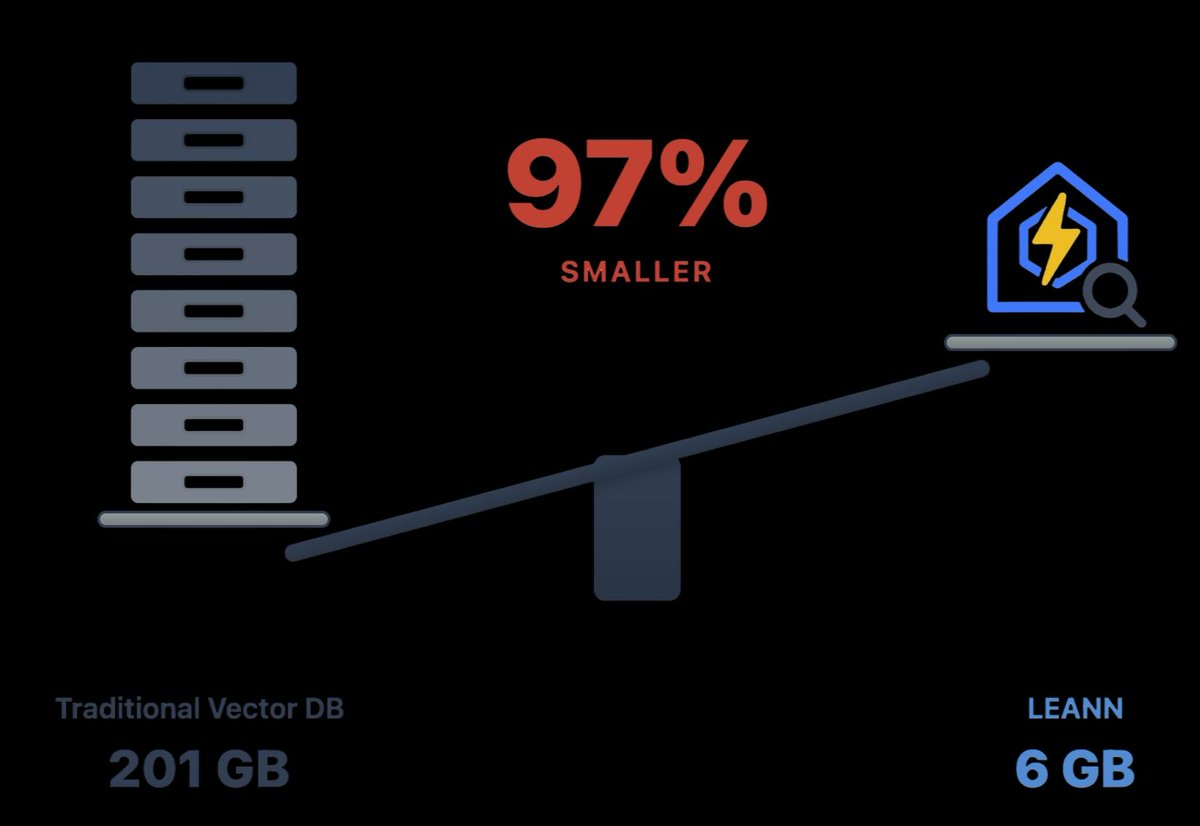
Stop storing embeddings.
A laptop can now index 60 million text chunks using 6GB, not 200GB.
LEANN, a new open-source project flips how vector search works.
𝗧𝗵𝗶𝘀 𝗶𝗻𝗱𝗲𝘅 𝗱𝗼𝗲𝘀 𝗻𝗼𝘁 𝘀𝘁𝗼𝗿𝗲 𝗲𝗺𝗯𝗲𝗱𝗱𝗶𝗻𝗴𝘀
Instead of saving every vector, it stores a compact graph.
Embeddings get recomputed only when a query actually needs them.
• Graph-based selective recomputation
• High-degree node pruning to keep recall stable
• No accuracy drop versus FAISS-style indexes
𝗧𝗵𝗲 𝘀𝘁𝗼𝗿𝗮𝗴𝗲 𝗴𝗮𝗶𝗻𝘀 𝗮𝗿𝗲 𝗺𝗮𝘀𝘀𝗶𝘃𝗲
Email archives shrink from gigabytes to megabytes.
Browser history fits in single-digit MBs.
A 60M-document corpus fits on a laptop SSD.
𝗜𝘁 𝗿𝘂𝗻𝘀 𝗲𝗻𝘁𝗶𝗿𝗲𝗹𝘆 𝗹𝗼𝗰𝗮𝗹
No cloud calls. No telemetry.
Everything stays on-device with zero ongoing cost.
𝗜𝘁 𝘂𝗻𝗹𝗼𝗰𝗸𝘀 𝗹𝗼𝗰𝗮𝗹 𝗥𝗔𝗚 𝗮𝘁 𝗻𝗲𝘄 𝘀𝗰𝗮𝗹𝗲
You can semantically search files, emails, chats, codebases, and live MCP sources.
All from one local index, without changing your workflow.
@copyconstruct I think they are still being built but people aren't hearing about them. The build vs buy pendulum has swung heavily to build with AI so you now have 50 vibe coded file systems etc with few users vs a category winner.
me: no but RAG can be done with plain old exact matching grep, it's totally fine
@mixedbreadai: rebrand search as grep
me: alright, then I guess I am doing grep now
@Yuchenj_UW Yann in his arguments stressed lack of physical world model and training from sensory data while Ilya focused more on LLMs not being coherent (flip-flopping, whale-a-mole errors etc) which I think makes more sense to people using LLMs day-to-day. Also timing is important.
The idea that an embedding model can also be a effective reranker (E2Rank) opens up a lot of interesting opportunities especially for local usage where you don't want to run multiple models.
@jxnlco@jxnlco I was actually watching one of your videos with around 200 views last week and thought the recommendations algorithm was broken.. Keep going the content is excellent.
@atulit_gaur If they talk about powers of 2 that is one thing, but if they talk about the history of embedding models, impact of BERT, and the hidden size of BERT-base being 768 and BERT-large being 1024 you have found a gem.