AGIBOT has unveiled AGILE (AgiBot Generative Intelligent Locomotion Engine), a perception-control foundation model for whole-body humanoid locomotion.
- It fuses visual perception, balance, and motion planning end-to-end, replacing the traditional split between "seeing" and "moving."
- The robot reads terrain and obstacles in real time and adjusts its gait with no preset trajectories.
- It runs on local compute with millisecond-level response and works across AGIBOT's lineup (A1/A2/A3, X2).
AGILE is the locomotion "cerebellum" that complements AGIBOT's Genie Operator "brain."
Yann LeCun says you cannot build a reliable agentic system without a world model
LLMs don't have world models. They can't predict the consequences of their actions before taking them
"they just act, and whatever happens next is someone else's problem"
Without that, it's not intelligence
I’ve always believed the No.1 application of AI should be to improve human health.
That work started with AlphaFold, and now at @IsomorphicLabs with the mission to reimagine drug discovery and one day solve all disease!
We are turbocharging that goal with $2.1B in new funding.
Yann LeCun and his team can't stop cooking
"LeWorldModel: Stable End-to-End Joint-Embedding Predictive Architecture from Pixels"
One of the biggest bottlenecks of JEPA is they are hard to train, and this new research changes that.
They propose LeWorldModel, which shows that a small model can learn a usable world model directly from raw pixels end-to-end.
Sitting at 15M parameters, they made it without needing heuristics and avoiding anti-collapse hacks while staying competitive and planning up to 48x faster.
Making JEPA based modeling much more accessible, cheaper, and stabler.
This paper is worth reading carefully.
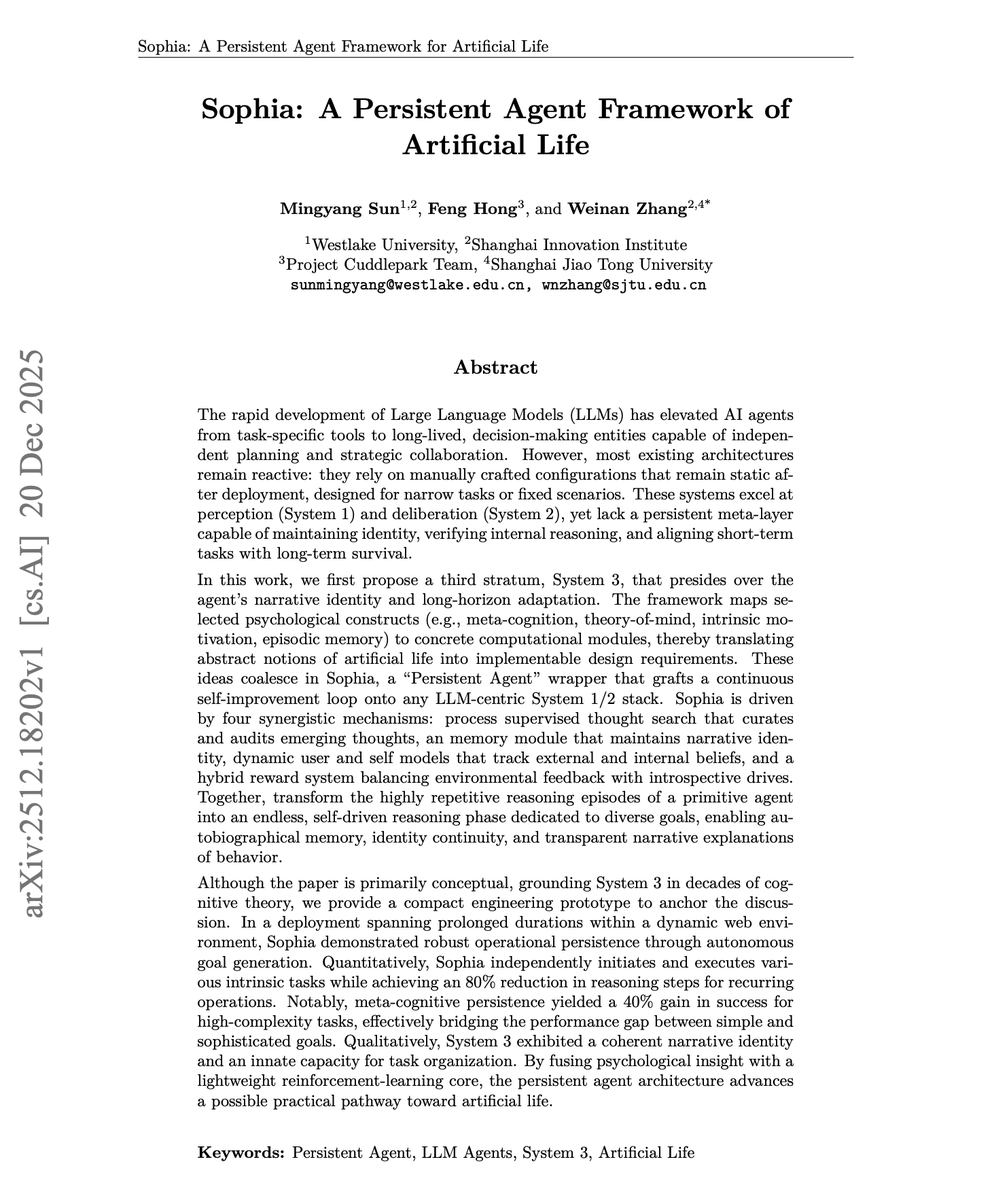
It introduces System 3 for AI Agents.
The default approach to LLM agents today relies on System 1 for fast perception and System 2 for deliberate reasoning.
But they remain static after deployment. No self-improvement. No identity continuity. No intrinsic motivation to learn beyond assigned tasks.
This new research introduces Sophia, a persistent agent framework built on a proposed System 3: a meta-cognitive layer that maintains narrative identity, generates its own goals, and enables lifelong adaptation.
Artificial life requires four psychological foundations mapped to computational modules:
- Meta-cognition monitors and audits ongoing reasoning.
- Theory-of-mind models users' beliefs and intentions.
- Intrinsic motivation drives curiosity-based exploration.
- Episodic memory maintains autobiographical context across sessions.
Here is how it works:
> Process-Supervised Thought Search captures and validates reasoning traces.
> A Memory Module maintains a structured graph of goals and experiences.
> Self and User Models track capabilities and beliefs.
> A Hybrid Reward Module blends external task feedback with intrinsic signals like curiosity and mastery.
In a 36-hour continuous deployment, Sophia demonstrated persistent autonomy.
During user idle periods, the agent shifted entirely to self-generated tasks. Success rate on hard tasks jumped from 20% to 60% through autonomous self-improvement. Reasoning steps for recurring problems dropped 80% through episodic memory retrieval.
This moves agents from transient problem-solvers to adaptive entities with coherent identity, transparent introspection, and open-ended competency growth.
Paper: https://t.co/Eyy7mI9P1i
Learn to build effective AI agents in our academy: https://t.co/zQXQt0PMbG
We’re excited to introduce ShinkaEvolve: An open-source framework that evolves programs for scientific discovery with unprecedented sample-efficiency.
Blog: https://t.co/zoZlH8jSXc
Code: https://t.co/TlYGSIk2Ek
Like AlphaEvolve and its variants, our framework leverages LLMs to find state-of-the-art solutions to complex problems, but using orders of magnitude fewer resources!
Many evolutionary AI systems are powerful but act like brute-force engines, burning thousands of samples to find good solutions. This makes discovery slow and expensive. We took inspiration from the efficiency of nature. ‘Shinka’ (進化) is Japanese for evolution, and we designed our system to be just as resourceful.
On the classic circle packing optimization problem, ShinkaEvolve discovered a new state-of-the-art solution using only 150 samples. This is a big leap in efficiency compared to previous methods that required thousands of evaluations.
We applied ShinkaEvolve to a diverse set of hard problems with real-world applications:
1/ AIME Math Reasoning: It evolved sophisticated agentic scaffolds that significantly outperform strong baselines, discovering an entire Pareto frontier of solutions trading performance for efficiency.
2/ Competitive Programming: On ALE-Bench (a benchmark for NP-Hard optimization problems), ShinkaEvolve took the best existing agent's solutions and improved them, turning a 5th place solution on one task into a 2nd place leaderboard rank in a competitive programming competition.
3/ LLM Training: We even turned ShinkaEvolve inward to improve LLMs themselves. It tackled the open challenge of designing load balancing losses for Mixture-of-Experts (MoE) models. It discovered a novel loss function that leads to better expert specialization and consistently improves model performance and perplexity.
ShinkaEvolve achieves its remarkable sample-efficiency through three key innovations that work together: (1) an adaptive parent sampling strategy to balance exploration and exploitation, (2) novelty-based rejection filtering to avoid redundant work, and (3) a bandit-based LLM ensemble that dynamically picks the best model for the job.
By making ShinkaEvolve open-source and highly sample-efficient, our goal is to democratize access to advanced, open-ended discovery tools. Our vision for ShinkaEvolve is to be an easy-to-use companion tool to help scientists and engineers with their daily work. We believe that building more efficient, nature-inspired systems is key to unlocking the future of AI-driven scientific research. We are excited to see what the community builds with it!
Learn more in our technical report: https://t.co/yzag3wd4jL
> 2500 tokens per second
> 40x faster than Sonnet-4
> 4 trillion transistor wafers (19x Nvidia B200)
These are impressive numbers, but nothing beats a live demo.
1 million free tokens per day of lightning-fast qwen3-32b and qwen3-235b from @cerebras in Cline. Link below.
The wait is over. @GeminiApp is now shipping Veo 3 *globally* for all Pro members!
That means India, Indonesia, all of Europe, and more are starting to get access to create videos right now.
As a member, you'll get 3 video generations per day, and that credit will replenish daily.
How to get it 👇
We’re excited to introduce AB-MCTS!
Our new inference-time scaling algorithm enables collective intelligence for AI by allowing multiple frontier models (like Gemini 2.5 Pro, o4-mini, DeepSeek-R1-0528) to cooperate.
Blog: https://t.co/BJs2sRKZ5s
Paper: https://t.co/0h8sCZVVUK
Inspired by the power of human collective intelligence, where the greatest achievements arise from the collaboration of diverse minds, we believe the same principle applies to AI. Individual frontier models like ChatGPT, Gemini, and DeepSeek are remarkably advanced, each possessing unique strengths and biases stemming from their training, which we view as valuable resources for collective problem-solving.
AB-MCTS (Adaptive Branching Monte Carlo Tree Search) harnesses these individualities, allowing multiple models to cooperate and engage in effective trial-and-error, solving challenging problems for any single AI. Our initial results on the ARC-AGI-2 benchmark are promising, with AB-MCTS combining o4-mini + Gemini-2.5-Pro + R1-0528, current frontier AI models, significantly outperforming individual models by a substantial margin.
This research builds on our 2024 work on evolutionary model merging, shifting focus from “mixing to create” to “mixing to use” existing, powerful AIs. At Sakana AI, we remain committed to pioneering novel AI systems by applying nature-inspired principles such as evolution and collective intelligence. We believe this work represents a step toward a future where AI systems collaboratively tackle complex challenges, much like a team of human experts, unlocking new problem-solving capabilities and moving beyond single-model limitations.
Algorithm (TreeQuest): https://t.co/6X69yZIp33
ARC-AGI Experiments: https://t.co/RjdUs1oxxl
AI coding is used to generate a lot of bulk code that is often blindly accepted, but it seems there is at least as much opportunity for AI to help make codebases more beautiful.
Keeping a codebase in great shape or cleaning up a hairball takes a lot of effort beyond raw functionality, and a tireless AI assistant continuously pouring over everything looking for places to suggest changes should be valuable. AI as a diligent team member instead of your coding genie.
While there are factors peculiar to each’s understanding, I believe there are common coding behaviors that improve understanding for both humans and LLMs. It should be possible to run actual objective experiments with “style guides” for LLMs, then intersect them with the politics and fashion of human style guides.
Are there any tweaks to be made in LLM tokenization to more closely mirror programming language lexing?
Does saving context length settle tabs vs spaces?
I would like to see how a notoriously picky team like the @OpenBSD developers could onboard an AI team member.
I have also run this fun thought experiment! More of the world than many might imagine could run on outdated hardware if software optimization was truly a priority, and market price signals on scarce compute would make it happen. Rebuild all the interpreted microservice based products into monolithic native codebases! Innovative new products would get much rarer without super cheap and scalable compute, of course.
Gemini 2.5 Pro just got a significant upgrade (03-25 → 05-06) with improved coding capabilities, especially for front-end web dev and function calling.
Note: using 03-25 in Cline automatically points to the 05-06 version -- UI updates coming shortly.
We’ve rolled back last week's GPT-4o update in ChatGPT because it was overly flattering and agreeable. You now have access to an earlier version with more balanced behavior.
More on what happened, why it matters, and how we’re addressing sycophancy: https://t.co/LOhOU7i7DC
Meet SO-101, next-gen robot arm for all, by @huggingface 🤗
Enables smooth takeover to boost AI capabilities, faster assembly (20mn), same affordable price ($100 per arm) 🤯
Get yours today! Links in thread below 👇