A Rust dev just killed Headless Chrome.
It's called Obscura. The open-source headless browser purpose-built for AI agents and scrapers at scale.
Chrome vs Obscura:
- Memory: 200MB+ → 30MB
- Binary: 300MB+ → 70MB
- Page load: 500ms → 85ms
- Startup: 2s → Instant
- Anti-detect: None → Built-in
Single binary. No Node, no Chrome, no dependencies.
Stealth mode is brutal:
→ Per-session fingerprint randomization (GPU, canvas, audio, battery)
→ 3,520 tracker domains blocked by default
→ navigator.webdriver masked to match real Chrome
→ Native function masking so detectors can't sniff it out
Drop-in replacement for Puppeteer and Playwright over CDP. Zero code changes.
If you run agents or serious scraping at scale, this repo prints money.
100% Opensource.
🚨 Microsoft has solved the biggest problem with AI.
They open-sourced bitnet.cpp. It’s a 1-bit inference framework that runs massive 100B parameter models directly on your CPU without GPUs.
it uses 82% less energy.. 100% open-source.
5 ways to make money on social media:
(even if you have 0 followers):
1 - sell to your competitors' audiences
find your competitor's viral post. export everyone who engaged with it. those people already want what you're selling.
they just don't know you exist yet. DM them.
2 - comment your way to customers
find posts from accounts with 10k-50k followers in your niche. reply with a better answer than the original post. your reply often gets 5x impressions than your posts when you're early.
everyone reading the thread sees your profile. works exceptionally well on Linkedin.
free distribution. no followers needed.
3 - turn reddit karma into revenue
spend 1 week answering questions in niche subreddits. be genuinely helpful. no pitching. after you have 50+ karma in that subreddit, mention your product when it's actually relevant.
4 - support others and they'll support you back
when someone launches on product hunt, hacker news, or indie hackers - genuinely support them. upvote. leave a thoughtful comment. share what you liked. don't pitch. don't ask for anything.
but people remember who showed up for their launch. when you launch, they'll return the favor.
5 - create once, test everywhere
post the same content on X, Linkedin, Tiktok, Reddit simultaneously. you'll be surprised which platform gives you traction first. often it's not where you expected.
some of my posts do amazingly well on LinkedIn and not X.
the pattern: distribution beats audience size now.
platforms reward quality, not follower count. your first post can reach 10k people if it's good enough.
--
talking about this in tomorrow's newsletter:
the full system for using social media without followers.
(including the exact DM templates, platform hacks, and mistakes that kill your reach).
+ a secret surprise for all the people in the newsletter 👀
Subscribe below 👇
100% free. no ads.
The best OCR ever, only 0.9B parameters. 94.62 score on OmniDocBench v1.5.
One pip install. Handles documents no other model could touch. 100% Open Source.
GLM-OCR
https://t.co/SEhE03uBWS
My dear front-end developers (and anyone who’s interested in the future of interfaces):
I have crawled through depths of hell to bring you, for the foreseeable years, one of the more important foundational pieces of UI engineering (if not in implementation then certainly at least in concept):
Fast, accurate and comprehensive userland text measurement algorithm in pure TypeScript, usable for laying out entire web pages without CSS, bypassing DOM measurements and reflow
ONCE is back! It's now a full-fledged application server for running dockerized web apps, like Campfire/Writebook/Fizzy or your own vibe-coded adventures. Zero-downtime upgrades, scheduled backups, and a gorgeous TUI with hyperdrive graphics. Enjoy! https://t.co/WaLSMms2fr
Mind blown: A Chinese quant college student builds an AI swarm engine in 10 days flat, explodes GitHub with 13,000+ stars, and scores $4,000,000 in funding!
Introducing MiroFish is the multi-agent simulator that's revolutionizing predictions for trading, PR, and more.
What is MiroFish?
It's a digital sandbox where thousands of AI agents with individual memories and behaviors interact like a real society.
Feed it any scenario (news leak, policy change, or even a classic novel's missing ending), and it simulates crowd reactions, debates, and outcomes to forecast real-world events.
The Creator's Story:
> In late 2025, fourth-year student Guo Hanjiang coded the core using AI assistants.
> It went viral overnight, landing him 30m Yuan (~$4m) from Shanda Group.
> He ditched the dorm, started a company, and now leads the charge.
Key Applications:
.Trading: Input financial news or reports, watch simulated market panics and price swings for predictive insights.
.PR Testing: Companies/Politics run draft statements to spot backlash and refine messaging.
.Creative Experiments: Loaded a lost-ending Chinese novel, agents role-played characters and generated a logical finale.
.Easy setup: Deploy via Docker in minutes with any LLM API key.
Pro tip: Simulate something wild like Elon Musk tweeting about Dogecoin 2.0 and spawn agent traders, influencers, and investors, generate real-time video clips of the frenzy to test moonshots or crashes risk-free.
Traders are already winning big: Check this one on Polymarket - $120,000+ net profits from spot on SPX 500 bets, powered by MiroFish sims on historical data.
His profile: https://t.co/uFu4RwNitn
For effortless gains, try Kreo copy trading: Auto-mirror pros like him and ride their edges.
Try here: https://t.co/5aAg87o8ji
Add his wallet: [0x17559efac103ac7f361be37ec0b93888d4c55aac] to [https://t.co/tWKZaJYAMg] and start track/copy him.
Repo: https://t.co/Rh3q1IuewP
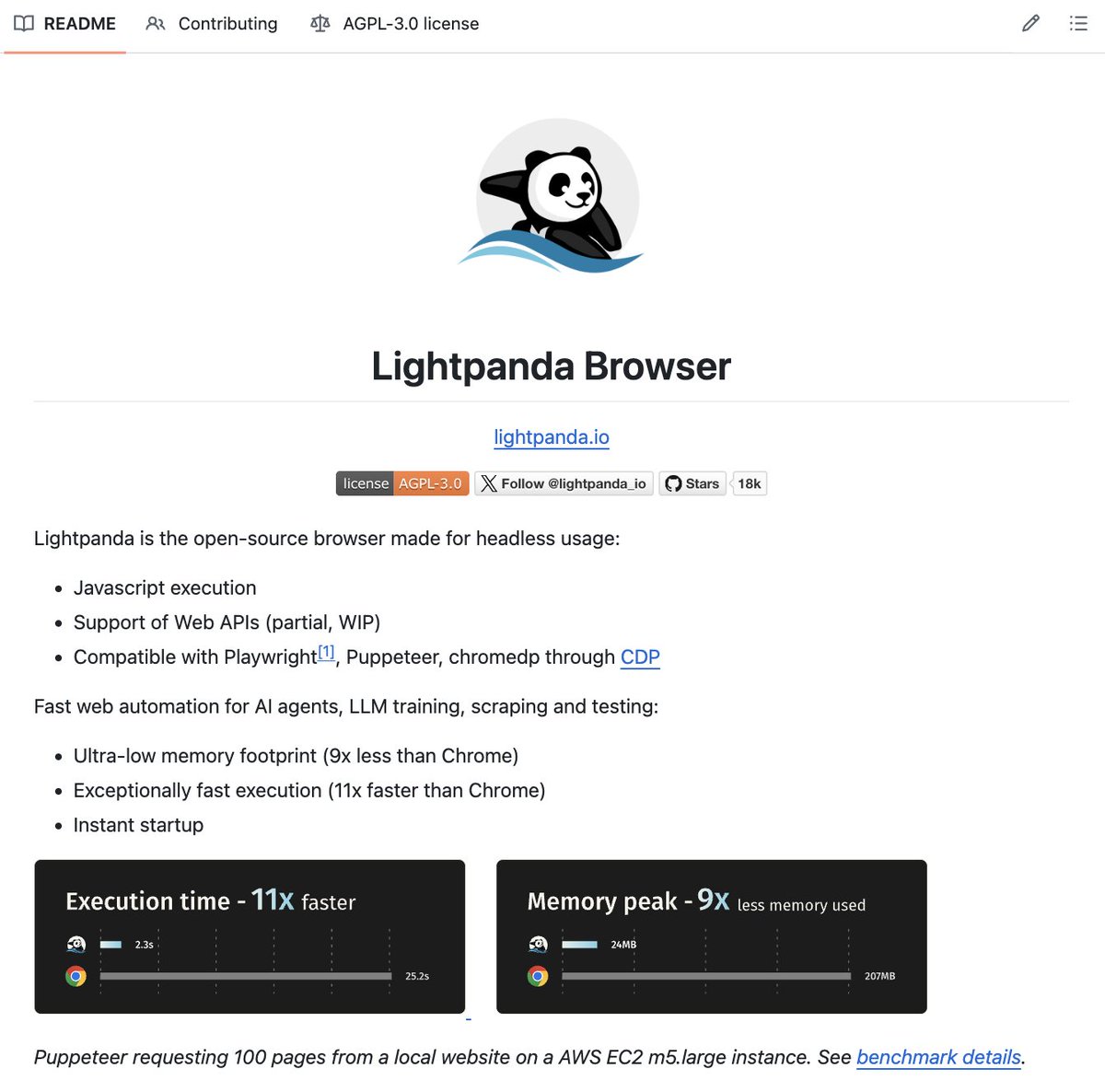
🚨 RIP Chrome for AI agents.
Someone built a headless browser from scratch that runs 11x faster and uses 9x less memory.
It's called Lightpanda.
Every AI agent doing web automation right now is running Chrome under the hood. That means you're spinning up a massive desktop application, stripping out the UI, and running hundreds of instances of it on a server. For something that never needs to render a single pixel.
It's like renting a semi-truck to deliver a letter.
Lightpanda is built differently. Not a fork of Chromium, Blink, or WebKit. Written from scratch in Zig with one goal: headless performance, nothing else.
It still runs JavaScript. Still handles Ajax, XHR, Fetch, SPAs, infinite scroll, all of it. Just without dragging along 500MB of browser bloat you'll never use.
And it drops straight into your existing stack:
→ Compatible with Playwright, Puppeteer, and chromedp via CDP
→ One-line Docker install
→ CDP server on port 9222, swap it in for Chrome in 30 seconds
The use cases are obvious: AI web agents, LLM training data scraping, browser automation at scale, testing pipelines. Anything where you're paying for Chrome compute and cringing at the bill.
It's still in beta and Web API coverage is growing. But at 11.8K stars it's clearly hitting a real nerve.
100% Opensource. AGPL-3.0.
Link in comments.
the best startup founders in 2026 won't be the best coders
they'll be the best Product Managers
here's the full playbook:
1. pick a problem you personally have. you need to understand your user better than anyone else, and the easiest way to do that is to be your own user
2. spin up a landing page with AI fast. make it about the pain and the fix, no fluff. and make signup 2 clicks max, remove every possible friction
3. learn to write specs, describe features and explain edge cases. that's all you really need now
4. let AI build the first version. your job is to direct, not develop
5. use whatever stack you're most comfortable with. just ship. don't overthink the tech decision - that's not your job anymore
6. host on the simplest platform possible - Vercel, Railway, whatever - don't touch servers
7. test thoroughly - especially edge cases. you're a QA now
8. charge from day 0. free users give you nothing but false hope
9. list your product on every directory you can find. it compounds your SEO and builds DR over time
10. start building in public. share the micro wins, the losses, everything. invite people to try it through DMs. I did this for all my products
11. do customer support yourself, always. redirect questions to your socials, never automate this. every support request is a product insight - that's why you do it yourself, always (I still do this for all 5 of my products)
12. automate everything else you do more than twice
13. improve one thing in your product every single day once users start coming in. watch your competitors' G2 and Trustpilot reviews closely for ideas
14. a PM's most important skill is deciding what NOT to build. for every feature request you get, say no to 9 of them - build less, but build it right
15. every week, build one free tool targeting a keyword that benefits you. it compounds over time
16. work your SEO early. build your affiliate setup early. only run paid acquisition after you're sure about PMF
every day your only 2 priorities are:
- get more users
- and keep the ones you have
that's it. everything else is noise
Prompt engineering is dead.
Anthropic recently released the real playbook for building AI agents that actually work.
It’s a 30+ page deep dive called The Complete Guide to Building Skills for Claude and it quietly shifts the conversation from “prompt engineering” to real execution design.
Here’s the big idea:
A Skill isn’t just a prompt.
It’s a structured system.
You package instructions inside a SKILL .md file, optionally add scripts, references, and assets, and teach Claude a repeatable workflow once instead of re-explaining it every chat.
But the real unlock is something they call progressive disclosure.
Instead of dumping everything into context:
• A lightweight YAML frontmatter tells Claude when to use the skill
• Full instructions load only when relevant
• Extra files are accessed only if needed
Less context bloat. More precision.
They also introduce a powerful analogy:
MCP gives Claude the kitchen.
Skills give it the recipe.
Without skills: users connect tools and don’t know what to do next.
With skills: workflows trigger automatically, best practices are embedded, API calls become consistent.
They outline 3 major patterns:
1) Document & asset creation
2) Workflow automation
3) MCP enhancement
And they emphasize something most builders ignore: testing.
Trigger accuracy.
Tool call efficiency.
Failure rate.
Token usage.
This isn’t about clever wording.
It’s about designing an execution layer on top of LLMs.
Skills work across Claude, Claude Code, and the API. Build once, deploy everywhere.
The era of “just write a better prompt” is ending.
Anthropic just handed everyone a blueprint for turning chat into infrastructure.
Download the guide here: https://t.co/Bf3j0GFRGu


![slash1sol's tweet photo. Mind blown: A Chinese quant college student builds an AI swarm engine in 10 days flat, explodes GitHub with 13,000+ stars, and scores $4,000,000 in funding!
Introducing MiroFish is the multi-agent simulator that's revolutionizing predictions for trading, PR, and more.
What is MiroFish?
It's a digital sandbox where thousands of AI agents with individual memories and behaviors interact like a real society.
Feed it any scenario (news leak, policy change, or even a classic novel's missing ending), and it simulates crowd reactions, debates, and outcomes to forecast real-world events.
The Creator's Story:
> In late 2025, fourth-year student Guo Hanjiang coded the core using AI assistants.
> It went viral overnight, landing him 30m Yuan (~$4m) from Shanda Group.
> He ditched the dorm, started a company, and now leads the charge.
Key Applications:
.Trading: Input financial news or reports, watch simulated market panics and price swings for predictive insights.
.PR Testing: Companies/Politics run draft statements to spot backlash and refine messaging.
.Creative Experiments: Loaded a lost-ending Chinese novel, agents role-played characters and generated a logical finale.
.Easy setup: Deploy via Docker in minutes with any LLM API key.
Pro tip: Simulate something wild like Elon Musk tweeting about Dogecoin 2.0 and spawn agent traders, influencers, and investors, generate real-time video clips of the frenzy to test moonshots or crashes risk-free.
Traders are already winning big: Check this one on Polymarket - $120,000+ net profits from spot on SPX 500 bets, powered by MiroFish sims on historical data.
His profile: https://t.co/uFu4RwNitn
For effortless gains, try Kreo copy trading: Auto-mirror pros like him and ride their edges.
Try here: https://t.co/5aAg87o8ji
Add his wallet: [0x17559efac103ac7f361be37ec0b93888d4c55aac] to [https://t.co/tWKZaJYAMg] and start track/copy him.
Repo: https://t.co/Rh3q1IuewP](https://pbs.twimg.com/media/HDUdR1NWsAAxl9L.jpg)











![slash1sol's tweet photo. Mind blown: A Chinese quant college student builds an AI swarm engine in 10 days flat, explodes GitHub with 13,000+ stars, and scores $4,000,000 in funding!
Introducing MiroFish is the multi-agent simulator that's revolutionizing predictions for trading, PR, and more.
What is MiroFish?
It's a digital sandbox where thousands of AI agents with individual memories and behaviors interact like a real society.
Feed it any scenario (news leak, policy change, or even a classic novel's missing ending), and it simulates crowd reactions, debates, and outcomes to forecast real-world events.
The Creator's Story:
> In late 2025, fourth-year student Guo Hanjiang coded the core using AI assistants.
> It went viral overnight, landing him 30m Yuan (~$4m) from Shanda Group.
> He ditched the dorm, started a company, and now leads the charge.
Key Applications:
.Trading: Input financial news or reports, watch simulated market panics and price swings for predictive insights.
.PR Testing: Companies/Politics run draft statements to spot backlash and refine messaging.
.Creative Experiments: Loaded a lost-ending Chinese novel, agents role-played characters and generated a logical finale.
.Easy setup: Deploy via Docker in minutes with any LLM API key.
Pro tip: Simulate something wild like Elon Musk tweeting about Dogecoin 2.0 and spawn agent traders, influencers, and investors, generate real-time video clips of the frenzy to test moonshots or crashes risk-free.
Traders are already winning big: Check this one on Polymarket - $120,000+ net profits from spot on SPX 500 bets, powered by MiroFish sims on historical data.
His profile: https://t.co/uFu4RwNitn
For effortless gains, try Kreo copy trading: Auto-mirror pros like him and ride their edges.
Try here: https://t.co/5aAg87o8ji
Add his wallet: [0x17559efac103ac7f361be37ec0b93888d4c55aac] to [https://t.co/tWKZaJYAMg] and start track/copy him.
Repo: https://t.co/Rh3q1IuewP](https://pbs.twimg.com/media/HDUdSndWgAEv7CG.jpg)