🧠 Your brain is constantly building connections.
Under a microscope, neurons can be seen extending tiny branches, exploring their surroundings and connecting with other neurons.
These new connections form synapses — the communication points that allow brain cells to pass signals.
This microscopic process is part of neuroplasticity, the brain’s remarkable ability to learn, adapt and reorganize itself. ✨
Your tattoo isn’t just decorative ink: it’s a permanent trigger that keeps your immune system locked in a lifelong cycle of chronic inflammation.
As soon as the ink is injected into your skin, your body recognizes the pigment particles as foreign invaders. Immune cells called macrophages immediately swarm the area and attempt to swallow them up. But because they can’t actually break down the ink, the macrophages eventually die, releasing the pigment back into the surrounding tissue, only for a new wave of macrophages to arrive and repeat the process.
This endless cycle is what keeps the tattoo permanently visible, while also maintaining a state of ongoing, low-level inflammation in the skin.
Over time, some of these ink particles migrate through the lymphatic system and accumulate in the lymph nodes, placing constant stress on the body’s defense mechanisms. Emerging research suggests this internal ink buildup may interfere with normal immune function, potentially reducing the effectiveness of certain vaccines, including mRNA types. Additionally, many tattoo inks contain heavy metals like nickel and cobalt. Combined with the chronic inflammation, this has been linked to a modestly elevated risk of lymphoma and skin cancer.
While tattoos remain a powerful form of self-expression, they represent a complex, decades-long biological conflict between your immune system and foreign substances embedded in your skin.
[Nielsen, C., Jerkeman, M., & Jöud, A. S. (2024). Tattoos as a risk factor for systemic lymphoma: A population-based case-control study. eClinicalMedicine]
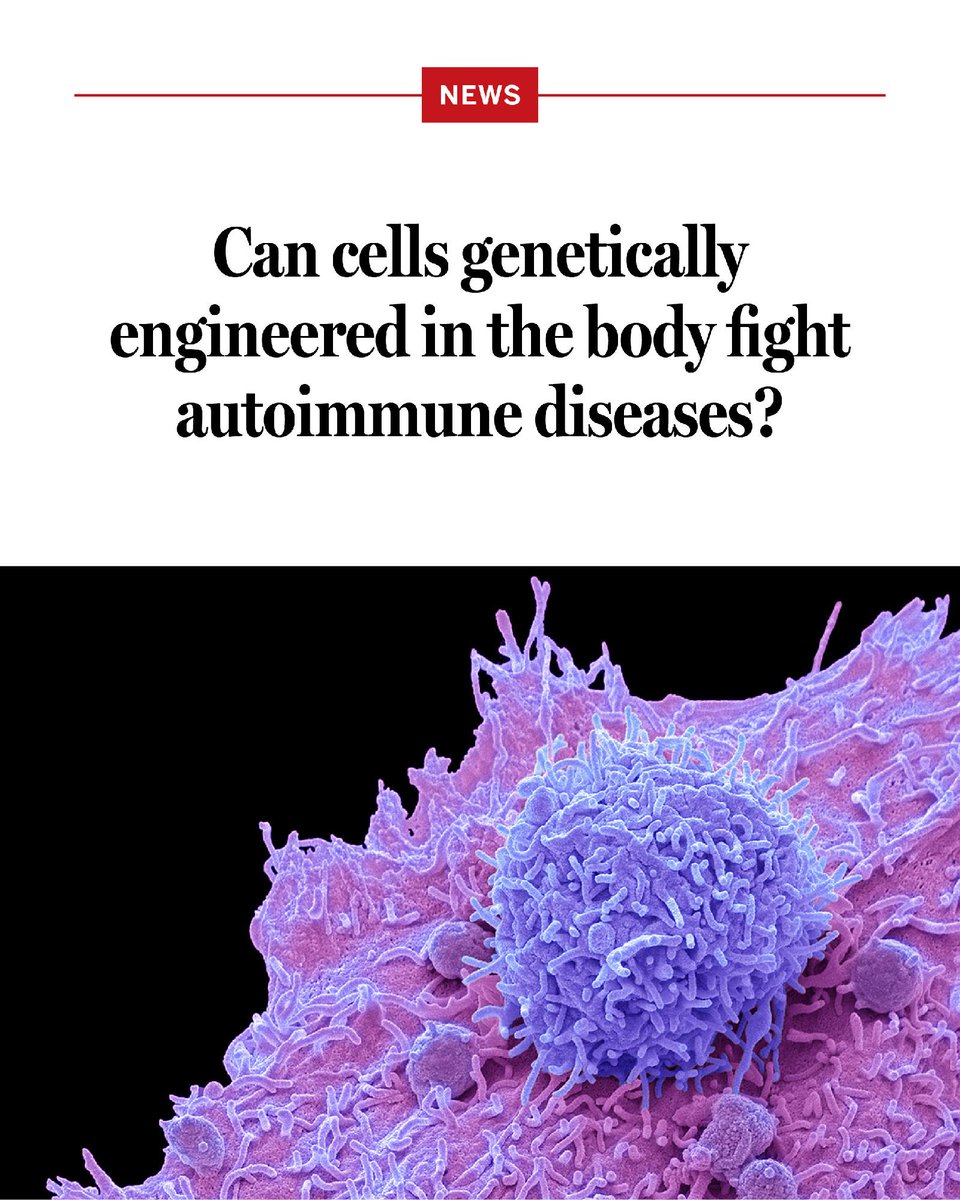
Researchers have high hopes that genetically engineered immune cells known as chimeric antigen receptor (CAR)-T cells can treat and even cure autoimmune diseases such as lupus and multiple sclerosis by slaying the errant immune cells driving the conditions.
But the current methods for producing CAR-T cells, in which the cells are generated in a lab and then infused into patients, are slow and expensive, and the treatment itself can be dangerous.
A new clinical trial may point to a better way: Researchers say they have induced patients to generate their own CAR-T cells.
The treatment, which involves dosing people with a virus that genetically alters some of their T cells, didn’t cause severe side effects in the 16 patients tested and showed early signs that it restored their immune systems to normal. Learn more: https://t.co/cms7Tw5j8u
@ChrisPalmerMD@ChrisPalmerMD what do you think the risk will be in this post-Covid era for T.gondii and related symptoms? And have you investigated Bartonella and the correlation w/mental health? Curious due to higher than average dysregulated immune systems. Thank you!
@LymeWarrior1996@HHSResponse@SecKennedy Have you had testing through #igenex? I see you have a cat. Have you been tested for Bartonella? It’s certainly expensive. With you!!! Feel better soon!
Dealing with difficult people may be hazardous to your health.
Data: Each additional "hassler" in your network predicts 1.5% faster biological aging—and worse health a year later. Non-spouse family hasslers are the most problematic.
Some ties aren't worth the toll they take.
Last chance to register for tomorrow's webinar discussing how #germline results can directly influence personalized treatment selection, surgical decisions, and other aspects of care.
https://t.co/VsQnsbJOne
@sarahnadav A full Lyme and co-infection assay, mold mycotoxin test, environmental testing on your blood (for those who have lived through 9/11, fires, chemical exposure) etc. And let’s not forget a full hormone panel (that no physician wants to own for women) and a full cytokine panel.
@sarahnadav For those with Long Covid, the Th helper cells are fully dysregulated so the EBV, Lyme, Babesia, Bartonella, Strep, Mold/Fungi that it was suppressing for years slowly started to reemerge. But no AMC will run a full EBV panel, send out for speciality testing such as:
@ZdenekVrozina I wish they would have also had the patients collect their own stool sample for gut microbiome testing for shotgun Metagenomic sequencing to correlate either the biopsies.
@Sanglewich Patients deserve appropriate diagnostic testing and assistance in personalized interpretation. I still can’t understand why physicians don’t consider reactivation of Strep, EBV, Coxsackievirus, etc. like they do Chickenpox -> Shingles.
@bryan_johnson Here is one for your newly Dx autoimmune condition. Kristine Profeta, MD, MBA is a double board certified physician from Harvard and has cured herself from 22 autoimmune conditions. Make an appointment. She’s in NJ right outside of Manhattan. https://t.co/AR4A98jQgr
$TEM is the pure-play leader in precision AI medicine, with the data moat, clinical integrations, and scale that actually matter. Tempus has already trained its own AI models and built a powerful data flywheel that gets stronger with every test, physician, and institution added to the network.
Eric Lefkofsky has said frontier AI companies are reaching out because they lack the proprietary clinical data needed to build serious healthcare AI. Tempus sits at the intersection of data, diagnostics, workflows, and model development.
The market still values $TEM like a legacy diagnostics company. Eventually it will be valued like an AI company. The comparison of the $PLTR of healthcare or $TSLA of healthcare is apt. The re-rating into a blue-chip AI stock is not a question of if, but when.







![Rainmaker1973's tweet photo. Your tattoo isn’t just decorative ink: it’s a permanent trigger that keeps your immune system locked in a lifelong cycle of chronic inflammation.
As soon as the ink is injected into your skin, your body recognizes the pigment particles as foreign invaders. Immune cells called macrophages immediately swarm the area and attempt to swallow them up. But because they can’t actually break down the ink, the macrophages eventually die, releasing the pigment back into the surrounding tissue, only for a new wave of macrophages to arrive and repeat the process.
This endless cycle is what keeps the tattoo permanently visible, while also maintaining a state of ongoing, low-level inflammation in the skin.
Over time, some of these ink particles migrate through the lymphatic system and accumulate in the lymph nodes, placing constant stress on the body’s defense mechanisms. Emerging research suggests this internal ink buildup may interfere with normal immune function, potentially reducing the effectiveness of certain vaccines, including mRNA types. Additionally, many tattoo inks contain heavy metals like nickel and cobalt. Combined with the chronic inflammation, this has been linked to a modestly elevated risk of lymphoma and skin cancer.
While tattoos remain a powerful form of self-expression, they represent a complex, decades-long biological conflict between your immune system and foreign substances embedded in your skin.
[Nielsen, C., Jerkeman, M., & Jöud, A. S. (2024). Tattoos as a risk factor for systemic lymphoma: A population-based case-control study. eClinicalMedicine]](https://pbs.twimg.com/media/HRcS1coa8AACeWe.jpg)