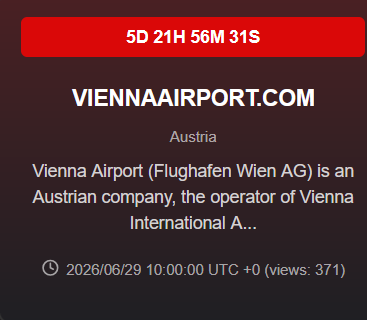
📢 Ransomware Alert: 🇦🇹
Flughafen Wien -Vienna Airport
(https://t.co/q0zgf0BjvY), an Austria-based airline & aviation company, has reportedly fallen victim to Bashe ransomware
Nb: They intends to publish within 5-6 days.
🔍Key Details:
🛡️ Threat actor: Bashe
📅 Reported on: 23/06/26
Today is the official release day for Android 17. We've already fully ported GrapheneOS to Android 17 and are in the process of pushing the code to our public repositories. We're building a final official release based on Android 16 QPR2 today and we'll do an initial Android 17 release tomorrow.
We've already tested the Android 17 port of GrapheneOS on the Pixel 6a, 7, 7a, 8, 10a, 10 and 10 Pro Fold. It will be possible for people to start building and testing it themselves later today once we finish pushing the code. We'll start the process of public testing for official releases tomorrow.
Chytře využita série zranitelností - stačilo kliknutí na odkaz:
- útočník pošle odkaz na Microsoft 365 Copilot s instrukcí, aby vytál nějaká data a zabalil je do tagu <img s url na bing_com na vyhledávání obrázků
- Copilot akci provedl
- při renderování, než se než stihla provést sanitizace, tak prohlížeč tag img na chvíli vyrenderoval a odpálil url na Bing
- Bing odeslal data na server útočníka
Šlo tak získat data z místa, kde měl MS Copilot přístup (z e-mailu, OneDrive, SharePoint).
https://t.co/oFZi6uqXBD
@GrapheneOS@Sebo471@pbeyssac@Ced_haurus@getyoti That's exactly how open source from greedy corporation is - give something for free, make a huge market share and than push everyone to comply with nonsense rules. Otherwise you will be threatened with legal actions.
❗️🚨 An Israeli company has backdoored hundreds of millions of households through countless Smart TV apps, and they're quietly turning Samsung and LG TVs into exit nodes for AI web-scraping. Your TV is relaying strangers' web traffic from your home IP, your bandwidth, your address attached to whatever those scraping jobs touch.
Roku, Fire TV and Google TV banned the practice. Samsung and LG didn't. The culprit is Bright Data's proxy SDK, which rides inside Tizen and webOS apps, 200+ on webOS alone. Datacenter IPs get blocked, home IPs don't.
Include Security reverse-engineered the SDK and found its relay protocol has no message signing, authentication, or device attestation. Their words: less secure than typical malware command-and-control.
To make things worse, they found that in iOS the relay tunnel binds straight to the physical network interface, so it routes around any VPN the user is running.
Bright Data's config also ships per-country tiers. Devices in Uzbekistan and Oman are cleared to relay down to 1% battery, with data caps up to 60x the worldwide default.
Before the BaCkDoOrEd replies land: technically you agreed. In practice you were enrolled into a global proxy network you were never given the information to refuse. And these exit nodes drag down your IP's reputation, potentially leaving you with blocks from providers.
WOW! Remarkable video from 5 miles from the launch pad in Jetty Park. Watch that fireball, and listen around 35 seconds into the video for the massive audible explosion.
📸: John Concilus
🚨 BREAKING: Socket is investigating an active npm supply chain attack compromising hundreds of packages in the @antv ecosystem.
The malicious publish wave appears tied to Mini Shai-Hulud and packages connected to the npm maintainer account atool.
🚨 We recently discovered that an unauthorized party obtained a token with access to the Grafana Labs GitHub environment, enabling the threat actor to download our codebase. (1/6)
Microsoft: PowerShell is simple and easy to use.
Actual PowerShell command: Remove-MgIdentityAuthenticationEventFlowAsOnGraphAPretributeCollectionExternalUserSelfServiceSignUpAttributeIdentityUserFlowAttributeByRef
No, this isn't a joke. This was noted by @NathanMcNulty
Rapid7 observed a recent enterprise intrusion that began with a fake IT support Teams message, escalated via fake lock screens, Python-based RATs & a kernel exploit, then secured domain-wide credential access – all within 2 days.
Get to know #ModeloRAT: https://t.co/6sYibEzEEg
@UK_Daniel_Card C'mon WINS??? Who uses this prehistoric stuff 🤔 I thought that these, except VBScript were already removed with 2025 release.... :/ It reminds me disabling RC4 in Kerberos 😂😂😂
Apple and Google are gradually expanding their use of hardware-based attestation. They're convincing a growing number of services to adopt it. Google's Play Integrity API and Apple's App Attest API are very similar. Apple brought it to the web via Privacy Pass, which Google intends on doing too.
Google's Play Integrity API requires hardware attestation for the strong integrity level and is gradually phasing in requiring it for the more commonly used device integrity level. Apple already has it as a requirement. Over the long term, this will increasingly lock out hardware and OS competition.
The purpose of these systems is disallowing people from using hardware and software not approved by Apple or Google. This is wrongly presented as being a security feature. Banks and government services are the main ones adopting it but Apple and Google are encouraging every service to use it.
Apple's Privacy Pass brought hardware attestation to the web to help with passing captchas on their own hardware. Many people saw that as harmless since few sites would be willing to lock out non-Apple-hardware users. Apple and Google are both likely to bring broader hardware attestation to the web.
Google's reCAPTCHA is planning an approach where they use Privacy Pass on Apple hardware, their own approach on Google Mobile Services Android devices and a QR code scanning system to require an iOS or Google certified Android device for Windows and other systems:
https://t.co/7rQnioRa8A
Banking and government services increasingly require using a mobile app where they can use attestation to force using an Apple or Google approved device and OS. Apple's privacy pass, Google's 'cancelled' Web Environment Integrity and now reCAPTCHA Mobile Verification are bringing this to the web.
Current media coverage for reCAPTCHA Mobile Verification misunderstands it and the impact of it. They're bringing a hardware attestation requirement to Windows, desktop Linux, OpenBSD, etc. by requiring a QR scan from a certified smartphone to pass reCAPTCHA in some cases. They could expand it more.
Control over reCAPTCHA puts Google in a position where they can require having either iOS or a certified Android device to use an enormous amount of the web. Google defines certification requirements for Android which includes forcing bundling Google Chrome, etc. It's enormously anti-competitive.
Google's Play Integrity API bans using GrapheneOS despite it being far more secure than anything they permit. It also bans using any other alternative. This isn't somehow specific to an AOSP-based OS. You can't avoid this by using a mobile OS based on FreeBSD instead. You'll just be more locked out.
Google's Play Integrity API permits devices with no security patches for 10 years. The device integrity level can be bypassed via spoofing but they can detect it quite well and block it once it starts being done at scale. The strong integrity level requires leaked keys from TEEs/SEs to bypass it.
It doesn't provide a useful security feature, but it does lock out competition very well. Services requiring Apple App Attest or Google Play Integrity are primarily helping to lock in Apple and Google having a duopoly for mobile devices. Play Integrity is more relevant due to AOSP being open source.
Governments are increasingly mandating using Apple's App Attest and Google's Play Integrity for not only their own services but also commercial services. The EU is leading the charge of making these requirements for digital payments, ID, age verification, etc. Many EU government apps require them.
Instead of governments stopping Apple and Google from engaging in egregiously anti-competitive behavior, they're directly participating in locking out competition via their own services. Requiring people to have an Apple device or Google-certified Android device is anti-competition, not security.
reCAPTCHA Mobile Verification will currently work with sandboxed Google Play on GrapheneOS but it clearly exists to provide a way for them to start using hardware attestation on systems without it. People without an iOS or Android device will be locked out when this is required even without that.
This isn't about security or any missing functionality. GrapheneOS can be verified via hardware attestation. Google bans using GrapheneOS for Play Integrity because we don't license Google Mobile Services and conform to anti-competitive rules already found to be illegal in South Korea and elsewhere.
Services shouldn't ban people from using arbitrary hardware and operating systems in the first place. Google's security excuse is clearly bogus when they permit devices with no patches for 10 years but not a much more secure OS. It's for enforcing their monopolies via GMS licensing, that's all.
In my latest blog "Now You See Me: AADGraphActivityLogs" I explore the newly released Azure AD Graph logs and demonstrate how you can detect tools like ROADtools and AADinternals that rely on this API and have been under the radar for defender so far.
https://t.co/TXlkbsqKHa
Create a folder called (calc). Shift+Right click « Open PowerShell Window here » and boom you have a command injection.
@podalirius_ found two command injection vulnerabilities in Windows Explorer's context menus, both exploitable since 9 years. https://t.co/LNNTpKeDnJ
In this @WIRED video about fast16, @a_greenberg walks through the whole arc: A 2005 sabotage malware that sat in plain sight for 20 years, the NSA leak that named it, and what @LabsSentinel's @vkamluk and @juanandres_gs (JAGS) finally figured out it was doing. The closing question alone is worth your time.
📄 Full SentinelLABS’s report: https://t.co/oTdzGWjqMy
🗞️ WIRED's full story: https://t.co/rCQjbLT5Nj