US MARGIN DEBT NEARS DOT-COM ERA RECORD, FLASHING MARKET WARNING
US margin debt has climbed to a record $1.4 trillion, with margin debt equal to 6.2% of M2 money supply, just below the 6.3% peak seen during the 2000 Dot-Com bubble. Historically, similar peaks in 2000, 2007, and 2021 preceded major stock market corrections. While elevated leverage is a cautionary signal, it does not by itself predict the timing or certainty of a market downturn.
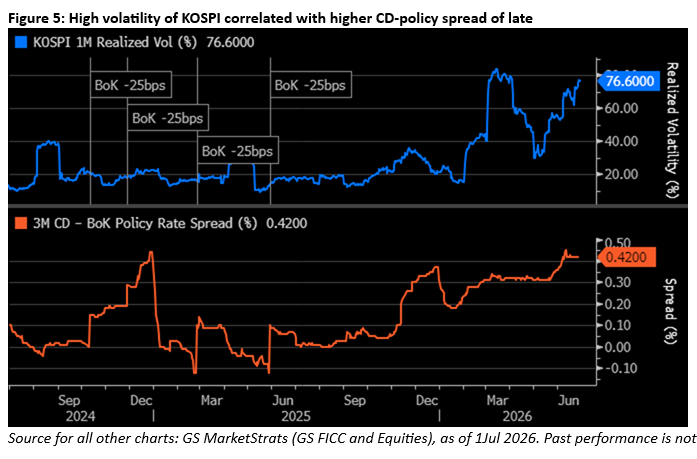
Leverage in South Korean chip stocks is out of control:
Single-stock leveraged and inverse ETFs tracking SK Hynix now hold ~$19 billion in total assets, more than 4 times the stock's average daily trading volume this year of ~$4.5 billion.
At the same time, Samsung has ~$12.4 billion in leveraged ETF assets, +176% above its ~$4.5 billion in average daily turnover.
Furthermore, the Hong Kong-listed 2x leveraged long SK Hynix ETF, which holds ~$13 billion in assets, is worth about twice the value of SK Hynix shares traded on an average day, the widest gap of any major stock with a leveraged ETF tracking it.
By comparison, Micron, $MU, has ~$9.9 billion in leveraged ETF assets, well below its ~$27.5 billion in average daily trading volume.
All while Tesla, $TSLA, and Nvidia, $NVDA, have leveraged ETF assets of ~$6.0 billion and ~$5.6 billion, both far smaller than their daily trading volumes of ~$23.6 billion and ~$28.8 billion, respectively.
Leverage concentration in Korean chip stocks is through the roof.
.@DavidSacks says Palantir CEO Alex Karp is brilliant and completely correct: companies must own their means of production if they don't want to transfer their alpha to OpenAI and Anthropic.
"Enterprises are at risk of transferring their knowledge, their know-how, their trade secrets and their customer data to model providers who might eventually decide to compete with them."
"Enterprises are waking up to this threat, and they're not happy about it. I think Karp is exactly right about that."
"What safety means for an enterprise is—they get to control their own data, their model weights and their compute, so a frontier lab can't hoover up their proprietary knowledge, their alpha, and turn it into their next product."
"Look at what happened to Figma. Anthropic 'blindsided' its then business partner with the launch of Claude Design."
" Anthropic's chief product officer even served on Figma's board and didn't resign until three days before the launch of Claude Design."
"This is not an isolated example."
"Anthropic has also launched Claude Science, Claude Security, Claude Legal, Claude Financial, and of course, Claude Code."
"Every single one of these vertical apps expanded into categories that was previously served by companies building on top of Anthropic's own models."
" They're watching where the value is being created on top of their models, then they're moving in directly."
"The pattern is clear. They are going to use their dominant position in the model to then grab more and more territory in any interesting and lucrative vertical."
" Back to Alex Karp's point: if you're an enterprise customer or a developer, why in the world would you ever want to share any proprietary data with them?"
"You are mortgaging your future. You're sealing your fate. You are going to lead to disaster for your company."
Via @theallinpod@jason@chamath@friedberg
Meta signed a 20 billion dollar compute deal in April and by June was quietly trying to sell the leftovers, and Dan Niles went on CNBC to explain why that flip means the AI building boom may have already peaked.
That timeline should stop you.
For two years, the whole AI bet ran on one idea: that nobody has enough compute, and everyone wants more, and the demand never ends.
Then Meta signed a 20 billion dollar deal in April. By June they were shopping the extra capacity to their rivals.
Niles explained what broke. Companies used to burn as many tokens as they could to look busy. Then they started cutting.
His example is the one that sticks.
Using the smartest model to summarize your emails is like driving a Ferrari to the corner store for milk. You do not need it.
Coinbase cut its AI spend in half while it used the tools more. Uber burned its whole budget in four months, then slashed it.
When the biggest spenders suddenly have compute to sell, the story cracks.
Everyone is still pricing these stocks like demand only climbs.
The people paying the bills just found the off switch.
@Dave32077615099@BullTheoryio investing cycles are getting shorter as information is faster and money supply is higher. Example 1920-30s people used newspaper. In late 1990s to 2000 people watched TV for the news as internet was still dialup in most places. Only until after 2008 did the smart phone age begin.
@StockMKTNewz This is really horror news as it screams Nvidia has more GPUs to sell than quality customers that it is giving them away in desperation. This is as bad as the Meta headline on excess compute.
US-hiring plans remain historically depressed:
US-based employers announced plans to add 10,933 jobs in June, marking a -44% decline from 19,536 in May.
Year-to-date, US hiring plans rose +10% YoY, to 91,405 workers.
This comes as technology sector hiring plans surged +167% YoY, to 14,761 workers.
However, excluding technology, hiring plans are down -1% YoY, to 76,644 workers.
The decline has been driven by entertainment and leisure hiring plans, which are down -57% YoY to 12,096 workers so far in 2026.
This also follows 5 consecutive years of declining hiring intentions, which fell -84% since 2020, to 508,000 for the full year 2025.
Hiring continues to weaken beneath the surface.
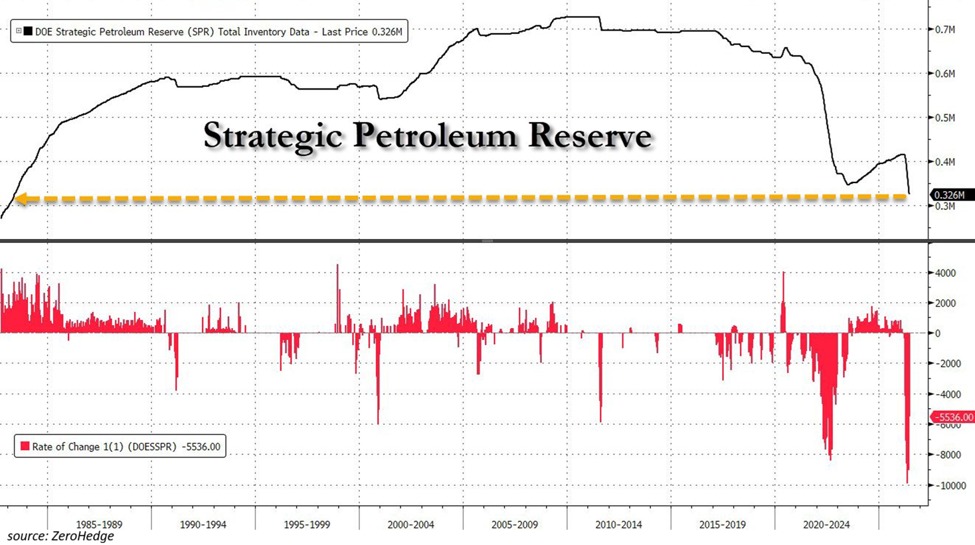
BREAKING: The Strategic Petroleum Reserve (SPR) fell -5.5 million barrels last week, to 326 million barrels, the lowest since May 1983.
This marks the 13th consecutive weekly decline, the longest streak since the 2021-2023 period, per Zerohedge.
Over this time period, US oil reserves in the SPR have fallen -89 million barrels.
This represents 51.7% of the planned 172 million barrels to be released under a relief program coordinated by the IEA to lower energy costs.
By comparison, the US added +69 million barrels of oil to the SPR between July 2023 and March 2026.
US oil reserves are being depleted at a historic pace.
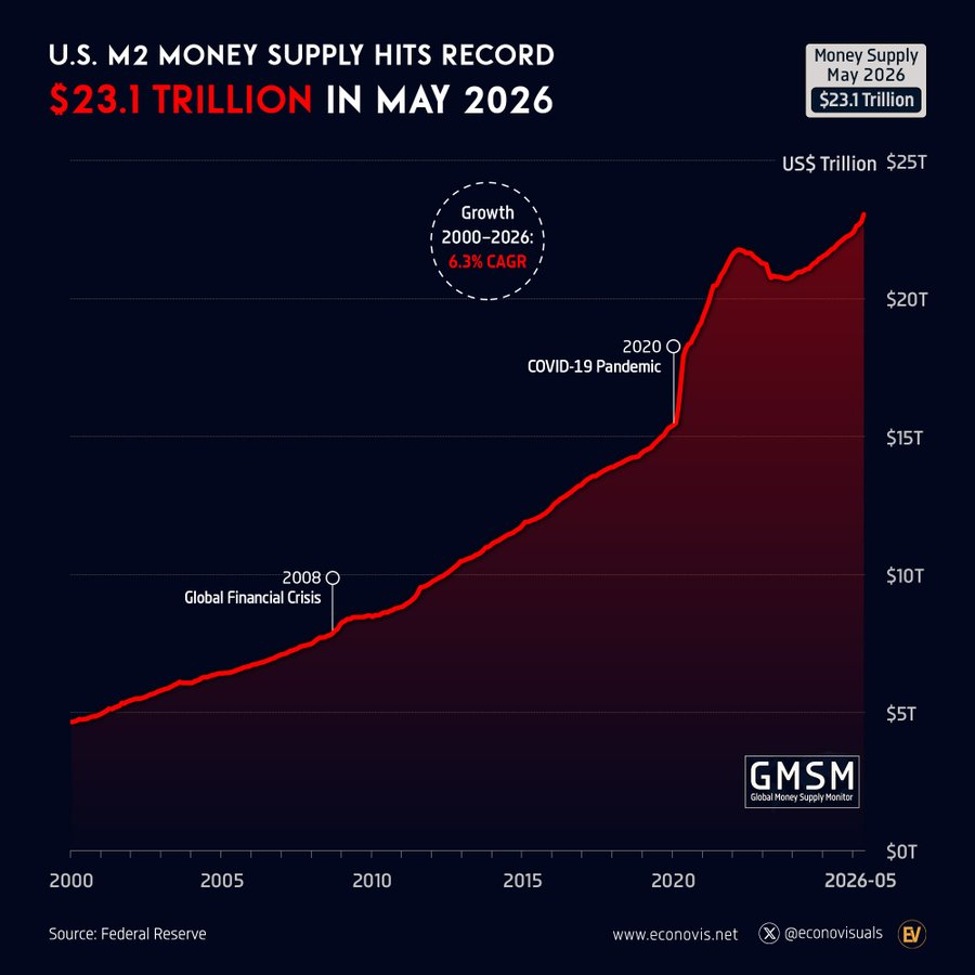
BREAKING: US M2 money supply surged +$247.8 billion in May, to a record $23.1 trillion.
This marks the largest monthly increase since May 2021.
Year-to-date, M2 has soared +$698.6 billion, the largest January to May increase in 5 years.
Money supply now stands $1.3 trillion above the March 2022 peak.
Since 2000, money in circulation has grown at an average annual rate of +6.3%.
US money creation is accelerating.
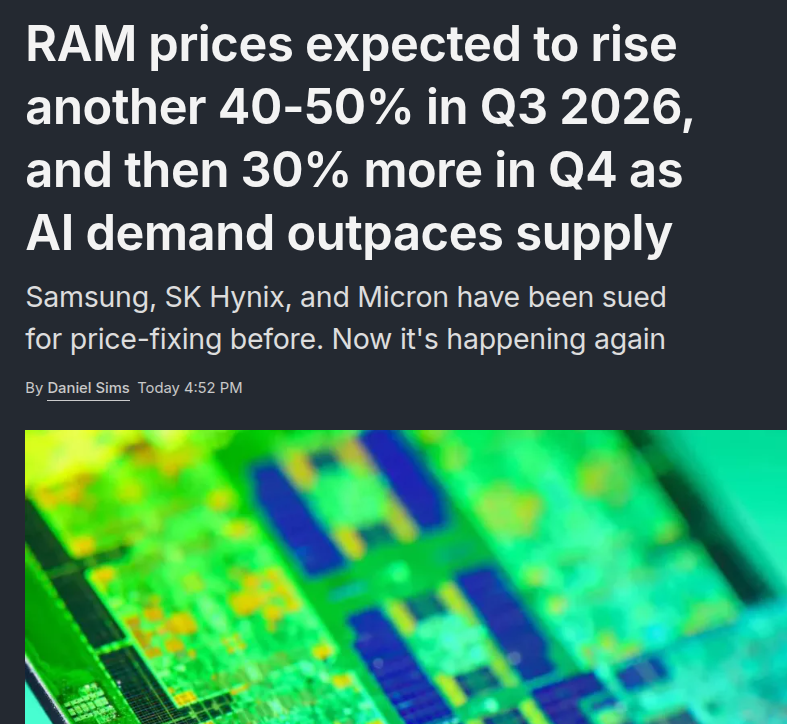
RAM prices now expected to jump another 40% to 50% as a lawsuit accuses Samsung, SK Hynix, and Micron of turning scarcity into market power.
Jefferies Research was told by memory consultant Ethan Tan that prices may rise 40% to 50% in Q3-26, then 30% to 40% in Q4-26, with relief unlikely before 2028.
DRAM feeds active computation, NAND feeds storage, so AI servers, laptops, phones, and consoles compete for the same scarce factory base.
HBM, stacked DRAM for AI accelerators, carries higher margins than consumer RAM, so manufacturers can shift capacity away from PCs without opening a new fab.
The California complaint says the 3 firms control about 90% of global DRAM and coordinated a move toward HBM while choking DDR3 and DDR4 supply.
The legal test will be proof of agreement, since the prior DRAM class action failed when judges saw parallel conduct rather than an illegal deal.
The industry history makes the allegation harder to shrug off, because DOJ said Samsung paid $300M and Hynix paid $185M in earlier DRAM price-fixing cases.
---
techspot. com/news/112934-ram-prices-expected-rise-another-40-50-q3.html