A combination of Tesla and Spacex will likely be a non-taxable event. Assuming you bought in 2020 before the run-up in Tesla stock price you have stock gains now. It makes no sense for you to sell now unless you don’t want either stock in your portfolio. Sit on your Tesla stock their board is in the driver’s seat to secure a premium at closing since the shareholders control the majority of the Tesla stock unlike SpaceX where Elon controls the vote.
I've decided not to sell any of $TSLA shares to buy $SPCX shares. My thesis was when I went ALL IN on Tesla stock was because of FSD & Robotaxis and although they have achieved that, they are nowhere near mass adoption or maturity yet. THIS is where I strongly believe it will move the needle. When? No later than 2030 which goes into my next point.
I made a commitment to myself in 2020 that investing in Tesla is at least a 10 year investment. I promised myself that I will not sell a single share unless 2 things happen:
1. 10X ROI.
2. Fundamental changes.
10X did not happen (after 2021) and my initial investment hasn't changed. In fact it's coming to life. It would be really dumb to sell now. On top of that, I feel like Tesla shareholders are going to get a nice deal with this merger. It's not guaranteed but with the effort being put into place and committees being made to discuss, it's hard not to believe something good is going to come out of it.
Even if by some chance the merger doesn't happen, I will not sell $TSLA to buy $SPCX. I will use fresh funds to build my SpaceX position.
So yeah, I guess I'm not longer ALL IN Tesla investor.
@valuetainment $299 a month is $3,588 a year. Eight years of that is about $28,700, nearly the $29,990 price, and the car doesn't move if you stop paying.
@firesidealpha If the five directors are still hashing out terms, what makes a year-end close realistic? More realistic is a year-end announcement followed by a long regulatory review and eventual vote.
@CuriousPejjy Worth watching how the vote is counted. Merger approval is usually measured against all outstanding shares, so a shareholder who doesn't vote counts like a no.
$3.5 trillion. That's the reported size of a Tesla-SpaceX all-stock merger, with five independent directors now running the talks.
For shareholders, all-stock is the friendly version tax-wise. If the deal qualifies as a tax-free reorganization, nobody owes tax at closing just because their shares get swapped.
Your original cost basis and holding period carry over into the new shares. The tax waits until you actually sell.
Two catches: any cash paid as part of the deal is taxable, and so is cash in lieu of fractional shares, usually a small amount.
The number to watch is the exchange ratio. That's where those five directors can change the value for each side and make it a deal to good to pass up.
29%. That's how much Nvidia jumped this morning after the board reinstated Jensen Huang as CEO.
Here's the math most people miss: the stock fell about 33% after Nov 8. A 33% drop needs about a 49% gain just to get back to even.
So today's jump is huge, but the hole isn't filled yet.
One person's job status moved a giant company's value by a third in two weeks. That's key-person risk, and the market just priced it twice.
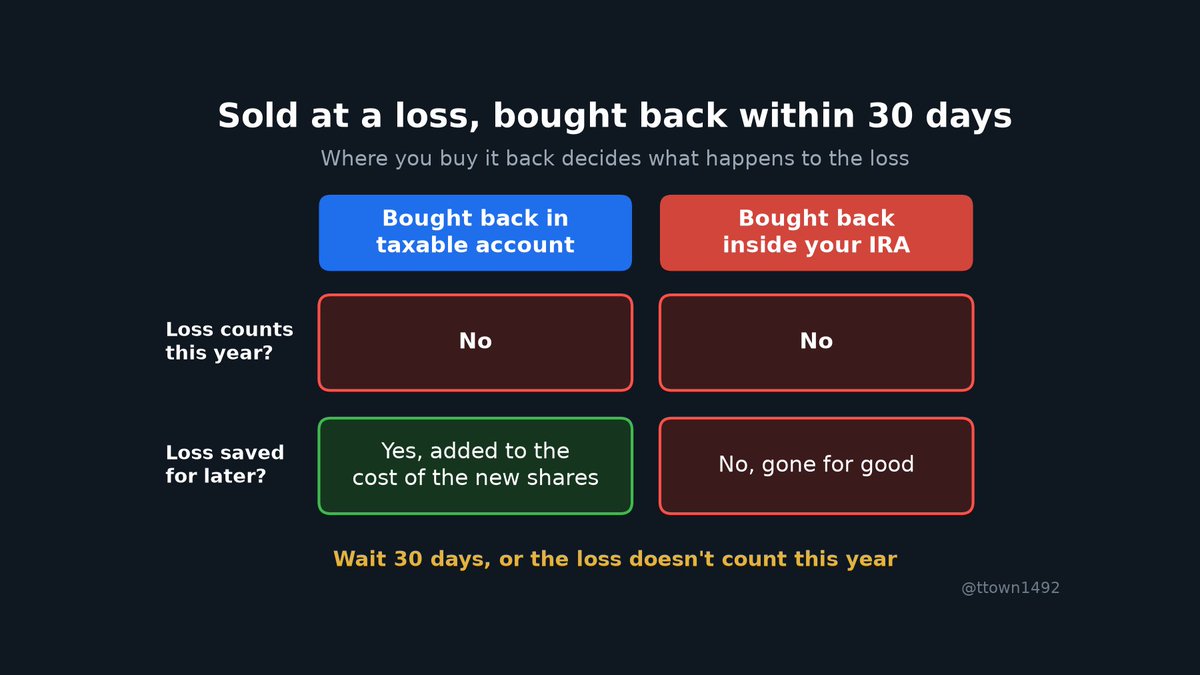
30 days. That's how long you have to wait to buy back a stock you sold at a loss, or the loss doesn't count this year.
With futures bouncing hard this morning, the urge to jump back in is real.
Buy it back early in your taxable account and the loss isn't lost, just pushed down the road. It gets added to the cost of the new shares.
Buy it back inside your IRA and the loss is gone for good. No cost-basis add, no second chance.
Rebound days are when this trap catches the most people.
$3,000. That's the most of a net capital loss you can deduct against wages or other ordinary income in a year.
Friday pushed the S&P 500 into a correction, more than 10% off its October high, and Nvidia is down 46% in seven weeks. Plenty of people are sitting on their first big losses.
Losses cancel gains first, dollar for dollar, with no cap. Only the leftover runs into the $3,000 limit. The rest carries forward with no expiration date.
So a $45,000 net loss with no gains to absorb it takes 15 years to work through. And losses still unused at death don't pass to your heirs.
Are you sitting on more losses than gains this year?
@IanSHoover Good angle. Dollar for dollar, a permanent buydown usually cuts the monthly payment more than a price drop, while a lower price shrinks your balance right away if you sell or refinance early. Which way do you see buyers leaning right now?
$137 a month.
That's what another half point does to the payment on a $400,000, 30-year mortgage: $2,756 at 7.35% becomes $2,893 at 7.85%. Over the life of the loan, that's about $49,500.
Fed Governor Waller said this morning the Fed should consider a 50 basis point hike in December. Mortgage rates already hit 7.35% last week.
The Fed doesn't set mortgage rates directly. They track the 10-year Treasury, which moves on what the Fed signals, not just what it does.
Is the housing market already pricing in the hike?
@wallstengine Anthropic sold about 956M of those shares itself. At the open that's $28.50 a share, roughly $27B that went to IPO buyers instead of the company. Smart pricing or the costliest check it'll ever write?
Update: ANT opened at $111.50, not $104. That's $28.50 a share above the $83 IPO price. 956 million x $28.50 = about $27 billion left on the table, $7 billion more than the estimate above.
$20 billion.
That's roughly what Anthropic leaves on the table if ANT opens where side markets point this morning, around $104 vs. the $83 IPO price.
Anthropic itself sold about 956 million of the 980 million shares. $21 a share x 956 million = about $20 billion that goes to IPO buyers instead of the company.
And it never shows up as a cost. No line on the income statement. The underwriting fee gets disclosed in the prospectus. The pop doesn't.
Is a 25% first-day pop a win for Anthropic, or the most expensive check it will ever write?
@tradertvshawn The $81.3 billion is the public offering. A separate $26 billion Class N placement brings the total to about $107 billion, still with no general vote.