@patrickc Tetrahedrons are the "simplest" 3D shape. If you want complex/robust 3D structures, you reach for tetrahedrons. (If you look at GaAs, it's still in some sense tetrahedral even if more complicated)
The best IT security practices, brought to you by @CalFTB. I especially loved waiting 20 seconds each page load for the @Akamai bot checks, and I'm excited I can seem them again when I have to rotate my password 🫶
I don't understand how companies like @NaviaBenefits can mishandle private info including my toddlers SSN (baby's first data breach 🙃) and get off with a letter reminding us to check his credit. There should be statutory damages and perpetual liability for future identity theft.
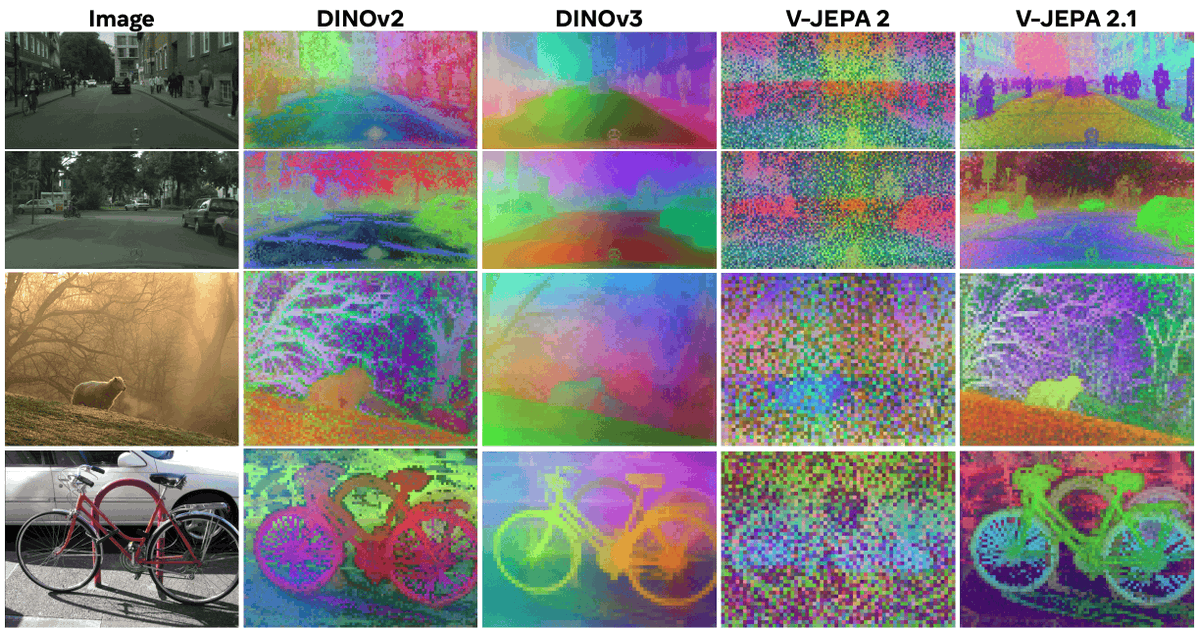
Thread on VJEPA 2.1🤟
This DEFINITELY flew under the radar: just a few days ago, @AIatMeta released V-JEPA 2.1, taking a massive step toward closing the gap between image and video domains.
For a long time, image backbones were the only option for solving dense vision tasks. This model disagrees, showing that universal spatial understanding also emerges from large-scale video models!🎥
@ziv_ravid Did you read the blog post? They assigned reviewers to 2 groups (based on reviewer preference even!) and only those in group A could not. The detection they did was not sophisticated and based on prompt injections in the manuscripts and humans verified the results.
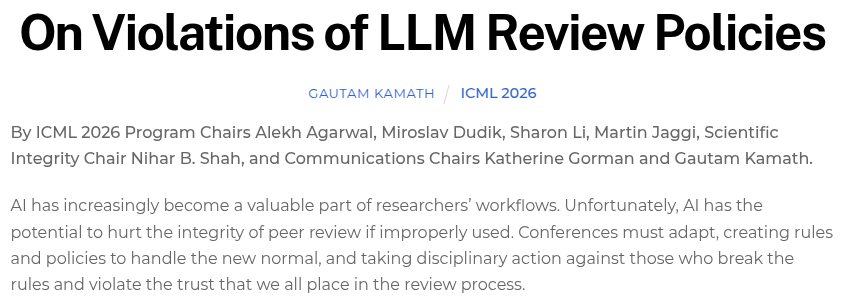
To ensure compliance w peer-review policies, ICML has removed 795 reviews (1% of total) by reviewers who used LLMs when they explicitly agreed to not. Consequently, 497 papers (2% of all submissions) of these (reciprocal) reviewers have been desk rejected
Details in blog post 👇
@SebastienBubeck@maxwellfarrens I agree with the first sentence of the quote, as do most people I assume, but surely that is orthogonal to whether or not you can force a company to go along with that decision and I don't think the quoted tweet engages with this point in good faith.
@Scott_Wiener@WIRED "The difficulty with this particular rumor is that, while I was unable to substantiate darker allegations, parts of the story still resonate."
I heard a rumor that Wired actually practiced journalism but I wasn't able to substantiate that rumor either 🙄
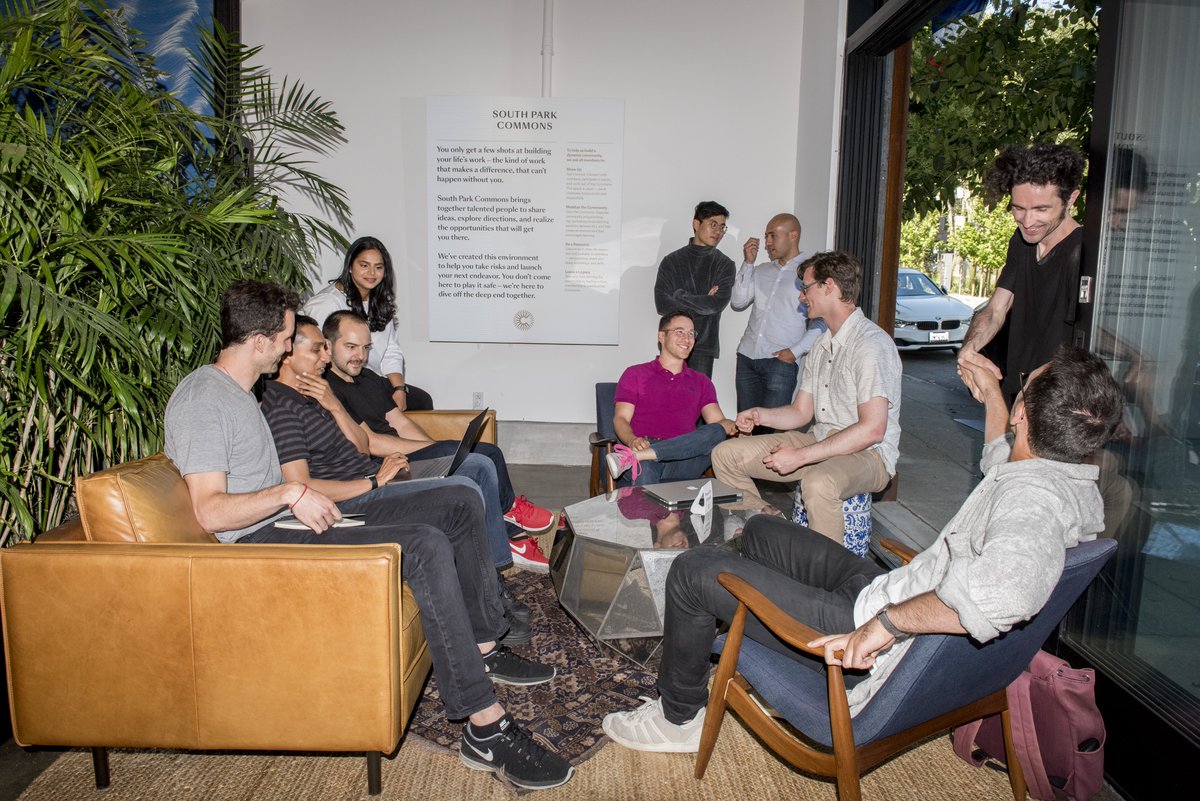
10 years ago, there were 10 people around my kitchen table. No structure, no brand, no certainty. Just a handful of builders showing up for something that yet didn’t exist.
Since then @southpkcommons has grown to over a 1000 members. Today, 25,000 people apply to SPC every year. We have offices in SF, NYC, and Bangalore.
But SPC isn’t about the numbers, it’s about the people and what emerges when they choose to show up for each other.
It looks like @anuraggoel, already successful and credible, showing up with generosity, helping others, sharing work, iterating in public. Patterns sharpened and @render was born.
It looks like @thejamescad and @dbabbs, who met at SPC to become cofounders building @tryprofound. One of the superpowers of SPC is the collision rate—not the shallow kind, but the kind that only happens when people keep showing up long enough to build trust.
It looks like @MaximilianMona, who moved out to California in an RV to be at SPC and eventually build Ironsite. That’s someone saying, with their whole life: this matters.
And it looks like @AshtonJEaton, an Olympic gold medalist, walking into SPC not for a career pivot, but for a deeper reinvention. To trade mastery for learning. Not for optics. For truth.
SPC has been designed by the community and for the community, with one goal that hasn’t changed: pay it forward. We’ve helped normalize taking time to find truly meaningful work, whatever shape that might take.
So on this ten-year anniversary, I want to thank the people who made SPC what it is.
The ones who showed up when they didn’t have a narrative.
The ones who lived in the question — and lingered in uncertainty for long enough to find out.
The ones who came back, again and again, for the work and for each other.
Happy ten years, SPC. Thank you for showing up!
Have you ever done a dense grid search over neural network hyperparameters? Like a *really dense* grid search? It looks like this (!!). Blueish colors correspond to hyperparameters for which training converges, redish colors to hyperparameters for which training diverges.
On full body MRIs:
I’ve read this article before and it is not what I would consider “good”
Most of the studies he cited were very poorly done and can not be extrapolated at all
Most of the arguments are around logistics and potential fear with some random stats on complications
Everyone is missing the point. I’ve gotten over a hundred of these scans on patients. Not ONCE have we subjected them to something unnecessary based on the findings. It was a delicate and detailed discussion about risks, benefits, alternatives, how we would cautiously wait and watch in a structured way.
On the other side, I’ve caught at least 4 early stage cancers in young people who would’ve never been screened (caught at stage 1 and dealt with), diagnosed years long MSK issues, see early white matter changes that lead to altered cognitive plan, etc etc. Most importantly, I’ve been able to give people piece of mind that nothing huge is underlying (with the caveat we don’t see everything).
If it’s about resources and logistics, that’s one thing. If it’s about causing widespread HARM, i just don’t see the data supports that. Why wouldn’t we make the same argument about ALL screening like colonoscopies as well?
All of these arguments come down to TIME and TRUST more than anything. If you give your patient time to explain everything, and have a relationship built on trust, then you don’t go spiraling down these pathways, you are informed and empowered by data to make real actionable change in their lives.
Also, just to say it, I should be able to get whatever the fuck test I want. The medical establishment has this patriarchal almost priest-like quality of believing only WE can decipher the truth for the plebs. It’s exhausting.
And lastly - technology will never stop advancing, it never has and never will. In the next decade, full body MRIs (or some other comprehensive diagnostic) will become so good and so affordable (say $100 each) that it will just be a yearly thing we all do. The science and technology WILL get there, as it always does. But this is the necessary rubicon we must pass. We have to go through this awkward messy phase before we break down paradigms and create a new standard of care.
Ok, end rant. And no this post was not sponsored by @prenuvo But you’re welcome @andrewlacy 😀