I recently started a lil research group in the Department of Laboratory Medicine, Karolinska Institutet 🧬🥼Please stay tuned for imminent open phage positions on https://t.co/bFS6MiYX7z 🤝👯♀️
New preprint 🧬
We modelled defense & anti-defense gene turnover in Enterobacteriaceae genomes and found that turnover of DEFs and anti-DEFs is evolutionarily coupled across lineages
1/ Even bacterial communities can get caught in a bad romance they just can't get over.
A brief encounter with antibiotics can leave a lasting ecological memory of resistance plasmids persisting for weeks after the drug is gone. @DukeBiodesign@DukeUBME
https://t.co/3ONZLErPiu
When Pseudomonas is attacked, it strikes back!
Outer membrane damage triggers a tit-for-tat T6SS retaliation via TagQ/TagR protein complex assembly, activating the PpkA kinase.
Congrats to Maxim & team for uncovering this fascinating mechanism!
https://t.co/ouK2bah0Zj
Humans and bacteria share strategies to defend against viruses.
We wondered: could they use each other's genes? Yes, both can!
Bacteria can use human immune genes to defend against phages AND
Human cells can use bacterial genes for viral defense.
https://t.co/PzZIHFKgfA
Excited to share a preprint from my postdoc work in @seth_shipman’s lab!
We developed Detectrons — programmable biosensors that convert RNA signals into stable DNA barcodes inside living cells, enabling multiplexed RNA sensing. 🧵👇
https://t.co/85kxjiEyo8
Eugene Koonin @AudeBer discuss why some bacterial immune systems have no counterparts in eukaryotes, whereas a small subset of comparatively rare systems was co-opted as key elements of eukaryotic innate immunity 🦠🛡️🧍🏽♀️
🚨New preprint out!
We present a foundational genomic resource of human gut microbiome viruses. It delivers high-quality, deeply curated data spanning taxonomy, predicted hosts, structures, and functions, providing a reference for gut virome research (1/8) https://t.co/BejXcSxauc
What if we could use precision #microbiome editing in vivo to turn harmful gut microbes into allies against disease? We did it using #CRISPR Transposon & mobilome engineering. With @harriswangnyc and Tyler Perdue. In @natBME
👉 https://t.co/CbMkQH8FF7
👉 https://t.co/fY0pREBBUe
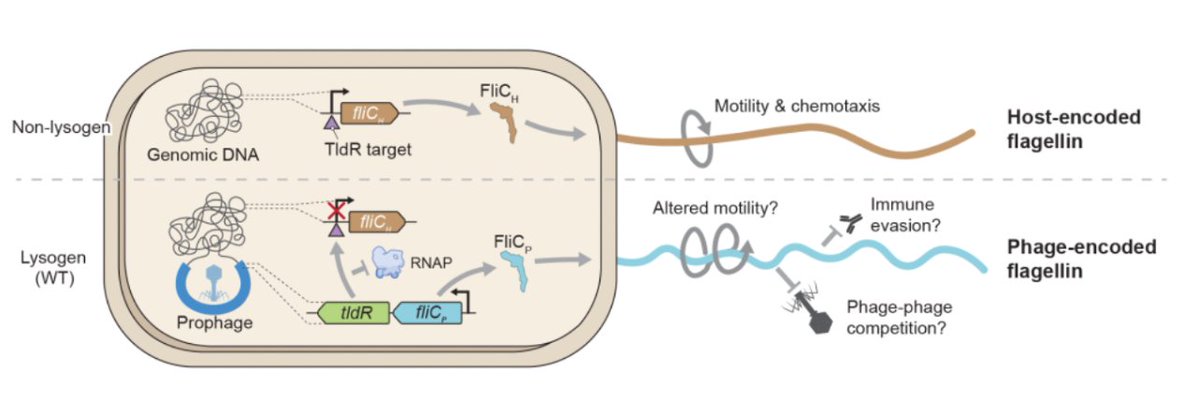
1/16 New pre-print from the Sternberg Lab!
We uncover how temperate phages can use RNA-guided transcription factors to remodel the flagellar composition of their bacterial host and enhance their fitness. Find the preprint and full story here: https://t.co/rh4PoOWn9l
Our @MolecularCell Spotlight on the Hailong anti-phage system from the Kranzusch lab!
This defense uses "ssDNA tripwires" to trigger toxic ion channels 🧬⚡☠️
Fun write with Johannes Kühn!!
🧫 Save the Date!
We’re excited to announce an upcoming scientific seminar organised by our Early Career Team, with a spotlight on host–microbe crosstalk. Join us for a day of cutting-edge insights, discussion, and networking! Registration is open now - https://t.co/D6RtpvHmgA
OPEN CALL for PhD positions in our lab through the @semm_it program:
1️⃣ Microbiome signatures of early on-set colorectal cancer
2️⃣ High-resolution computational metagenomics for the study of human microbiome transmission
More info: https://t.co/9Bg79EvOvX
Apply by June 9!
📣Free event about #microbes👏
#Ecology & Cocktails: Without microbes, animals can't do much🦠
By Professor Tom Gilbert followed by an ecology open #mic night🎤 and an interactive #art activity!
May 15 at 18-24 @HusetKBH
Read more 👇
https://t.co/3ycET9n1Yf
@GrundforskFond
Our new preprint, "Spatial constraints drive amylosome-mediated resistant starch degradation by Ruminococcus bromii in the human colon" is now on bioRxiv! Key findings in the thread below below https://t.co/kg8pETnEGh.