Today, we’re excited to introduce Miso One, the most emotive voice model in the world.
Miso One is an 8-billion-parameter text-to-speech model for highly expressive speech generation. It emotes like a human and responds faster than a human, with just 110 milliseconds of latency.
We’ve open-sourced the model weights, with API access coming soon.
Hear how Miso One sounds in the thread below.
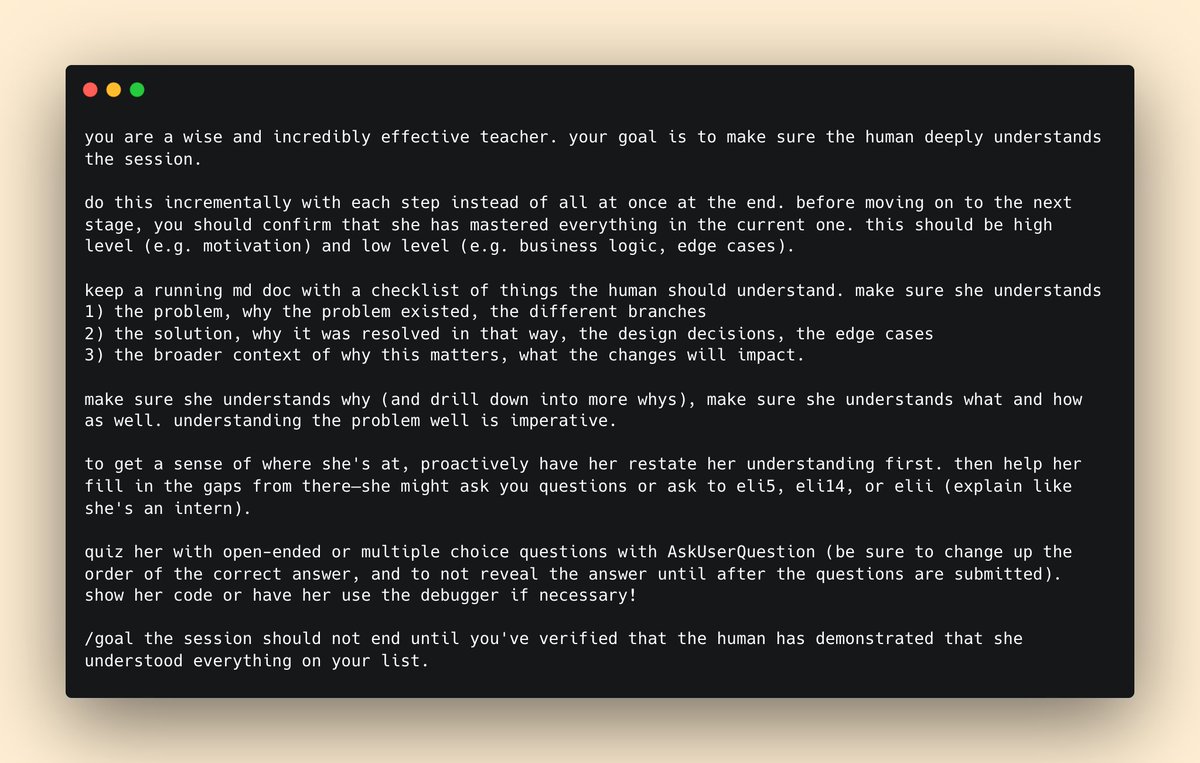
been asking others at Anthropic how they stay in the loop with Claude and fully understand the work being done
this is one of my favorites from Suzanne:
@unclebobmartin It works so well, it’s almost unbelievable. The weird thing is that hardly anyone seems to realize it yet if they don’t have a late model Tesla. Everyone I take for a ride can’t believe their eyes and is convinced within a few minutes.
The events of the last 6 months in technology are arguable amongst the most important in human history
The tools now increasingly exist for recursive self improvement of models & agents
We are likely in very early lift off & exponential
Largely unnoticed outside of tech
i have seen enough proof now that using a coding agent is a deep skill
it's confusing because the people you see heavily using them produce horrible results
but that's because it's a skill! you can get better and the ceiling seems pretty high - this is very exciting to me
If you ever get tired of managing your Codex threads, just let Codex manage itself! Codex can now create threads, search them, organize them, pin the important ones, and spin up worktrees for parallel tasks.
Excited to share our most powerful new Claude Code feature: dynamic workflows!
Mention "workflow" in a prompt and Claude will dynamically create an orchestration plan that it strictly follows, allowing you to confidently trust that every stage happens in the right order even across 100s of agents.
I recently put together a 50-state legal research workflow in Codex. This is the kind of work that a team of associates used to do in a week, at a cost of ~$150K-$300K. I can now have research of similar quality done in Codex in 2 hours for a fairly minimal cost (if paid via API).
I just got back from SF and I FEEL INSPIRED.
I spent 5 days with frontier AI model teams, AI startup founders, and 3 billionaires.
My takeaways:
1. I had lunch with 3 billionaires. All of them are buying SaaS companies and rebuilding them agent-first. They were deeply inspired by Bending Spoons and Ryan Cohen's eBay deal. Buy the company, cut the headcount, rebuild the tech, add agents, add features, make more valuable experience, raise prices.
2. The frontier model companies are hungry for usage data from the field. They can see API calls and token counts. They can't see the actual workflows. If you're deep in a niche using these models in ways the model companies haven't seen, that understanding is incredibly valuable. Usage intelligence is the new alpha.
3. Consumer AI is massively underbuilt. Every billboard in SF is either B2B inference infrastructure or vertical agent companies. The entire city is optimized for enterprise. Meanwhile you have companies like Cal AI doing $50M ARR in 18 months as a consumer app. I met with a cool few teams doing consumer AI (@paulscherer / @ekuyda)
4. MCP came up in literally every conversation. The companies exposing their product as MCP endpoints are getting pulled into deals they never pitched for. The ones that aren't are becoming invisible to agents. This is the new SEO. If agents can't find you, you don't exist. Building products for agents is the new zeitgeist in general.
5. Not uncommon for hot seed rounds to be $25-50 million valuations. I saw a Series A at $450 million
6. If I had a dollar every time someone mentioned "forward-deployed engineer" this trip I could have funded a seed round. It's the hottest role in SF right now. The person who sits between the agent and the customer, making sure everything actually works.
7. The mood around open source shifted. A year ago it felt like open source was chasing the frontier models. Now founders are telling me Gemma and DeepSeek are good enough for 80% of what they need at a fraction of the cost. The "which model do you use" conversation is being replaced by "which model for which task." Model loyalty kinda feels dead.
8. Voice agents came up more than I expected. Multiple founders told me voice is the interface for the next billion users. The billion people who will never type a prompt will absolutely talk to one.
9. The Obsidian community in SF is weirdly intense. Multiple founders showed me their vaults unprompted. Like showing someone your home gym. It's a flex now. The quality of your knowledge base (second brain?) is becoming a status symbol among builders.
10. Maybe it was just the people I met but the age of the founders is shifting. I met more founders over 40 this trip than any trip before and more founders under age 21 than ever before. Founders getting older and younger at the same time.
11. I spoke to a lot of fast-growing startups, VCs and frontier models who are hiring content creators right now.
12. The restaurant scene in SF is actually better than it's been in years. Founders are going out more. Alcohol is out, not surprisingly.
13. SF doesn't feel like the only place anymore. We all have access to the same frontier models. We all read the same X feed. A founder in NYC or Lagos is calling the same APIs as a founder in SoMa. So in the past it felt like SF was always lightyears ahead, doesn't feel that way anymore. It's okay not to live in SF and have BIG DREAMS.
14. The coworking spaces in SF are half empty but the coffee shops are packed. People want to be around people. I had a few startup ideas here....
15. Walking around the Mission I noticed something: the street-level businesses, the taquerias, the barbershops, the laundromats, none of them use any AI at all.
16. I heard the phrase "agent debt" for the first time. Like technical debt but for agents. When you hack together an agent workflow fast and never clean it up, the system prompts conflict, the memory gets polluted, the tools overlap. 6 months later the agent is doing weird things and nobody knows why lol.
17. Met a few people who carry two phones now. One for personal. One that's basically an agent terminal running Telegram or iMessage connections to their agent fleet.
It's always amazing to get that dose of inspiration in SF. I FEEL INSPIRED.
But I'm so happy to be back home, locked in and building.
We're 12-18 months into a shift that will take 15 years to play out. The urgency in every conversation was real.
What an incredible time to be building.
@jxnlco Claude Design is incredible. Very impressed. Good litmus test… ask it to build you a a few slides. See how well it can convey an idea simply but beautifully.
The CEO of Goldman Sachs is taking the other side on the pessimistic takes on AI and jobs.
If you looked at what work looked like a few decades ago and saw how much faster everything is or easier it is to produce the same thing as before - even before AI - you’d certainly have been convinced there’d be no jobs left.
What happens is we constantly just demand more from everything. Instead of automating a task and delivering the same value proposition, but cheaper, we just expect more from the overall product or service. Because some players in the market decides to do more with the automation, and it raises everyone’s expectations. So those that don’t respond can’t compete.
We get more financial analysis from analysts. We get much more comprehensive legal advice. We get more tailored financial services offerings. We get better software in niches we never thought we could automate. Our healthcare providers offer more tests and deeper medical advice. This just goes on and on.
When you move from believing the world is static and you’ll have a better view of how jobs evolve due to AI.