This is the burial site of Leonard Matlovich. Following three deployments in Vietnam, Matlovich earned both the Bronze Star and Purple Heart. On March 6, 1975, after a dozen years of service, he handed a letter to his commanding officer, disclosing his homosexuality. Despite his commendable achievements and outstanding military record, Matlovich was declared unfit for service and promptly discharged. He initiated a legal battle to regain his position, swiftly becoming a prominent figure in the gay rights movement during a period when LGBT advocacy was still striving for recognition in the United States.
Here's an excerpt from Matlovich's conversation with Studs Terkel, just a few months following his discharge:
"My philosophy now is that everyone in the world should be allowed to do what they want, when they want, where they want to do it, as long as what they're doing does not violate the rights of another human being.”
"What two consenting adults do in their bedroom is their business and no one else's. And for someone to put them down or... Just that two men can touch and love and have feelings of to want and be wanted and to need and be needed and to desire and be desired and just to love and be loved, I think is very, very beautiful. And that parents growing up today will give our little children guns, and we are very proud of them when they play Cowboys and Indians and run around. But when they show emotions and, and love, and two little boys touch, people get uptight, and they're so afraid that their child may, may love. It's very sad."
Deeply concerned about the arrest of lawyer and human rights activist Imaan Mazari. Such actions undermine the principles of justice and free speech.
#SaveImaanMazari
Galileo Galilei on the language of Mathematics 💭
Philosophy is written in that great book which ever lies before our eyes — I mean the universe — but we cannot understand it if we do not first learn the language and grasp the symbols, in which it is written. This book is written in the mathematical language, and the symbols are triangles, circles and other geometrical figures, without whose help it is impossible to comprehend a single word of it; without which one wanders in vain through a dark labyrinth.
-- as mentioned in The Assayer (1623)
The ultimate purpose of education is to change an empty mind into an open one. If you wanna be a good teacher, teach open-mindedness, teach enthusiasm, inquisitiveness, heuristics, and values. ~R.Feynmann
Five productivity Feynman strategies:
i) Stop trying to know-it-all.
ii) Do what you get the most pleasure from.
iii) Don't worry about what others are thinking.
iv) Have a sense of humor and talk honestly.
v) Make mistakes and learn.
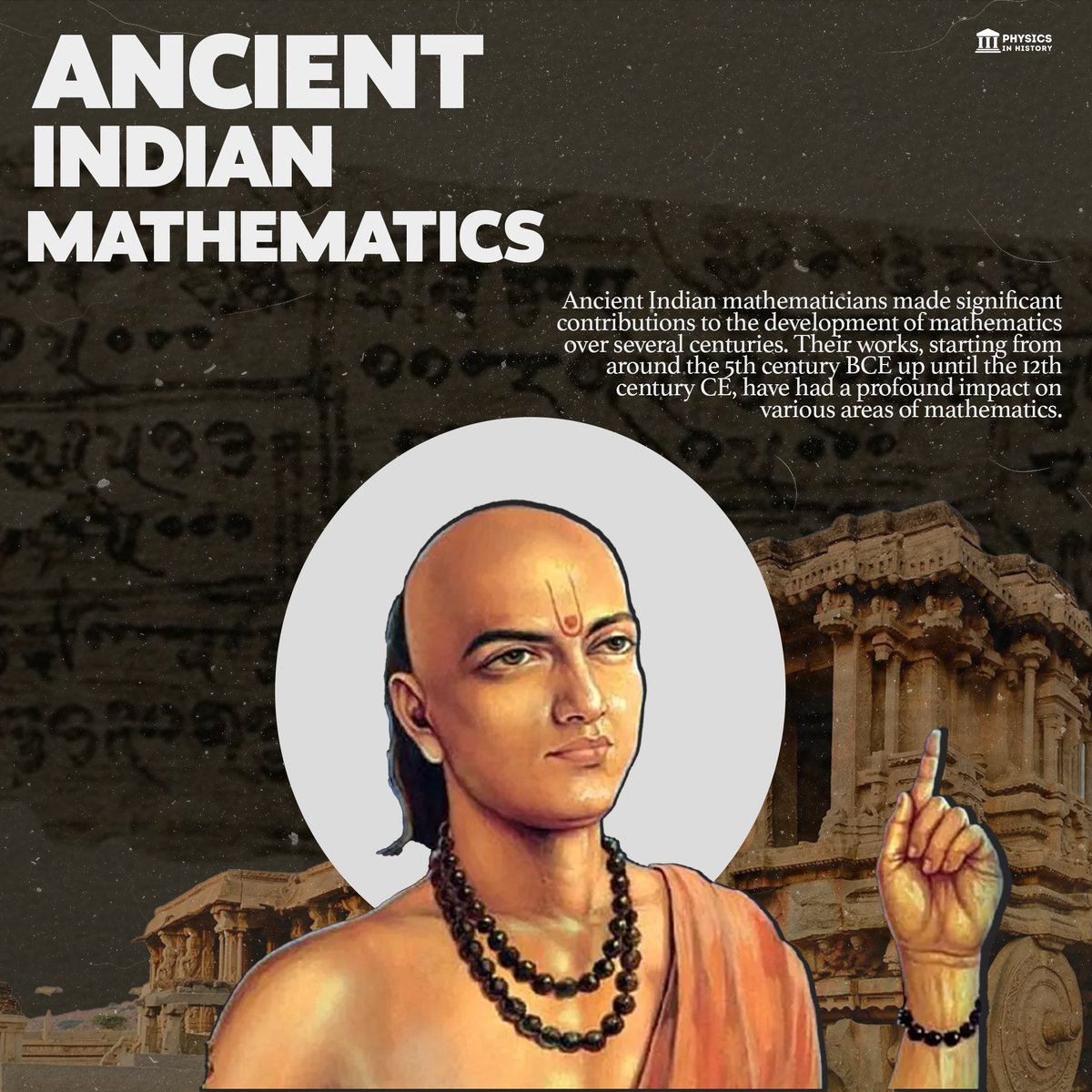
Ancient Indian Mathematics 📜
Ancient Indian mathematicians made groundbreaking contributions to the development of modern mathematics. They invented the decimal system and introduced zero as a placeholder, revolutionizing arithmetic. Algebra flourished with solutions to linear and quadratic equations. Trigonometry and trigonometric functions were developed, and π was approximated with remarkable accuracy. Remarkable Indian mathematicians who made these discoveries, such as Aryabhata, Brahmagupta, Bhaskara II, Madhava, and Ramanujan have left a lasting legacy of cultural influence and inspiration.
Vedic number words and geometry: The earliest traces of mathematical activity in India can be found in the Vedas, the ancient religious texts of Hinduism. The Vedas contain number words for large numbers, such as shankha (10¹⁷) and padma (10¹⁴), as well as geometric constructions for altars and fire rituals.
Decimal place-value system and zero: The Indians were among the first to develop a decimal place-value system for writing numbers, using symbols for nine digits and a dot or a small circle for zero. The earliest known inscription of this system dates from the 5th century CE, but it may have been used earlier in astronomical texts. The concept of zero as a number, as well as its algebraic and arithmetic properties, was also explored by Indian mathematicians.
Arithmetic and algebra: They developed various methods for performing arithmetic operations, such as addition, subtraction, multiplication, division, square roots, and cube roots. They also invented algorithms for finding solutions to linear and quadratic equations, as well as indeterminate equations of the form ax + by = c. Some of the notable mathematicians who contributed to this field were Aryabhata (5th century CE), Brahmagupta (7th century CE), Bhaskara II (12th century CE), and Mahavira (9th century CE).
Trigonometry: Ancient Indian mathematicians made significant advances in trigonometry, the study of the relations between angles and sides of triangles. They defined the six trigonometric functions (sine, cosine, tangent, cotangent, secant, and cosecant) and derived formulas for calculating their values for various angles. They also developed methods for finding the sines and cosines of multiple and submultiple angles, as well as the inverse trigonometric functions. Some of the prominent mathematicians who worked on trigonometry were Varahamihira (6th century CE), Aryabhata, Brahmagupta, Bhaskara II, and Madhava of Sangamagrama (14th century CE).
Calculus: They were pioneers in the development of calculus, the branch of mathematics that deals with rates of change, limits, infinite series, and integrals. They discovered many infinite series expansions for trigonometric functions, logarithms, and π, using techniques such as term-by-term differentiation and integration. They also applied calculus to problems in astronomy, geometry, and physics. Some of the remarkable mathematicians who contributed to calculus were Madhava, Nilakantha Somayaji (15th century CE), Jyesthadeva (16th century CE), and Srinivasa Ramanujan (19th-20th century CE).
Geometry, number theory, combinatorics, and the concept of infinity were also explored. Their work spread globally, influencing mathematics in other civilizations and laying the foundation for future discoveries, making ancient Indian mathematicians indispensable in the development of mathematics.
I chatted with Christopher Nolan about Oppenheimer last week - a film I think is superb cinematically but also important intellectually - I’ve been fascinated by Oppenheimer, particularly his post-war thought, for a long time. https://t.co/X4xc6LjoKk
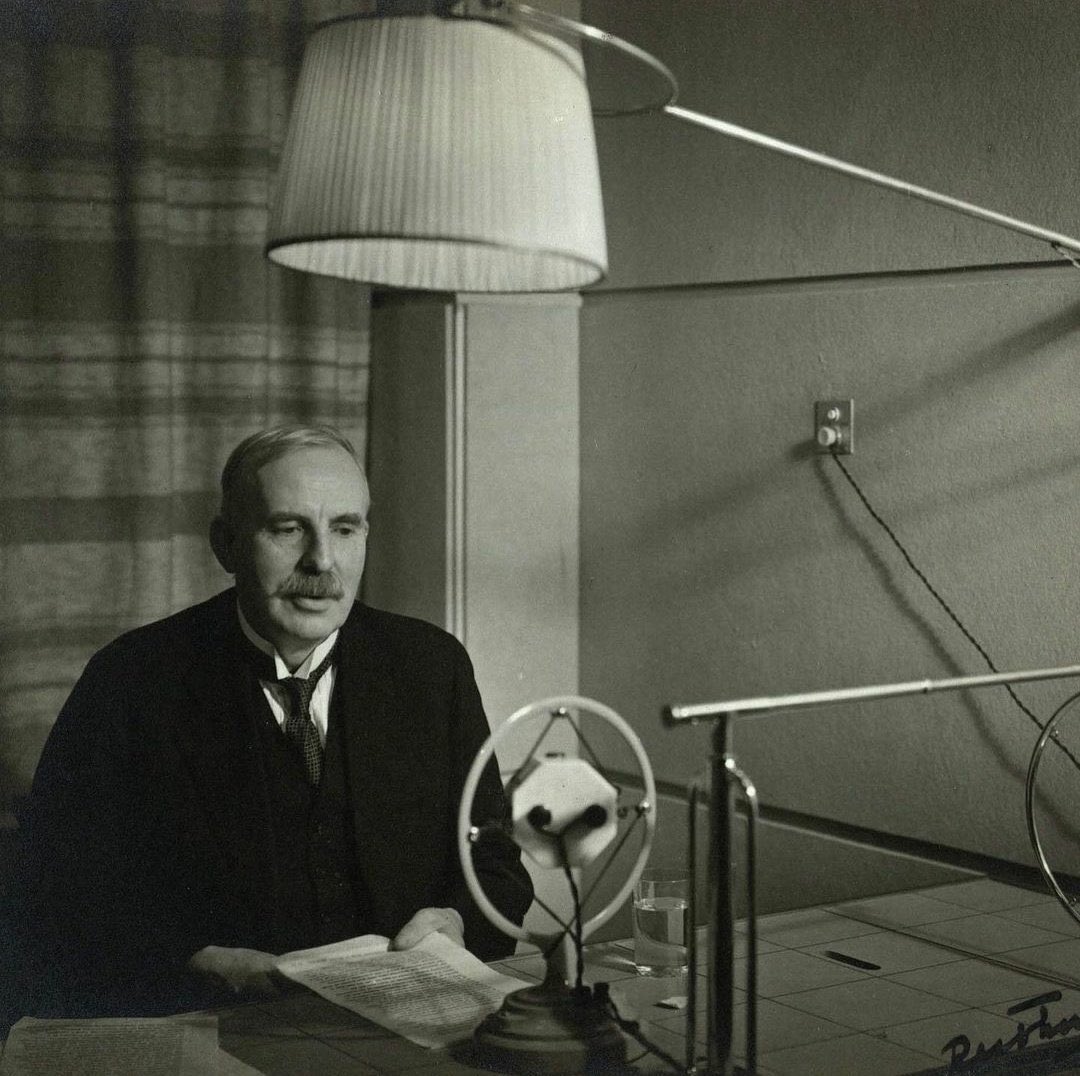
Rutherford postulated the nuclear structure of atoms, discovered α-rays and β- rays, and proposed the laws of radioactive decay. He received the 1908 Nobel Prize in Chemistry.
Happy 151st Birthday to Ernest Rutherford, the father of nuclear physics.
“We've arranged a society based on science and technology, in which nobody understands anything about science technology. And this combustible mixture of ignorance and power, sooner or later, is going to blow up in our faces.”
- Carl Sagan