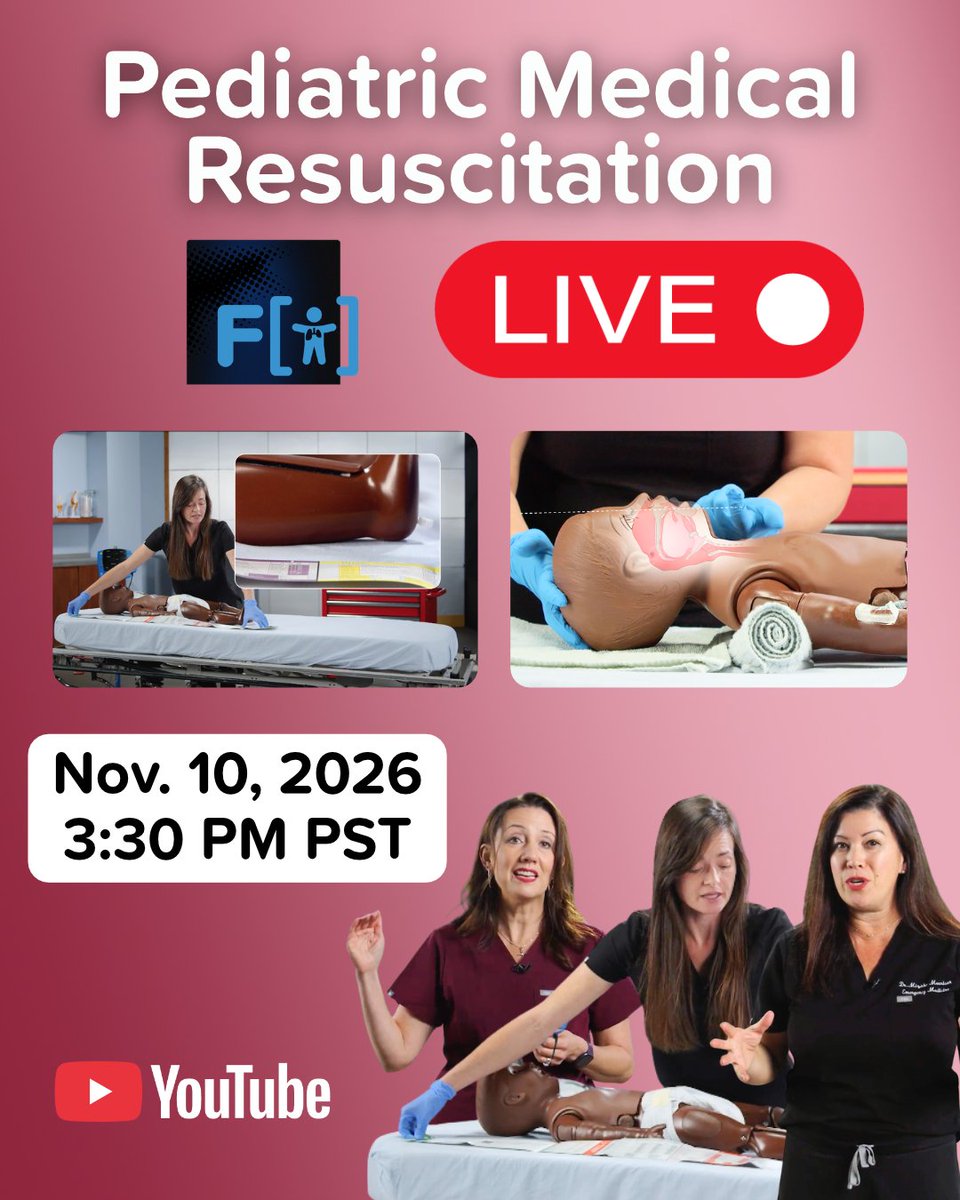
📅 Save the date: Tuesday, November 10th at 3:30 pm PST (Livesteaming on YouTube📺)
Join us live from the studio 🎥 with Miz, Britt, and PEM expert Dr. Emily Rose for a fast-paced and case-based session on pediatric medical resuscitation pearls 🩺👶
🚨 From the moment a sick kiddo hits the door to stabilization, we know every minute counts.
💡 Boost your pediatric medical resus skills + live Q&A 💬
#Pediatrics #Peds #PedsMedicalResus #Resusciation #PedsResus #EM #EMRAP #EmergencyMedicine #MedEd #Livestream
🫁 High-flow nasal oxygen in acute hypoxemic respiratory failure: does it really change outcomes?
The SOHO Trial, published in NEJM, randomized 1,116 patients with acute hypoxemic respiratory failure (PaO₂/FiO₂ ≤200, RR >25/min and pulmonary infiltrates) to high-flow nasal oxygen (HFNO) or standard oxygen therapy.
The results deserve attention:
🔹 28-day mortality: 14.6% vs 14.6% — no difference.
🔹 Intubation by day 28: 42.4% with HFNO vs 48.4% with standard oxygen — an absolute difference of ~6 percentage points.
For me, the clinical message is important: HFNO may help avoid intubation in some patients, but avoiding intubation is not synonymous with improving survival.
And this brings us back to physiology. In the ED, HFNO should not become a destination. It is a therapeutic trial that requires close and repeated reassessment of oxygenation, respiratory rate, work of breathing and clinical trajectory.
The real challenge is not simply deciding HFNO vs standard oxygen.
It is recognizing who is responding—and, crucially, when non-invasive support is failing and intubation should no longer be delayed.
📚 Frat JP et al. High-Flow or Standard Oxygen in Acute Hypoxemic Respiratory Failure. N Engl J Med. 2026;394:2095-2106. DOI: 10.1056/NEJMoa2516087.
@DiegoEscarraman@javier20ch@MarlonVFZR@DrCriticalCare@drkeithsiau@franciscojlk@Dr_Dive@dasairway@911EDiaz@SOMELaguna@SEmergencistas@SafeAirway@SMMEAC@IhabFathiSulima@Anaes_Journal@NEJM@anesthesianews@italo05airway@JackelineEstof1@OrlandoRPN
MAP is 62 in your septic pt. Do you escalate pressors, or check for perfusion first?
Rory Spiegel, MD (@EMNerd_) from ResusX:ReUnion:
Chasing a number without asking if organs are actually perfusing is the trap. What's guiding your resuscitation beyond MAP? Comment below.👇
"ARISE FLUIDS trial summarized into a paper in a pic by Dr. Challen. https://uploads.disquscdn.c..." — Ken Milne https://t.co/CdBwz9uzvY @KirstyChallen
Most consults go sideways before medicine is even discussed.
Three tips:
Don't apologize for calling.
Start with the question—not the past medical history.
Clear communication makes everyone's job easier.
What's your best consulting tip?
Today we remember Dr John Hinds #Delta7 - 11 years since his passing.
John was more than a colleague. He was a much-loved friend, an exceptional doctor, and an inspiration to so many across pre-hospital care and motorsport medicine.
His passion, skill, humour, and unwavering commitment to helping others left a mark that will never fade. The legacy he created continues to influence, motivate, and guide those who follow in his footsteps.
Thinking of John, his family, friends, colleagues, and everyone who had the privilege of knowing him.
Always remembered. Never forgotten.
#Delta7 #DrJohnHinds #AlwaysRemembered
EMCrit 428 - A Few Things
🔹 ARISE Fluids: Does the 30 mL/kg sepsis mandate finally crumble?
🔹 BIHCA & SODABIC
🔹 Traumatic Tamponade: Can a 12Fr catheter prevent a thoracotomy in austere settings?
🔹 DKA Guidelines: Why the ADA has it completely backward when it comes to the anion gap.
https://t.co/ZXQ8KTzm5t