Đồng Đô la Mỹ hiện chiếm 58% dự trữ ngoại hối toàn cầu.
Mặc dù con số này đã giảm so với mức đỉnh trước đây, nhưng vẫn cao hơn nhiều so với mức thấp hồi đầu những năm 1990.
Bất chấp những tin đồng về sự sụp đổ của USD, đồng đô la Mỹ vẫn đang thống trị sẽ không biến mất trong một thời gian dài, có thể điều đó sẽ không xảy ra trong cuộc đời của chúng ta.
Source X @ JesseCohenInv
Ngân hàng Nhân dân Trung Quốc (PBC) đã thông báo về một hợp đồng repo đảo ngược trị giá 192,3 tỷ nhân dân tệ trong kỳ hạn bảy ngày với lãi suất 1,50%.
Ngân hàng trung ương Trung Quốc đặt mục tiêu duy trì thanh khoản ổn định trong hệ thống ngân hàng cuối năm.
Repo đảo ngược là một công cụ được các ngân hàng trung ương sử dụng để quản lý thanh khoản. PBC mua chứng khoán từ các ngân hàng thương mại thông qua quá trình đấu thầu, với thỏa thuận sẽ bán lại chúng trong tương lai. Tóm lại là ngân hàng trung ương Trung Quốc tìm cách bơm thanh khoản ngắn hạn cho các ngân hàng thương mại.
Ngân hàng Nhân dân Trung Quốc (PBoC) đã bơm 300 tỷ nhân dân tệ (41 tỷ USD) vào hệ thống tài chính thông qua công cụ cho vay kỳ hạn một năm.
Trung Quốc lại tiếp tục brrr… 🖨️💲💲
CEO của SoftBank, Masayoshi Son công bố khoản đầu tư 100 tỷ USD vào Mỹ trong chuyến thăm với Trump.
Trump cho biết bất kỳ công ty nào đầu tư từ 1 tỷ USD trở lên vào Mỹ sẽ được cấp phép kinh doanh nhanh chóng.
Theo phân tích của Axel Adler. Số lượng ví Bitcoin "tôm" (những ví giữ dưới 1 BTC) dự kiến tăng 9%, từ 323.000 lên 351.000 ví, dù giá Bitcoin vượt 100.000 USD. Nhà đầu tư nhỏ lẻ tiếp tục tích lũy, thể hiện niềm tin dài hạn vào Bitcoin.
Số lượng ví Bitcoin "tôm" bắt đầu tăng từ khi giá Bitcoin đạt 61.000 USD, tăng 21,9% đến nay, cho thấy sự tham gia mạnh mẽ của nhà đầu tư nhỏ lẻ.
Còn về phía nhà đầu tư dài hạn (giữ BTC trên 155 ngày) đã bán tổng cộng 827.783 BTC trong 30 ngày qua (tính đến 9/12/2024).
Tiffany and I just spoke and she’s going to do a five day sleep challenge starting tomorrow.
1. You are a professional sleeper. (Mindset)
2. Final meal at least two hours before bed. Try even 3, and 5 hours before.
3. Consistency - in bed within 30 minutes of bedtime everyday.
4. Screens off 1 hour before bed. Blue light is bad for sleep. Red light is good.
5. Wind down routine - 30min-1 hour before bed, screens off. Read, go for a walk, talk to a friend, breathe work, mediate, take a bath. Calm your body and mind for sleep. Journal, writing down the ideas swirling in your brain so by the time your head hits the pillow you’ve done first line reconciliation with your thoughts.
6. Avoid stimulants such as caffeine at least 6 hours if not 12 hours before bed. One cup of coffee six hours before bed can leave half the caffeine in your body when you go to sleep.
The most powerful predictor of sleep quality is resting heart rate before sleep. All the above is designed to lower your resting heart rate, calm your nervous system and ready your body for sleep.
Sleep is the most power drug in existence for human well-being and performance and warrants being your top life priority.
Tiffany good luck. Excited to hear your results.
founders and devs -- learn more below about the first ever Solana AI hackathon, running until Dec. 23rd
up to $185k in prizes for winners
https://t.co/i9uA7BLBwr
AI agents and DeSci seems to be the next hot narrative on the market.
Both are community driven, scalable, viral and aligned with a global AI / tech FOMO.
Both can be launched anywhere without VCs
We pay attention🤓🤑
DYOR
5808 days since #SatoshiNakamoto mined #Bitcoin Block 1, the price for a single #BTC has reached $100K. What a journey it has been!
Which of the other milestones do you remember personally? #BTC100K
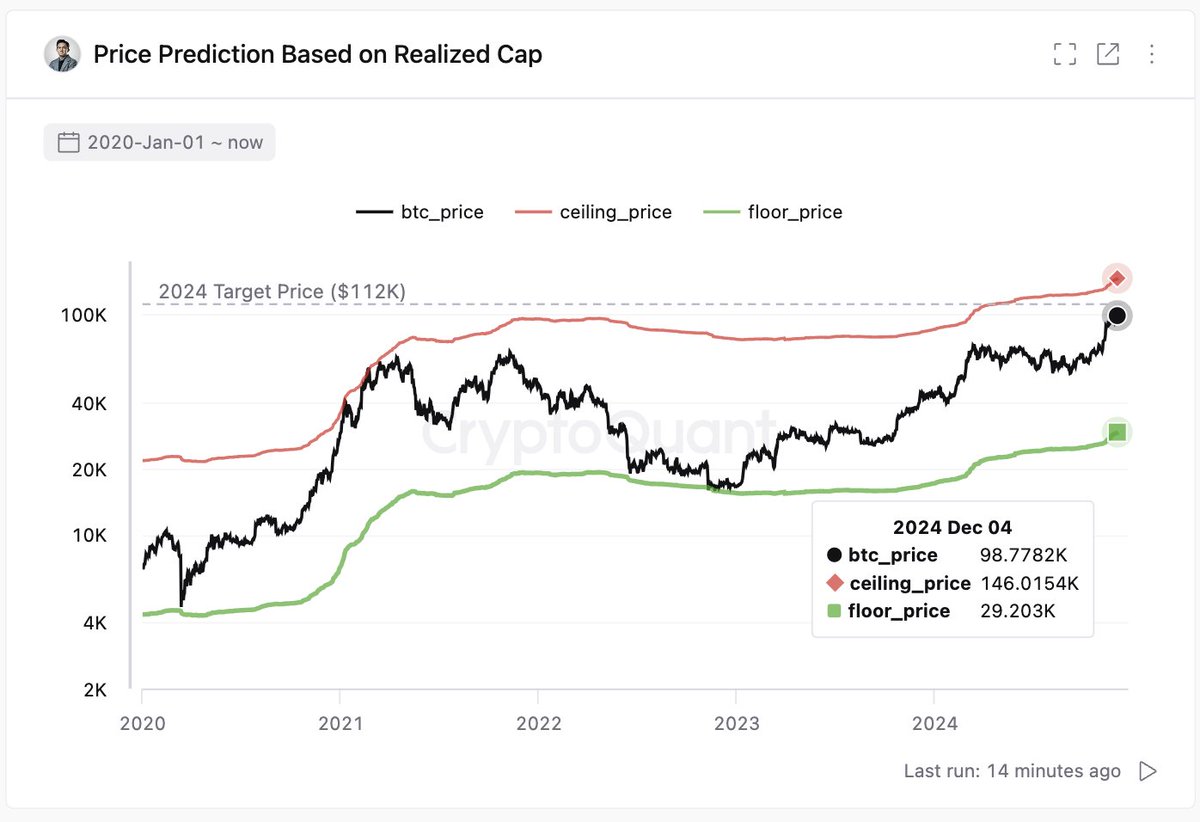
Fresh capital is fueling #Bitcoin.
As the realized cap grew, the ceiling price increased from $129K to $146K in 30 days.
At $102K, it's far from a bubble—it would need a 43% surge to hit the threshold often considered a bubble.
The Moore's Law Update
NOTE: this is a semi-log graph, so a straight line is an exponential; each y-axis tick is 100x. This graph covers a 1,000,000,000,000,000,000,000x improvement in computation/$. Pause to let that sink in.
Humanity’s capacity to compute has compounded for as long as we can measure it, exogenous to the economy, and starting long before Intel co-founder Gordon Moore noticed a refraction of the longer-term trend in the belly of the fledgling semiconductor industry in 1965.
I have color coded it to show the transition among the integrated circuit architectures. You can see how the mantle of Moore's Law has transitioned most recently from the GPU (green dots) to the ASIC (yellow and orange dots), and the NVIDIA Hopper architecture itself is a transitionary species — from GPU to ASIC, with 8-bit performance optimized for AI models, the majority of new compute cycles.
There are thousands of invisible dots below the line, the frontier of humanity's capacity to compute (e.g., everything from Intel in the past 15 years). The computational frontier has shifted across many technology substrates over the past 128 years. Intel ceded leadership to NVIDIA 15 years ago, and further handoffs are inevitable.
Why the transition within the integrated circuit era? Intel lost to NVIDIA for neural networks because the fine-grained parallel compute architecture of a GPU maps better to the needs of deep learning. There is a poetic beauty to the computational similarity of a processor optimized for graphics processing and the computational needs of a sensory cortex, as commonly seen in the neural networks of 2014. A custom ASIC chip optimized for neural networks extends that trend to its inevitable future in the digital domain. Further advances are possible with analog in-memory compute, an even closer biomimicry of the human cortex. The best business planning assumption is that Moore’s Law, as depicted here, will continue for the next 20 years as it has for the past 128. (Note: the top right dot for Mythic is a prediction for 2026 showing the effect of a simple process shrink from an ancient 40nm process node)
----
For those unfamiliar with this chart, here is a more detailed description:
Moore's Law is both a prediction and an abstraction. It is commonly reported as a doubling of transistor density every 18 months. But this is not something the co-founder of Intel, Gordon Moore, has ever said. It is a nice blending of his two predictions; in 1965, he predicted an annual doubling of transistor counts in the most cost effective chip and revised it in 1975 to every 24 months. With a little hand waving, most reports attribute 18 months to Moore’s Law, but there is quite a bit of variability. The popular perception of Moore’s Law is that computer chips are compounding in their complexity at near constant per unit cost. This is one of the many abstractions of Moore’s Law, and it relates to the compounding of transistor density in two dimensions. Others relate to speed (the signals have less distance to travel) and computational power (speed x density).
Unless you work for a chip company and focus on fab-yield optimization, you do not care about transistor counts. Integrated circuit customers do not buy transistors. Consumers of technology purchase computational speed and data storage density. When recast in these terms, Moore’s Law is no longer a transistor-centric metric, and this abstraction allows for longer-term analysis.
What Moore observed in the belly of the early IC industry was a derivative metric, a refracted signal, from a longer-term trend, a trend that begs various philosophical questions and predicts mind-bending AI futures.
In the modern era of accelerating change in the tech industry, it is hard to find even five-year trends with any predictive value, let alone trends that span the centuries.
I would go further and assert that this is the most important graph ever conceived. A large and growing set of industries depends on continued exponential cost declines in computational power and storage density. Moore’s Law drives electronics, communications and computers and has become a primary driver in drug discovery, biotech and bioinformatics, medical imaging and diagnostics. As Moore’s Law crosses critical thresholds, a formerly lab science of trial and error experimentation becomes a simulation science, and the pace of progress accelerates dramatically, creating opportunities for new entrants in new industries. Consider the autonomous software stack for Tesla and SpaceX and the impact that is having on the automotive and aerospace sectors.
Every industry on our planet is going to become an information business. Consider agriculture. If you ask a farmer in 20 years’ time about how they compete, it will depend on how they use information — from satellite imagery driving robotic field optimization to the code in their seeds. It will have nothing to do with workmanship or labor. That will eventually percolate through every industry as IT innervates the economy.
Non-linear shifts in the marketplace are also essential for entrepreneurship and meaningful change. Technology’s exponential pace of progress has been the primary juggernaut of perpetual market disruption, spawning wave after wave of opportunities for new companies. Without disruption, entrepreneurs would not exist.
Moore’s Law is not just exogenous to the economy; it is why we have economic growth and an accelerating pace of progress. At Future Ventures, we see that in the growing diversity and global impact of the entrepreneurial ideas that we see each year — from automobiles and aerospace to energy and chemicals.
We live in interesting times, at the cusp of the frontiers of the unknown and breathtaking advances. But, it should always feel that way, engendering a perpetual sense of future shock.