There is a specific kind of investor who bought NVDA in October of 2022, when the stock was at $112, when the entire chip sector was being thrown overboard, when the financial press had decided that crypto mining demand was permanently gone, when gaming was in a cyclical trough, when the data center business was an unproven side bet, and when the consensus on financial Twitter was that semiconductors were a dying category that had been over-earning for two years and was now mean-reverting to a price nobody would want to own.
This investor did not buy NVDA because he had a thesis about generative AI. He had never heard the phrase “transformer architecture.” He could not, if you had asked him in October 2022, have explained what a GPU did that a CPU could not, beyond a vague gesture toward “graphics.” He bought NVDA because the stock was down 65% from its high, because the company was profitable, because the balance sheet had net cash, because management had been buying back shares through the entire drawdown, and because the multiple, on trailing earnings, had compressed to a level that, in any other sector, would have been considered cheap.
He did not size the position aggressively. He bought $40,000 worth, at an average cost of $118, which in his portfolio represented about 4% of his capital, and he held it next to 30 other unloved names he had bought for similar reasons in similar drawdowns, none of which he had any particular conviction about as individual ideas, all of which he owned because the math, when he ran it, told him the basket would work even if he could not predict which names within it would carry the weight.
Then ChatGPT launched in November of 2022, and the world reorganized itself around a thesis that this investor had not held, did not understand, and had not been positioned for, and the stock he had bought because it was cheap proceeded to compound at a rate that no human being could have rationally predicted, and the $40,000 became, over the next 36 months, somewhere north of $700,000, and the investor, who had spent 25 years buying boring unloved companies for reasons that had nothing to do with the eventual catalyst that produced the return, watched it happen with a mixture of bewilderment, mild embarrassment, and quiet confirmation of the only principle that has ever actually worked in equity investing, which is that price is the entire edge, and the people who pay attention to price are sometimes rewarded by catalysts they could never have predicted, and the people who chase catalysts are almost always penalized by the prices they paid to chase them.
This is not a story about NVDA. This is a story about the only style of investing that has ever produced asymmetric returns at scale, which is buying things for less than they are worth, in a basket, patiently, without trying to predict which one will be the one that pays for everything else. The catalyst is gravy. The price is the meal. The investor in this story did not know about AI. He knew about a stock that was down 65% and had net cash on the balance sheet, and that was enough, and that has always been enough, and that will always be enough, in every cycle, in every sector, in every market, for as long as humans remain humans and prices remain mispriced and the people willing to ignore the narrative continue to outnumber, at the bottom, the people willing to chase it at the top.
The UK is a great country with an extraordinary history. Our stagnation is real, but it's fixable and worth fixing.
Enjoyed giving this talk at @lfg_uk last week and so encouraged by the optimistic responses I've had from people who are building a brilliant future for Britain 🚀
One of the coolest things in cryto right now: GENIUS Act meets film funding and tokenisation via @joinrepublic
Republic has raised about $30M in film financing from 35,000 retail investors — actually making the films and already returning money to investors. Now the GENIUS Act and stablecoins will unlock this market and adjacent asset classes. The idea is to channel private capital into fractional, tokenised securities. By the way, Republic was already tokenising film in a compliant way before the GENIUS Act.
Here’s the film-side logic chain: YouTube and TikTok disrupted distribution, influencers disrupted celebrities, AI is disrupting production — and now tokenisation is going to disrupt funding and capital formation.
Republic’s three most recent campaigns were oversubscribed. Pressman Film (American Psycho, Wall Street) raised $2M; Robert Rodriguez (Sin City, which I love!) raised $2M; and horror director Eli Roth (Cabin Fever, Hostel) raised $5M from 2,500 fans. Roth’s deal let fans own a stake in his studio, not just individual films — which is very cool. While Rodrigez’s one let fans pitch him films.
In other words, they’re delivering what Web3 promised. Maybe it wasn’t the tech that held Web3 back, but the lack of regulatory clarity — and we’re about to see what happens when that piece finally clicks into place.
To be clear, Marex has no financial interest in Republic. I’m mentioning it because it’s a rare case of crypto developing outside DeFi. I’m a big fan of the project and happy to make intros to the Republic team. @metamarq
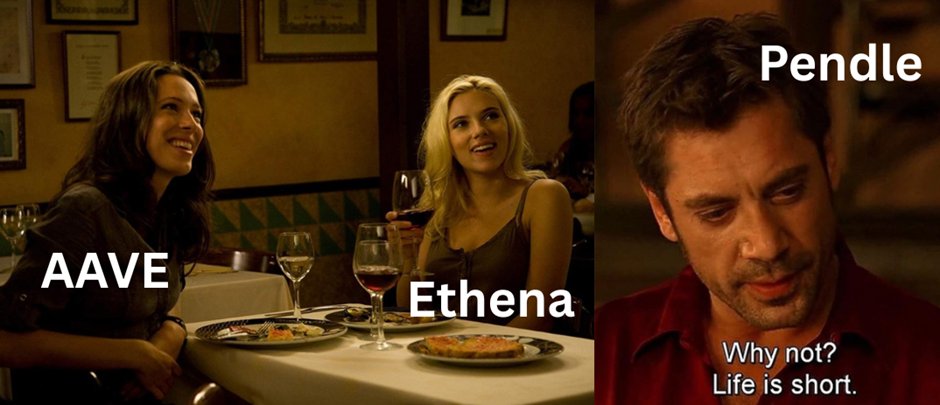
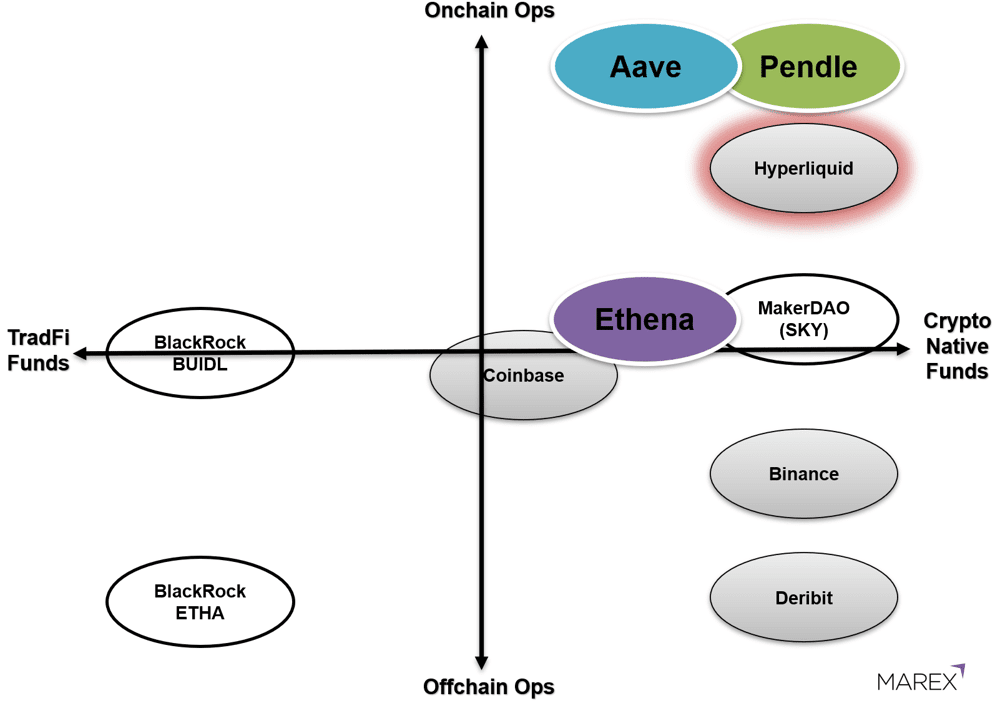
In the sultry world of DeFi, @HyperliquidX is quietly slipping into the ménage à trois between @ethena, @pendle_fi and @aave.
Here are the first two acts.
Act 1: The Seduction of Yield
Here’s how the romance unfolds: (a) Ethena’s USDe stablecoin – or “synthetic dollar” – promises tantalising yields from shorting perpetual futures. (b) USDe falls into Pendle’s arms, which decomposes it into Principal Tokens (PTs) with a fixed yield (say, 10%). (c) PTs serve as collateral on AAVE, unlocking their full potential for borrowing USDC at a lower rate (say, 6%). (d) The borrowed USDC runs back to Ethena, reborn as fresh USDe, closing the loop—ready to do it all over again.
Watch the moment Pendle invites Ethena and AAVE for the ride of their lives. https://t.co/qEVw6j7R5V
This affair is worth over $4B, representing most of Ethena’s deposits on AAVE and the lion’s share of Pendle’s TVL.
I think much of the chemistry between these protocols has to do with EVM composability and proximity across the TradFi↔DeFi and Offchain↔ Onchain axes (see chart).
Act 2: Hyperliquid’s Irresistible Charm
Its maturing Layer 1 — the HyperEVM — becomes the irresistible fourth.
Pendle and Hyperliquid already share a history with ~$300M TVL from the HyperEVM already in place. And Pendle’s new Boros funding-rate markets seem destined for Hyperliquid perps.
Ethena uses Hyperliquid perps, and USDe is rapidly getting embedded in both Core and the HyperEVM.
AAVE's relationship with Hyperliquid is still tenuous, mainly through a new partnership with @hyperlendx, a “friendly fork.”
Let’s hope Act 3 doesn’t end the same way Woody Allen’s screenplay did: a tragedy of basis trades, flattening contango, and post-airdrop blues.
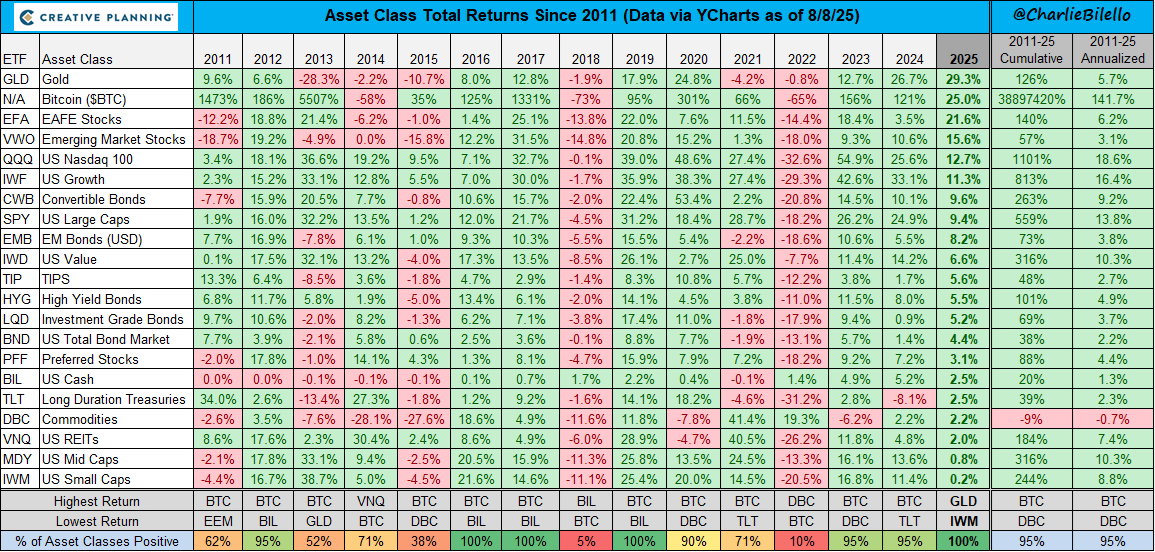
Gold (+29%) and Bitcoin (+25%) are the top performing major assets so far in 2025. We’ve never seen these two in the #1/#2 spots for any calendar year. $GLD $BTC
Video: https://t.co/Vely2D0bMD
Compounding works best when it's uninterrupted.
Here are the most durable companies when it comes to consecutively growing sales and profits Y/Y, ranked by consistency (not growth or total return).
The performance of the top 4 is extremely impressive. $ORLY $AZO $NVO $ROL
Não conheço o Léo Lins nem o teor das suas piadas, mas condenar um humorista a 8 anos de prisão, em regime fechado, por suas piadas — por mais ofensivas que elas sejam — é um completo absurdo.
my dad sat me down once and said:
“There are only two jobs in the world: building or selling. If you’re not doing one of those, you’re just an expense.”
still think about this.
The paper titled "The Equity Compounders" was published by Morgan Stanley in 2016.
"These compounders have generated superior risk-adjusted returns across the economic cycle".
🧵 Our 6 favourite highlights:
Mario Draghi's report on European competitiveness -- the key message on energy states the very often ignored obvious: "High energy costs in Europe are an obstacle to growth"
Executive summary (69 pages): https://t.co/pKy3rSXBd1
Full report (328 pages): https://t.co/QQs0UE1iOd
THIS IS A HUGE ACHIEVEMENT:
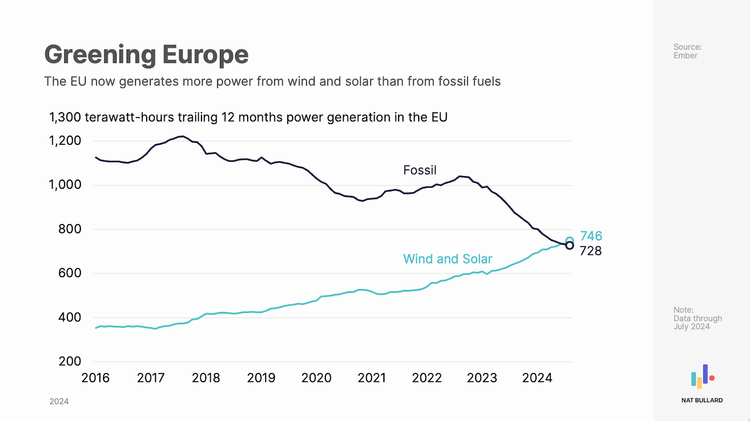
The EU now generates more electricity from wind and solar than from fossil fuels.
Graph from @NatBullard data @EmberClimate