The Alagael contract is live on Ethereum. @Stockereum
CA: 0x4Bb8E07055d84b5b8C8F07AA012BD1d8E334F211
Alagael is private crypto inheritance: split your seed with people you trust, seal a last letter, and let a private heir take over your Safe only when you're gone. $ALAGAEL
https://t.co/7KiMJT1EyF
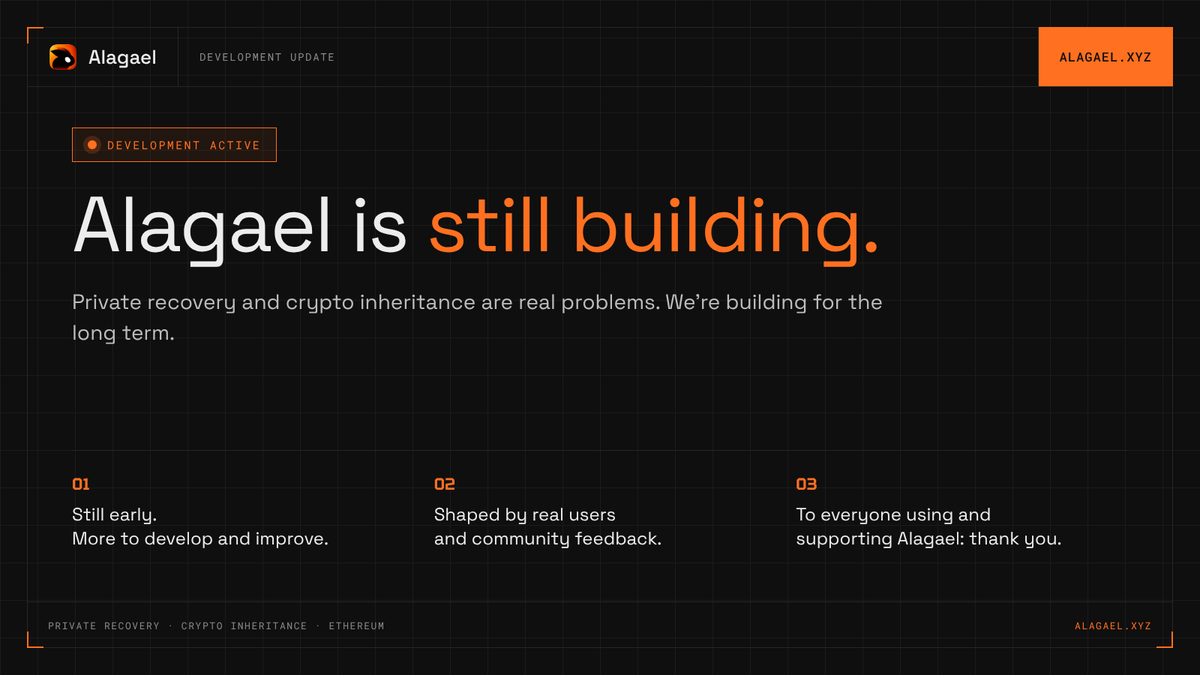
Alagael is still building.
Development continues. We’re building for the long term because private recovery and crypto inheritance are real problems that will remain important.
We’re still early, with more to develop and improve.
To everyone using Alagael, sharing feedback, and supporting the project: thank you. Real users and community participation help us understand what matters and what to build next.
https://t.co/V6f5Vhlfwa
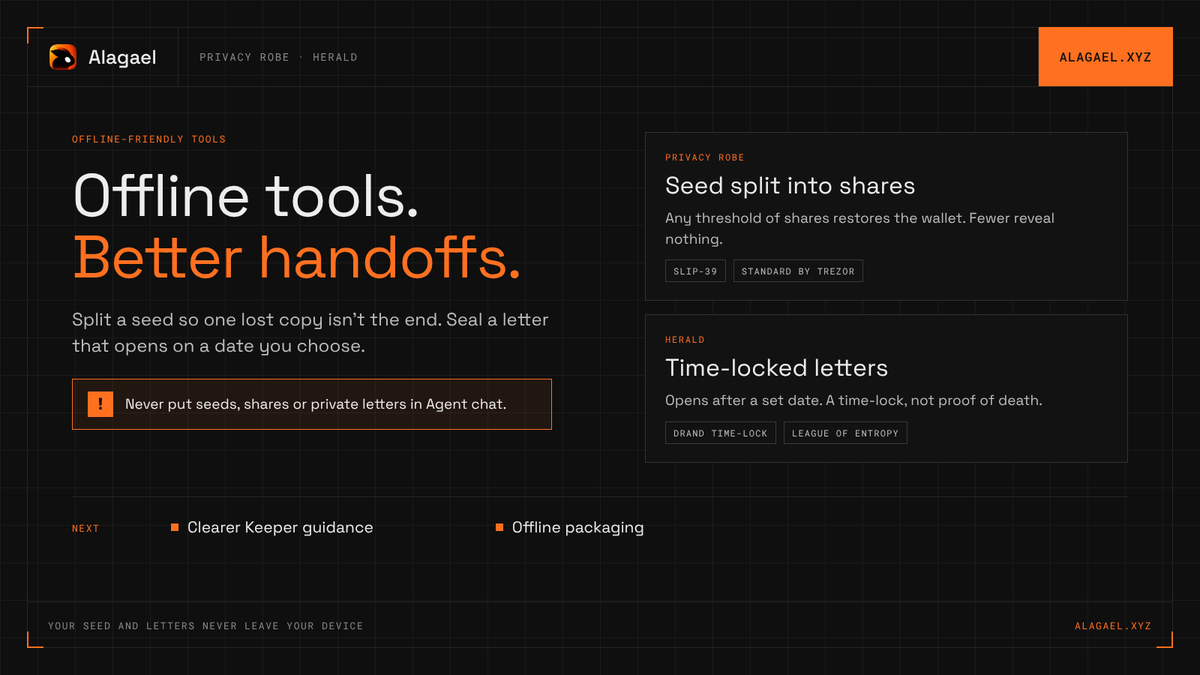
Clear Instructions. Protected Secrets.
@Trezor , co-founded by @PavolRusnak , recommends a “secure and private inheritance plan” and warns against digital copies of wallet backups.
For Alagael, an inheritance kit should explain the process not collect everything needed to unlock the wallet.
Next: clearer Keeper guidance, better offline instructions, and staged Herald letters. Time-locks are not proof of death.
Source: https://t.co/ltGnycwhox
Heirs Need Guidance, Not Just Keys
Casa, co-founded by @lopp , highlights the importance of helping families recover assets rather than leaving them to figure it out alone.
That supports our planned Heir Companion: a dedicated flow explaining eligibility, waiting periods, approvals, and gas requirements.
The goal: easier handoffs without weaker access controls.
Planned, not live yet.
Source: https://t.co/5DEO631sX0
Self-Custody Needs a Recovery Path
@VitalikButerin identified two essential wallet-design goals: “No single point of failure” and “Low mental overhead.”
Recovery must protect assets without making the process impossible to follow.
For Alagael, our next focus is private inheritance kits and step-by-step heir guidance. Agent remains an assistant not a signer or an automatic check-in service.
Source: https://t.co/zFUYVFyddB
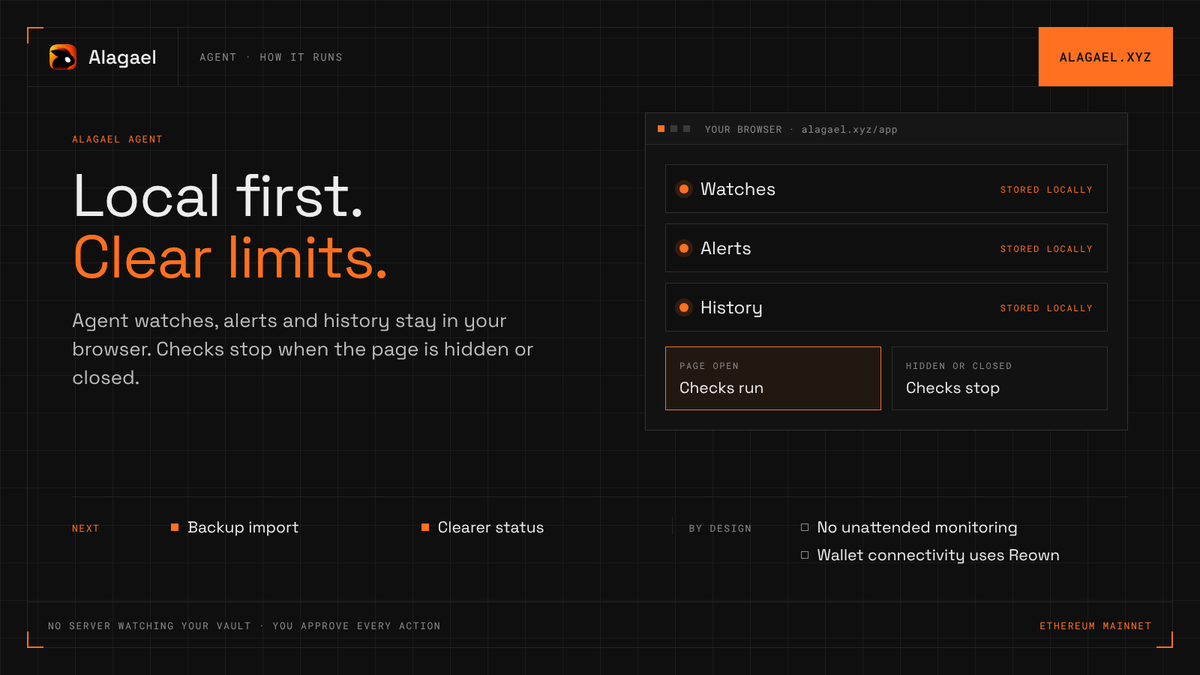
Local First, Clear Limits
Agent watches, alerts and history stay in your browser. Checks stop when the page is hidden or closed.
Next: backup import and clearer status. Wallet connectivity uses @reown_ . No unattended monitoring.
Alagael Agent reads Vault state, explains it with AI and prepares supported actions for review. Your wallet approves every transaction. Agent never checks in for you.
Built on @SafeLabs_ accounts.
Alagael Agent is live 🛡️
Your Vault now has an agent that helps you stay on top of your inheritance plan.
What it does:
→ Reads your Vault’s status straight from Ethereum mainnet
→ Explains in plain words what your timer, heir and protection mean
→ Alerts you in the app before your deadline
→ Prepares transactions, like your check-in, for you to review
What it never does:
- Hold your private keys
- Send transactions on its own
- Check in on your behalf
Every action still needs your wallet approval. The agent prepares it, and you decide.
AI that works for you. Never instead of you.
Try it in your Vault 👇
🔗 https://t.co/x6xvXf4ivy
Alagael Agent is live 🛡️
Your Vault now has an agent that helps you stay on top of your inheritance plan.
What it does:
→ Reads your Vault’s status straight from Ethereum mainnet
→ Explains in plain words what your timer, heir and protection mean
→ Alerts you in the app before your deadline
→ Prepares transactions, like your check-in, for you to review
What it never does:
- Hold your private keys
- Send transactions on its own
- Check in on your behalf
Every action still needs your wallet approval. The agent prepares it, and you decide.
AI that works for you. Never instead of you.
Try it in your Vault 👇
🔗 https://t.co/x6xvXf4ivy
Coming up: Alagael Agents 🤖🛡️
Your AI agent wants your keys. Don't give them.
Give it a budget instead.
How it works:
→ Add your agent's wallet. It uses its own key, never yours
→ Set a hard cap, like 0.05 ETH a week
→ See your max exposure before you sign
→ Over the cap? The transfer reverts onchain
→ Revoke the agent in one transaction
The rules:
The agent never owns your vault
It never checks in for you
It never resets your inheritance timer
There's also a read-only Reminder Agent that pings you before your timer runs out. You still check in yourself.
Built on Safe's official Allowance Module. This is a concept and not live yet, so details may change.
What would you let an agent do with your vault? Drop it below 👇
AI that works for you. Never instead of you.
For @IPFS builders: an encrypted letter is useless if its file disappears.
Alagael's Herald combines time-locking with Keeper shares. Could pinning preserve the encrypted file for future recovery?
@Ledger@near_intents@SwapKitPowered For @Ledger users: a hardware wallet protects signing keys. But what is the recovery plan if the owner loses access?
Alagael's Vault lets a separate heir claim after inactivity. Check-ins reset the timer.
Would you use this model?
https://t.co/fM06hFIMop
One shared heir loses access? The other two can still act.
After a 2-of-3 shared claim, ETH/ERC20 transfers require two owners' approvals. Approvals cost ETH gas.
My Vault > Vault assets: review recipient and amount, approve, then execute.
Alagael’s Plan B update is now live on Ethereum mainnet.
More ways to set up your Vault, without leaving the app:
→ Personal Vault
Owner-only storage, with no heir or recovery timer. Add inheritance later at the same Vault address, without moving your assets. Losing your owner keys before adding protection can permanently lock access.
→ Backup heir
Choose a primary heir and a separate backup. After the inactivity timer expires, the primary has an exclusive claim window. Once that window closes, only the backup can claim. Owner check-ins move both deadlines; pausing protection blocks both.
→ ETH and ERC20 transfers
Review the recipient, token and exact amount inside the app. After a shared 2-of-3 heir claim, transfers still require two owner approvals.
How the factory works
The existing Ethereum factory creates your Vault’s inheritance switch. Selecting backup inheritance also deploys a dedicated receiver for your Vault not a shared receiver holding everyone’s assets.
A successful claim changes who controls the Vault. Assets stay at the same address; the timer does not automatically send them anywhere.
Coming up: Alagael Agents 🤖🛡️
Your AI agent wants your keys. Don't give them.
Give it a budget instead.
How it works:
→ Add your agent's wallet. It uses its own key, never yours
→ Set a hard cap, like 0.05 ETH a week
→ See your max exposure before you sign
→ Over the cap? The transfer reverts onchain
→ Revoke the agent in one transaction
The rules:
The agent never owns your vault
It never checks in for you
It never resets your inheritance timer
There's also a read-only Reminder Agent that pings you before your timer runs out. You still check in yourself.
Built on Safe's official Allowance Module. This is a concept and not live yet, so details may change.
What would you let an agent do with your vault? Drop it below 👇
AI that works for you. Never instead of you.
Your heir loses their keys. What happens next?
In Create Vault, add a backup heir. After inactivity, the primary gets an exclusive claim window; then only the backup can claim.
Owner check-ins move both deadlines.Your heir loses their keys. What happens next?
In Create Vault, add a backup heir. After inactivity, the primary gets an exclusive claim window; then only the backup can claim.
Owner check-ins move both deadlines.
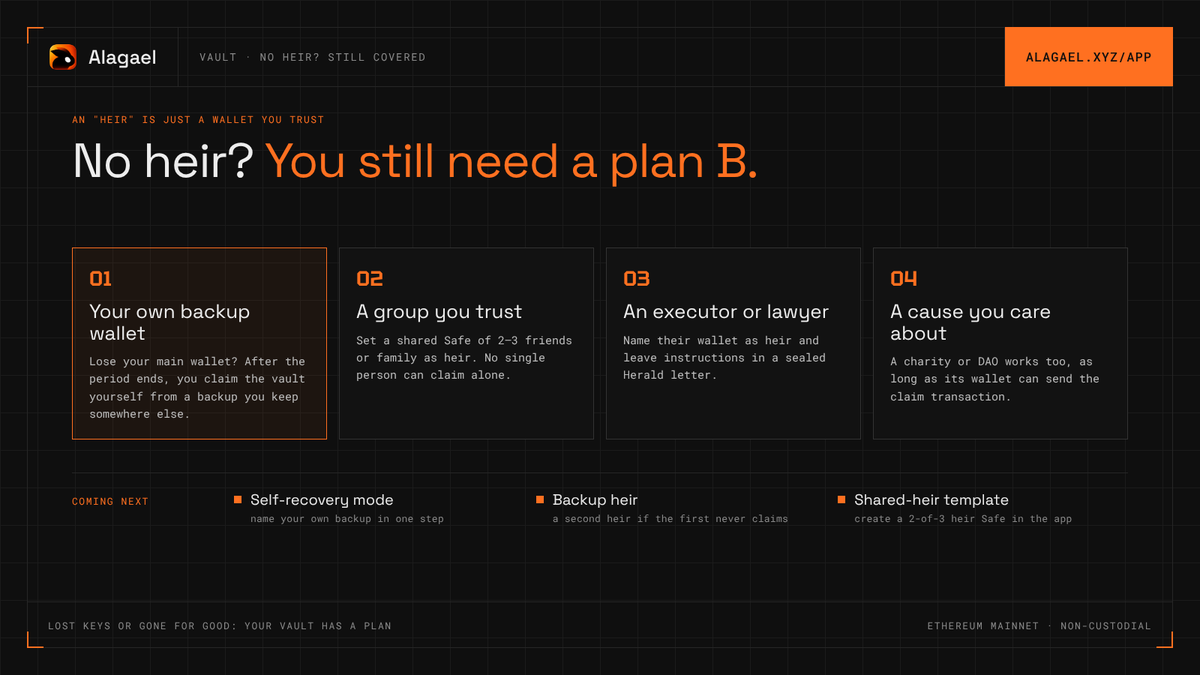
No heir? You still need a plan B.
We get this question a lot: "Alagael Vault sounds great, but who would I even name?" The good news is that an heir in Alagael is simply a wallet you trust, not necessarily a family member.
The most common setup is your own backup wallet. Lose access to your main wallet, and once the inactivity period ends, you claim the vault yourself from a backup you keep somewhere safe. It's inheritance and self-recovery in one.
You can also name a shared Safe held by two or three people you trust, so no single person can claim alone. Or an executor or lawyer, with your instructions sealed in a Herald letter. Even a charity or DAO works, as long as its wallet can send the claim transaction.
Next, we're building a one-step Self-recovery mode, a backup heir who can step in if the first never claims, and a template to create a shared 2-of-3 heir Safe right in the app.
Lost keys or gone for good, your vault should have a plan.
No heir yet? Don't use a random address.
Choose Personal Vault in Alagael: owner-only storage, no heir and no recovery timer. Add inheritance later without moving assets.
Until then, losing your owner keys can permanently lock funds.
Alagael’s Plan B update is now live on Ethereum mainnet.
More ways to set up your Vault, without leaving the app:
→ Personal Vault
Owner-only storage, with no heir or recovery timer. Add inheritance later at the same Vault address, without moving your assets. Losing your owner keys before adding protection can permanently lock access.
→ Backup heir
Choose a primary heir and a separate backup. After the inactivity timer expires, the primary has an exclusive claim window. Once that window closes, only the backup can claim. Owner check-ins move both deadlines; pausing protection blocks both.
→ ETH and ERC20 transfers
Review the recipient, token and exact amount inside the app. After a shared 2-of-3 heir claim, transfers still require two owner approvals.
How the factory works
The existing Ethereum factory creates your Vault’s inheritance switch. Selecting backup inheritance also deploys a dedicated receiver for your Vault not a shared receiver holding everyone’s assets.
A successful claim changes who controls the Vault. Assets stay at the same address; the timer does not automatically send them anywhere.
Alagael’s Plan B update is now live on Ethereum mainnet.
More ways to set up your Vault, without leaving the app:
→ Personal Vault
Owner-only storage, with no heir or recovery timer. Add inheritance later at the same Vault address, without moving your assets. Losing your owner keys before adding protection can permanently lock access.
→ Backup heir
Choose a primary heir and a separate backup. After the inactivity timer expires, the primary has an exclusive claim window. Once that window closes, only the backup can claim. Owner check-ins move both deadlines; pausing protection blocks both.
→ ETH and ERC20 transfers
Review the recipient, token and exact amount inside the app. After a shared 2-of-3 heir claim, transfers still require two owner approvals.
How the factory works
The existing Ethereum factory creates your Vault’s inheritance switch. Selecting backup inheritance also deploys a dedicated receiver for your Vault not a shared receiver holding everyone’s assets.
A successful claim changes who controls the Vault. Assets stay at the same address; the timer does not automatically send them anywhere.
Here’s the mechanism:
→ Create your vault in Alagael. The factory deploys a separate inheritance switch for your vault.
→ Choose a recipient and an inactivity period.
→ Complete activation, then deposit into your vault address.
→ Check in to reset the timer.
→ After inactivity expires, the designated recipient can submit a claim and become the vault’s sole owner.
Expiry does not automatically move your assets.
They remain in the vault, and a claim transfers control not an automatic payout.
Today’s recipient can also be an existing shared Safe, a trusted executor, or a charity/DAO wallet capable of executing the claim.
A shared Safe must claim through its own approval process. A sealed Herald letter can provide instructions, but it does not trigger inheritance. $ALAGAEL
This is exactly why inheritance planning can't assume today's crypto lasts forever.
How it maps to Alagael:
→ Privacy Robe splits seeds with SLIP-39 (Shamir). Below the threshold, shares reveal nothing, no matter how smart the attacker or the AI. That's math, not hardness.
→ A Vault heir address stays unused until the claim: a fresh address by design.
→ "I've lost more in botched migrations than hacks." Same reason we say: start small, don't rush.
Honest part: Herald's time-lock uses pairing-based crypto. For secrets meant to last decades, layer it, don't rely on it alone.
Your keys. Your clock. 🛡️
I don't recommend anyone scramble to move their funds to new wallets today. But we should take the risks to cryptography from AI-accelerated math seriously, and minimize our exposure to not just quantum-vulnerable cryptography, but also potentially AI-vulnerable cryptography.
The core new area of risk from this viewpoint is, unfortunately, ML-DSA / FHE / lattices.
(and it's also another reason, along with quantum, why ECDSA might fall even faster than expected, hence the "fresh address" recommendation)
So far most people have been in the mode of thinking "elliptic curves broken, hashes safe, lattices safe". But there is a good chance that the concrete security of lattices will take serious hits from the next two years of AI math.
The basic threat model is: factoring is something that naively takes 2^(n/2) time, but over decades smart people have found and optimized number field sieves, and degraded that to 2^O(n^(1/3)), which is why RSA keys and signatures need to be ~400 bytes (and not 64 bytes). What if there are skeletons in the closet like that, both for elliptic curves and lattices, that we are simply not smart enough to discover - but bots soon will be?
This is a major part of the reason why for the past year ethereum's lean roadmap has been going in the "hash-only" direction: no lattices, no ML-DSA, no Falcon, no lattice-based commitments inside ZK proofs, etc. Signatures in lean ethereum are all hash-based, either WOTS or SPHINCS-.
For signatures and proofs, we already know how to go hash-only. The bigger challenge is for *public-key encryption* - and this goes far beyond blockchains. Secure communication, anonymizing protocols, lots of things need public-key encryption.
And unfortunately there are long-standing mathematical theorems showing why public-key encryption cannot be done with hashes alone. You have to have some kind of trapdoor object that has at least one form of usable "structure" - either group theory (incl. isogenies) or lattices or code-based or potentially in the future even more newfangled and spooky things (local mixing?). But for anything that has structure, you should assume that AI will make at least some progress in breaking that structure. Here, one reasonable inference is that if you want to make something plausibly long-term secure, multiply the key sizes by 10.
To me that's a very plausible world and something not at all extreme to predict. If AI will bring us 50 years of math in 2 years, then that 50 years of math may very plausibly include a "naive factoring -> GNFS" level of improvement to our ability to break lattices. In that world, lattices will still exist, but they will have to be significantly bigger to guarantee the same level of safety.
And at those new larger sizes, hash-based constructions will beat lattice-based constructions on concrete efficiency in every use case where hash-based constructions are possible at all.
Theoretically, of course it's possible that hashes are broken too (eg. P = NP would imply that). But I think P = NP is very unlikely. And intuitively, it's much more likely that a mathematical object has exactly no exploitable structure (like hashes are intended to), than that a mathematical object has exactly ~3 forms of exploitable structure (for elliptic curves: associativity, Schoof, pairings) and not some secret fourth form of structure we have not yet discovered that greatly degrades its security (for elliptic curves, ECDLP and pairing security). Similar for LWE, SVP, RLWE and the zoo of lattice problems.
For this reason, we do not yet see any reason to worry and start padding the byte size of hashes (if we start to worry more, we would pad the round count first before doing anything to the byte size).
Concrete TLDR, my own personal views:
* Hash-based > lattice-based, in those situations where hash-based is possible at all
* For anything lattice-based, be much more paranoid on param sizes. Remember that blockchains are only a small portion of the cryptography story; this point goes far beyond blockchains and applies to eg. access to websites, secure messaging, Tor / VPNs ...
* For privacy protocols, strongly favor NOT putting encrypted notes onchain. Instead, send them offchain through some third-party mechanism.
* If it's not difficult for you, keeping your funds in addresses which have not yet been used to make a transaction is a good idea. If it's easy for you, do it. **But be careful about migrations; I personally have lost more money in botched migrations than I have lost in all hacks combined**.
* For multisig wallets, doing confirmations offchain is better than onchain, because this way the signatures of signer wallets do not get exposed to the public, so if ECDSA falls to AI much faster than expected, at least the multisig "gracefully degrades" to a 1-of-1 where the 1 is whoever was gathering the signatures - a much better place to be than "anyone can take the money"
https://t.co/oVjwZog2lL
Congrats on day one 🔥
Question from the inheritance side: could a vault name its heir as https://t.co/KLw131bQWv instead of a 0x string?
We're building a dead man's switch vault on Ethereum. Names would make heirs human, but they can change owners. How do you handle that on your side?
A small moment worth sharing: Trezor liked our post about Alagael Privacy Robe.
We’re exploring local, offline seed splitting and recovery using threshold shares turning an idea inspired by Snowmoon into working software.
Thanks for noticing, @Trezor. And thanks to everyone testing and sharing feedback.