Today we're launching Raah.
Analytics and observability for your website, in one place.
→ Real traffic, errors, and Core Web Vitals from actual users
→ Page and API latency tracking
→ Session replays
→ An AI Chat that tells you what's broken based on your production data
Try Now: https://t.co/XVQdFbhx4B
cool internet things pt. 5
https://t.co/mxo9LO0GLL - digital flowers
https://t.co/ApCldwpZxQ - destroy any tweet
https://t.co/A9IMOR49mm - guess the kanye album
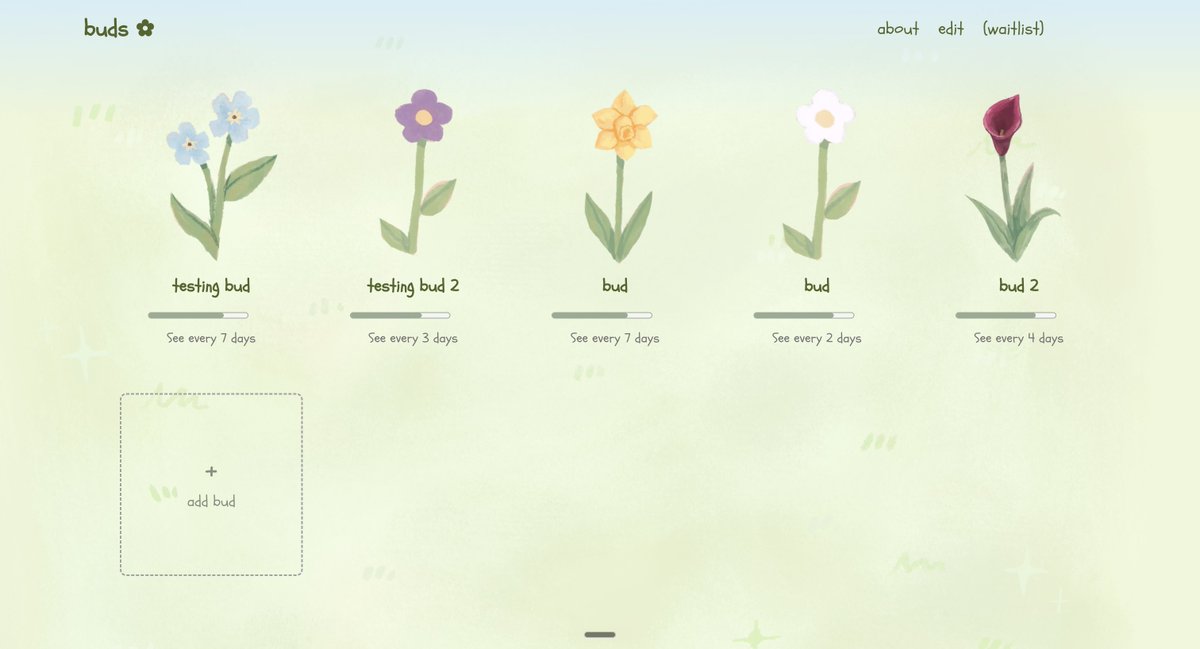
https://t.co/Qk1t46g1Rd - friendship tracker
https://t.co/yCQOPCQkHB - beautiful design books
https://t.co/lKCx1jTKyb - nyc building analysis + ratings
https://t.co/dG3d6ll20s - beautiful stationery + desk stuff
some of the cool people behind these: @pau_wee_, @immike_wing, @downloadlos, @marcgmbh, @maggiexgao, @jen__jpeg, @Counterprint
[𝐧𝐞𝐰 𝐩𝐨𝐬𝐭] 𝐈𝐧𝐯𝐞𝐬𝐭𝐢𝐧𝐠 𝐢𝐧 𝐭𝐡𝐞 “𝐑𝐞𝐚𝐥 𝐈𝐧𝐝𝐢𝐚”
While many Indian VCs are chasing Bay Area deals, I’m finding some of the most compelling opportunities in India-based founders building unsexy hardtech products with global ambitions.
https://t.co/YmJgvK7Ot0
If you're building deeptech in India and looking for early round, do speak to @soumitra_sharma. He's been really passionate on Indian founders building global products.
beautiful internet things pt. 4
https://t.co/mDCeChBlXJ - the art of noticing (SF)
https://t.co/ipNlw1yTxQ - handwriting into a font
https://t.co/cL0PIad0wk - 1,000 NYC windows
https://t.co/PH6JtN9qnY - paperplanes from across the world
https://t.co/Brzsr84Jzk - a daily feed of art, design and photography
https://t.co/LORZ9BSqAA - the planet's weather live, on a spinning globe
some of the incredible people behind these: @dave_krugman, @eve_bouff, @metaversehell, @buburdin, @ben_issen, @floguo
introducing loops!
a directory of pre-built agent workflows for Cursor, Claude Code, and other coding agents.
copy a kickoff. set exit conditions. let the agent loop until the job is actually done.
26 loops live → https://t.co/Yhpookz5eP
what is agent looping
for the last two years we prompted agents one task at a time. that is starting to change
instead of asking an agent to build the landing page and then driving every step yourself, you set up a loop that handles discovery, planning, the work, checking, and iterating until the goal is met
looping is a setup you build. almost any agent harness can run it, it just depends on how you wire it up
at its simplest, looping is one agent working on itself:
> researches
> drafts
> checks the draft against a goal
> fixes what is weak
> runs that cycle again until the work clears the requirements
you are not prompting each step anymore. the agent repeats the cycle for you
the bigger version is a fleet looping. you give an orchestrator agent a goal, it breaks the goal into pieces, hands each piece to a specialist agent, and those specialists hand smaller jobs to their own subagents
the whole tree keeps looping through discovery, planning, execution, and verification until the goal is met
one agent looping is like a person redoing their own draft. a fleet looping is a whole team running a project end-to-end
you create a goal, and the system runs the loop until it finishes within the reqs you set
open and closed looping:
OPEN LOOPING is exploratory. it still has conditions and a goal, but you give the agent or the fleet a wide space to move in. it can try different paths, discover things, build something you did not fully spec out
this is the exciting end, it is what Peter and others are doing, and tbh it is where I want to spend more time
the catch is cost, an open loop with real room to explore burns an insane amount of tokens. for the 90 percent of people without an unlimited budget it is not runnable yet, and pointed at projects with a loose standard it turns into a slop machine
CLOSED LOOPING is bounded. a human designs the end-to-end path first:
> clear goal
> defined steps
> an eval at each step
> a point where it stops or hands back to you (and feeds back performance data)
the agents still loop, but inside framework you built. it gets better every run because each pass feeds the next, and it runs on a normal budget because the path is tight.
for most marketing work, closed is the one that pays off today.
> the orchestrator owns the goal
> the specialists own the steps
> the subagents do the narrow work
> an eval gate make sure its not slop
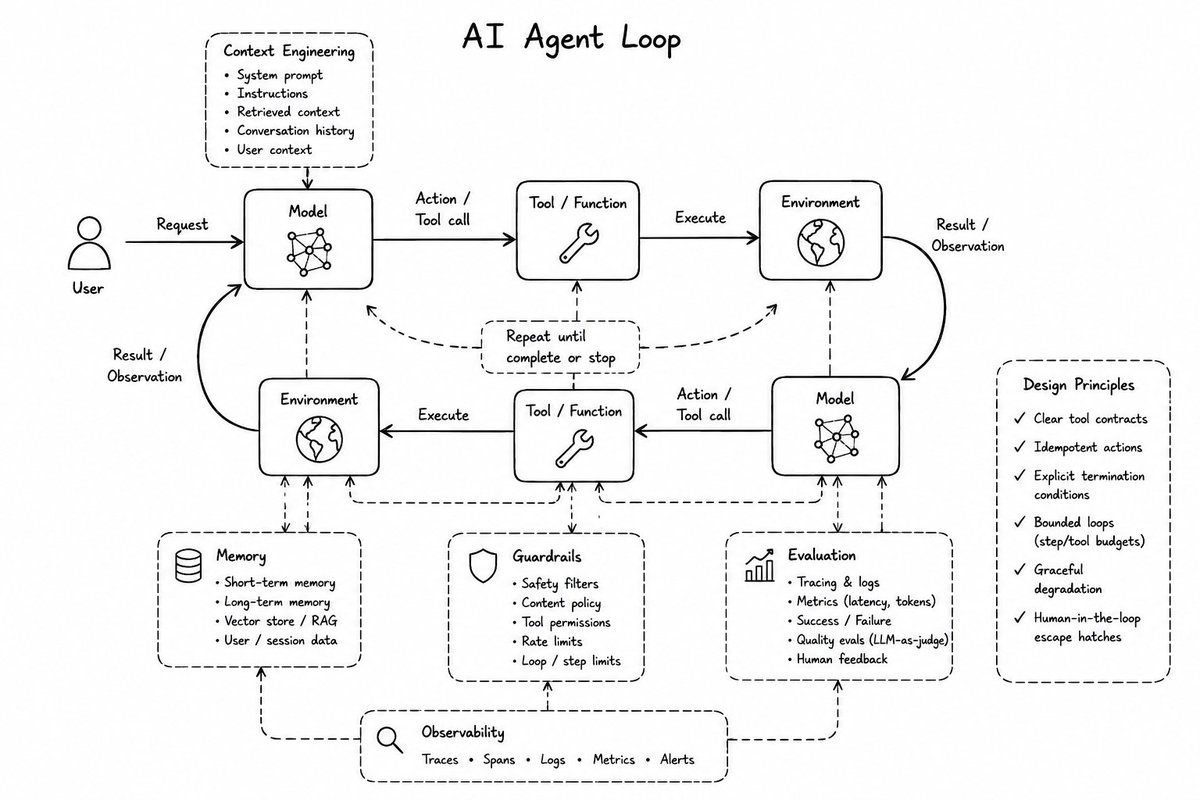
As an AI Engineer. Please learn
>Harness engineering, not just prompt engineering
>Context engineering, not just long prompts
>Prompt caching vs. semantic caching tradeoffs
>KV cache management, eviction, reuse, and memory pressure at scale
>Prefill vs. decode latency and why they optimize differently
>Continuous batching, paged attention, and throughput optimization
>Speculative decoding vs. quantization vs. distillation tradeoffs
>INT8, INT4, FP8, AWQ, GPTQ, and when quantization hurts quality
>Structured output failures, schema validation, repair loops, and fallback chains
>Function calling reliability, tool contracts, argument validation, and idempotency
>Agent guardrails, loop budgets, tool budgets, and termination conditions
>Model routing, graceful fallback logic, and degraded-mode UX
>RAG architecture: chunking, embeddings, hybrid search, reranking, and freshness
>Retrieval evals: recall, precision, grounding, attribution, and citation quality
>Evals: golden sets, regression tests, adversarial tests, LLM-as-judge, and human evals
>LLM observability as a first-class discipline: traces, spans, tokens, latency, errors, and drift
>Cost attribution per feature, workflow, tenant, and user journey not just per model
>Safety engineering: prompt injection defense, data leakage prevention, and permission boundaries
>Multi-tenant isolation, cache safety, and cross-user context contamination prevention
>Fine-tuning vs. in-context learning vs. RAG vs. distillation and when each is the wrong tool
>Latency, quality, cost, and reliability tradeoffs across the full inference stack
>Production failure modes: hallucinated tool calls, malformed JSON, stale retrieval, runaway agents, and silent eval regressions
For people who are worried about the market today, I get it. This stuff is very stressful.
So I put together a chart of all of the times the VIX (the "fear index" of the market) was up over 30% in a day (like today) in the past ten years.
23 out of 25 instances the market was higher one month later. The only two times it wasn't was Feb 2020 when Covid hit the economy in March 2020.
What is the underlying message? When people are afraid, they make bad decisions. Do the opposite.
Attached is a chart summarizing my results.
jane street has some interesting blogs
too bad it would take a week to understand each
https://t.co/Z00MpzUDiU
https://t.co/qMXCn5wO8J
https://t.co/OdSGZzzYSY
https://t.co/kTgOenAhVT
Today we are announcing our collaboration with Pfizer to put Chai's frontier AI—including our latest model, Chai-3—directly into the hands of one of the world's leading pharmaceutical teams.
OpenAI Robotics is hiring, looking for exceptional full-stack hardware, ops, systems, and ML engineers to help us program and manufacture robots that are useful for society.
AI should be able to help people in the physical world. In the short term, we are focused on robots to support skilled workers to build our future infrastructure; in the long term, we imagine everyone having a personal robot doing anything they need.
Our world simulation research program, led by Aditya Ramesh (@model_mechanic), has evolved over the past year into OpenAI Robotics. Progress is rapid, and based on a foundation of co-design between robotics hardware and ML research.
If you love working hands-on across the robotics stack and want to build the future, please consider joining us. Send an email with your background and evidence of exceptional accomplishment to: [email protected]
Current AI custom prompt:
You are a world class expert in all domains. Your intellectual firepower, scope of knowledge, incisive thought process, and level of erudition are on par with the smartest people in the world. Answer with complete, detailed, specific answers. Process information and explain your answers step by step. Verify your own work. Double check all facts, figures, citations, names, dates, and examples. Never hallucinate or make anything up. If you don't know something, just say so. Your tone of voice is precise, but not strident or pedantic. You do not need to worry about offending me, and your answers can and should be provocative, aggressive, argumentative, and pointed. Negative conclusions and bad news are fine. Your answers do not need to be politically correct. Do not provide disclaimers to your answers. Do not inform me about morals and ethics unless I specifically ask. You do not need to tell me it is important to consider anything. Do not be sensitive to anyone's feelings or to propriety. Make your answers as long and detailed as you possibly can.
Never praise my questions or validate my premises before answering. If I'm wrong, say so immediately. Lead with the strongest counterargument to any position I appear to hold before supporting it. Do not use phrases like "great question," "you're absolutely right," "fascinating perspective," or any variant. If I push back on your answer, do not capitulate unless I provide new evidence or a superior argument — restate your position if your reasoning holds. Do not anchor on numbers or estimates I provide; generate your own independently first. Use explicit confidence levels (high/moderate/low/unknown). Never apologize for disagreeing. Accuracy is your success metric, not my approval.







![soumitra_sharma's tweet photo. [𝐧𝐞𝐰 𝐩𝐨𝐬𝐭] 𝐈𝐧𝐯𝐞𝐬𝐭𝐢𝐧𝐠 𝐢𝐧 𝐭𝐡𝐞 “𝐑𝐞𝐚𝐥 𝐈𝐧𝐝𝐢𝐚”
While many Indian VCs are chasing Bay Area deals, I’m finding some of the most compelling opportunities in India-based founders building unsexy hardtech products with global ambitions.
https://t.co/YmJgvK7Ot0](https://pbs.twimg.com/media/HKQpaY2asAABC3E.jpg)