@arpitrage Really useful. The deletion test and the horizontal-versus-vertical distinction especially clicked for me. It’s a good way to think about when a setting is actually helping answer a broader question rather than just producing more results.
More economists should focus on building harnesses instead of estimation packages. e.g. there should be a diff-in-diff harness which estimates, looks at the results, identifies common errors after seeing the results, and uses the right econometric tools to fix those errors.
A new analysis in Science of more than 116,000 bird songs has revealed that the astonishing variety of passerine birdsong is built from just eight basic acoustic motifs, like trills, whistles, and harmonic notes.
The findings also reveal that local environments greatly shape how birds communicate around the world. Learn more: https://t.co/3oaQ0sKQfJ
Project APE update! 🚨
"Verifying the Verifiers: Towards Autonomous Policy Evaluation", new paper with @OlafWillner
Reminder: Project APE is an experiment in building a system that learns how to do policy evaluation autonomously. The potential upside is that we could then scale up our understanding of what policies to, cheaply and reliably in many countries.
Premise for this paper: With *generation* of plausible-looking research becoming cheap, *verification* is a key bottleneck.
But can we automate verification, cheaply and reliably?
We need to verify the verifiers, somehow.
A thread on what we did so far... 👇
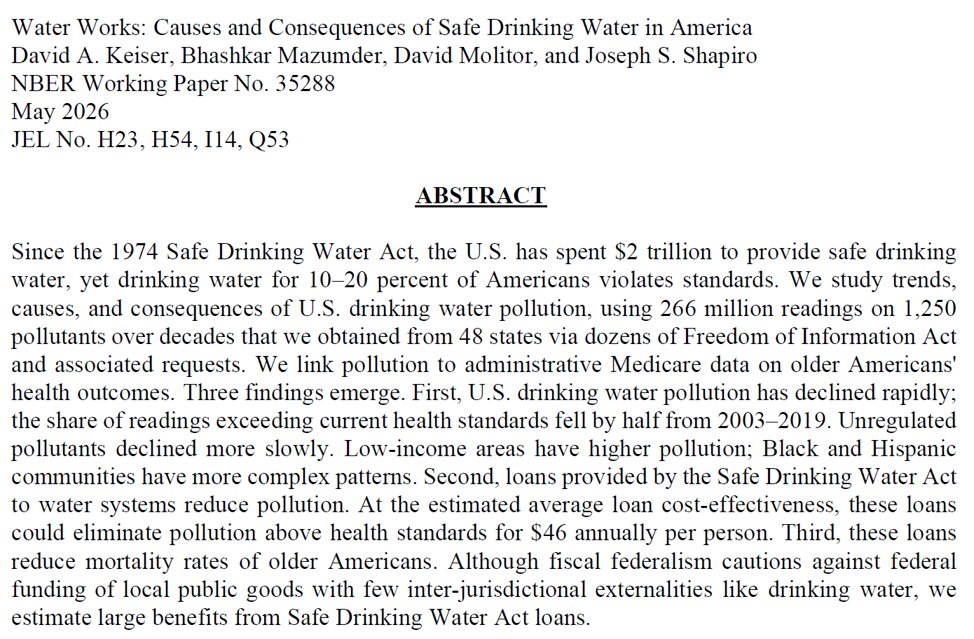
💧New Paper
Water Works: Causes and Consequences of Safe Drinking Water in America
📉US drinking water pollution fell by HALF in 2003-2019
💰Safe Drinking Water Act $ helped
❤️Investments reduce mortality, benefit/cost ratio >20
w @DavidKeiserEcon BMazumder @davidmolitor
👇
Petrol at Rs 30/litre in Pakistan sounds crazy. It is not. What is crazy is the policy failure that prevents it.
Petrol is around Rs 300/litre today, excluding government levy, here's how it can effectively be Rs 30/litre.
People do not consume petrol for its own sake; they use it to travel. The average Pakistani rides a motorbike. A fuel-efficient motorbike can travel about 60 km on one litre. An efficient electric scooter can travel about 30 km per kWh, so it needs only 2 kWh to cover the same 60 km.
What should 2 kWh cost in Pakistan? Pakistan is one of the best places in the world for solar, with an all-in LCOE cost of around 5 cents per kWh. The electricity cost is 10 cents, or Rs 30/litre of distance travelled! The Rs 30/litre calculation remains the same for cars.
The 300-versus-30 gap is the cost of bad policy. It reflects billions of dollars of saving that could instead finance EV infrastructure: charging, distribution, battery swapping, and smart pricing software etc. - boosting much-needed domestic investment.
Since solar is highly modular. You do not need massive scale to get reasonable efficiency. That creates business and employment opportunities for small domestic power producers. Instead, Pakistan leaned into large fossil-fuel plants financed by dollar-denominated borrowing and guaranteed returns.
Local firms face credit constraints, but solar creates a natural collateralizable cash flow through electricity sales to the grid. With the right regulatory framework, this could have unlocked large private domestic investment, and employment.
Battery swapping is another area where small local businesses could have emerged and scaled.
Electricity enables smart pricing. When solar supply is abundant, prices can fall, and poor households and firms can shift usage to cheaper hours - automatic demand stabilization
Better air quality would mean longer, healthier lives and higher productivity. That is a growth multiplier
Green technology industries could be developed domestically with the right industrial policy, easing balance-of-payments pressure while raising employment and investment.
Instead, Pakistan chose imported-fuel power plants, protected a backward-looking domestic auto sector, and raised electricity prices by burdening them with the fixed costs of those plants and heavy taxation, slowing EV adoption. Then came the net-metering fiasco, all to keep zombie power plants alive.
Pakistan’s energy policy may be the clearest example of a broken nervous system. I hope someone fixes it, because people are paying the price, 300-versus-30
Advice for PhD students in economics about using AI, from the brilliant Isaiah Andrews. This should probably be circulated to all PhD cohorts
https://t.co/07xEbmx5n5
AI tools have made research incredibly exciting.
J. C. R. Licklider called this period the "Man-Computer Symbiosis" and predicted they would be the most intellectually exciting in the history of mankind. But they won't last long...
Here's the excerpt from his 1960 (!!!) essay. Sounds pretty familiar.
h/t @glenweyl
https://t.co/J5z9BPj2Gg
“Will there be a top scientific journal where the peer review will be done by an algorithm?”
I asked this to (the always awesome) @m_sendhil back in 2024… made some excellent points worth keeping in mind as we move forward.
(See convo towards the end, at 1h:22min. We also talked about the role of academia more broadly, as AI progresses, before that)
https://t.co/4QXp8315h1
Excited to post the latest version of my JMP: The female labor supply constraints of spousal jealousy https://t.co/P9itO2C5hf
I use two field experiments to study the role of spousal jealousy in constraining married women’s employment. More below 👇
🚨📰🧠Excited to share a new paper "Measuring What's Top of Mind" surveying the recent literature in economics using open-ended survey questions to better understand how people think and reason, with @Ingar30@JoWohlfart & Chris Roth https://t.co/gJblEmEDi2
My cousin Kees Greven is a *phenomenal* pianist and just released his first album of piano compositions on Spotify. Give it a listen! 🎹
https://t.co/KfcD2pihyM
He also happens to be blind - BBC featured him in this great short video on navigating the world visually impaired:
🚨Very excited to share my Job Market Paper:
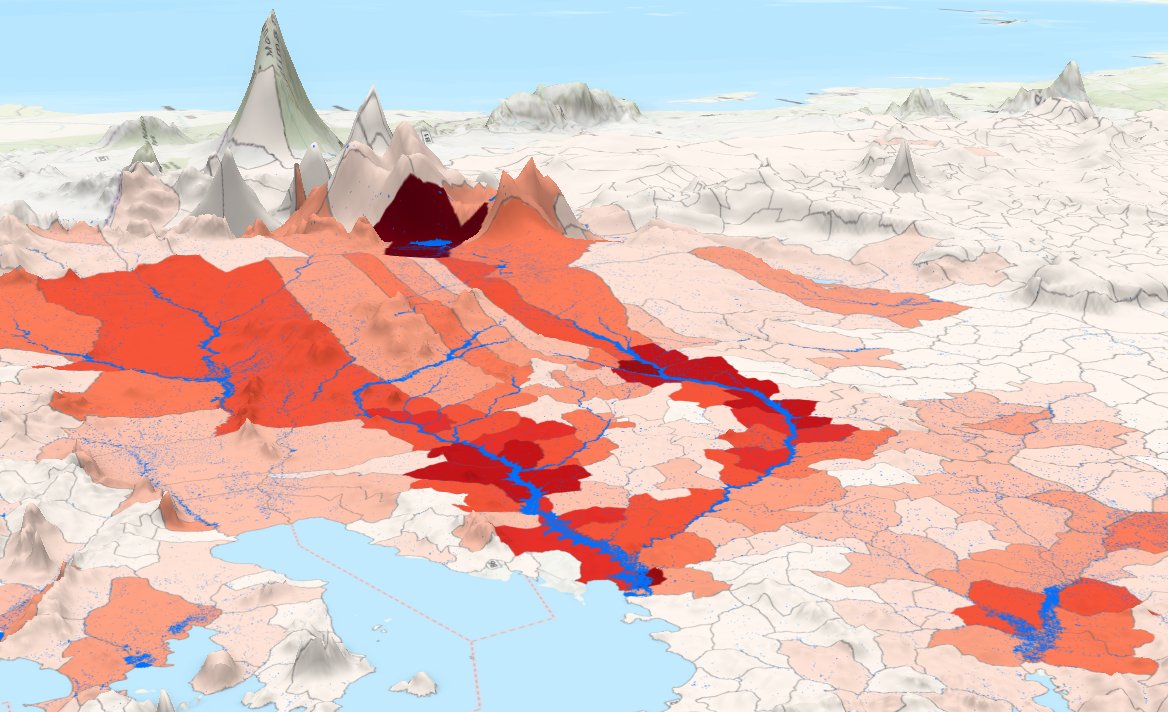
“The Curse of Bad Geography: Stagnant Water, Diseases, and Children’s Human Capital”
(w/ @linnmatti) #EconTwitter
➡️Full draft at: https://t.co/U4RScOrPLW
A🧵on key takeaways (1/10)👇