Minkowski Space ✍️
Minkowski space is the mathematical framework that shows how space and time are not separate but rather a single four-dimensional structure known as spacetime. To grasp this idea, we must let go of the intuitive but incorrect belief that time flows the same way for everyone, no matter how they are moving. For much of human history, space was viewed as a three-dimensional area where events occur left and right, forward and backward, up and down and time was seen as an independent clock ticking at the same rate for all observers. Albert Einstein changed this view in 1905 by revealing that moving faster through space means moving slower through time. He demonstrated that two events that seem simultaneous to one observer can happen at different times to another observer moving relative to the first one. He also showed that the speed of light is constant for everyone, no matter their motion. Two years later, the mathematician Hermann Minkowski, who had been one of Einstein's professors, understood that all of Einstein's unusual results could be framed as statements about the geometry of a single four-dimensional structure that combines space and time. The geometric framework he created is what we now call Minkowski space.
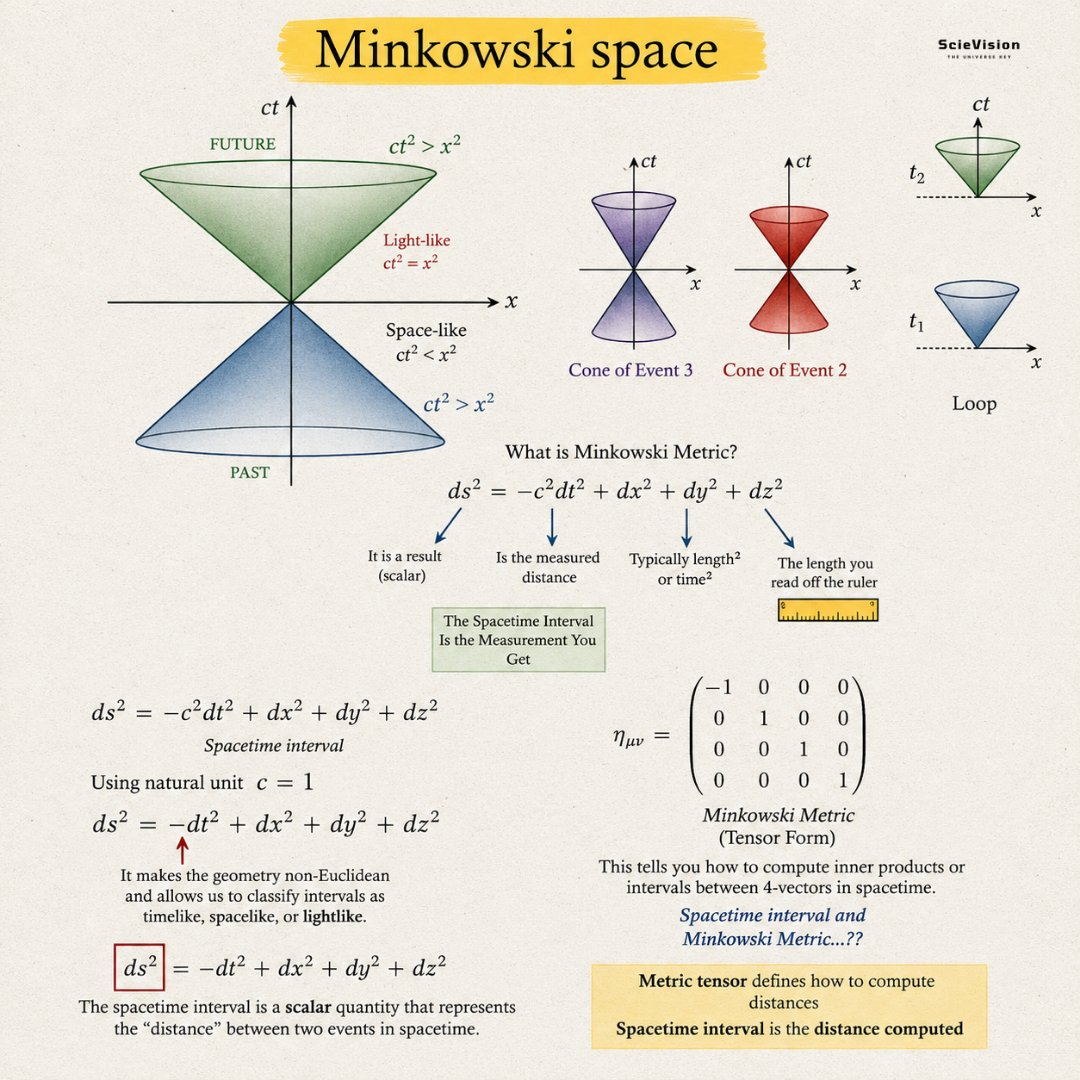
The key visual aspect of Minkowski space is the light cone, depicted in the diagram as two cones one pointing up into the future and the other pointing down into the past. To understand this, imagine you are standing in one place at one moment and you emit a flash of light in all directions. This light travels outward at the speed of light, which is the fastest speed in the universe. If you picture time going upward and space going sideways, this expanding sphere of light outlines a cone shape that opens upward as time moves forward. This is the future light cone, and everything within it represents events you could reach, influence, or send a signal to by traveling at or below the speed of light. The downward cone symbolizes the past all events that could have sent a signal or exerted influence on you at this moment. Together, these two cones separate spacetime into three distinct regions. Events within the upper cone are in your causal future you can affect them. Events within the lower cone are part of your causal past they could have affected you. Events outside both cones are termed spacelike separated from you. This means they are so distant in space that light could not travel between you and them in the available time, making them completely isolated in terms of causality. No signal, no influence, and no cause-and-effect relationship exists between you and them. There isn’t even a definitive answer about whether they occurred before or after your current moment, as different observers moving at different speeds will provide varying answers to that question, and all will be equally valid.
The key mathematical feature that enables Minkowski space to function and generates these peculiar properties is that time enters the geometry with the opposite sign from space. In conventional geometry, when finding the distance between two points, we square the distances in each spatial direction and add them together this always produces a positive result. In Minkowski space, when measuring the separation between two events in spacetime, we do something different: we subtract the time contribution instead of adding it, while still summing the three spatial contributions.
Probability distributions capture the essence of randomness and are central to all statistical work.
A comprehensive visual reference shows the shapes of many continuous and discrete distributions, each with key parameters such as location, scale, degrees of freedom, shape, and rate labeled on the plots.
It includes the normal, t, uniform, beta, gamma, exponential, Poisson, binomial, chi-square, F, Weibull, Cauchy, logistic, log-normal, Pareto, and specialized forms like noncentral chi-square, censored normals, and half-Cauchy.
It is used to guide the selection of appropriate probability models when analyzing data in Bayesian statistics, finance, engineering, and scientific experiments.
A quick dive into the Mellin-Laplace-Fourier Transform.
It is interesting because it combines a Mellin Transform, a Laplace Transform, and a semi-Fourier Transform (over the nonnegative reals).
Vector calculus identities relate key operators on scalar and vector fields.
The divergence of the gradient of a scalar function gives its Laplacian. Any gradient has zero curl while any curl has zero divergence.
The gradient of the product of two scalars splits according to the product rule, and so does the divergence of a scalar times a vector field.
These identities are used to derive the wave equation in electromagnetism from Maxwell's equations.