The multi-model comparison of accumulated rainfall for next 15 day's indicates a strong and consistent signal of very heavy precipitation along the Himalayan foothills, Northeast India, and adjoining Bangladesh region, where all four models (ECMWF, GFS, AIGFS, and AIFS) show maxima exceeding 150–300 mm, suggesting a high-confidence heavy rainfall zone. The ECMWF and AIFS (AI-model) produce relatively sharper and more localized intense rainfall cores, while GFS and AIGFS (AI model) show broader and more diffused precipitation patterns extending into central and peninsular India. Over central India, there is moderate agreement for light to moderate rainfall, though intensity varies across models, indicating lower confidence. South peninsular India shows weak to moderate rainfall signals in all models, with localized enhancement along the Western Ghats. The key difference between AI and dynamical models is that AI models tend to generate more structured and concentrated rainfall patterns based on learned data relationships, whereas dynamical models simulate physical processes leading to smoother and more spread-out precipitation fields. Based on overall consensus, the most robust forecast highlights heavy to very heavy rainfall over Northeast India, sub-Himalayan regions, moderate rainfall over parts of central India, and comparatively lower rainfall over northwest India.
Image courtesy meteologix
IIT Bombay discovers the roots of the heatwave crisis in the Indo-Gangetic plains
New research from @iitbombay reveals that heatwaves in the Indo-Gangetic plains are affected by local land and atmospheric conditions, such as soil moisture and night-time clouds, which are the primary drivers. Understanding these local factors would aid in providing timely warnings and health advisories tailored to specific locations.
To know more, tap:
https://t.co/G0T82Xq5fD
@deekshith_np | @KarthikeyanL07 | @v2dixit | @theAGU
#heatwaves #summer #globalwarming #machinelearning #scicomm #science #sciencecommunication #IndianScience #ScienceinIndia
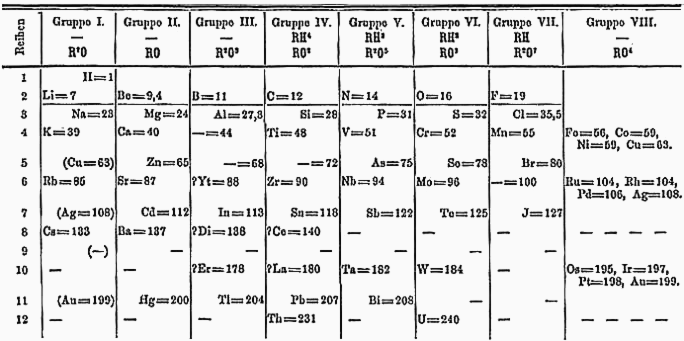
Dmitri Mendeleev, who is credited with creating the Periodic Table of Elements was nominated for a Nobel Prize in Chemistry 9 times but never won.
His awarding was blocked each time by the 1903 winner, Svante Arrhenius, who held a grudge against Mendeleev for criticizing one of his papers.
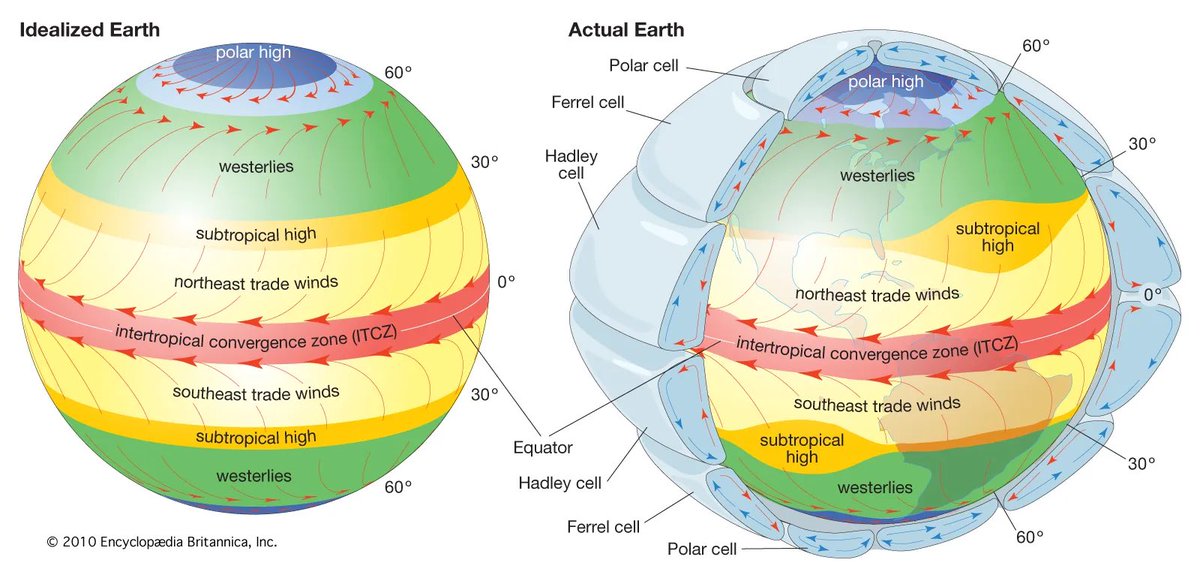
Earth’s 6 Climate Cells
The Earth’s atmosphere is made up of 6 different climate cells; 2 Hadley cells, 2 Ferrel cells, 2 Polar cells. One of each for North and South hemispheres.
At any time each of these cells is carrying a certain amount of energy, water vapour and particulate.
Each cell exchanges energy and mass with its neighbouring cells, with the Earth below it, and with space above it.
So whilst we have 1 atmosphere we really have 6 cells.
They are all subject to Earth’s gravity, the Earth spinning, the moon pulling on them, all the energy and mass exchanges and their own internal expansion / contraction.
What is cool is that you can figure out the energy content and mass of each of the cells.
Typically…
Hadley (tropical)
Summer… 1.28x10^18 kg… 4.5x10^23 J
Winter… 1.29x10^18 kg… 4.1x10^23 J
Ferrel (Temperate)
Summer… 0.94x10^18 kg… 3.0x10^23 J
Winter… 0.95x10^18 kg… 2.7x10^23 J
Arctic (Polar)
Summer… 0.34x10^18 kg… 1.0x10^23 J
Winter… 0.35x10^18 kg… 0.91x10^23 J
So atmospheric energy density varies from 250 kJ / kg to 352 kJ / kg
The difference is essentially the latent heat of water vapour. The Hadley cells are able to operate a huge annual energy swing, absorbing and release enormous amounts of energy charging up in Spring and releasing the energy in Autumn.
This annual energy charge and discharge is what drives tropical storm formation in the autumn.
This is when most of the rock weathering happens and also then the atmosphere scrubs much of its CO2 discharge.
The Earth is a fascinating machine.
The scale of the Earth’s atmospheric engine is difficult to comprehend but our planets huge 22° axis inclination drives this huge seasonal annual swing in atmospheric energy content and actually allows the atmosphere to scrub itself of many gases via accelerated weathering during major storms.
What I particularly like is the self regulating negative feedback behaviour that emerges, the polices an unusually stabile window, it’s very cool.
Found this great treasure on Internet Archives:
https://t.co/FzaoEFcMUg
A five hour program featuring Vasantrao Deshpande, Kumar Gandharva and Bhimsen Joshi, from half a century ago!
Recorded in 1974 in Pune - possibly at the Sawai Gandharva Mahotsav.
Prof. @akshaya_nikumbh from @ClimateIITB@iitbombay featured in this @BBCHindi report explaining what could be causing floods and landslides in Himalayan regions.
https://t.co/yN6wss7ptz
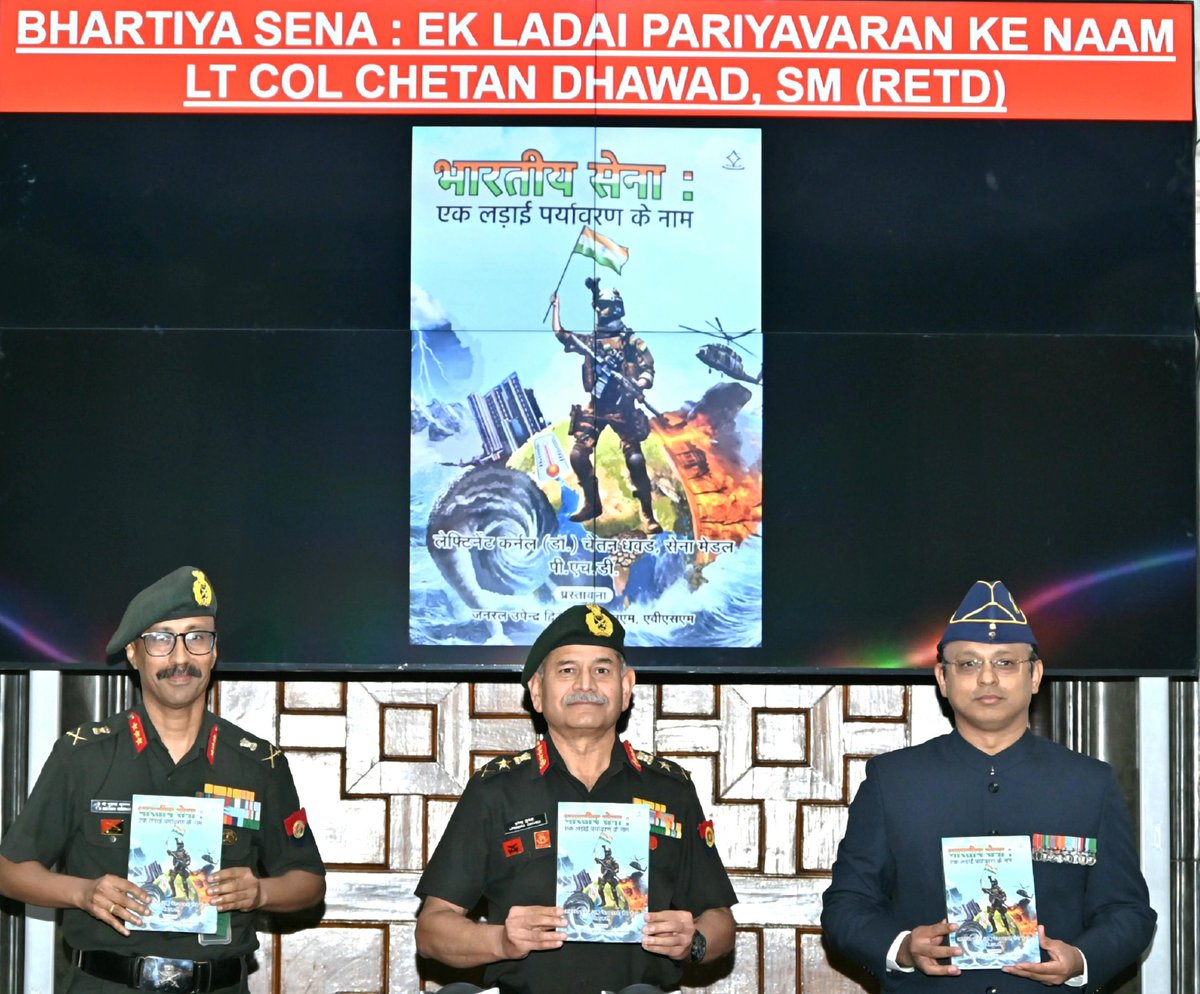
#GeneralUpendraDwivedi, #COAS unveiled the book ‘भारतीय सेना: एक लड़ाई पर्यावरण के नाम’, authored by Lieutenant Colonel Chetan Dhawad (Retd).
The book simplifies the complex issue of climate change through engaging sketches and lucid explanations, inspiring readers to become ‘Climate Warriors’ and contribute to India’s national climate goals.
This book is the Hindi adaptation of the author’s earlier work, ‘Indian Defence Forces to Combat Climate Change: Green Defence’, which reinforces the message that protecting the environment is as vital as defending the nation.
#IndianArmy
@moefcc
🌧️With the end of 2025 monsoon, we’re wrapping up our experimental daily rainfall forecasts.
Forecasts will return with the onset of 2026 monsoon!
https://t.co/b2KMRSqXnk funded by @HDFCERGOGIC HE-IITB Innovation Centre. #MumbaiRains
Here is our model performance for S-Ward👇
Heavy to very heavy rainfall alert for Mumbai this weekend (based on experimental forecasts by @ClimateIITB@iitbombay). If you’re stepping out for #DurgaPuja2025#DurgaBodhon, please plan carefully and stay updated with the forecast.
@aravindEO Nice inforgraphic, though I feel that there is an arrow missing from traditional forecast models to ERA5 data. ERA5 data is produced by models.
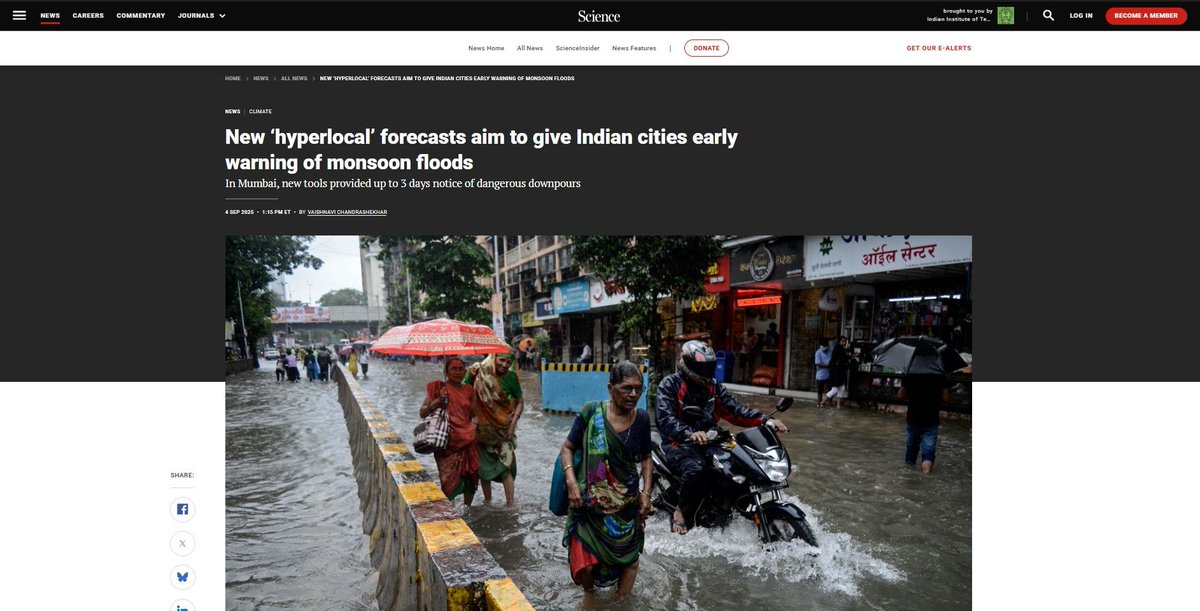
Excited to share that our work on Mumbai Extreme Rainfall & Flood Forecasting has been featured in @ScienceMagazine . https://t.co/PtHyfRUI9S Big thanks to HDFC ERGO IITB Innovation Lab for funding @iitbombay@ClimateIITB@EnggHead Our teammebers are tagged in the post
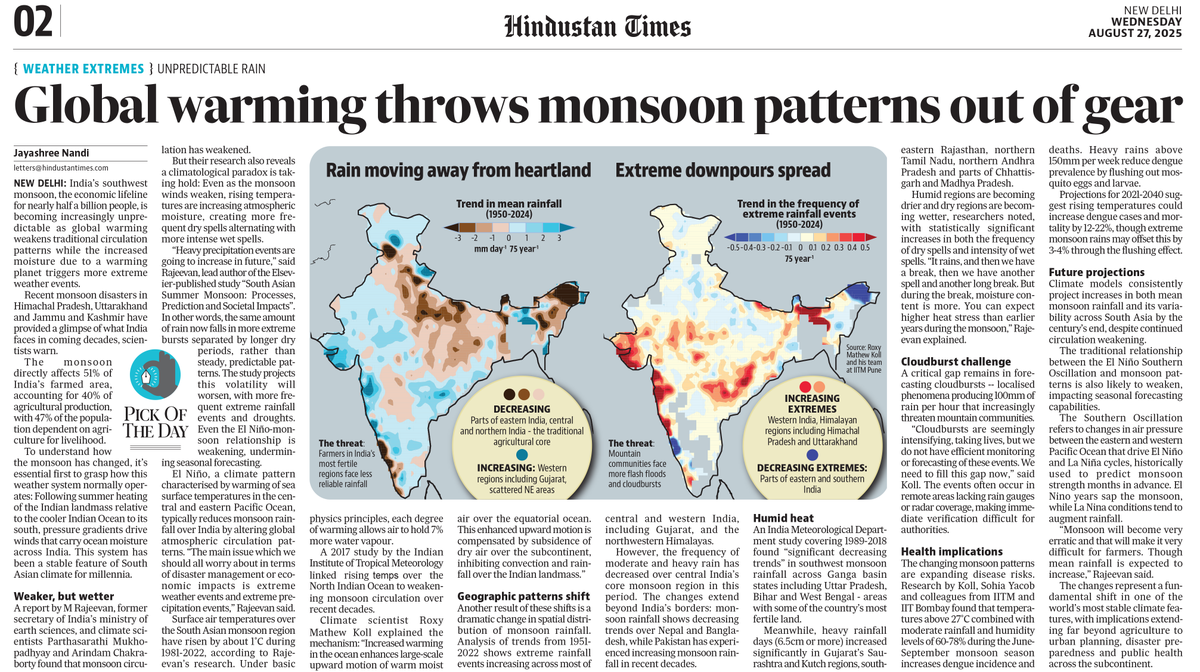
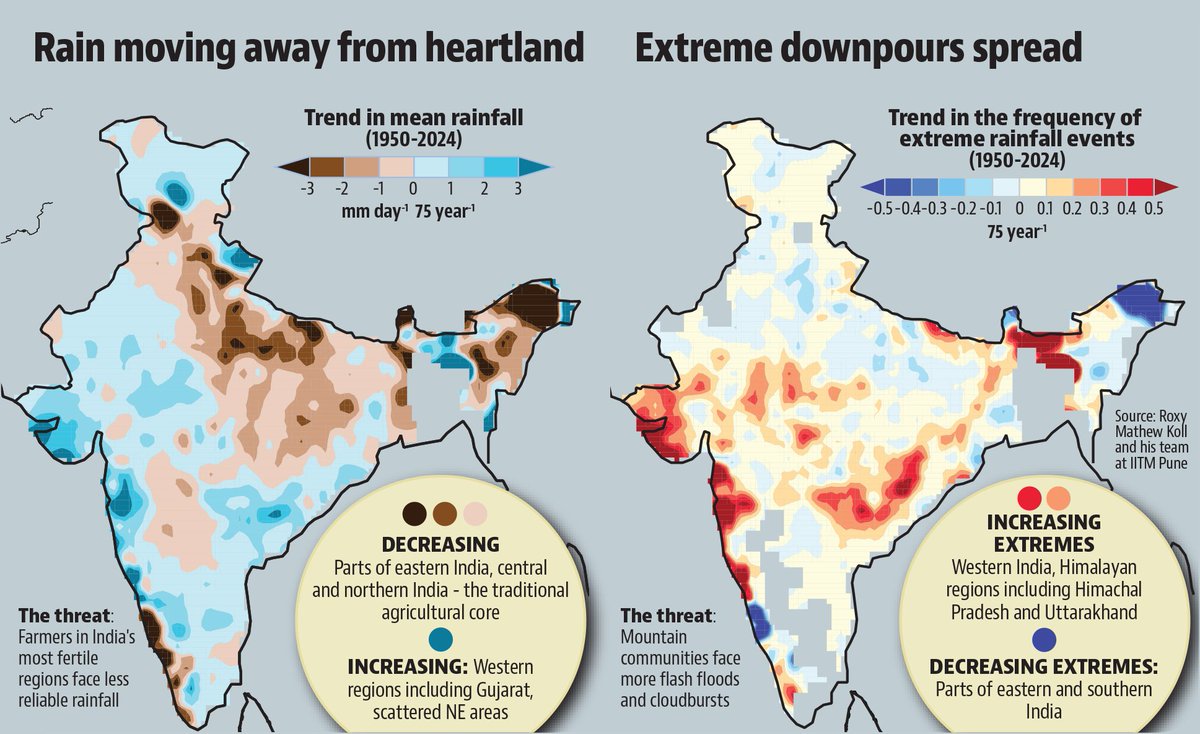
Global warming is rewiring the monsoon — mean rainfall patterns are changing, and extreme rain events are spiking across regions.
Our updated rainfall trend maps featured in today’s Hindustan Times by @jayashreenandi
Read: https://t.co/wlo9LHC1Hz
🌧️🌧️🌧️☔☔
🟧🟥Very Heavy rains forecasted for next few days in #Mumbai by our model.
Stay careful...
⚠️Report flood in your area via https://t.co/b2KMRSqXnk
Experimental daily rainfall forecasts, supported by HE-IITB Innovation Lab @HDFCERGOGIC.
#MumbaiRains
🚨⚠️ 🌧️☔️🌧️☔🚨⚠️
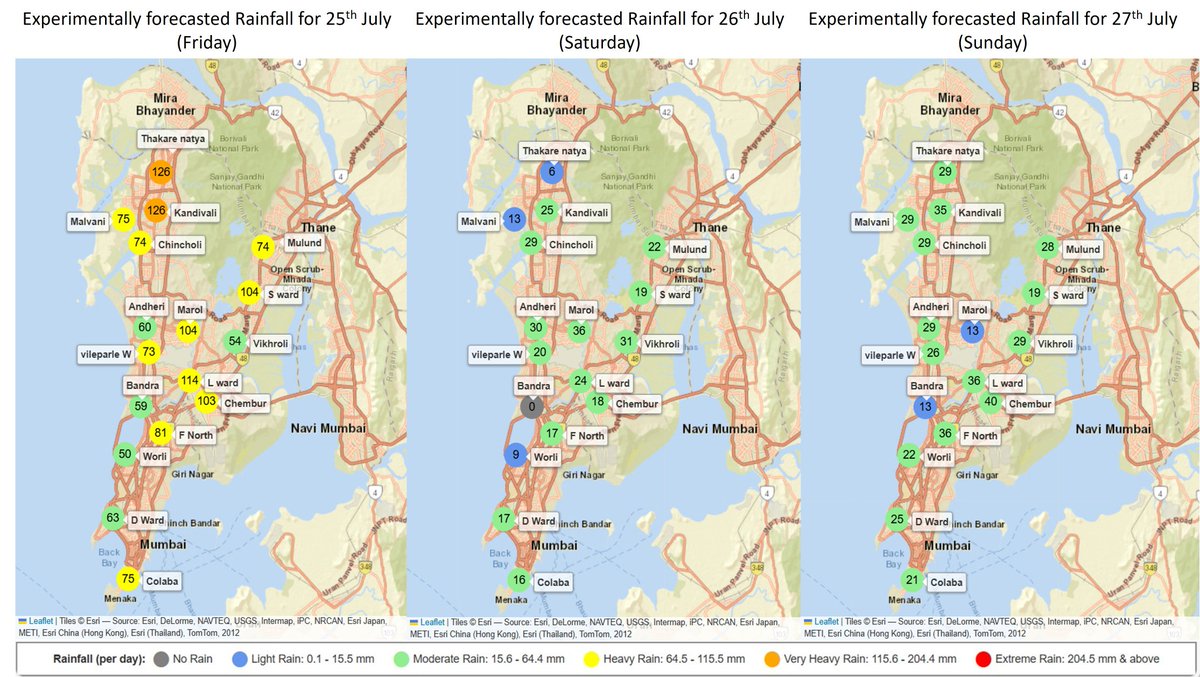
HEAVY Rainfall expected TOMORROW in most parts of Mumbai, VERY HEAVY in few.
Might reduce to Moderate the day after.
Experimental rainfall forecasts from @ClimateIITB sponsored by @HDFCERGOGIC#MumbaiRains
Hope this helps you plan your day ahead safely...
Light to Moderate Rainfall forecasted for tomorrow. Notably, 30th June shows widespread moderate rainfall, while 1st July continues with consistent moderate rain across Mumbai.
Experimental Rainfall Forecasts by @ClimateIITB sponsored by @HDFCERGOGIC#MumbaiRains