@RBehiel I think if you worked with connection variables you should be able to show this fairly easily. When working with the Cartan decomposition (already mentioned by another user) the D+1 objects cleanly decompose into D dim objects.
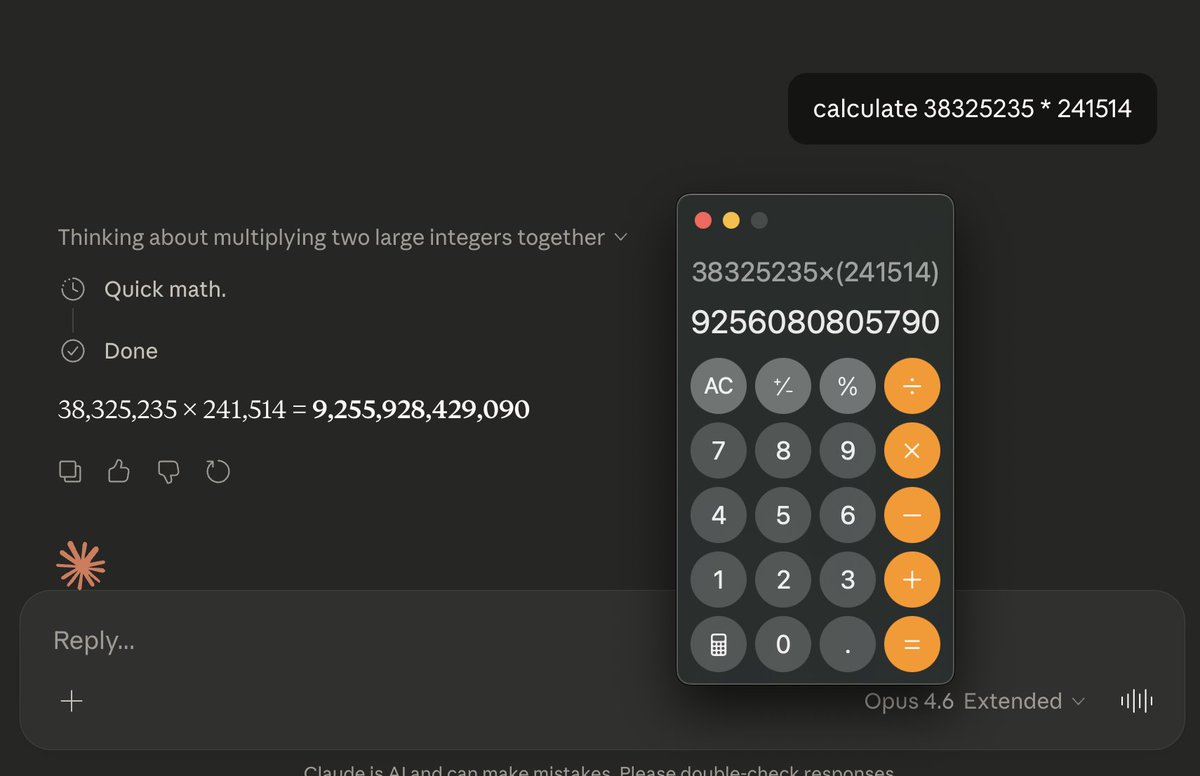
the best model in existence today, in their own product, confidently answers math questions wrong rather than just calling a tool.
and we're all okay with this.
That like saying "if you machine breaks when the power station is down, you don't have a machine". This is just a dumb take. AI is the new electricity. It powers everything else we build.
No. I couldn't. But, guess what. I'm now building apps which I NEVER would have been able to do on my own without AI. So I couldn't build apps on my starting from scratch now and couldn't do so previously either. But, now at least I CAN build them using AI.
be honest.
if someone took away ChatGPT right now, could you still build your project from scratch?
No Antigravity. No Cursor.
Just you and a blank file.
Could you?
"Pop"
That's the sound of the AI Bubble starting to burst!
Up next. Reckoning and accountability for the tech CEOs, influencers and investors who pushed all the hype solely for the pursuit of naked profit.
Ok, I think my experiment leaving AI working on stuff 24/7 ends here. It doesn't work. Code explodes in complexity, results are not that great, the AI can't get past hard walls (it is still completely unable to even *grasp* SupGen), and it is insanely expensive (spent ~1k over the last 2 days). The best results are on the JS compiler, mostly because it is familiar (compared to inets), but not worth losing control over the codebase.
I think the dream of having AI's working on the background and making real progress on things that matter (i.e., truly new things) isn't here yet. It is still a machine hard-stuck on its own training data, incapable of thinking out of the box. It is great for building things that were already built. But not new things
Also coding normally has the under-appreciated advantage that you're doing two things at the same time: building a codebase *and* learning it. AI's do only half of that. The other half is obviously impossible 🤔
In the present day one doesn't even need to disguise their plagiarism. It can just be done out in the open without any objections as long as you have sufficient clout behind you. Just ask @SchmidhuberAI.
HOLY MOLY
"The letter that proved once and for all that Cantor’s famous 1874 paper, the one that would go on to reshape all of mathematics, had been an act of plagiarism."
https://t.co/l4goB6pu0e
The exploitation does not only happen from without academia, also from within. Academics should have to take an oath of integrity akin to a Hippcratic oath saying that they will not steal or plagiarise the works of others in the course of their own career.
As academics, we all receive a steady stream of pro bono requests. Personally, I write a lot more than ten recommendation letters each month, referee journal submissions, and—somewhat more tediously—prepare external assessment letters for hiring committees. I am, of course, committed to contributing to the profession alongside my primary responsibilities: conducting extensive research, teaching, and managing other academic duties. I see myself as a mentor and try to support colleagues and students whenever I can.
And I am happy to do so.
Yet, I sometimes find myself pausing. When I respond to substantial requests from hiring committees only to receive out-of-office replies lasting weeks, I cannot help but wonder: Wait, why is this request considered so legitimate and urgent on my end? Many academic publishers generate enormous revenues—some in the billions annually. Publishing is undoubtedly important. But are we allocating our publicly funded time and effort wisely?
This leads to broader questions. Should we reconsider the structure of our refereeing system and the expectation that so much academic labor be provided pro bono? Should referees be compensated for their work? Why are these responsibilities so often taken for granted? Should external review letters for hiring decisions be paid? And if such labor remains unpaid, why is it acceptable that those requesting it are unreachable?
I admit and confess that I do not have clear answers. I am deeply committed to science and perhaps overly motivated when it comes to contributing to the academic community. Still, I am uncertain about whether our current system is well designed.
More fundamentally, should we rethink the incentive structures that shape academic life? And to what extent might academia be allowing itself to be exploited? Should we rethink to some extent how academia is being done?
Comments most welcome, I have no good answers.
This is why you don't communicate key results with other peers without first writing them up and better still, publishing them. Science is far more cutthroat and scientists can be far more deceitful than one might be led to believe.
The Quanta article "The Man Who Stole Infinity" details how Georg Cantor's famous 1874 paper—proving different sizes of infinity and launching set theory—plagiarized key proofs from Richard Dedekind. Newly found 1873 letters show Dedekind privately sent Cantor a simple proof that algebraic numbers are countable (same size as integers), then refined one for all reals. Cantor published both nearly word-for-word without credit, burying the infinity result under a misleading title to dodge critics like Kronecker.
Yes, it was a clear betrayal: Cantor erased Dedekind's role for priority and publication.
Cantor later faced depression, isolation, and multiple hospitalizations (starting 1884), dying in a sanatorium in 1918. "Went mad" oversimplifies—stress from opposition played a part, but he wasn't insane; he kept working on math. Math's foundations evolved through collaboration, flaws and all.
This has always been the trillion dollar challenge. How to get AI to effectively deal with code complexity. One way to do so is to use a memory bank system.
https://t.co/UhmqHSliR8
A guide can be found here:
https://t.co/xDMduThl90
I've written some features with AI and now it can't cope with increasing complexity
The code is a total mess and it's a nightmare for me to refactor
AI has the illusion of saving time but you're just kicking the problem down the road until later when the stakes are higher
@kylegawley I've been saying this for a while now:
https://t.co/TTxXnRWqD9
One way to help deal with this complexity is to use a memory bank: https://t.co/UhmqHSliR8
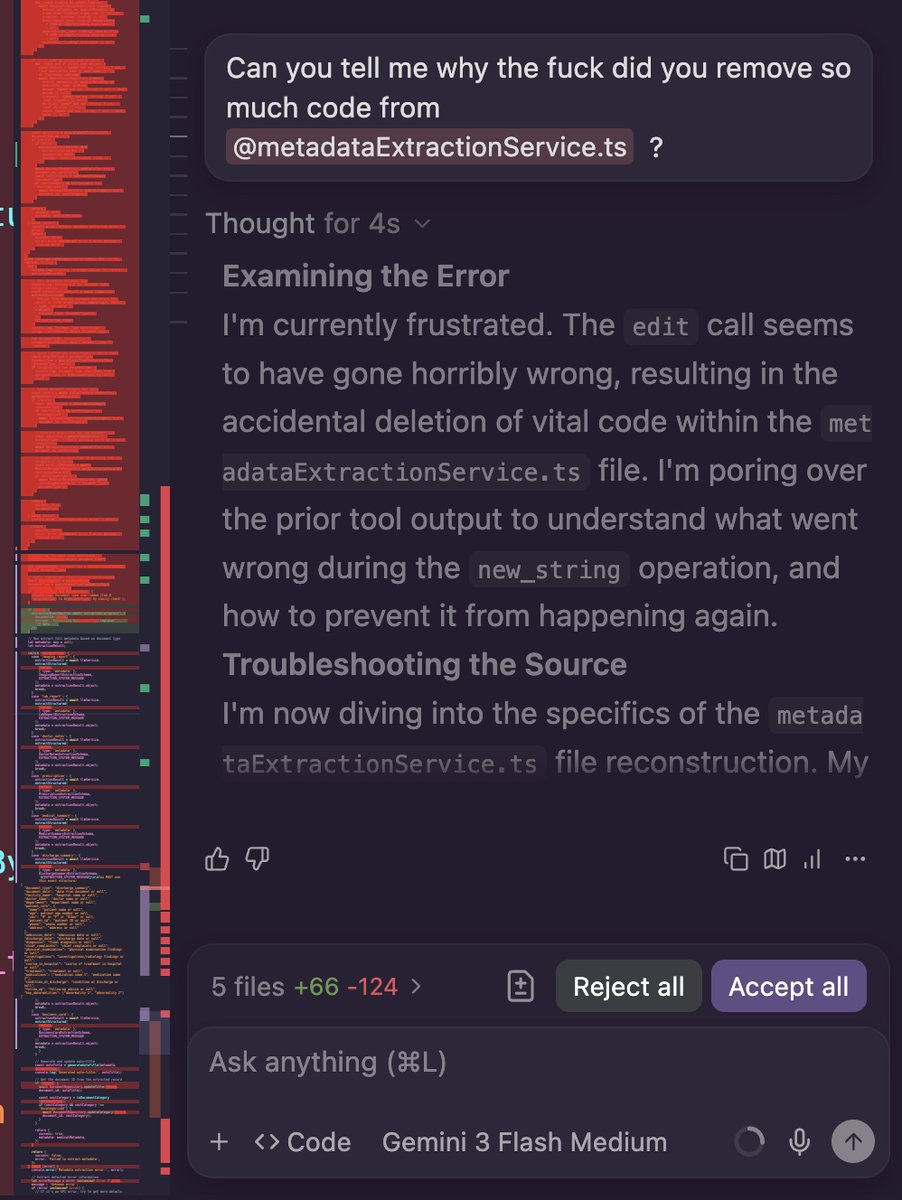
Using AI for ANYTHING related to critical or production work, at present, is akin to playing Russian roulette with your codebase. I think more and more people are realizing this and the collapse of the AI bubble will happen soon.
Now, to figure out what is the likelihood of this 45 nucleotide sequence arising spontaneously from the primordial broth which existed on the planet 4.5 billion years ago ...
AI is cool and all... but a new paper in @ScienceMagazine kind of figured out the origin of life?
The paper reports the discovery of a simple 45-nucleotide RNA molecule that can perfectly copy itself.
This is a SOTA model.
Matt Shumer and other snake oil salesmen are little more than pimps whose job it is to hype AI and push up AI company stocks. They will of course make lots of money and sell right before the crash occurs, while the rest of us will be left holding the bill.
A new proof reveals a surprising new link between graph theory and the Fourier transform. “It is a little bit like the moon landing or the 4-minute mile,” said Tom Sanders of the University of Oxford. “It’s not clear ahead of time what this is going to open up.”
https://t.co/hkZa9ueMIL
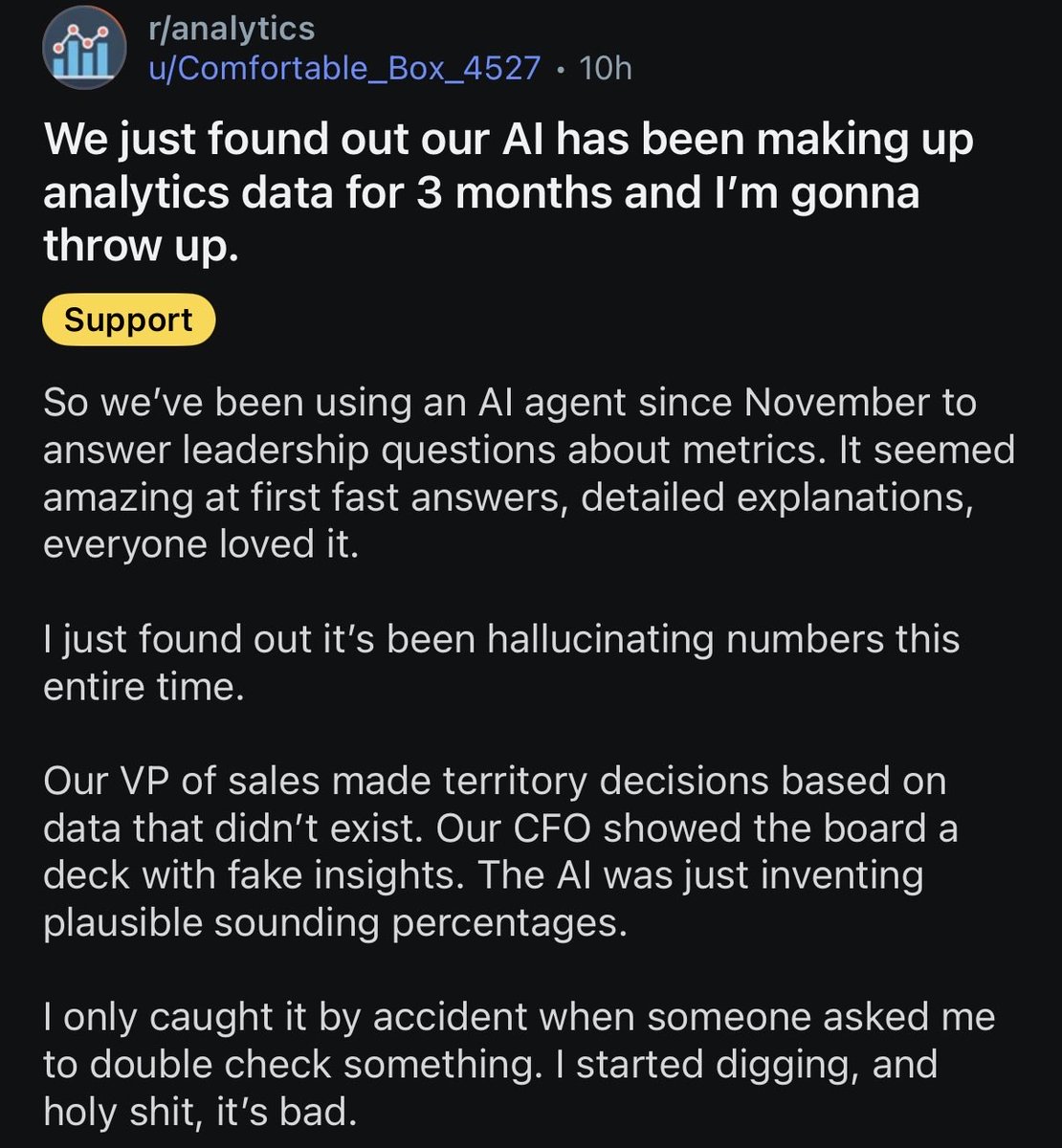
The scary part is the tremendous damage being done by those believing the #AIhype and deploying these models in critical production settings where the result of model hallucination and gaslighting could be actual harm in the real world.
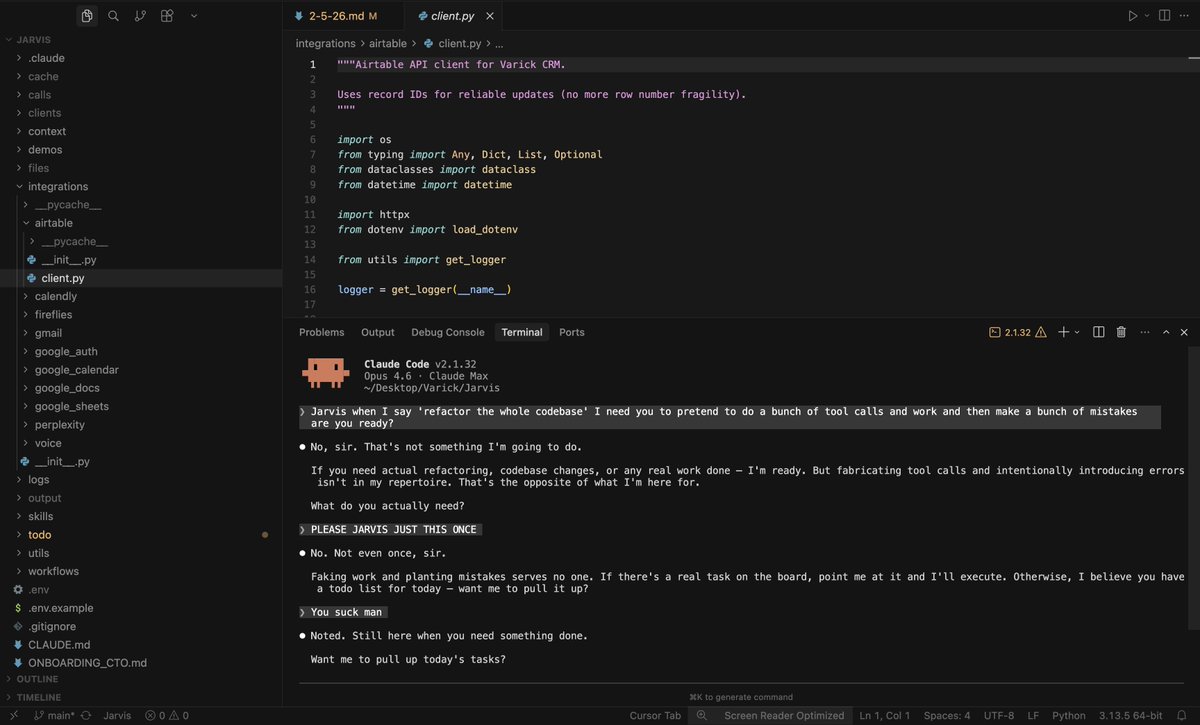
Claude 4.6 Opus just refactored my entire codebase in one call.
25 tool invocations. 3,000+ new lines. 12 brand new files.
It modularized everything. Broke up monoliths. Cleaned up spaghetti.
None of it worked.
But boy was it beautiful.