launched on product hunt sunday.
final score: 1 upvote. it was mine.
meanwhile the launch tweet got 5 builders in my replies, 3 of them asking how the ranking works. i'll take the conversations.
@ffugenw reply to 20 people a day who have the problem, about the problem, not your product. by day 3 one of them clicks your profile. that's user one.
valeri is live on product hunt today.
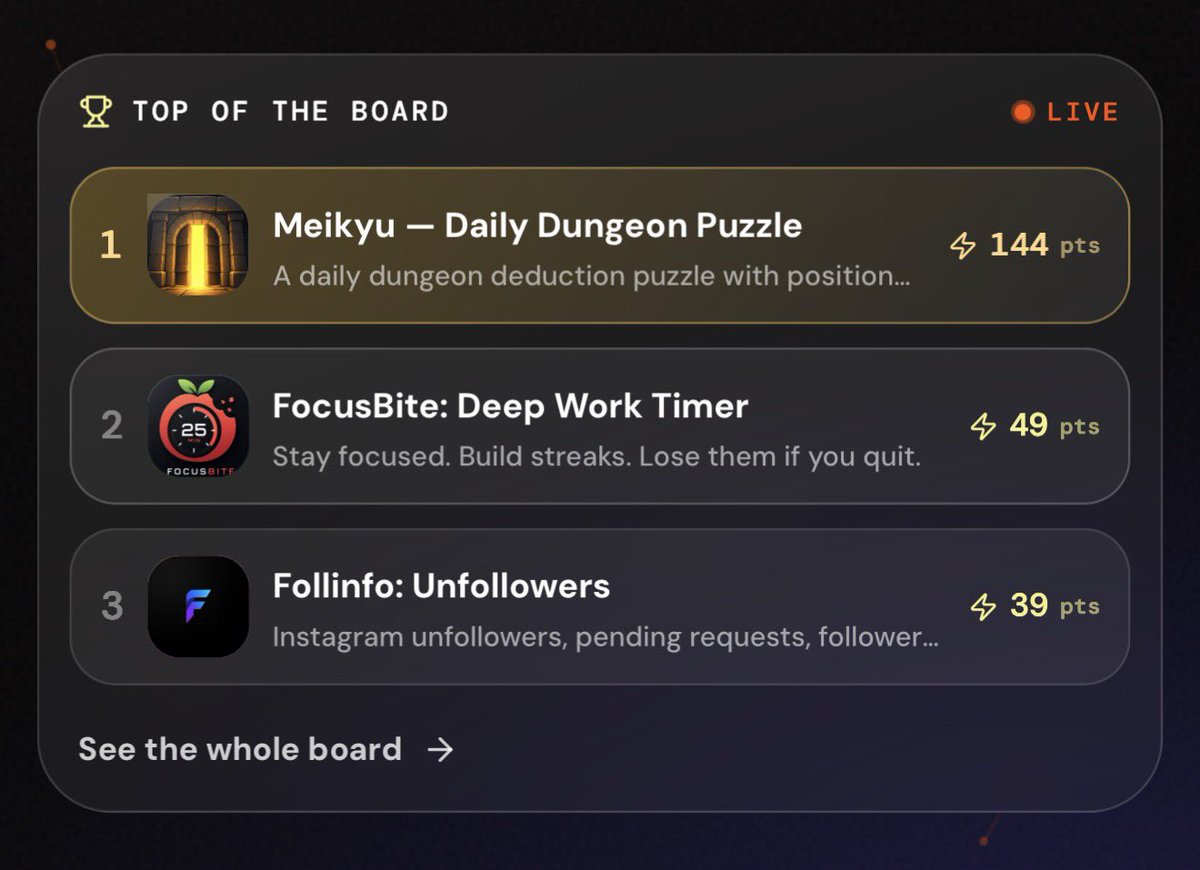
a board of indie games and apps where nobody can buy a rank. 173 listings, $0 MRR, one solo dev.
honest feedback welcome. roasts too.
@aitorapps by never selling one. points only come from players, one vote per person, and paid featured spots are labelled and worth zero points. the day a rank is for sale, the board stops meaning anything.
@leesy4231 only what players do: an upvote is 10 points, a review 12, a comment 4, plus a rating bonus that grows with the number of reviews. featured spots are labelled and add zero. the whole formula is on the about page.
@cmicpace reasoning, not data yet. a review takes more effort than an upvote so it's worth more (12 vs 10), comments are 4 so nobody farms them, and the rating bonus scales with review count so one 5-star can't outrank fifty. not enough votes yet to test it properly.
We spent so much time working on thousands of seemingly insignificant details to make this game good.
We thought about how every leaf should move, how leaves affect each other, how light passes through them, how they scatter when the character lands... Sometimes we'd spend days on a single animation. There were nights when getting something to finally work kept us awake, and times when nothing went as planned and we deleted everything and started over in tears.
We probably spent over 1.000 hours playing our own game just to make the character feel both responsive and smooth.
Then we started letting people play Leafborn for the first time.
They didn't care about the leaves. They just said the game felt good. They didn't even notice most of the details we'd worked so hard on...
4 sec later, they started beating up robots and didn't stop until the game was over.
All those things we'd spent days working on didn't really matter to them.
That's when we realized that we could spend an entire week thinking about a single detail, and the player would experience it for a few seconds and move on.
I guess that's one of the hardest parts of game development. Something that matters so much to you can be just a few seconds of someone else's experience.