After listening to the @Kee_Talk space with @Sukukfi ( well educated) and hearing him speak so positively about Keeta, I walked away with one main takeaway.
He said:
“I don’t hold $KTA tokens, but we’re going to be using KEETA Network for our benefit. We’re coming from a selfish point of view because this is a better solution than the majority of Fintechs we’ve worked with in the past.”
That statement is one I loved hearing, its validation to what a lot of us have been saying for quite sometime…
Keep in mind, they also referenced testing hundreds of other networks since 2019. They’ve had years to compare different technologies, architectures, and solutions, yet after all of that, they still see #Keeta as the better option!!
This isn’t someone promoting a token they own. It’s someone looking at the network from a purely practical standpoint and saying, essentially, “This works better for what we need.”
To me, that says far more than any marketing campaign ever could
🤙
NETWORK OF NETWORKS
Been seeing people posting about Sui hitting 6M+ TPS, so I actually went and read what they were doing.
The headline makes it sound like the blockchain itself processed 6 million transactions every second.
But that’s not what Sui’s own announcement says.
They achieved it through Sui Tunnels, where millions of actions happen off-chain first before being batched and settled back onto the blockchain.
Think of it like expense reports.
Keeta: You turn in every single receipt. Every purchase is individually processed and recorded.
Sui Tunnels: You total up all the receipts yourself, write “Total: $4,872,” and hand in that instead.
The total may be accurate, but the accounting system never processed every receipt individually.
That’s why I don’t think these TPS numbers are an apples-to-apples comparison.
If Keeta can process millions of transactions directly on Layer 1, then I think the bigger question is this:
Why build on a blockchain that has to move activity off-chain just to reach that scale, when another blockchain is designed to process that same activity directly on-chain?
To me, that’s the real innovation. Not finding new ways around the blockchain, but building one that doesn’t need to be worked around in the first place.
@KeetaNetwork $KTA @SuiNetwork@chainspect_app
The UAE-based investment group @askgroupae and U.S. blockchain company @KeetaNetwork have partnered to launch a public exchange where physical assets will be traded as fractional digital tokens
$KTA #keeta
https://t.co/bgB16wBQOc
(1/7) Keeta Personal is live!
Built to bring everyday banking, payments, and digital asset management into one application.
Users can now hold, manage, and move crypto, fiat, and other investments from a single platform.
"@KeetaNetwork is the missing link that enables all existing Web3 and TradFi systems to communicate with one another seamlessly."
We spoke with CEO @schenkty about cross-border payments, compliance and shared rails.
Read more 👇https://t.co/qdPma3SjhE
Everyone’s talking about Keeta Personal right now, but honestly I’m already more interested in what comes after it.
I think people are slowly starting to realize Keeta is building something different than anyone else in the space.
They’re building compliant financial infrastructure.
When you actually look at the architecture and SDK, the rollout path starts making a lot more sense.
Right now with Keeta Personal we already have:
- KYC/KYB
- fiat interoperability
- programmable transfers
- multi currency support
- identity integrated into the system
- real routing numbers and IBAN deposits
- FX conversion built directly into the rails
- compliance built into the transaction layer itself
Keeta Personal initially running through Bivo infrastructure is important too.
That tells you regulated rails, banking relationships and compliance layers are already being integrated into the system from day one.
Next is likely:
- more anchors
- more liquidity providers
- institutional integrations
- expanded payment and FX routing
And eventually:
RWAs.
I actually think tokenized T-Bills and treasury products likely come before tokenized stocks.
Why?
Because they make a ton of sense for what Keeta is building.
Imagine:
- global users holding yield bearing digital dollars
- instant movement across borders
- programmable settlement
- compliant onboarding already built in
- direct interoperability between fiat rails and tokenized treasury liquidity
That’s a pretty crazy combination when you think about it.
Especially because institutional demand for tokenized treasuries is already exploding.
You already see it happening with:
- Ondo
- BlackRock
- tokenized treasury products
- programmable finance infrastructure
And then you have projects like:
- Ondo
- Plume
- SHIFT RWA
all building toward tokenized finance and RWAs in different ways.
At some point all of these projects need the same thing:
- compliant settlement
- identity/KYC
- banking connectivity
- cross border interoperability
- liquidity routing
- programmable finance infrastructure
That is exactly what Keeta is architected for.
Tokenized equities are still a much bigger regulatory headache:
- SEC oversight
- broker dealer requirements
- custody
- settlement restrictions
- jurisdiction compliance
That stuff takes time.
Which is why when Ty talks about “tokenized stocks on Keeta” I don’t necessarily think that means Keeta itself becomes the stock issuer.
I think it means Keeta becomes the compliant routing and settlement layer underneath tokenized financial systems.
That honestly fits the architecture way more:
- anchors
- identity layers
- programmable settlement
- multi currency routing
- institutional interoperability
No proof any of these projects are directly partnered with Keeta.
But I believe the direction everything is moving is getting a lot easier to see.
@KeetaNetwork $KTA
@schenkty In my experience you have to design properly then give it llm . If u leave it to llm trust me after some point u will lose track of it. Everything has to be design first and then ask it to implement
Lightchain AI Mainnet Launch: The Beginning of Community-Governed Decentralized AI
Today marks a defining milestone for Lightchain AI.
After a long road of development, testing, refinement, governance discussions, community feedback, infrastructure upgrades, and continued belief from supporters across the ecosystem, Lightchain AI has reached mainnet.
This is not just a network launch.
This is the beginning of Lightchain AI as a live decentralized AI ecosystem.
It is the beginning of a new phase for AI infrastructure that is not controlled by a central authority. It is the beginning of broader community participation, builder access, worker deployment, open development, DAO governance, and decentralized AI applications built on top of Lightchain.
The voice of the community has continued to drive Lightchain forward. That same voice continues to drive the Lightchain DUNA. This launch marks the start of Lightchain AI becoming what it was always intended to be: a community-led decentralized AI network where governance, development direction, participation, and ecosystem growth are shaped by the people who build, support, and use the network.
Mainnet is live.
The next chapter begins now.
Mainnet Explorer Is Live
The Lightchain AI mainnet explorer is now available:
Mainnet Explorer: https://t.co/wClsQvPuXz
The explorer gives the community visibility into mainnet activity, including blocks, transactions, contracts, accounts, and network-level data. As mainnet activity grows, this will become one of the most important places for users, builders, workers, and contributors to track the live state of the Lightchain ecosystem.
Mainnet transparency matters.
A decentralized AI network should be visible, verifiable, and open for the community to observe. The explorer is a key part of that foundation.
Bridge to Mainnet
Users can begin accessing mainnet through the Lightchain Bridge:
Bridge to Mainnet: https://t.co/hbbWCEA4Ca
The bridge is an important piece of the mainnet rollout because it allows users to move into the live Lightchain ecosystem and begin preparing for the next phase of participation.
As always, users should verify that they are using official Lightchain links before interacting with any bridge, wallet, explorer, DEX, DAO, launchpad, or ecosystem application.
Updated Mainnet Worker Documentation
Workers can now begin preparing for mainnet participation using the updated worker documentation:
Run a Worker on Mainnet: https://t.co/6U2fwj0l0Z
Workers are a core part of Lightchain AI. The updated mainnet worker guide describes workers as the supply side of the network, running whitelisted models through Ollama, operating alongside the Worker Sidecar, serving encrypted inference jobs through the Worker Gateway, and earning fees for completed jobs.
The updated mainnet guide also outlines the full worker lifecycle, including prerequisites, mainnet network references, worker key generation, model setup, funding, on-chain registration, running the worker, verifying activity, rewards, slashing and jailing considerations, deregistration, and mainnet contract references.
This is one of the most important participation layers in the Lightchain AI network.
Workers help turn decentralized AI from an idea into an operating network. They allow inference workloads to be served through distributed participation rather than centralized control. They give contributors a path to support the network directly. They also help create the foundation for decentralized AI applications that rely on live, community-powered infrastructure.
Mainnet worker participation is now a major focus for the ecosystem.
Chat Inference Update: Signature Requirement Removal Is a Priority
At launch, inference on chat currently requires a signature.
This is already a priority update.
In the next update, removing the current signature requirement for chat inference will be a key focus so that the user experience becomes smoother, faster, and easier to access.
This matters because Lightchain AI is not only building infrastructure for developers and workers. It is also building toward AI experiences that normal users can interact with without unnecessary friction.
The goal is to make decentralized AI feel simple, accessible, and usable.
The first version of mainnet chat inference is part of the launch foundation. The next priority is improving that flow so users can interact more naturally while the network continues to mature.
DAO on Mainnet: No Wrapping Required
The Lightchain DAO will also be moving into the mainnet phase soon.
A key point for the community: DAO participation on mainnet will not require wrapping.
This is important because governance should be as direct and accessible as possible. The Lightchain DAO is not meant to be a closed process or a governance layer controlled by a central party. It is meant to be the voice of the community.
The DAO moving to mainnet without requiring wrapping helps simplify participation and keeps the governance experience aligned with the broader goal of open, community-led decision-making.
The Lightchain DUNA continues to be driven by the community, and the DAO will remain one of the most important mechanisms for shaping the direction of the ecosystem.
Lightchain AI was built around the principle that decentralized AI should not have a central authority deciding everything behind closed doors. The community must have a real role in shaping the network.
Mainnet DAO participation is a major step toward that future.
Meme Launchpad Coming Soon
The Meme Launchpad will also be coming soon as part of the continued mainnet rollout.
This adds another important piece to the Lightchain ecosystem by giving the community more ways to create, launch, experiment, and participate in new token activity on mainnet.
The Meme Launchpad will help expand community-driven creation inside the Lightchain ecosystem. It gives users and builders another path to bring ideas to life, create culture around the network, and support broader ecosystem activity.
Mainnet is not only about infrastructure.
It is also about participation.
It is about giving the community tools to create.
It is about giving builders and users more ways to activate the network.
The Meme Launchpad will be part of that next stage.
DEX Coming Soon — Builders Can Start Building Today
The Lightchain DEX is also coming soon.
This will be another major component of the mainnet ecosystem, giving users a native place to trade, interact with liquidity, and support token activity across the network.
But importantly, builders do not have to wait.
Builders can openly create and build a DEX on Lightchain starting today.
Mainnet is open for builders.
Developers who want to experiment with decentralized exchange infrastructure, liquidity tools, trading interfaces, DeFi applications, token launches, AI-powered market tools, or ecosystem-specific financial applications can begin building now.
This is an important message for the entire builder community:
Lightchain AI mainnet is not a closed environment.
It is open infrastructure.
The ecosystem is not limited to one team, one application, one product, or one central authority. Builders can create. Developers can experiment. The community can propose, launch, test, and improve. That is how a decentralized ecosystem grows.
The upcoming DEX will be an important part of the Lightchain ecosystem, but the opportunity for builders begins immediately.
Mainnet Is the Foundation, Not the Finish Line
The mainnet launch is a major achievement, but it is not the end of development.
It is the beginning of the next development phase.
Over the next several months, Lightchain AI will continue rolling out development updates periodically. The community should expect regular updates as new features, improvements, infrastructure upgrades, governance tools, ecosystem applications, and user experience refinements continue to be released.
This continued rollout will include work across several important areas:
Chat inference improvements, including removal of the current signature requirement.
Mainnet DAO rollout with no wrapping required.
Meme Launchpad release.
DEX release and broader DeFi ecosystem development.
Open builder support for DEX and decentralized applications.
Worker onboarding and worker network growth.
Mainnet explorer improvements and network visibility.
Bridge monitoring and mainnet flow improvements.
Model governance expansion.
Developer tooling improvements.
AI application infrastructure.
Continued AIVM-related development.
Governance updates through the community and Lightchain DUNA.
Periodic public updates over the next several months.
Mainnet gives the ecosystem a live foundation.
Now the work shifts toward expansion, refinement, adoption, and community-led growth.
Workers: A Core Layer of Decentralized AI
One of the most important next steps for Lightchain AI is growing the worker network.
Workers are essential because they help provide the infrastructure required for decentralized inference. They run models, connect to the network, process jobs, and support the broader AI execution layer.
The updated mainnet worker documentation gives operators a clear path to begin participating:
Mainnet Worker Docs: https://t.co/6U2fwj0l0Z
The guide includes important mainnet details such as RPC information, chain ID, Worker Gateway, model requirements, staking requirements, worker setup, and verification steps. The documentation notes that mainnet LCAI has real value and users should double-check every address, RPC URL, and chain ID before signing transactions.
This is an important caution for all mainnet participants.
Mainnet is live infrastructure.
Transactions matter.
Keys matter.
Addresses matter.
Users should take the time to read documentation carefully, verify official sources, and understand the steps before deploying a worker or moving funds.
Developers: Start Building on Mainnet
Lightchain AI mainnet is open for builders.
This is one of the most important parts of the launch.
Builders can start creating applications, tools, interfaces, dashboards, governance utilities, DeFi products, DEX infrastructure, launchpad concepts, AI applications, model tooling, and ecosystem experiences today.
The Lightchain ecosystem is not meant to be a single app or a single product.
It is meant to become a decentralized AI network with many layers of contribution.
That includes:
Workers providing AI inference capacity.
Builders creating applications and tools.
Users interacting with AI and ecosystem products.
DAO participants shaping governance.
Token holders supporting the network.
Community members proposing ideas.
Developers expanding DeFi and DEX infrastructure.
Contributors helping improve documentation, education, and adoption.
Mainnet opens the door for all of this.
The more builders that participate, the stronger the ecosystem becomes.
The Community Drives the Future of Lightchain AI
The Lightchain AI mainnet launch is a technical milestone, but it is also a community milestone.
This project has reached this point because the community continued to believe in the vision of decentralized AI.
That matters.
The Lightchain DUNA continues to be driven by the voice of the community. This is not a network built around a single authority deciding the future of AI infrastructure for everyone else. It is a network built around participation, decentralization, governance, and open development.
The community is the force behind Lightchain AI.
The community pushed the vision forward.
The community will continue to shape what comes next.
And the community will remain central as the DAO moves further into mainnet, as builders create new applications, as workers come online, as the DEX and Meme Launchpad roll out, and as decentralized AI becomes more usable, more visible, and more powerful.
True decentralized AI cannot be built behind closed doors.
It must be built in the open.
It must be governed by the people who use it.
It must allow builders to build without permission.
It must allow contributors to participate without relying on a central gatekeeper.
It must allow governance to evolve through the community.
That is the purpose of Lightchain AI.
The Next Several Months
The next several months will be an active rollout period.
The team and community will continue releasing updates periodically as development progresses. These updates will cover the next stages of mainnet infrastructure, application releases, DAO activation, worker improvements, DeFi tools, launchpad development, chat improvements, and broader ecosystem growth.
Some updates will be technical.
Some will be governance-related.
Some will focus on user experience.
Some will focus on builders.
Some will focus on workers.
All of them will move Lightchain AI closer to the long-term goal: a decentralized AI ecosystem with no central authority, powered by community participation and open development.
The launch of mainnet is the moment where the network begins its next phase.
But the rollout continues.
The building continues.
The governance continues.
The community continues.
Key Mainnet Links
Bridge to Mainnet:
https://t.co/hbbWCEA4Ca
Mainnet Explorer:
https://t.co/wClsQvPuXz
Run a Worker on Mainnet:
https://t.co/6U2fwj0l0Z
A Long Road to a New Beginning
It has been a long time to reach this goal.
Mainnet represents years of vision, development, discussion, community patience, and continued belief in what Lightchain AI can become.
There have been many steps along the way. Testnet progress. Documentation updates. Governance conversations. Infrastructure improvements. Worker development. Bridge preparation. Ecosystem planning. Community debate. Builder interest. DAO formation. Technical refinement.
All of it led to this moment.
But this is not the end.
This is the beginning.
Lightchain AI mainnet is now the foundation for the next era of decentralized AI.
The bridge is open.
The explorer is live.
The updated worker documentation is available.
DAO on mainnet is coming soon and will not require wrapping.
The Meme Launchpad is coming soon.
The DEX is coming soon.
Builders can begin creating and building a DEX today.
Chat inference improvements are already a priority, with the current signature requirement planned to be removed in the next update.
Regular development updates will continue over the next several months.
The community remains the voice of Lightchain DUNA.
And Lightchain AI continues forward as a decentralized AI network with no central authority.
This is the beginning of Lightchain AI on mainnet.
This is the beginning of community-governed decentralized AI.
This is the beginning of a network shaped by builders, workers, users, contributors, token holders, and the community itself.
The future of decentralized AI starts here.
A tool designed to detect DeFi rug pulls just scanned a Layer 1 governance token and called it a critical risk.
That is not analysis. That is a category error.
Sentinacle is an automated scanner built for one specific purpose. It looks at anonymous DeFi projects with unverified contracts and unknown teams and asks: does this look like a rug pull?
Applied to those projects it is a useful tool.
Applied to KTA it is the correct tool used on the wrong asset entirely.
Here is what Sentinacle cannot see.
KTA is not a DeFi token. It is the governance token for a Layer 1 blockchain. The ERC-20 contract on Base is a wrapped representation for trading liquidity. The actual token, the actual governance, and the actual network all live on Keeta mainnet. Scanning the Base wrapper for rug pull signals is like running a smoke detector on a photograph of a fire.
Here is what Sentinacle also cannot see.
Keeta Inc is a Delaware corporation. CIK 0001927907. Registered with the SEC. Formerly LFG Payments Inc. Signed by Ty Schenk as President. Operating address 730 Arizona Avenue Santa Monica CA.
Keeta Financial Services Inc holds FinCEN MSB registration. Federal BSA and AML obligations active since April 2025. The same compliance sequencing followed by Circle, Ripple, and Paxos before their institutional relationships matured.
Anonymous teams rug pull. Registered companies with SEC filings and federal compliance obligations do not disappear overnight.
Sentinacle scored KTA 20 out of 100. It gave that score to a company with a public founder, a registered operating entity, federal regulatory obligations, a verified FinCEN MSB number, and a network that shipped four releases and ten pull requests in four days last week.
The score tells you nothing about Keeta. It tells you everything about the limits of the tool.
An automated scanner has one job. Pattern match against its training data. If the pattern does not match a known rug pull it flags it as suspicious. If the pattern does not match a known safe DeFi protocol it flags it as suspicious. KTA is neither. It was never going to score well on a tool that does not have a category for Layer 1 governance tokens from registered companies.
This is not a new type of FUD. It is a recurring one.
The correct observation applied to the wrong framework produces fear. The correct observation applied to the correct framework produces clarity.
KTA on Base is a trading wrapper. The governance lives on mainnet. The company is registered. The compliance obligations are federal. The team is public. The code ships every week.
No rug pull checklist was designed for this. That is not a weakness. That is the point.
https://t.co/5uRQmayWd7
https://t.co/p5nfZybUUO
https://t.co/vv8KuUuYf2
Ran $10k USD to EUR through Wise, Revolut, and my Keeta Route Engine at the same time using the same rates
Wise shows about €8,619 to €8,627 received and even differs inside its own UI. In one view they show a $35.90 fee, in another it’s “included” and discounted, so it looks cleaner than it actually is
They also show Chase around €8,437 received and Wells Fargo around €8,384 received which shows how much gets eaten on bank rails
Revolut shows about €8,638 received and explicitly lists about $86 in fees which is mostly FX spread and plan based pricing
Keeta route about €8,668 received
That’s roughly €30–€50 more vs Wise, about €30 vs Revolut, and over €200 vs traditional banks
Not only that, but much faster
Wise says about 2 hours. Keeta routes in seconds
That is the difference
More middlemen = more cost and slower speed
More shows up on the other side and it gets there faster
This is why Keeta will win adoption. It just makes too much sense to leave money on the table when Keeta is simply plug and play with their anchor system
Screenshots below
https://t.co/HyhzP94fo6
@KeetaNetwork $KTA
Global bank accounts in 190+ countries.
20+ tokenized fiat currencies.
Local deposits in 7 regions.
Global SWIFT deposits.
FX Atomic swaps.
20+ blockchain rails.
90+ fiat rails.
24/7/365.
11M+ TPS.
Native Digital Identity.
Complete Global KTA Clearinghouse.
We here to win.
10M TPS isn’t hype.
It’s preparation for the next generation of finance.
As global payments, markets, and day-to-day finance move on-chain, transaction volume will reach levels most networks were never built to handle.
@KeetaNetwork is a first of its kind payment network
They’re taking on global payments with an open network and also offering a flagship service on top
The bank acquisition helps Keeta inc. negotiate with banks as regulatory equals.
Moreover they’ll be gutting the acquired bank and running it completely on blockchain.
This blockchain-first (and only) bank will offer seamless international transactions through the Keeta Pay app. This is a competitor to Revolut, Wise, etc.
The acquired bank will serve as a reference to other established banks on how to go onchain.
$KTA doesn’t compete with existing banks, as it’s an infrastructure player. The bank is only for global payments – no lending
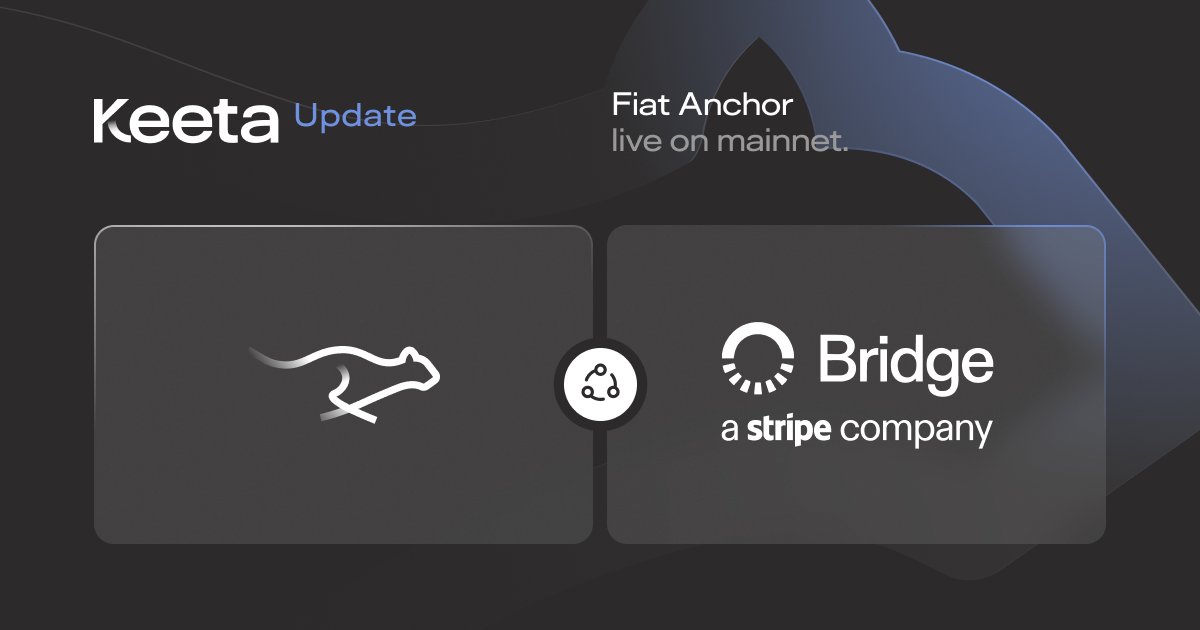
(1/3) We’re excited to announce that Bridge @Stablecoin is now live as the first Fiat Anchor on Keeta Network!
Bridge enables seamless movement between fiat and stablecoins, allowing users to deposit or withdraw directly to and from their bank accounts with speed and reliability.
$KTA
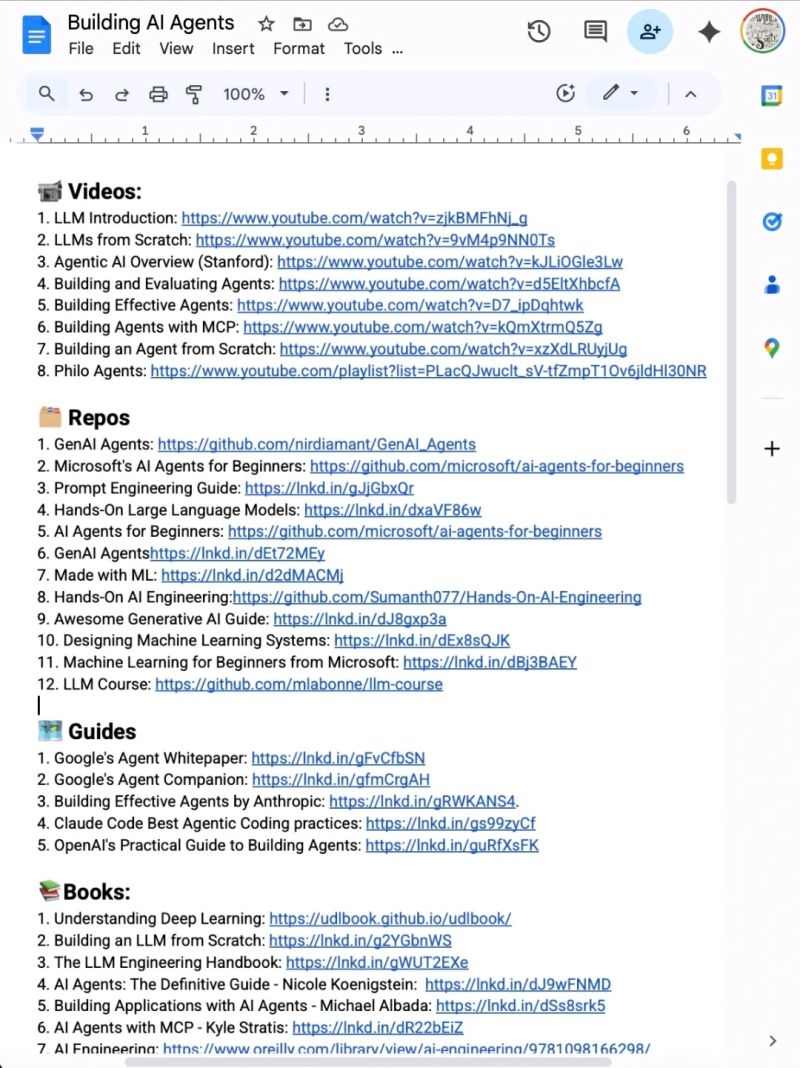
Stop wasting hours trying to learn AI. 📘📚
I have already done it for you.
With one list. Zero confusion. And no fluff
📹 Videos:
1. LLM Introduction: https://t.co/Avq3pNZxWY
2. LLMs from Scratch: https://t.co/nGJGCQYi89
3. Agentic AI Overview (Stanford): https://t.co/1JbA2JypnJ
4. Building and Evaluating Agents: https://t.co/02o8b7RAS2
5. Building Effective Agents: https://t.co/Jw0cd23A3K
6. Building Agents with MCP: https://t.co/9uvcpin1j9
7. Building an Agent from Scratch: https://t.co/QiYCLK48tn
8. Philo Agents: https://t.co/TCSX4hnKRf
🗂️ Repos
1. GenAI Agents: https://t.co/VdfLWAA3wW
2. Microsoft's AI Agents for Beginners: https://t.co/3SpFdnMcQa
3. Prompt Engineering Guide: https://t.co/4W7Eh6NKaE
4. Hands-On Large Language Models: https://t.co/LEtKGYBdgU
5. AI Agents for Beginners: https://t.co/3SpFdnMcQa
6. GenAI Agentshttps://lnkd.in/dEt72MEy
7. Made with ML: https://t.co/sL3gbmGUky
8. Hands-On AI Engineering:https://t.co/J79go1Ivlo
9. Awesome Generative AI Guide: https://t.co/xXF08rY8zP
10. Designing Machine Learning Systems: https://t.co/Q39XZLn50b
11. Machine Learning for Beginners from Microsoft: https://t.co/vfkyHL1Gnx
12. LLM Course: https://t.co/wuDkhQ0572
🗺️ Guides
1. Google's Agent Whitepaper: https://t.co/BSjthrG81u
2. Google's Agent Companion: https://t.co/wdzh5zuSvp
3. Building Effective Agents by Anthropic: https://t.co/HmYVgMIA7l.
4. Claude Code Best Agentic Coding practices: https://t.co/H3JpJWlpp3
5. OpenAI's Practical Guide to Building Agents: https://t.co/G1TL1Z2TR3
📚Books:
1. Understanding Deep Learning: https://t.co/EEqkGL7lHe
2. Building an LLM from Scratch: https://t.co/8Ehn91NNxE
3. The LLM Engineering Handbook: https://t.co/yzvXeQAgtV
4. AI Agents: The Definitive Guide - Nicole Koenigstein: https://t.co/FKEzpBewe4
5. Building Applications with AI Agents - Michael Albada: https://t.co/nvBaoR6FxZ
6. AI Agents with MCP - Kyle Stratis: https://t.co/u0M1GfBlsL
7. AI Engineering: https://t.co/A2QxhrpmDc
📜 Papers
1. ReAct: https://t.co/Vbc3vWxQHO
2. Generative Agents: https://t.co/PvNHYnqsOD.
3. Toolformer: https://t.co/HFdds582DI
4. Chain-of-Thought Prompting: https://t.co/GxX5BxXLzV.
🧑🏫 Courses:
1. HuggingFace's Agent Course: https://t.co/zhizqjunzS
2. MCP with Anthropic: https://t.co/LqDZ0oCRfj
3. Building Vector Databases with Pinecone: https://t.co/ncqSVaVHqH
4. Vector Databases from Embeddings to Apps: https://t.co/JOl7SIlguq
5. Agent Memory: https://t.co/5m0UrGwDM9
Repost for your network ♻️
&follow for more stuff on building AI Agents.
The market has begun to outgrow the infrastructure it runs on.
Scalability matters more than ever as blockchain adoption accelerates across industries and institutions.
$KTA