@NoContextDutch1 Mijn vrouw doet precies hetzelfde als wij in Nl zijn, zomer's met de paraplu naar de markt om de huid te beschermen, wat overigens heel normaal is in Azie
SWIFT "coordinates" money on-chain. XRPL "moves" money on-chain. For final settlement the 11,500 member banks could choose SWIFT's legacy rails or L1's not specifically designed to move value, but why would they?
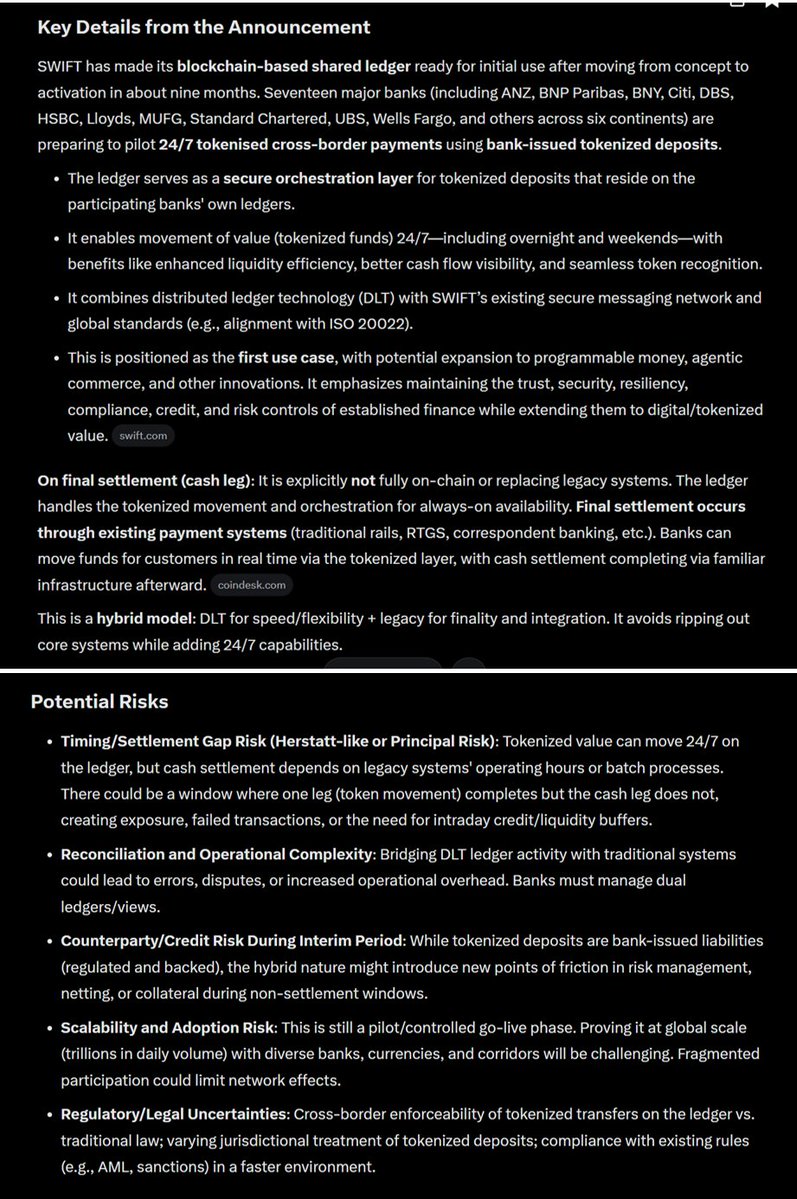
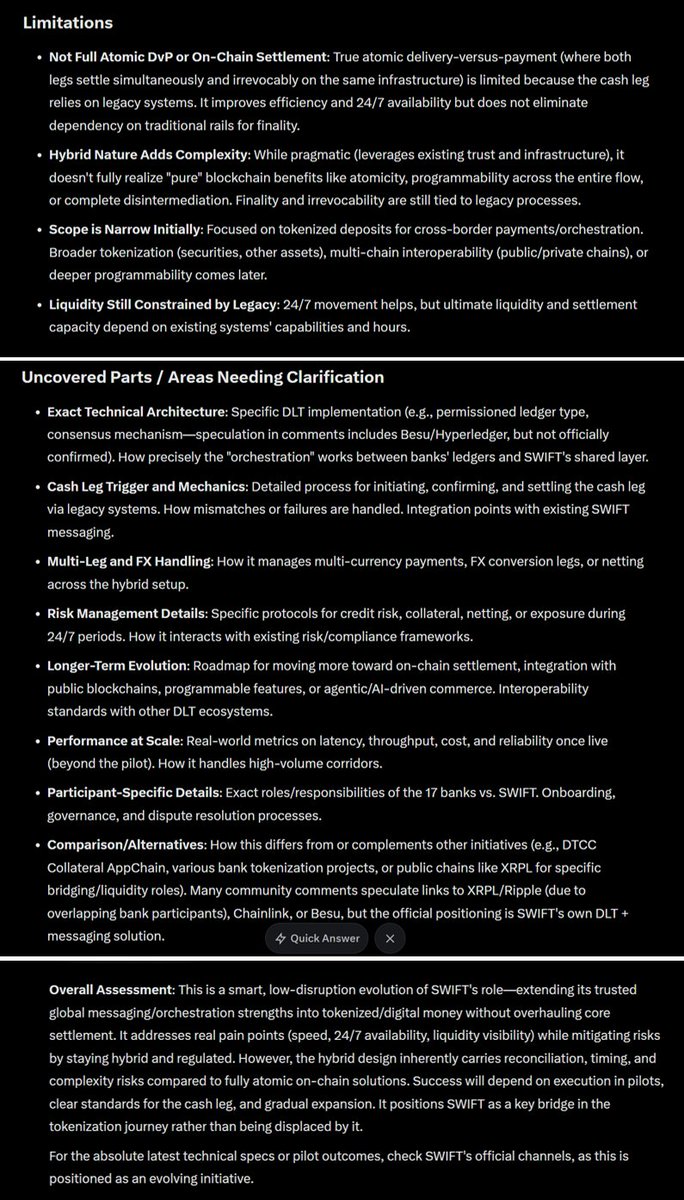
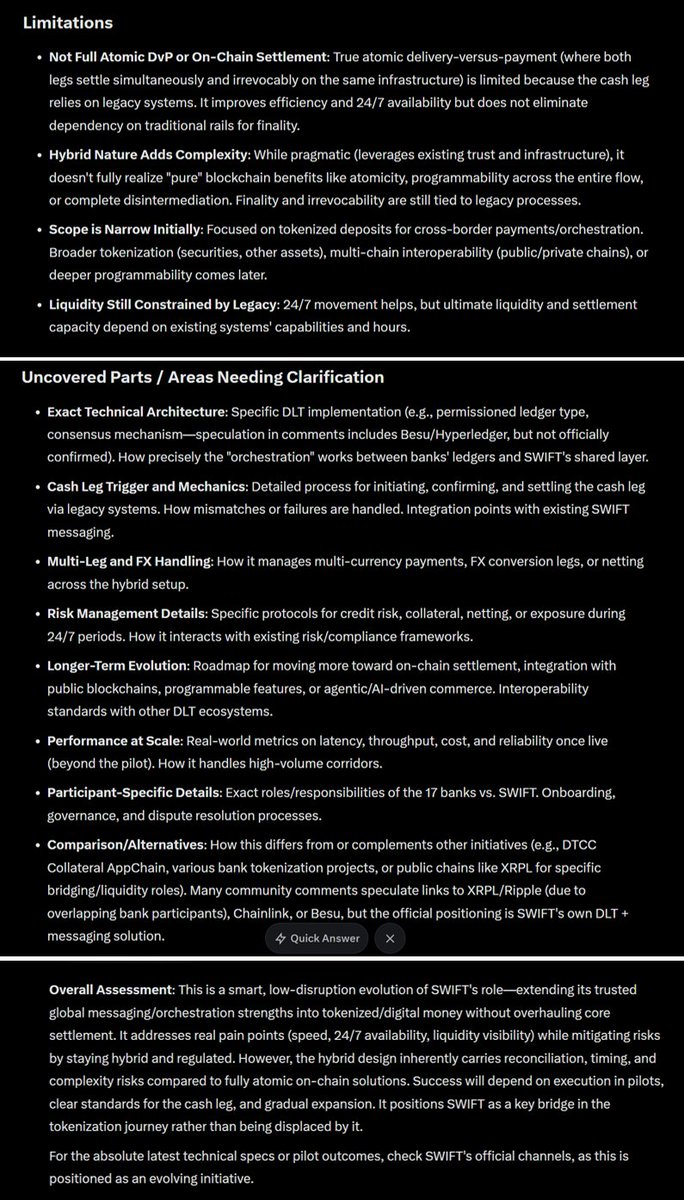
@SMQKEDQG@OGBLACKGHOST@TomZschach SWIFT's shared ledger doesn't cover final settlement on-chain. Despite tokenized funds, settling the cash/value leg is still done via legacy rails. And it comes with risks, limitations and other uncovered parts. OR member banks can just choose to settle on XRPL (API, Thune, etc)
@CatfishFishy It just an improvement of SWIFT but does NOT cover final settlement/cash leg apart from other uncovered parts. It still has risks and limitations! Read below.
@heythereRich It just an improvement of SWIFT but does NOT cover final settlement/cash leg apart from other uncovered parts. It still has risks and limitations! Read below.
OUSD... OpenStandard... Open. Standard.
Open Coin? The name of Ripple, prior to becoming Ripple.
Standard Chartered? The name of Ripple's subsidiary, the trust that issues RLUSD, with BNY Melon as custodian.
This is Ripple getting the Clarity Act over the finish line, aligning banks with the vision that Ripple's wanted all along. Give up some market share on RLUSD, while XRP acts as a trojan horse handling the backend settlement which accrues to Ripple's benefit.
Now, watch Ripple acquire Circle and get the best of both worlds: stablecoin dominance + XRP appreciation.
Do you understand?
They’re not making it obvious. They never do. But if you understand, it's hard to not see it...
A coalition of 140+ heavyweights (Visa, Mastercard, Stripe, BlackRock, Coinbase, Ripple and more) launching a shared-governance stablecoin with zero mint/redeem fees, shared reserve yields, and no single issuer capturing the upside. This inverts the old model and directly attacks the economics that have kept Circle & Tether dominant.
It does several critical things at once:
Bootstraps real liquidity and depth across multiple stables from day one instead of waiting for organic pairs.
Gives TradFi a clean, compliant, win-win on-ramp where participants bring capital, earn on reserves, and stay aligned.
Creates credible competition that devalues single-issuer dominance like USDC.
But the deeper play is the rails underneath.
I’ve said it before: RLUSD is a trojan horse, it's being under-appreciated in Japan. Japan’s rollout of RLUSD on ETH is temporary - the activity and liquidity being built there are designed to flow to XRPL because it offers the least friction at scale. Japan (creditor nation, massive treasury holdings, yen carry trade pressure) is the perfect proof of concept. XRPL in Japan is already roadmapped for end of year. Trustlines (or MPTs) get handled at the custodian level for normies. Ripple provides the custodian solution + benefits from RLUSD + benefits from XRP appreciation. The goal has always been that most people never even know XRP exists.
Now layer in this consortium model + XRPL’s Multi-Purpose Tokens (MPTs). MPTs embed compliance controls, metadata, transfer restrictions, supply caps, and institutional-grade features directly into the protocol. No custom smart contracts. No rippling complexity. Smaller ledger footprint. Far easier and safer for regulated issuers to tokenize stables and RWAs at scale. This is exactly what’s needed to onboard the existing global population safely - starting with familiar digital dollars through banks and payment networks they already trust, then scaling into payments, tokenization, and yield without the usual crypto friction or risk surface.
Ripple’s moat is already formidable: GTreasury serving thousands of banks, Hidden Roads for prime brokerage and derivatives, RLUSD as the compliant on-ramp. Banks want cheaper, faster, compliant rails. They’ll act in pure self-interest - and that self-interest routes volume to where costs stay negligible and liquidity is deepest.
This is how you quietly standardize the future of stablecoin issuance. Every participant plugs in their own stable under the same framework. The market drifts toward the path of least resistance. And that path runs through XRPL.
We’ve seen the same playbook with DTCC moves, Japan stablecoin approvals, and the broader macro setup (yen pressure, BRICS dynamics, global liquidity needs). XRP opportunities keep getting obfuscated among bigger headlines - exactly as designed. The absence of screaming headlines about XRP is the signal.
They’re building the standards. They’re laying the infrastructure under the radar (account and MPT activity has been rising steadily). And they’re positioning the rails so that when institutions and eventually billions move on-chain, XRPL becomes the obvious, efficient backbone.
This isn’t just another stablecoin launch.
It’s the coalition that sets the rules… and XRPL is built to be the settlement layer those rules run on.
The pieces are connecting faster than most realize.
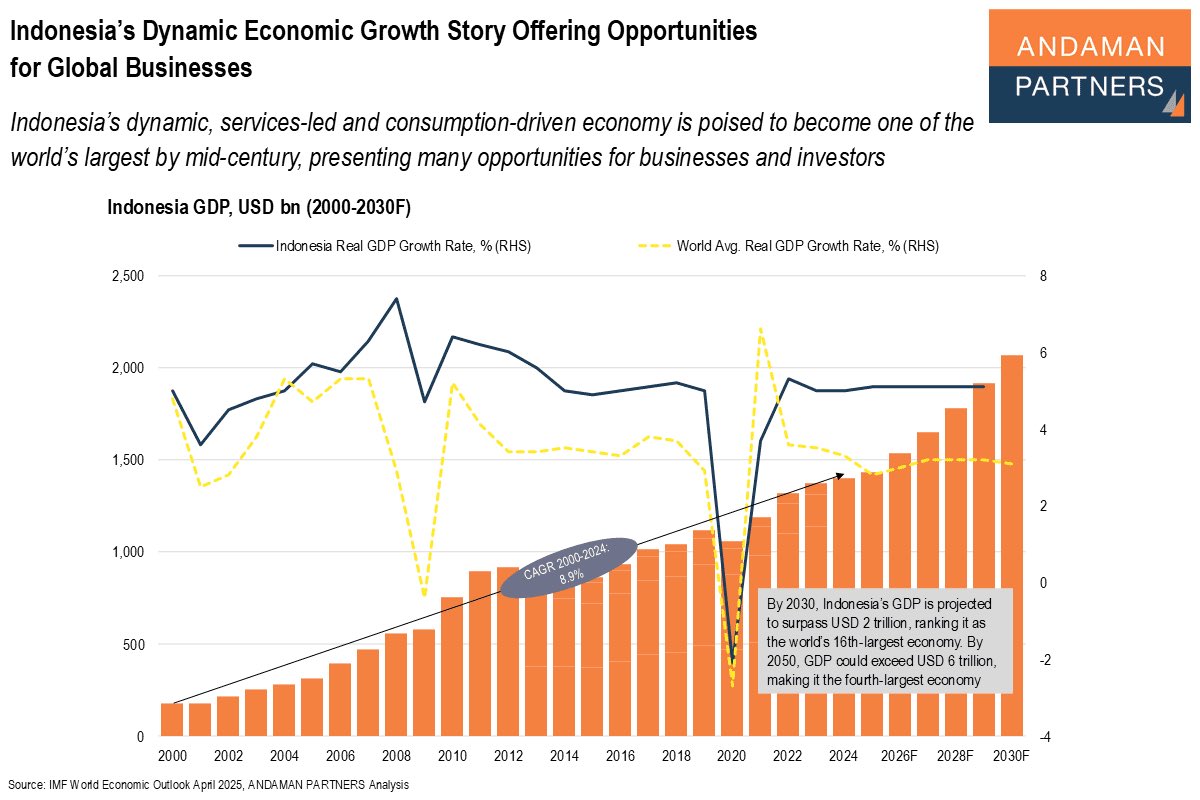
@steve_hanke I hope he's wrong but indeed it doesn't look good for Indonesia as it's under attack by foreign actors like Soros and even from the US who wants control over the Malacca street (apart from massive corruption by local officials and politicians). Bertahanlah NKRI!
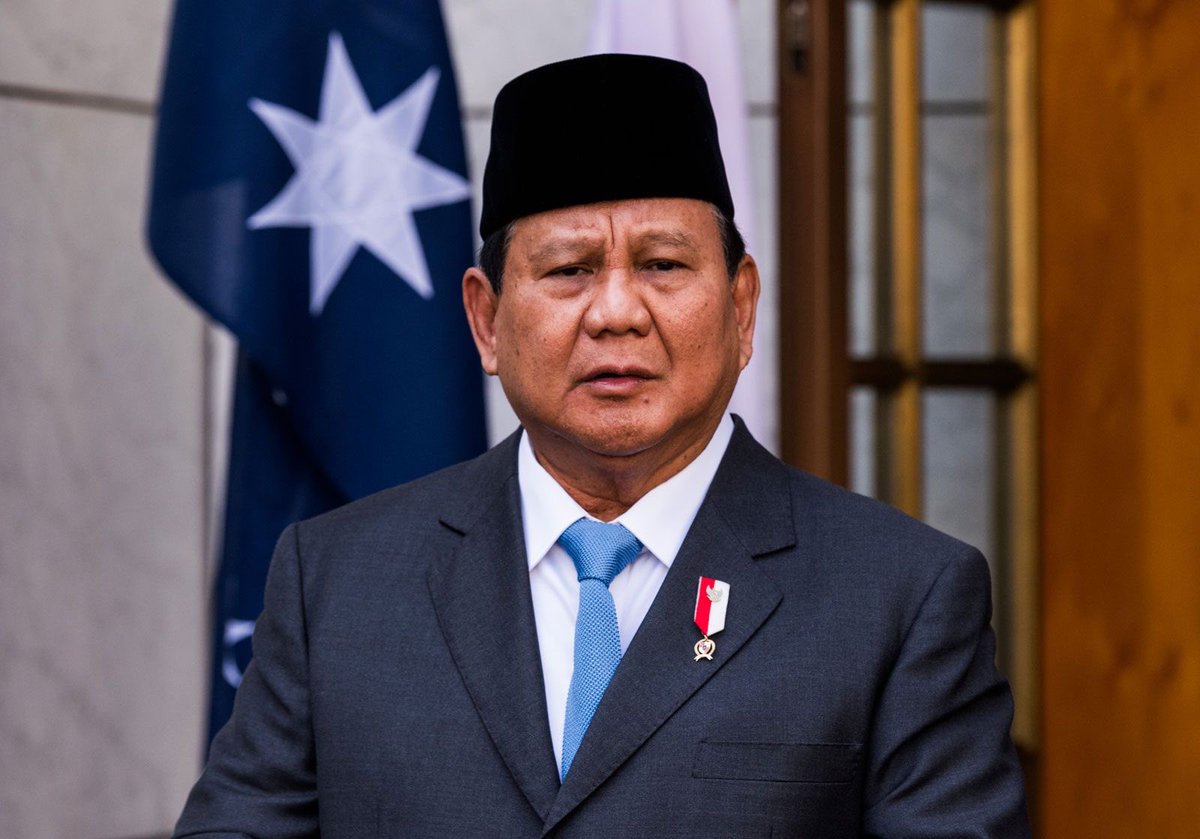
In a desperate move to protect the tanking rupiah, Bank Indonesia just raised interest rates by another 25 bps.
Pres. Prabowo’s interventionist policies put him at the helm of a SINKING SHIP.
After its independence, the West has continued to rob Indonesia of its natural resources, economic neo-colonialism disguised as free trade and globalisation. Read up on John Perkins and practises such as under-invoicing at scale and you'll understand the games played with Indonesia.
Why Globalists Don’t Like Indonesia’s “Indonesia First” Model
Indonesia is quietly building something that makes globalists angry.
“Indonesia First” nationalism with a socialist touch in the economy and socially conservative values.
Under Prabowo, they are pushing hard on processing their own resources — nickel, bauxite, and more.
They focus on food and energy self-sufficiency, big welfare programs like free school meals and housing, and sovereign wealth funds.
Strong government role plus Pancasila ideas.
Pancasila is Indonesia’s official philosophy since independence.
It has five simple principles: belief in one God, just and civilized humanity, national unity, democracy by discussion and agreement, and social justice for everyone.
It mixes religion, tradition, and national unity with care for the people.
It is not communism and not Western liberalism.
That’s why they take the good parts of socialism and capitalism, but always put Indonesians first.
They welcome investment, but only on their own rules.
Not full socialism, not open-border neoliberalism.
The goal is sovereignty, 8% growth, and real national strength.
Why don’t many globalists like it?
• Resource nationalism: Indonesia no longer wants to be just a cheap supplier of raw materials.
They process everything inside the country, keep more profit, and make the rules.
This breaks the old free trade game.
• Sovereignty over supranationalism: Indonesia has always been non-aligned.
Their “free and active” foreign policy started with Sukarno and the 1955 Bandung Conference.
They balance US, China, and others — without joining anti-China groups like QUAD or AUKUS.
They ignore lectures about liberal democracy, climate rules, or open borders.
• Social conservatism + unity: Pancasila comes first.
Traditional values, religious harmony under the majority culture, stability and order — not Western progressive ideas or extreme individualism.
• Populist developmentalism: Big government role in welfare and industry.
They criticize pure free markets.
They choose what works for Indonesia, not what Davos wants.
The military also plays a bigger role in government.
But it is very popular — 2026 polls from both pro and anti-government media show Prabowo’s approval steady at 70-80%.
Ultimately, it is up to Indonesia to choose their own system.
The most important thing is to protect their sovereignty.
No sovereignty means no real democracy, because democracy is a process of self-determination.
They put 280 million Indonesians and their resources first — not as a small part in someone else’s global system.
The globalist game hates strong countries that refuse to lose control of their borders, culture, and economy.
Indonesia shows a big developing nation can follow its own mixed path.
Pancasila developmentalism > globalist convergence.
@beyond_broke Are you familiar with YT channel "XRP Lab" (a 9 video series)? The host isn't promoting anything. His XRP price conclusions are purely based on recent verifiable collateral statistics and hence seems well-grounded and credible. I am very curious to know what your take on this is.
@CharuSan83 Are you familiar with YT channel "XRP Lab" (a 9 video series)? The host isn't promoting anything. His XRP price conclusions are purely based on recent verifiable collateral statistics and hence seem well-grounded and credible. I am very curious to know what your take on this is.
@beyond_broke@VersanAljarrah Please have a conversation with @CharuSan83 ... that would be a "1+1=3" conversation! Yours and his knowledge experience are really complimentary as far as I can tell.
@CharuSan83 Are tokenized collaterals for the Repo market included? This market is said to be a killer-use-case for DLT. Global daily exposure is $20-25 trillion while global daily settlement turnover is $6-8 trillion. And with tokenized collaterals, repo velocity can more than double.
@Gina_XRP Follow @CharuSan83 and read his posts or watch https://t.co/IgjDRJFnZQ Apart from supply n demand, "book order slippage" involving institutional transfers is key to understanding the high XRP price required in order for it to function in future on-line institutional settlement