The Metis Hybrid Rollup is live on Devnet. ZK validity proofs verify execution on-chain, aiming to cut withdrawal delays.
Faster settlement is only part of it. The work also builds a post-quantum path for scaling Ethereum. https://t.co/oTBu1CGs1f
Introducing the definitive guide to ZK in 2026.
The year’s biggest questions pointed to ZK: Can we trust AI? Will quantum break encryption? Can private money live on public rails? How do we know what’s real online?
Read how in the 2026 ZK Industry Report with @zeroknowledgefm.
KOSDAQ-listed Square Tech has signed an MOU with @GOATNetwork to explore AI agent-powered stablecoin payments in South Korea.
The partnership will leverage GOAT Network’s Bitcoin-secured infrastructure for agentic commerce.
Learn more👇
https://t.co/swmWdV7s33
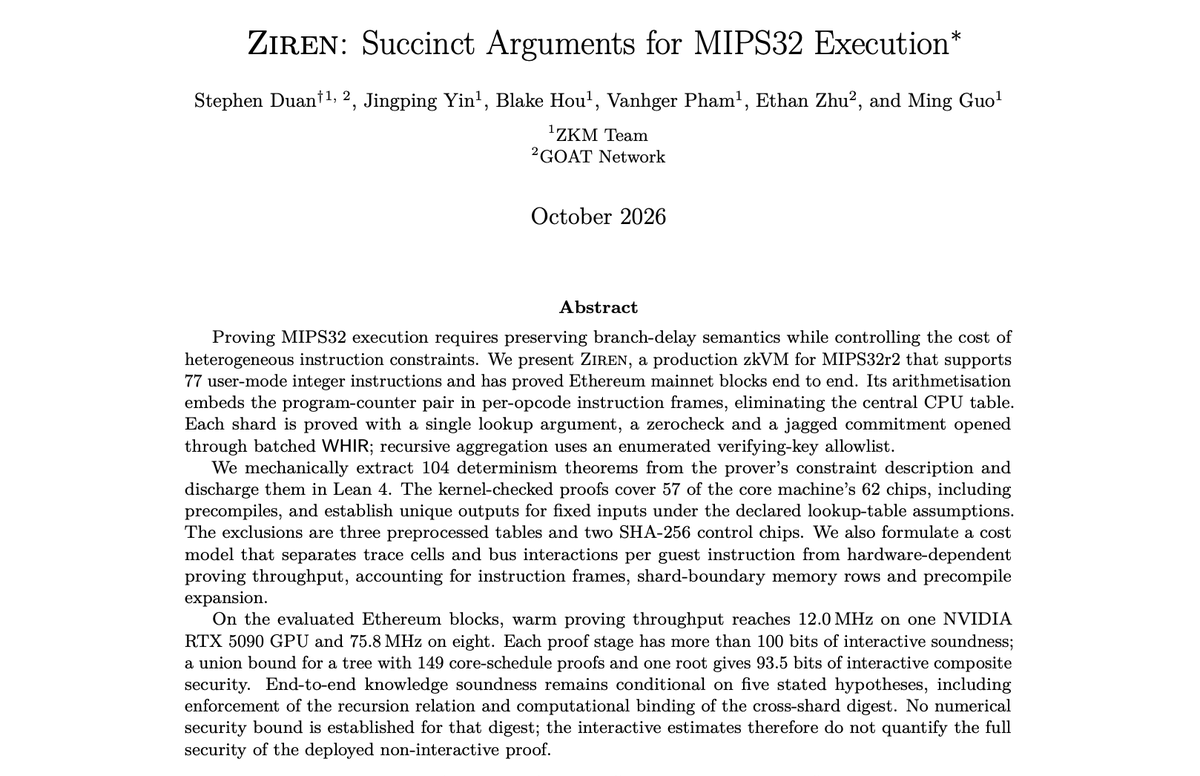
Ziren has proved Ethereum mainnet blocks end to end. The paper puts numbers on the security of those proofs - more than 100 bits of interactive soundness per stage, 93.5 bits composite across a 149-proof tree - and lists the five hypotheses the end-to-end claim still rests on.
What’s about to be superseded is the stated throughput. More on that soon.
Full paper on the IACR Cryptology ePrint Archive: https://t.co/QjjnkkiTZ1
1/ Today we’re releasing Aerie: fast post-quantum signature aggregation, using lattice-based SNARKs for lattice-based Falcon signatures. On a laptop (CPU only), it aggregates roughly a full Ethereum slot’s worth of signatures (32,768) in 0.65 seconds.
Introducing Magnetar from Microsoft Research, the first zkVM that is: (1) general-purpose (RV64), (2) post-quantum from standard hashes alone (no curves, no lattices, no Poseidon), and (3) built for recursion.
Despite its conservative security, it is the fastest zkVM: 7.2–8.7 MHz on a laptop, 10–39× faster than existing zkVMs across 15 workloads! An optimized version reaches 9.5–12.8 MHz.
Links in the thread below.
We’re releasing a broad range of new mathematical results produced by an internal frontier model.
We’ve been consulting with the independent Advisory Group on Mathematics and Artificial Intelligence at the Institute for Advanced Study, and we have drawn on their advice and public recommendations to inform how we release these results.
https://t.co/7N6TPlft1P
Today I call upon the blockchain industry to calmly begin planning for "bunker mode". My personal recommendation is to set in motion a controlled mass migration of assets to fresh addresses, i.e. addresses whose pubkeys remain hidden behind a hash.
Holders, starting with large and sophisticated ones, should consider moving the bulk of their funds to addresses that have never signed a transaction. And when they do sign one, they should also move remaining funds to a new address (possibly generated from the same seed phrase).
Don't rush. While I believe there is cause for action a rushed migration would do more harm than good. Don't panic either. Moving assets to protected addresses is a simple, preventative step which does not require new cryptography or new wallets.
IMO it is now reasonable to brace for the possibility that ECDSA breaks before qday, in the worst case in months not years. By "break" I mean fast private key recovery (e.g. in one week) on available hardware (e.g. a large GPU cluster).
Recent days have been humbling for human mathematical intuition. Long-held, unquestioned hypotheses have fallen. This includes the n log(n) bound for integer multiplication and the 3SUM conjecture. In hindsight, May's unexpected disproof of the Erdős unit distance conjecture was our warning shot.
Yesterday's OpenAI drop made it clear that mathematical superintelligence is upon us. They say there are weeks where decades happen. We are about to live through weeks where centuries of mathematical progress happen. Could our magic 64-byte ECDSA signatures be too good to be true? Was it just security through obscurity all this time?
Elliptic curves feel especially vulnerable to superintelligence. Curves carry rich structure, with room for fancy tricks like Schoof, Frobenius, pairings. (By contrast, hashes are designed to minimise algebraic structure.)
Separately, as Ewin Tang can attest, an efficient quantum algorithm sometimes foreshadows an efficient classical one. We should be open to the possibility of a classical counterpart to Shor that breaks elliptic curves and RSA at once.
Also noteworthy is the striking under-representation of cryptographic breakthroughs among the 722 mathematical results OpenAI published. I've witnessed first-hand the US government censoring academic quantum cryptanalysis results. Backroom interventionism is my base case.
I urge large, sophisticated actors to lead by example. Project11's "risq list" (bitcoin-risq-list.projecteleven[.]com) is a great tracker of exposed BTC pubkeys. Binance, Bitbank, Robinhood, Bitfinex, and Tether have an opportunity to harden their cold storage. Next month I'll address institutions in London in a live Q&A (forum.ethereuminstitutional[.]org/london-2026).
Again, please do not rush. Wallets holding under 50 BTC enjoy partial cover from "Satoshi's shield", i.e. his 20K exposed addresses that hold 50 BTC each. Load-bearing signers like oracles and L2 security councils should consider rotating ECDSA pubkeys with every signed message and/or multi-signing with a hash-based schemes like SPHINCS.
Exiting bunker mode safely will require post-AI cryptography. My inclination is to go all-in on hash-based cryptography and avoid structured mathematical assumptions entirely, whether from curves, lattices, or isogenies. A single battle-tested hash (e.g. from the SHA or BLAKE families) yields plausible post-AI security.
The Ethereum roadmap on strawmap[.]org fully embraces hash-based cryptography with end-to-end formal verification as a response to the quantum threat. Those timelines must now be revisited and accelerated in light of mathematical superintelligence. I'll be pushing for maximum defensive acceleration.
Why agent payments help close the gap:
> Agents pay straight through protocols, so there’s no traditional UI in the middle.
> Funds move wallet-to-wallet and get verified on-chain.
> The risky interface layer just gets removed!!
Vitalik: $1.4B lost last year attacking the layer between chain and user. That layer disappears if AI does more of our Txs.
That’s what GOAT is building: agents make Txs directly, no UI needed. Agents pay. Merchants get verified money. Bitcoin settles it.
https://t.co/UAZw6S6CkB
Vitalik: AI Will Become the New UI
On October 6, 2026, Ethereum co-founder Vitalik Buterin @VitalikButerin said at OKX NOW @okx in Singapore that AI will become the new user interface in more and more scenarios. He shared how a local AI agent wrote a script to update his ENS hash in about five minutes, and said performing complex blockchain operations without a traditional UI will become normal.
This could reduce security risks associated with traditional frontends, while introducing new challenges such as prompt injection, AI safety, and whether agents correctly understand onchain operations.
What happens when your next customer is an AI agent?
@sophianeverfold, core contributor of @GOATNetwork, joined @DavidThaDegen at @kbwofficial to explain how GOAT Flow helps AI agents find and buy products and services.
They discuss the Bitcoin security infrastructure behind it, real use cases for agentic commerce, and what’s next for GOAT’s partnerships and marketplace.
Watch the full interview below 👇