@tpktelangana@gkcs_ I agree with you, in 2021 ai government conference this was present as a solution by one of the state and this system is already already in place for long time.
Vector Search is not Memory.
RAG is great for retrieving documents, but it fails at maintaining User State. If you are just dumping chat logs into a vector DB, you aren't building an Agent, you're building a semantic search engine.
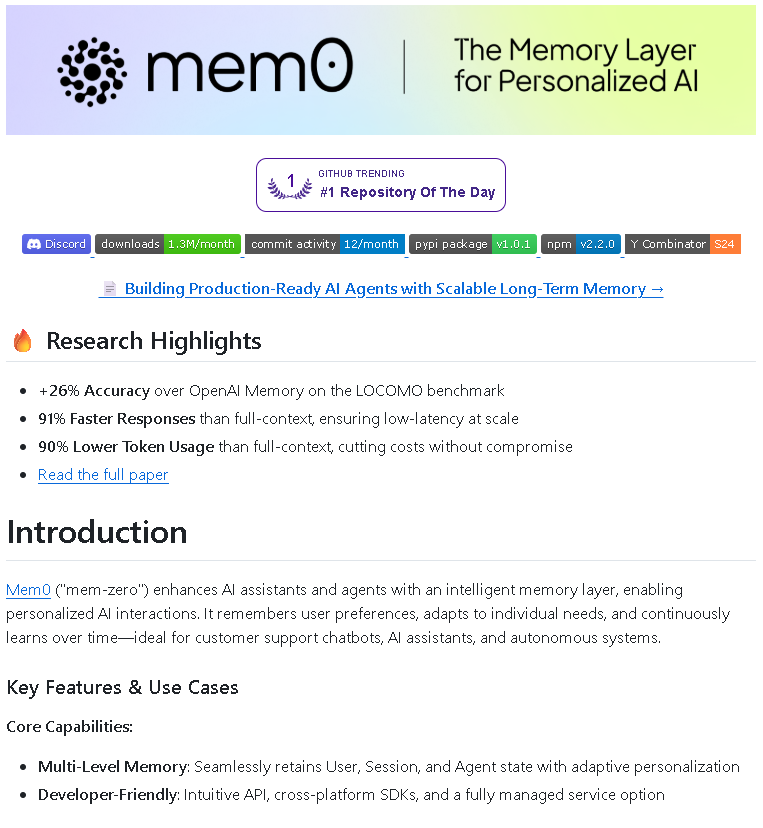
I found the open-source library that solves this. It’s called Mem0.
It acts as a self-improving Memory Layer that sits between your user and the LLM.
The Cheat Code for AI Agents => Instead of static retrieval, Mem0 creates adaptive memory that evolves with every interaction.
This solves the three biggest bottlenecks in Agent production:
1./ The Amnesia Problem
Standard RAG retrieves facts but forgets preferences. Mem0 tracks User, Session, and Agent state separately. If a user prefers Python over JS in session 1, the Agent remembers it in session 50.
2./ The Context Window Trap
Mem0 uses a Memory Compression Engine. It distills complex history into optimized prompts. Result: 90% reduction in token usage and significantly lower latency (TTFT).
3./ Multi-Agent Coordination
If you use CrewAI or LangGraph, your agents are usually siloed. Mem0 acts as a shared brain. What your "Researcher" agent learns, your "Writer" agent instantly knows.
It’s fully open-source and integrates with OpenAI, Vercel AI SDK, and LangChain.
Stop building stateless bots.
We've just published the Smol Training Playbook: a distillation of hard earned knowledge to share exactly what it takes to train SOTA LLMs ⚡️
Featuring our protagonist SmolLM3, we cover:
🧭 Strategy on whether to train your own LLM and burn all your VC money
🪨 Pretraining, aka turning a mountain of text into a fancy auto-completer
🗿How to sculpt base models with post-training alchemy
🛠️ The underlying infra and how to debug your way out of NCCL purgatory
Highlights from the post-training chapter in the thread 👇
Tokenization has been the final barrier to truly end-to-end language models.
We developed the H-Net: a hierarchical network that replaces tokenization with a dynamic chunking process directly inside the model, automatically discovering and operating over meaningful units of data
Tokenization has been the final barrier to truly end-to-end language models.
We developed the H-Net: a hierarchical network that replaces tokenization with a dynamic chunking process directly inside the model, automatically discovering and operating over meaningful units of data