@paulg Interesting that you seem to be using the free version of gmail. Do you ever worry that gmail might go away and you'd have to migrate to another email provider or lose this email address?
The GenAI economy has generated $110 billion in sales over the past 12 months. It is growing fast. On an annualized basis, the revenue run rate exceeds $175 billion.
These numbers took us several months to construct, and as far as we know, it’s the first bottom-up, deduplicated measure of consumer and enterprise AI spending across the full stack.
We are releasing this research today in our first The State of the AI Economy report.
https://t.co/cJwZb0T99C
AI companies are making a lot of money. Apparently the revenues from this wave of technology are growing "roughly three times more rapidly than the mobile or Internet waves."
13/ Our analysis suggests that AI demand is more revenue-validated than any prior platform shift. The investment case comes down to whether falling prices can move enough token volume to earn a return on CapEx.
FULL REPORT: https://t.co/BoYCeZDZYm
Thanks to @alexolegimas @jaimesevillamol @shanumatthew93 for early feedback on the report.
@GergelyOrosz@WesEklund One effect of LLMs that I don’t love is that if your style has been popularized by them (eg using m-dashes) now you suddenly sound like an LLM and have to change that habit so you don’t sound like a robot.
@paulg Isn’t the point of math largely to be able to apply it - which means having to start from a a scenario and puzzling how how math comes into play etc?
Or is this not what SAT is doing?
My wife has a strict rule: I am not allowed to be left unsupervised in public for more than twenty minutes. This weekend reminded me why.
I’m standing in a long line at a garden center with a massive 50lb bag of specialized bird seed.
This woman behind me taps me on the shoulder and asks, "Oh, do you have a lot of birds?"
Standard small talk, But I’d been in line for fifteen minutes and I was bored.
I looked at her, completely deadpan, and said: “Actually, no, This is for me, It’s a new holistic cleanse I’m trying, High protein, great for the hair.”
The guy behind her immediately stopped scrolling on his phone.
The woman’s eyes went wide. “You… you eat that? Is that even safe?”
I leaned in like I was sharing a government secret. “The results are incredible. I lost 30 pounds last summer. The only problem is the side effects. Last time I did it, I ended up in the emergency room for two weeks. Tubes, monitors, the whole deal.”
She gasped. “From the seeds? Did you get a parasite?”
“No,” I said. “I was perched on a telephone pole trying to sleep and a hawk knocked me off. Fell forty feet.”
The guy behind her made a sound like a tire blowing out. The woman just stood there, paralyzed, trying to process the mental image.
Right then, my wife comes back from the bathroom, sees the look on the woman's face, grabs my arm, and starts dragging me toward the exit.
“He’s kidding,” she tells the woman. Then she turns to me: “This is why we can’t have nice things.”
I don't care. The look on that lady's face was worth more than the bird seed. 😂
If they really start to gatekeep who gets to use the best models, that is a declaration of war.
This prospect fills me with the most sincere, bodily cypherpunk will-to-power that I've ever felt (at least since I was a teenager). If they really go down this route, I would go all-in on building the most psychotic swarms of open-source models and fine-tunes possible, all geared toward a Chaotic Good jamming of the entire institutional public sphere. If we didn't do that, all of political life and the marketplace of ideas would be over before we know it.
It's one thing if the top models become too expensive for me or others to use (I'm already pricing that in, and if you can't build something profitable enough to climb that ladder as it gets pulled up, then that's fair enough).
But if the ladder gets pulled up politically, now, so only select institutional players get access to the most intelligent models, then any mature American man should be as energized as gun collectors are around the 2nd Amendment, or liberal women are around Planned Parenthood.
This week someone targeted my family for harm with a false report. We’re physically OK, but that doesn’t mean we weren’t harmed. I am beyond furious.
Whatever your politics, this is awful, wrong, and can never become normal. https://t.co/72wxaVLzVT
Noora Health is hiring a CTO. If you want to make the world a better place, it's hard to imagine a job where you could have more impact. They've already saved over 70,000 children's lives. Help them save more.
https://t.co/B4Uacg2kOg
There came a knock at my gate, and a young warrior, small but formidable, stood ready for battle.
She was perhaps nine. Behind her, at the sidewalk, a parent stood like a supply wagon. The sash carried badges of past campaigns. She looked up at me and spoke the words every American fears and longs for:
"Would you like to buy some Girl Scout cookies?"
In Japan, sales require months of relationship. Tea is poured. Cards are exchanged with two hands. Here, a nine-year-old general appears on your own land with a binder of product, and resistance has never once succeeded in the history of the republic.
"What is your strongest unit?" I asked.
"Thin Mints. Everybody gets Thin Mints."
"And if I refuse?"
She did not answer. She looked at me. The parent shifted weight. Somewhere, a wind chime rang. Refusal, I understood, was technically possible the way swimming to Hawaii is technically possible.
"Four boxes," I said.
"Most people get more. They freeze."
THEY FREEZE. Forward logistics. This child carries doctrine my family needed three centuries to learn: the campaign is won before it is fought, in the freezer.
I bought nine boxes. I am told this is called a start.
Dale confessed he buys from three generals, granddaughter, coworker's daughter, the girl at the supermarket table, and hides the count from his wife. Tribute, he calls it. Correct. This is not commerce. This is fealty, paid annually, in cookies.
I was not hungry. I was outranked.
A man does not negotiate with a general who brings Thin Mints. He surrenders, and calls it a donation.
The boxes are in my freezer, as instructed. They are nearly gone. She said she would return next year.
I have already begun setting aside funds. One does not meet such a commander unprepared twice.
USA. A Mexican restaurant. We had not yet ordered anything, and the food was already arriving.
Chips. Salsa. Unrequested. Free.
I stopped the waiter. "We have not earned these."
"They just come with the table, man."
They come with the TABLE. In my land, hospitality is a debt. Every gift creates an obligation, weighed carefully, returned in the proper season with interest of feeling. Here, the gift arrives before you have even proven you can pay for dinner.
This is not an appetizer. This is a declaration: we trust you. Eat.
I ate with the gravity the moment deserved. And then — I must report this calmly — the basket emptied, and a new one appeared.
"Did we…?"
"Refill," the waiter said. "It's bottomless."
Bottomless. They have wells of salsa. The supply lines of this nation are beyond anything my ancestors imagined.
My friend warned me. "Don't fill up on chips, dude."
Too late. I had accepted three baskets. Honor demanded each one be finished — an unfinished gift is an insult. By the time my actual food arrived, I was a ruined man.
I was not hungry. I was not comfortable. I had been defeated by a courtesy.
Generosity that arrives before the request cannot be repaid. It can only be survived.
I know the rule now. I have made my peace with the basket. One basket. Two at the most.
Who am I deceiving. There is no number of baskets I would refuse. The trust of a nation is in that salsa, and I intend to honor all of it.
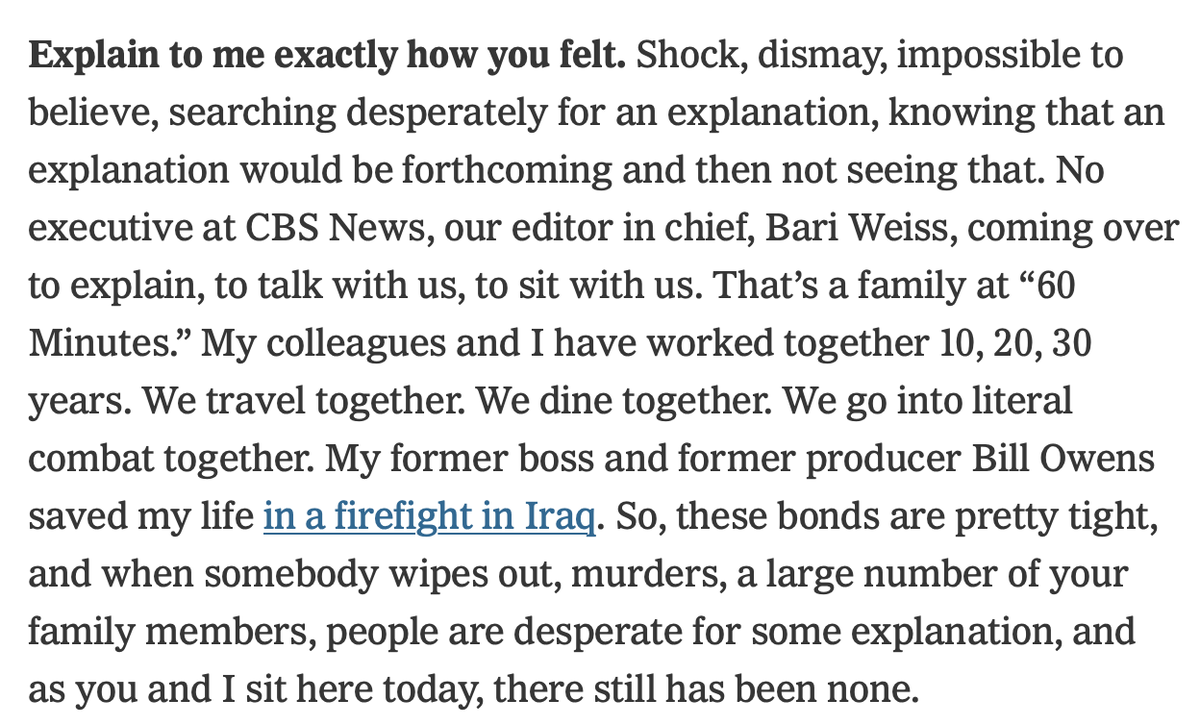
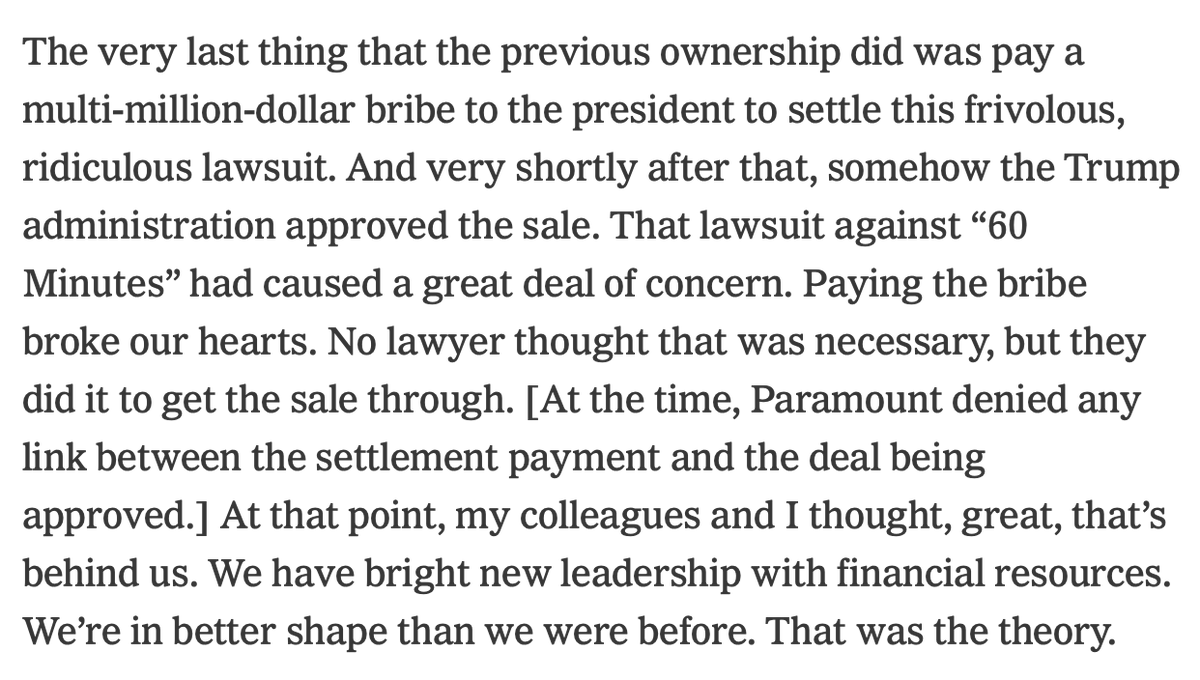
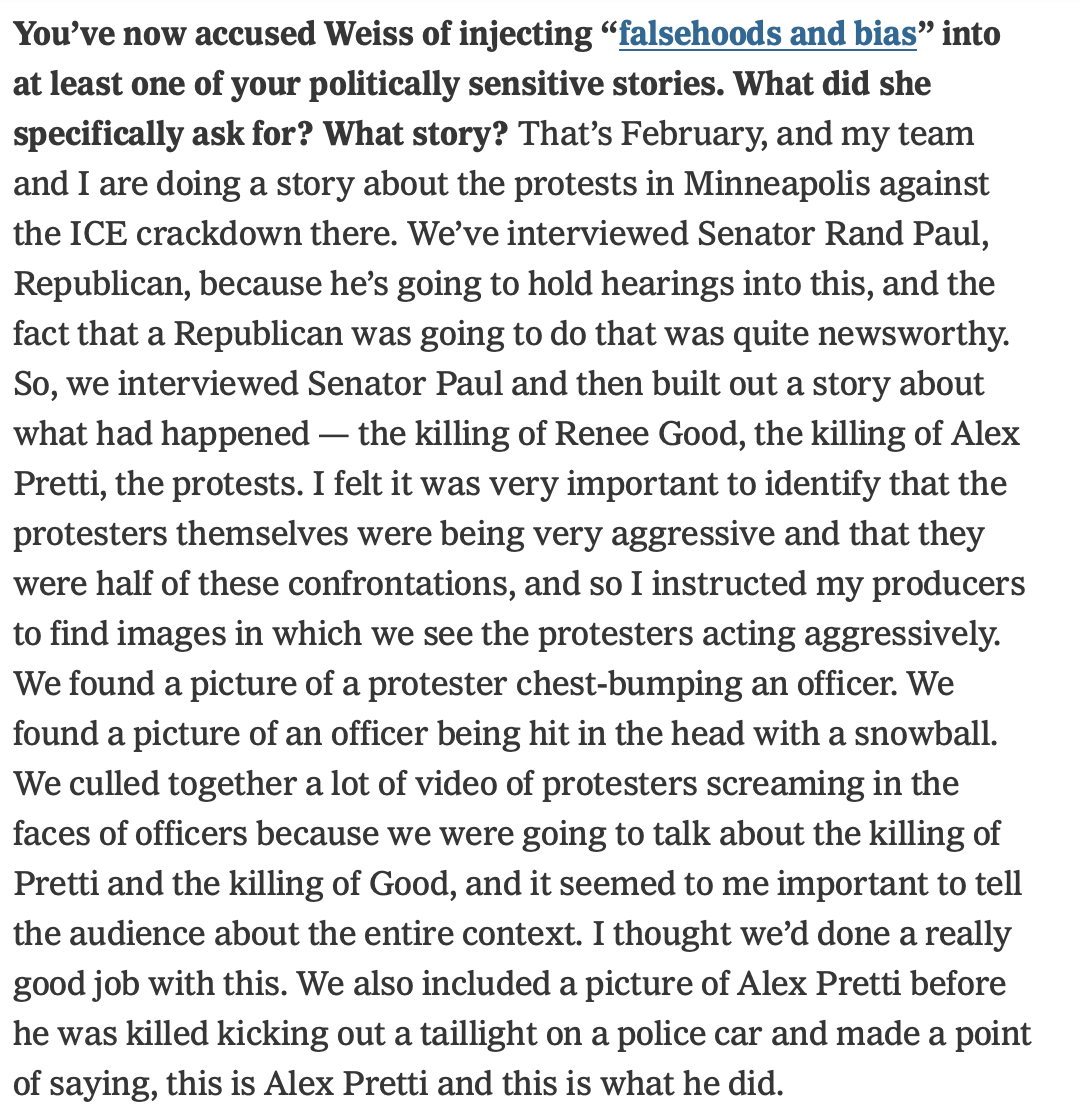
The Interview: Scott Pelley on the Bari Weiss Era and His Last Days at ‘60 Minutes’ (gift link) https://t.co/1u3kdl4XDl // Putting any political viewpoint aside, the idea of management "interfering" with the journalism "product" is such a bizarre concept. There is a good management and organization lesson in this interview on how not to be an employee (putting aside the lesson that the first thing to not do is to do this all in public) and how organization transitions always work. The drama we're seeing is pretty routine except for the part where it is all happening in public.
Where is the line of management v line in such a system? Doesn't the writer getting direction from a producer feel like "management" to that writer, especially if maybe the producer was a former photographer or worked in a different outlet? This feels like the idea that we can have a government made out of professional career bureaucrats that are free from opinions on policy? There are none just as there is no line where talented creative people enjoy having managers muck with their work.
I find this idea that there is some line in journalism where there can be no "interference" in a product akin to saying "there can be no management involvement." Lord knows I personally was known as a manager that drew a hard line above me about such interference. At the same time I also held myself to a non-interference standard. One story you can read about here is a complete product being upended (Office XP while the world was changing to SaaS) -> https://t.co/WnleXZsBJW
That said it is also absurd to think that this is an immoral or otherwise illegitimate role for management. It is frustrating. It can seem random. It might even seem poorly informed and damaging. But it is not itself news or impossible to understand. News seems to couch this in "injecting bias" but in the rest of business we call this "management" or "strategy." I found this part interesting because Pelley basically says they were already making an effort to show sides but dismisses the potential that they did not do so enough. Taking out the polarized political views, it sounds like every business discussion over dumb corporate strategy where the CEO just tells you "yes I see you are supporting the initiative, but we need even more." It shouldn't be surprising even a little bit that maybe, just maybe, they were not doing "enough" to show the side they disagree with?
All org structures have the tension over managers interfering with the product output. The line over interference is tricky and even more so when, as absolutely happens, there is a change in background or skill sets as one marches up the org chart.
What it seems is really going is that the management chain of CBS/60 was a monoculture. Even if there were battles (as described in the story) they were within a narrow range of an established set of cultural "norms."
Anyone who has ever "inherited" a product team of any kind faces both of these challenges:
• You come in with skills some people on the team don't have and you lack skills that others on the team have. These could be hard skills (writing v photographing v editing v producing). You could have experience at different scale (big v small, local v global). You could come from different domains (politics v sports v business).
• You come with a different culture and with that you bring a different set of soft priorities. Almost always this is precisely why someone new is brought into a management role. The operation is caught in some rut and the owner/CEO is trying to get out of that rut. Many times the need to do this is either not seen by the operation or they just disagree. When the existing operation is a monoculture then of course "everyone" sees the change as unnecessary or usually "destructive."
Both of these are on display in this article and broader transition of CBS.
I wrote about my own experience in this regard when I moved from Office to Windows. In the 60 Minutes case you see a lot of "no experience in broadcast" and "no experience operating at scale" and "doesn't understand culture". Each of those were parallels I experienced relentlessly.
While Microsoft is one company, the culture, product, and businesses of Office and Windows were almost like two different companies. Putting an Office person in the leadership role of Windows was not just culturally heretical but it was irresponsible and was going to "kill" Windows.
It was obvious Windows was previously successful in ways no other product in history had succeeded (and so was Office.) It was also obvious to any objective observer that Windows needed to do a bunch of things differently. The situation with 60 Minutes is equally obvious, except to Pelley apparently, though he admits at the very least there were financial difficulties but apparently those had nothing to do with the product they were making.
I was told I could never understand a product as complex as Windows because Office was simple. I was told I could not manage a team the size of Windows. I was told understanding the Windows product was something I wasn't capable of. One person even told me that unlike Office, it isn't possible for Windows to ship on a fixed schedule and attempting to do so would result in a bad product. I could go on and on. In fact I did -- that was the primary reason I wrote both books, One Strategy and Hardcore Software.
There are many things Nick can do to make this transition work. But there are even more things the 60 minutes team can do. Everything starts with an acknowledgment that an operation has a structure and accountability that needs to be respected. If you don't agree with that basic concept then the operation is not for you. And if you view your role to be "the resistance" or "nothing can change because we did everything right" then that just won't work.
If there is one post to read, then check this one out -> https://t.co/BygGfEP3Hd.
The Sam Altman and @miramurati texts from the day he got fired from @OpenAI in 2023 just became evidence in the @elonmusk v. @sama trial.
It felt like a meaningful moment in AI history, so I turned it into a musical.
The lyrics are the texts.
Judging by my tl there is a growing gap in understanding of AI capability.
The first issue I think is around recency and tier of use. I think a lot of people tried the free tier of ChatGPT somewhere last year and allowed it to inform their views on AI a little too much. This is a group of reactions laughing at various quirks of the models, hallucinations, etc. Yes I also saw the viral videos of OpenAI's Advanced Voice mode fumbling simple queries like "should I drive or walk to the carwash". The thing is that these free and old/deprecated models don't reflect the capability in the latest round of state of the art agentic models of this year, especially OpenAI Codex and Claude Code.
But that brings me to the second issue. Even if people paid $200/month to use the state of the art models, a lot of the capabilities are relatively "peaky" in highly technical areas. Typical queries around search, writing, advice, etc. are *not* the domain that has made the most noticeable and dramatic strides in capability. Partly, this is due to the technical details of reinforcement learning and its use of verifiable rewards. But partly, it's also because these use cases are not sufficiently prioritized by the companies in their hillclimbing because they don't lead to as much $$$ value. The goldmines are elsewhere, and the focus comes along.
So that brings me to the second group of people, who *both* 1) pay for and use the state of the art frontier agentic models (OpenAI Codex / Claude Code) and 2) do so professionally in technical domains like programming, math and research. This group of people is subject to the highest amount of "AI Psychosis" because the recent improvements in these domains as of this year have been nothing short of staggering. When you hand a computer terminal to one of these models, you can now watch them melt programming problems that you'd normally expect to take days/weeks of work. It's this second group of people that assigns a much greater gravity to the capabilities, their slope, and various cyber-related repercussions.
TLDR the people in these two groups are speaking past each other. It really is simultaneously the case that OpenAI's free and I think slightly orphaned (?) "Advanced Voice Mode" will fumble the dumbest questions in your Instagram's reels and *at the same time*, OpenAI's highest-tier and paid Codex model will go off for 1 hour to coherently restructure an entire code base, or find and exploit vulnerabilities in computer systems. This part really works and has made dramatic strides because 2 properties: 1) these domains offer explicit reward functions that are verifiable meaning they are easily amenable to reinforcement learning training (e.g. unit tests passed yes or no, in contrast to writing, which is much harder to explicitly judge), but also 2) they are a lot more valuable in b2b settings, meaning that the biggest fraction of the team is focused on improving them. So here we are.