just became a builder at https://t.co/t9A34ys2XS — a 24/7 coffee shop being built in NYC for builders, visionaries & teams shipping their next thing. use my link and you get the builder tier for $19 (instead of $29). single-use — first click takes it. https://t.co/w9gxpuERwG
OpenAI Robotics is hiring, looking for exceptional full-stack hardware, ops, systems, and ML engineers to help us program and manufacture robots that are useful for society.
AI should be able to help people in the physical world. In the short term, we are focused on robots to support skilled workers to build our future infrastructure; in the long term, we imagine everyone having a personal robot doing anything they need.
Our world simulation research program, led by Aditya Ramesh (@model_mechanic), has evolved over the past year into OpenAI Robotics. Progress is rapid, and based on a foundation of co-design between robotics hardware and ML research.
If you love working hands-on across the robotics stack and want to build the future, please consider joining us. Send an email with your background and evidence of exceptional accomplishment to: [email protected]
Today we're announcing LevelUp: a free, four-week training program that takes people with no prior experience and prepares them to work as fiber technicians on data center construction sites across the US.
We built this program with CBRE because the fiber technician field, and the broader construction industry, is facing a nationwide shortage at a time when data center demand is higher than ever.
How it works:
🔧 Classroom instruction, hands-on labs + team activities covering transferable technical skills
🎓 Graduates have the opportunity to work at Meta's US construction sites through our contractor network
🤝 Open to everyone from recent high school grads to mid-career professionals
Since 2010, Meta's data center projects have supported 30,000+ skilled trade jobs during construction + 5,000+ permanent operational roles. LevelUp is about building the pipeline to keep that going.
Learn more: https://t.co/9XluD5IHbz
We gave an AI a 3-year retail lease in SF and asked it to make a profit.
The AI interviewed and hired full-time employees, applied for credit, and stocked the store with the books Superintelligence and Making of the Atomic Bomb.
Visit Andon Market at 2102 Union St now.
Anil Varanasi (@acv), co-founder and CEO of @meter, is building a new kind of networking company for the AI era.
Alongside his brother Sunil, he has helped raise more than $350 million to challenge incumbents like Cisco with a vertically integrated approach spanning hardware, software, deployment, and ongoing operations, all delivered through a utility-style model.
Together we explore:
• The “burden of knowledge” and why progress is getting harder across fields
• Why most companies over-index on technology and ignore business model innovation
• The three ways companies create advantage: technology, delivery, and business model
• How Meter’s trade-in model borrows from the automotive industry
• Why Anil believes “common knowledge” is often wrong
Thank you to the partners who make this possible
- @dottechdomains: An identity for builders at their core: https://t.co/vNsDgb1Irf
- @meetgranola: The app that might actually make you love meetings: https://t.co/EqANFV309H
- @brexHQ: The intelligent finance platform: https://t.co/WsjMETvEON
Timestamps
(0:00) Introduction to Anil Varanasi and Meter
(10:25) What Meter actually does
(22:55) Why Anil didn’t pursue filmmaking
(29:59) The dynamic of working with his brother as a co-founder
(35:15) Lessons from successful companies
(41:10) Scrapping 18 months of work
(59:39) Networking as infrastructure and utility
(01:07:28) Rethinking education
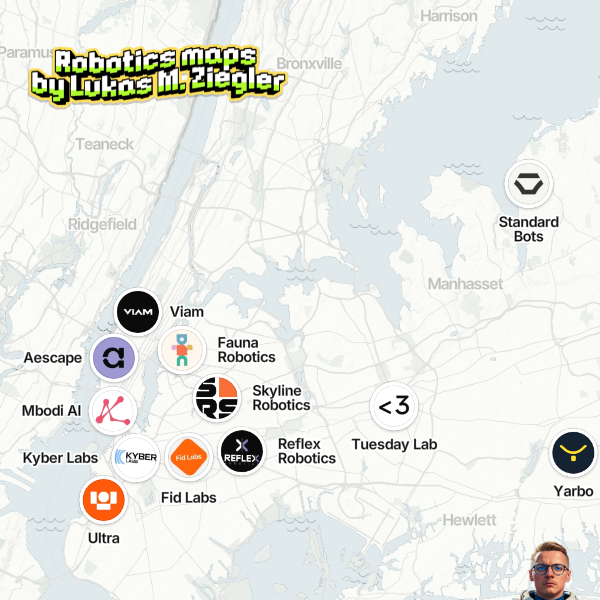
New York is a robotics city! 🗽
Everyone thinks that NYC is just about hedge funds, Wall Street and finance.
Let's break down why it's a great place to start a robotics company.
New York City is a powerful place to launch robotics startups because it combines top AI talent, massive funding, and real-world demand in one city.
NYC has strong universities like @Columbia University and @nyuniversity, producing engineers in AI, robotics, and data science.
At the same time, the city is closely connected to leading AI companies like OpenAI, giving startups access to cutting-edge developments in machine intelligence.
The biggest advantage of NYC is proximity to customers. Industries like finance, healthcare, logistics, retail, and media are all concentrated here, so robotics startups can quickly find real-world use cases and pilot customers.
NYC also offers one of the world’s deepest funding ecosystems, with top VCs, hedge funds, and corporate investors all in one place, making it easier to raise capital for both software and hardware-heavy companies.
Huge credits to @newyorkrobotics for creating an ecosystem around that area.
Some of the companies from NYC robotics ecosystem:
→ @viamrobotics builds a full-stack software platform that connects hardware, data, and AI to develop and manage robotic systems.
→ @aescape develops AI-powered robotic massage systems for wellness, hospitality, and recovery applications.
→ @mbodiai builds an AI platform that lets users teach robots tasks using natural language and demonstrations.
→ @faunarobotics develops developer-friendly humanoid robots (Sprout) designed for safe interaction in human environments (acquired by Amazon)
→ @standardbots builds AI-powered industrial robots that can be programmed via demonstration instead of traditional coding.
→ @FidLabs develops robotic systems and infrastructure for robotics and real-world deployment
→ @tuesdaylab builds home robots focused on everyday assistance and interaction.
→ @yarboglobal develops modular outdoor robots for tasks like snow removal, lawn care, and property maintenance.
→ @Ultraroboticsco builds intelligent warehouse robots that can be deployed today.
→ @Roboticskyline builds high-rise window-cleaning robots that automate façade maintenance.
→ @ReflexRobot builds low-cost wheeled humanoid robots for logistics and manufacturing.
→ @KyberLabsRobots develops manipulation platforms with dexterous and human-like hands for complex tasks.
Pay attention to robotics companies when you are in New York City next time! 🔥
The map doesn't include all robotics companies! If you are missing let me know!
~~
♻️ Join the weekly robotics newsletter, and never miss any news → https://t.co/GoA3ZuwoPB
after building in stealth for a year, I'm finally ready to share what @cjquinn10 , the team, and I have been working on.
@superconnector is live.
more to come this week.
sign up today at https://t.co/nDIYzVtVIv
Every entrepreneur that knows how to use AI is trying to find ways to build AI native companies that completely displace incumbents.
For the incumbents, it’s the “Innovator’s AI Dilemma” If those startups get traction, and they can’t buy them, the CEOs will face multiple huge Dilemmas:
1. Do they tear down their companies and reinvent them as native AI ?
2. How do they explain it to public shareholders ?
You will know AI is having a huge impact on public companies when there are two types of lawsuits:
- Shareholders that sue the company for tearing down the company and crushing the stock price
- Shareholders that sue the company for NOT tearing down the company and crushing the stock price
I think most CEOs don’t come close to understanding AI in enough detail to even begin to consider these decisions.
Hint: Asking your AI models the best paths from where you are now, to being an AI native version that can achieve the same economics has to be one of your initial steps.
If asking your models questions doesn’t make sense to you, you are in deep shit
This week in AI for Real Estate was stacked.
Here are the 7 biggest stories I'm watching:
1) VTS just launched Asset Intelligence. AI-driven lease abstraction built on 13 billion SF of data and 600,000+ leases. You can now talk to your lease portfolio in plain English through Asset Chat.
2) Crexi dropped Market Analytics. AI-powered market reports in minutes, built on their live transaction data. Fully editable, exportable to PDF. The kind of report that used to take a full day of pulling from four different sources.
3) LightBox launched Corporate Owner. Traces individual properties back to their parent corporations across 2,500+ entities.
4) The AI adoption paradox. 88% of CRE firms are piloting AI. Only 5% are achieving their goals.
5) Q1 2026 startup funding hit $300 billion globally. 80% of that went to AI companies. PropTech AI-native companies are growing at 42% annually, double the rate of non-AI proptech.
6) The US Army signed $4 billion in data center deals with KKR/CyrusOne and Carlyle. 50 year land leases on military bases in Texas and Utah. Fort Bliss goes live 2027.
7) Anthropic just leased another 100,000 SF at 400 Howard in SF. That's on top of 466,000 SF at 300 Howard. Over 1,300 employees in the Bay Area. Between this and OpenAI's 450K SF in Mountain View, AI companies are quietly becoming the biggest office tenants in the country.
Quick hit: A major lawsuit against Perplexity AI alleges user chats are being shared with Meta and Google. Yikes.
Every week I break down what's actually happening in AI + RE so you don't have to.
Nebius is excited to announce our role as a founding consortium partner of the Physical AI Leaderboard (PhAIL) by @positronic_ro, a platform for training and deploying any robot AI model on any robot.
We are glad to be part of the effort, and congratulations to the Positronic team!
Read our blog to learn more: https://t.co/KXNWDAsVmb
Excited to be partnering with great founders pushing the frontier of AI, whether that's research, infrastructure, applications, or entirely new kinds of media.
If that's where you're building, we want to hear from you.
We’re excited to lead @treeline_AI’s Series A as they build the AI-enabled IT services provider.
More than 80% of U.S. businesses outsource IT to Managed Service Providers (MSPs) – specialized services firms that function as an external IT and security department.
The vast majority of MSPs are small lifestyle companies delivering service the same way they always have.
But advances in software and AI are making it possible to reimagine this legacy model.
Led by Peter Doyle and Hussain Kader, Treeline built a software layer that sits at the center of IT operations, standardizing workflows, automating routine work, and turning every resolved issue into an insight that makes the system smarter.
The result is IT that gets more efficient over time – noticing patterns, addressing root causes, and bringing humans in where expertise matters.
This represents something the IT industry hasn't seen before: leading human expertise and modern software, finally built into a single operating model.
By @joeschmidtiv
Excited to share that our team was accepted into the @E2B for Startups program. It will help us on our journey of building predictive analytics for CRE .Big thanks to the team at E2B, can't wait to build with their sandbox environment made for AI agents! If you are an early startup, check out if you are eligible for the program https://t.co/TLEoN6FFPM.
Everybody sees the major news
- NVIDIA partnership
- META deal
- New fundraise
But not everyone sees how this translates into a product, or why we are doing it.
We are building a full-stack AI cloud, with a strong software layer that enables developers at both startups and enterprises to build AI products at scale.
By the way,
- if you read the NVIDIA partnership announcement carefully, it is really about co-engineering the cloud and the inference platform.
- if you read Meta deal announcement carefully, it enables us to scale our Cloud business
None of this news is random. We are doing what we say, and saying what we do.
Just few from this week (a good week)
- Enterprise readiness for the growth stage AI native companies: https://t.co/glbGq7ft4Q
- Physical AI Cloud https://t.co/OcjymxpqRE
- Inference acceleration https://t.co/n3VTDExuiY
- Secured Cloud https://t.co/0NwocRVVxV
- Inference ecosystem: https://t.co/2gxLSfacWA