Los congresistas @Danielbricen y @CarolBordaA llevan semanas repitiendo falacias sobre los impuestos saludables.
Una que amplifica constantemente Briceño tiene que ver con que "no hay estudios en Colombia que prueben los impuestos hayan mejorado la salud". Aquí les respondemos.
Dos razones:
No quieren salir a bolsa con cinco grandes crisis abiertas pero necesitan justificarlo con sus nerviosos inversores
Han liberado una nueva clase de malware y quieren lavarse las manos de toda responsabilidad.
Mi columna de hoy en @el_pais
https://t.co/XrUCTW5Qv9
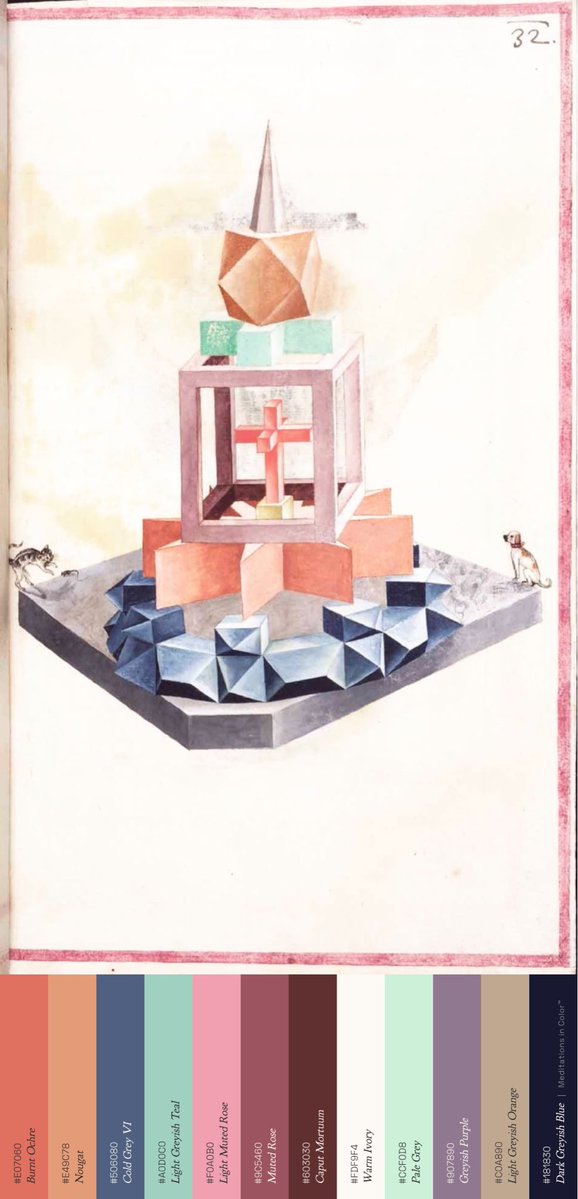
One of the stranger surviving books of Renaissance geometry.
An unknown 16th century artist made 36 sheets of colored perspective studies, then populated them with birds, animals and other tiny figures. There is no text explaining what any of it means.
Navier-Stokes Millennium saga continues. Here are my slides and a summary from a recent talk. Disclaimer: this is a physicists view of the problem & solution! 🧵
DA IGUAL lo que diga @DarioAmodei@sama o @elonmusk. La decisión de no comercializar productos peligrosos no está en sus manos. Para eso hay leyes de protección del consumidor, competencia y responsabilidad. Mi columna sobre este oportunista malentendido https://t.co/mJGB3NenVk
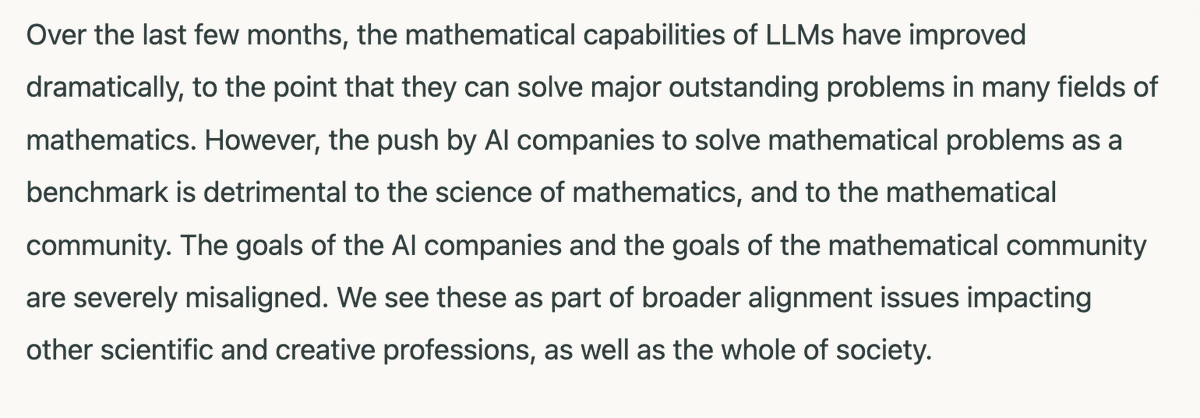
Today a new declaration, "Math and AI", has been issued, initially signed by 25 Fields medallists and currently signed by more than 1000 mathematicians.
The text points to many phenomena induced by the potential development of AI-driven mathematical activities, including AI slop generation, poor knowledge integration, lack of community-building aspects, capital concentration, and more. These issues are identified, but I am missing in this text the most important part: a clear list of countermeasures. Who is going to fight, and how, for the budgets to build a "CERN for AI"? How should we rebuild the education of students? Is it really possible for AI companies to let mathematics dry out of open problems, etc.? I would like to hear from those declaring mathematicians what their long-term vision of mathematics is, provided that the technology will stay with us, might not be equally distributed, and perhaps the standard view of the field is going to change forever.
We should design damage control, develop bold new ideas about the purpose of human mathematical activity, and embrace the possibility that we might no longer be single-handedly the most intelligent entities in this world. It is a humbling perspective and a disruptive view, and perhaps a difficult reality in which nothing is given. We need to fight for every single bit of human intellectual dignity and seek new ways of enjoying, curating, and developing the cognitive process of mathematical exploration.
It is time to abandon some of the old ways, brace for the impact, and build something anew. We will not stop this tectonic shift, we need to reshape our perspective on our capabilities and find new directions of development, possibly inventing completely new skills complementary to what AI can possibly do. It is a new intellectual age of discovery, and by stagnating we risk the gradual erosion of the field as we know it.
A lot of people are missing Terence Tao’s point and thinking “mathematicians are upset that AI is better than them.” That’s not what he’s saying, and some people are forgetting that Tao is one of the most AI-pilled mathematicians out there.
His point is that when people work on discovering something, along the way they invent new concepts. Those concepts later become useful far beyond the original goal, and enables further inventions. Finding a solution does matter, but the intermediate idea is often what makes the field richer, because other people can share it and build the next thing from it.
In tech, we can use the analogy of collaborative software. We started with algorithms for merging changes in a Word document, and evolved that to concepts about versions, diffs, and merges, and later to real-time collaboration tools like Git, Google Docs, and Figma. Humans built upon these concepts and developed more powerful solutions.
Terence’s worry is that a machine automating a solution robs the field of the value of developing the intermediate discoveries in the pursuit of larger discoveries.
When automating a solution, the intermediate discoveries and invention of concepts can be buried or completely hidden in the black box. We don’t learn from them to build the next thing; it’s like we never made the invention of collaborative document editing and thus could not have the conceptual understanding to invent the next version – and since it’s hidden, we also don’t socialize them to allow other people to invent, too, a core tenet of collective discovery.
So then, in both code and math, this leads to the atrophy of development of concepts in the field.
In other words: pure ‘solution extraction’ that hides the process of discovery can leave the field with a checked-off theorem but little new insight or new questions to pursue. And it might prevent us from understanding a field deeper.
I am seeing, first-hand, that atrophying of skills in software development. We push buttons and get solutions. There is much less incentive to develop new concepts and human skill. The bet most software companies are making is that LLMs are so effective in writing code that you’re still shipping overwhelmingly more value even with human skill atrophy, and it’s the right bet IMO.
However, much of the software industry is built upon building things, not necessarily novel invention and research. In such an environment, you can say that you accept some atrophying of conceptual invention and human skill for more output.
On the other hand, sectors like math and pure sciences that are focused on invention and insight might be the hardest hit by this.
Practical/applied sciences might fall somewhere in the middle. An Alzheimer’s cure, room-temperature semiconductor, or highly effective carbon capture solution are far too valuable to sandbag and say only humans can do that to develop concepts in the ‘proper’ way. The outcome matters too much to treat the preservation of concept invention as the highest goal. Even there, though, hidden intermediates can slow the next breakthrough if nobody can see how the first one actually worked.
So the question is not “is AI allowed to solve hard problems?” It is “in this field (math, science, tech, etc.), is the answer itself the main point, or are the concepts and abstractions we use to get there also the thing we need to maintain?”
In pure math, there’s an argument that the intermediates are often more useful than the solution, and atrophy in concept development is highly detrimental to the field. Solving Navier–Stokes, contrary to what some people claim, has little practical application, and pure math might be one of those fields where just finding a solution isn’t the entire point, and can actually be contrary to the field, which is what Tao is worried about.
What you are seeing in math right now is a consequence of the jagged frontier, and a precursor of what is to come in other professions. Yes, mathematicians do math, but they also have other tasks they view as important (mentor students, maintain a scientific community, safeguard the future of a field, foster a love of math) that AI can't do.
At least one worry that mathematicians seem to have is that by focusing on the flashiest, most obvious element of what mathematicians do (make proofs), the AI companies are damaging the other tasks that AI can't do. AI can discover superhuman proofs, but that is not all that the math profession is about, and actually can undermine and reduce the attention to the other aspects of the job that are important to mathematicians. It becomes harder to defend the value of the many other tasks mathematicians do to the outside world if the most visible part is taken away.
I suspect we will see more of this across fields and professions that will increasingly be forced to help people understand that their jobs consist not only the most visible tasks that AI can do, but also tasks that the AI cannot do or does badly.
La fe en la IA es el viejo sueño de la planificación central después de descubrir las GPUs. La fe en blockchain nace de la intuición contraria, que el conocimiento está disperso, la confianza debe fragmentarse y ningún centro debería pretender verlo todo.
La fe en la IA tiende a imaginar que suficiente capacidad de cálculo, suficientes datos y un modelo suficientemente competente pueden concentrar información dispersa, descubrir regularidades y tomar decisiones mejores que una multitud de agentes descoordinados. Es una intuición emparentada con el sueño de la planificación central, aunque trasladada del burócrata al algoritmo. El problema clásico de Hayek. ¿Puede existir realmente un centro capaz de absorber el conocimiento local, tácito, cambiante y contextual que está distribuido entre millones de personas?
El blockchain parte casi de la sospecha contraria. Asume que no debemos confiar demasiado en ningún centro precisamente porque nadie posee toda la información, nadie merece toda la confianza y los incentivos pueden corromper cualquier nodo privilegiado. En vez de construir un cerebro central más inteligente, intenta construir reglas que permitan coordinar muchos actores parcialmente ignorantes y potencialmente adversarios.
La IA pregunta «¿podemos comprimir el conocimiento disperso en un modelo?». Blockchain pregunta «¿podemos coordinarnos sin necesidad de comprimirlo en ningún sitio?».
El dilema tecnológico del siglo XXI quizá no sea solo democracia o autoritarismo, sino pingüino o Leviatán. El pingüino representa la inteligencia distribuida, el protocolo abierto, la coordinación entre nodos, la desconfianza convertida en arquitectura. El Leviatán representa la inteligencia centralizada, la promesa de una mirada total, la tentación de que una instancia superior calcule por todos. La IA empuja con facilidad hacia el segundo imaginario. El blockchain, al menos en su forma más pura, nace del primero.
The way OpenAI handled this Navier--Stokes situation was the first time I've actually felt disgust at the whole AI in math situation. Like watching a billionare celebrate his hunting prowess by mounting the head of an endagered rhino on his wall, after 1000 soldiers trapped it.
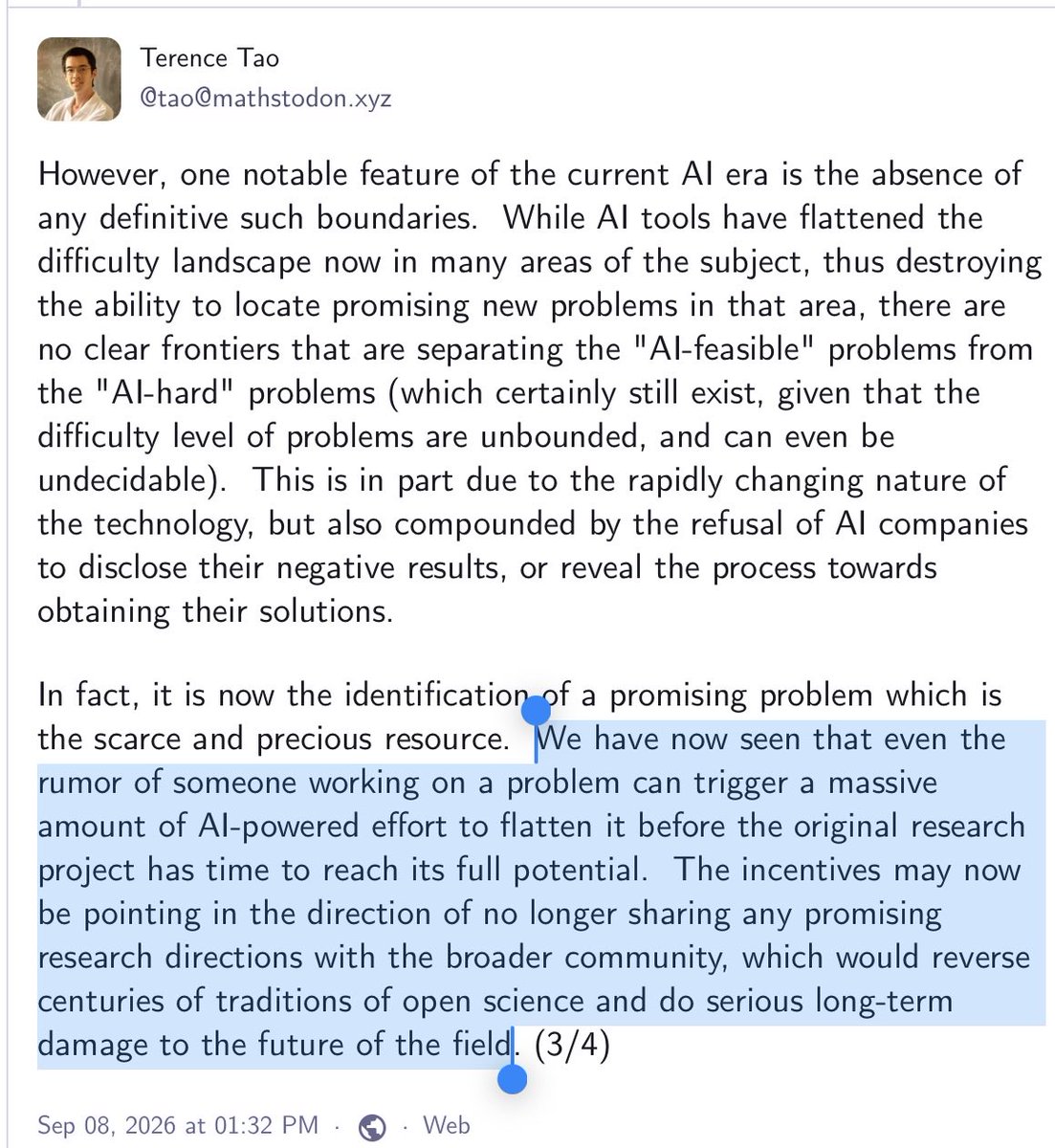
Still more absolute 🔥 from Terence Tao:
“We have now seen that even the rumor of someone working on a problem can trigger a massive amount of AI-powered effort to flatten it before the original research project has time to reach its full potential. The incentives may now be pointing in the direction of no longer sharing any promising research directions with the broader community, which would reverse centuries of traditions of open science and do serious long-term damage to the future of the field”
El Congreso Colombiano de Astronomía, CoCoA 2026, acaba de terminar y sus 148 contribuciones, entre presentaciones orales y pósteres, muestran una radiografía de la investigación astronómica que se desarrolla actualmente en Colombia.
La Astrofísica Solar y Estelar se consolida como la principal temática, con el 29,1 % de los trabajos presentados. Le siguen Galaxias y Cosmología, con el 23 %; Instrumentación, Ciencia de Datos e Inteligencia Artificial, con el 16,2 %; Sistema Solar, Exoplanetas y Astrobiología, con el 11,5 %; Altas Energías, Astropartículas y Astronomía Multimensajera, con el 9,5 %; Educación, Divulgación e Historia de la Astronomía, con el 6,8 %; Astronomía Fundamental y de Posición, con el 2 %; y Astronomía Observacional Multibanda, también con el 2 %.
Estos resultados muestran la consolidación de la investigación en la astrofísica solar y estelar, y también la gran diversidad y crecimiento de la comunidad astronómica colombiana. Nos vemos en el CoCoA 2028.
En la tesis XI de las Tesis sobre Feuerbach, que Marx escribió en 1845, podemos leer: «Los filósofos no han hecho más que interpretar el mundo de diversos modos; de lo que se trata es de transformarlo».
Estamos ante una mezcla de ambición genuinamente moral con una dosis considerable de arrogancia. Transformar el mundo implica decidir, desde una visión particular, qué debe conservarse, qué debe desaparecer y qué forma de vida merece imponerse sobre las demás. Pero el mundo no es una máquina averiada que alguien pueda arreglar desde fuera. Está hecho de millones de personas con fines, valores, conocimientos y proyectos de vida que a menudo no encajan entre sí.
Además, todavía entendemos muy poco de esa complejidad. Cambiar algo que no se comprende bien no es un acto de lucidez, sino una apuesta cuyos costes suelen pagarlos otros.
Por otro lado, interpretar el mundo tampoco es una actividad pasiva o estéril. Altera los marcos desde los que actuamos y permite descubrir los límites de nuestras propias certezas. De manera que quizá no se trate de renunciar a transformarlo, sino de hacerlo con la cautela de quien sabe que no posee el plano completo ni el derecho automático a dibujarlo para los demás.
Nos enteramos hoy del fallecimiento de Tim Curry (1946 - 2026).
Se nos va un actor único, un actor que fue un Pennywise inolvidable en “It (1990)”, un recepcionista implacable en “Solo en casa 2 (1992)” o un doctor legendario en The Rocky Horror Picture Show (1975)
DEP, Tim😞💔
Bitácora de viaje.
Por fin tengo algo de luz.
En mi recorrido por Cali tuve la maravillosa oportunidad de acompañar a personal muy teso de Gestión de Riesgo en un recorrido por la ciudad (ustedes saben quienes son, de corazón gracias).
Llegamos a maravillosas conclusiones +