Plastic Packaging (FMCG, Pharma, Cosmetic), Auto Parts, Drone Parts manufacturer | Injection Molding | 2+ decades experience. DM to work with us.📍India 🇮🇳
When a single pellet of polypropylene drops from the hopper into the barrel of an injection molding machine, it doesn't know what it’s about to become. It’s just an inert, translucent bead of oil derivative.
But within ninety seconds, it is subjected to 280°C of shear heat, squeezed by a reciprocating screw, and slammed into a tool steel cavity under two hundred tons of hydraulic pressure. It is forced through a gate narrower than a needle. It either yields perfectly to the precise geometry of the mold, or it burns, degrades, and turns to toxic gas. There is no middle ground. The physics of plastic do not care about your intentions; they only care about pressure, temperature, and time.
Reading the highlighted text about entrepreneurs being shaped not by a static class, but by the violent motion of an economic vector, hit me straight in the soul.
The Reality of the Inheritance
People look at a second-generation manufacturer and see an inheritance. They think you were handed a monument. But when you inherit a factory floor in India, you don't inherit a monument - you inherit a thermodynamic system in constant, volatile motion.
When I entered, "Made in India" wasn't the global badge of engineering pride it is today. It was a daily fistfight against:
Erratic power grids that could trip your plant mid-cycle.
Sky-high interest rates.
The deep-seated skepticism of international buyers who thought we could only make cheap trinkets.
We weren't patrician heirs lounging in corporate boxes. We were mechanics managing kinetic energy.
If an injection molding machine stops running because the power cuts, the molten plastic inside the barrel freezes. It becomes a solid rock of polymer. When that happens, you don't call a consultant. You grab a blowtorch, a brass rod, and you spend fourteen hours in 40-degree heat sweating through your clothes, chipping out a dead mass so the business can breathe again.
That is the "flux" the generalist talks about. You don't learn how to survive from a balance sheet; you learn it from the smell of burnt nylon at 3:00 AM.
The Cigarette Pack Shim
There is a beautiful, insane legacy to how India built its manufacturing muscle. In the early days of our industrial push, local molders couldn't afford imported Japanese or German CNC machines. They bought scrap metal, engineered their own toggle presses, and ran them on sheer intuition.
There’s an old story about a toolmaker in North India who was machining a critical mold for an automotive component. He didn't have a digital micrometer to measure an incredibly tight tolerance on the core. So, he took the cellophane wrapper off a pack of cigarettes - knowing by touch that it was exactly 20 microns thick and used it to shim the mold. The tool ran. The parts were delivered. They kept an assembly line moving for a decade.
That isn't just "grit." That is a desperate, brilliant alignment with a nation’s upward vector. It’s what happens when you refuse to let a lack of resources dictate your capacity to create.
The Vector of 2026
Today, my shop floor doesn't use cigarette wrappers. We run closed-loop, fully automated machines feeding high-precision components to auto/EV supply chains. The tolerances are measured in microns by lasers, not by fingers.
But the underlying vector - the fierce, unstoppable momentum of Indian manufacturing, remains exactly the same.
The text below is entirely right → the most resilient founders are those who have tasted the precarity of the shift. We are pro-manufacturing because we know that making physical things is the only way a nation builds real, unshakeable muscle. We don't just tolerate the friction of the flux; we use the pressure to mold the future.
This is the slitting machine we use for one of the caps we manufacture.
We installed this more than a decade ago. Rarely anyone used such a cap for Edible oil.
We brought it to India early - to save on costs & wastage.
Of course, it was more capex but it had to be done. For the edible oil industry.
We did it & we will keep doing it again & again.
We are prototyping a new design, hopefully another gold standard.
Will launch as soon as patent is granted.
Onwards 🇮🇳
Sunil Mittal giving a communication signal to a village. Sajjan Jindal giving India the steel to stand tall. Pankaj Patel sending medicine to a mother who had given up hope. Roshni Nadar training a girl from a small town to work in a global company. Nandan Nilekani giving a farmer his first digital identity. Deepinder Goyal creating a livelihood for a million delivery partners. Kumar Birla planting an Indian flag in boardrooms across five continents. Sanjiv Bajaj giving a family their first real safety net. Sridhar Vembu building world-class software from a quiet village in Tamil Nadu.
Nine entrepreneurs. Nation building with India as their longest, proudest project.
Manufacturing happens where heat moves.
Take two identical dies.
+ Same steel
+ Same machine
+ Same alloy
One produces parts faster, flatter, stronger and with a better finish. The other spends its life fighting warpage, sink marks and inconsistent quality.
Difference is often invisible.
Cooling.
Think about pouring hot tea into a glass. The outside cools first while the inside stays hot. Different parts of the glass expand and contract at different speeds.
Now imagine doing that thousands of times a day with molten aluminum.
That's the battle every die caster is fighting.
Straight cooling channels are like trying to cool a city with a few roads running through it.
Conformal cooling is like building roads that follow every neighborhood, every curve, every bottleneck.
The goal isn't to cool the part faster.
The goal is to cool every part of the part at the same rate.
+ That's where cycle time comes from.
+ That's where surface finish comes from.
+ That's where dimensional stability comes from.
Some of the most important innovations in manufacturing are never visible in the final product.
Nobody buying a casting will ever see the cooling channels hidden inside the die. But they'll see the result in every part that comes out of it.
Manufacturing is full of these invisible advantages.
The best factories are often winning battles their customers don't even know exist.
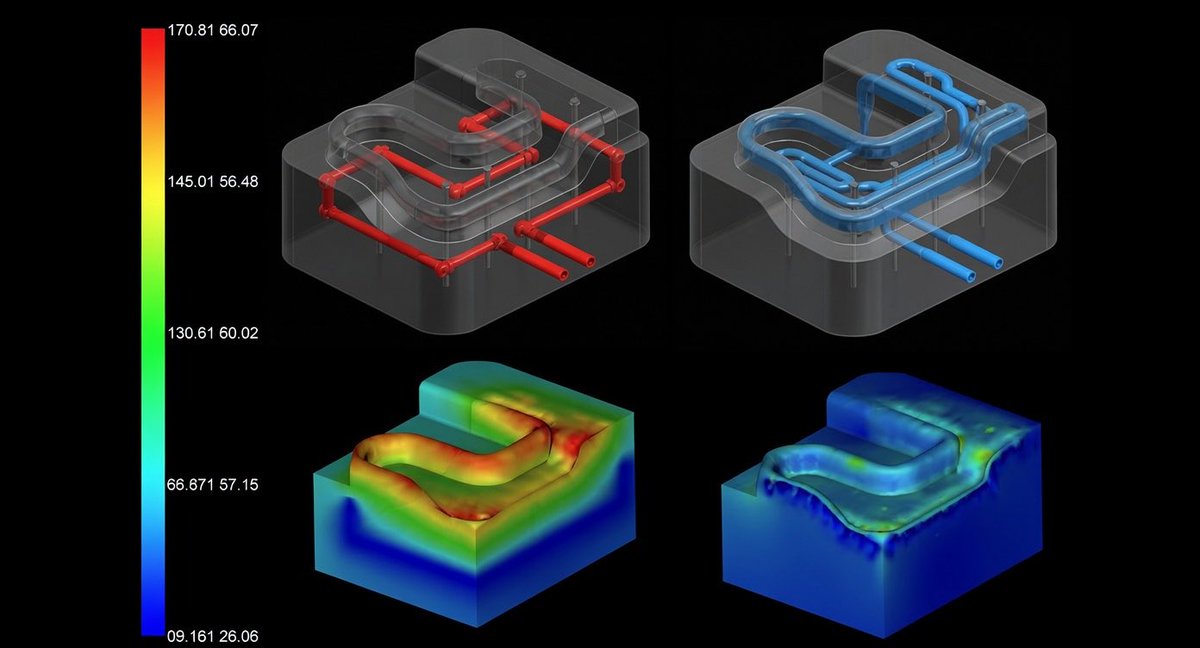
Inside our massive dies aren’t just simple straight holes for cooling — we use conformal cooling channels that twist and turn to follow the exact shape of the part.
This advanced tech (simulated in NovaFlow) gives us:
• Faster cycle times
• More uniform cooling
• Better mechanical properties
• Amazing surface finishes (down to 2-5um on parts)
Old straight-drilled channels can’t compete.
This is how we deliver high-performance
aluminum castings that outperform expectations.
Most people never think about what’s hidden inside the tooling making their everyday products… but this is next-level manufacturing.
What die casting secret should I unpack next? 👇
Anthropic’s Dario Amodei has only 1 direct report, his chief of staff.
The rest of Anthropic’s executive system flows through Dario’s sister, Anthropic President Daniela Amodei, who handles daily operations and reports to the board.
For some comparison, OpenAI CEO Sam Altman has around half a dozen direct reports, while Nvidia Corp. CEO Jensen Huang has 60 people reporting to him.
---
From "Bloomberg Originals" YouTube channel, (link in comment)
A CNC machine looks deceptively simple →
+ Block of metal goes in
+ Finished part comes out
+ Most people see the part
Manufacturers see the invisible stack beneath it →
+ Spindle
+ Controller
+ Servo drives
+ Tooling
+ Software
+ Process knowledge accumulated over thousands of cuts
For decades, India has been exceptionally good at operating machines designed elsewhere.
The harder challenge is building the machine that builds the machine.
The line that stood out to me was "India's first domestic CNC controller."
Because controllers are to machine tools what operating systems are to computers. They determine precision, speed, reliability and ultimately who captures the highest-value part of the ecosystem.
A 300,000 sq. ft. factory is impressive.
A domestic controller is strategic.
Manufacturing leadership is rarely built by making more parts. It's built by moving one layer deeper into the stack every decade.
+ First the component
+ Then the machine
+ Then the controller
+ Then the software
+ Then the IP
The countries that dominate manufacturing today followed exactly this path.
Good to see more Indian companies choosing the harder road.
Big milestone for Ethereal Machines.
We've raised $28.5M in Series B funding, led by @AvataarVC with participation from @peakxvpartners and other investors.
We're using this capital to:
• Build a 300,000+ sq. ft. advanced manufacturing facility
• Develop India's first domestic CNC controller
• Scale our AI-powered factory OS, Vesper
• Expand globally
India has the talent to lead in advanced manufacturing. We're building the capability to match.
Thank you to our customers, investors, partners and team for being part of this journey.
@MuddaKaushik Navin Jain @Sumeet_Patil96@BlumeVentures@SteadviewCap@indigoedge@prashanthp@shaileshlakhani@aaasandeep@LipBuTan1@BKartRed@arpiit@RajanAnandan
#DeepTech #AdvancedManufacturing #MakeInIndia
i hooked my whoop to my work calendar to find which coworker gives me the most stress 🚨
thanks to fable, I reverse engineered whoop to pull per minute heart rate. nd matched spikes with cal events and attendees
I now have a leaderboard and I think about it daily.
few info masked for obvious reasons ;)