NOBODY TELLS YOU HOW TO ACTUALLY BEAT THE S&P 500.
SO HERE IT IS.
(Write these down. Save them. Screenshot them.)
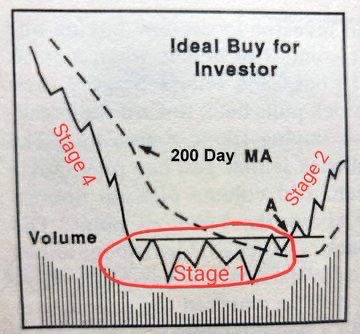
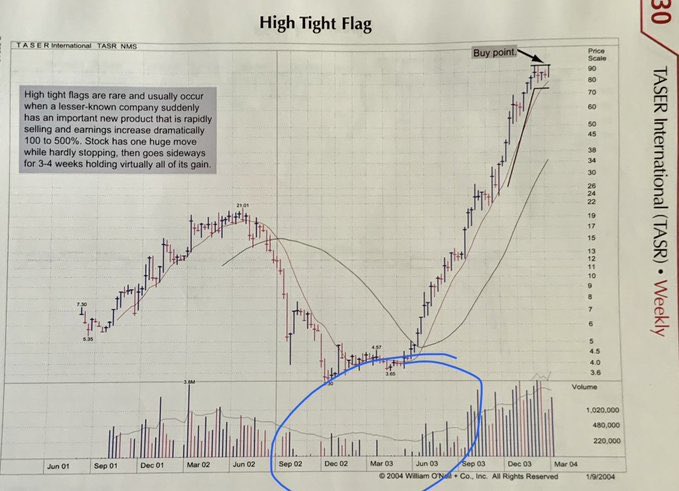
1: Buy quality only when it trades below its 200 week moving average.
Morgan Stanley: Bearings
The Big Picture: Bearings as a Core Robotics Play
> Architecture-Agnostic Growth: Bearings offer a diversified way to invest in the robotics sector because they are required regardless of a robot's ultimate design or form factor.
> Massive Market Expansion: Morgan Stanley forecasts a massive ~300x growth in the robot bearings market through the year 2050.
> Low Risk of Obsolescence: Bearings face very low substitution, in-sourcing, or obsolescence risks—you simply cannot design moving machines around them.
> OpenAI Endorsement: In a recent Request for Proposal (RFP) for U.S.-based hardware manufacturing capacity, OpenAI listed precision bearings as 1 of 6 critical components in its robotics category.
Content Scales with Robot Complexity
> Bearings 101: Every single motor in a robot requires at least one or more bearings to reduce friction and support rotating parts.
> Degrees of Freedom (DoF): As robots get more complex, the number of bearings multiplies.
Small quadcopter drone: Requires 8–12 bearings.
Humanoid robot: Requires 70 or more bearings.
> Pricing Variability: Depending on the specific use-case, individual bearings can range from under $1 to as much as $100
Global Bearings Market Dynamics
> Consolidated Supply: The top 6 global manufacturers control over 50% of the global roller market, with Chinese manufacturers making up about 25%.
> Current Demand Split: Roughly 40% of the overall market goes to industrial equipment OEMs, 30% to automotive, and 30 to distribution channels
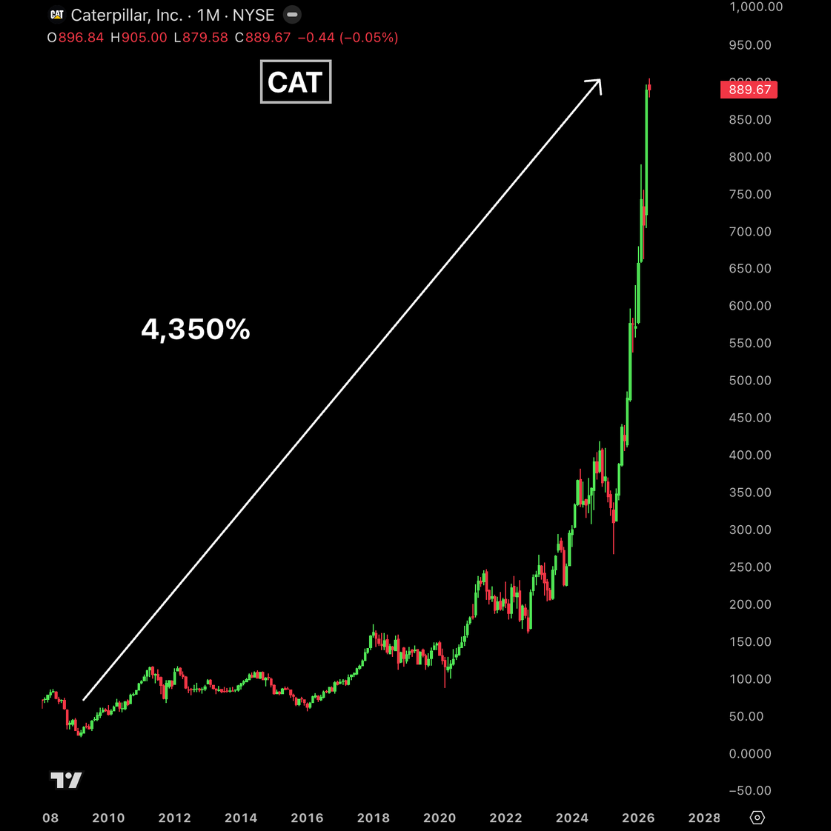
This 100 year old bulldozer company is up 4,350% just because of AI.
And if you invested $100,000 in Caterpillar during the dot com crash, today it would be worth $4.5 million.
While everyone was buying tech stocks, a company that makes bulldozers and excavators quietly delivered 43 times your money.
Caterpillar just reported Q1 2026 revenue of $17.4 billion, up 22% year over year, crushing Wall Street estimates of $16.5 billion. EPS came in at $5.54 against an estimate of $4.63.
But why a century old equipment manufacturer is suddenly an AI company?
Every AI data center being built needs massive uninterrupted power. Caterpillar makes the generators, engines and turbines that supply both primary and backup power to those facilities. Power generation revenue jumped 41% to $2.82 billion, with most of that growth directly linked to data center demand.
Caterpillar's order backlog just hit a record $63 billion, up 79% from a year earlier. Those are confirmed orders stretching into 2028. The AI infrastructure buildout has years left to run and Caterpillar is booked through most of it.
The man who turned 225 million dollars into 5.5 billion dollars explained on camera exactly why he made his biggest bet.
This is Leopold Aschenbrenner, the same person whose Bloom Energy position is now worth close to 2 billion dollars after Oracle's 2.8 gigawatt fuel cell deal laying out the power math that drove every investment decision his fund has made.
In 2022, the GPT-4 training cluster consumed roughly 10 megawatts of power and cost about 500 million dollars.
AI compute has been scaling at roughly half an order of magnitude per year meaning the largest training cluster doubles in power requirement every 12 to 18 months without stopping.
By 2024, the largest cluster was approximately 100 megawatts, the equivalent of 100,000 high-end GPUs and costs in the billions.
By 2026, right now, the leading training cluster requires a full gigawatt of continuous power and that is the output of a large nuclear reactor.
By 2028, the projection reaches 10 gigawatts, more electricity than most US states generate in total.
By 2030, the trillion-dollar cluster, 100 gigawatts, over 20 percent of everything the United States currently produces in electricity, consumed by a single AI training installation.
And that is just the training cluster.
Inference, the continuous compute required to actually run AI products for hundreds of millions of users requires multiples of that on top.
Meanwhile, total US electricity production has barely grown five percent over the last decade and the grid was not built for this.
And the transformer shortage, the switchgear backorders, and the canceled data center projects that are making headlines right now are the first visible symptoms of a power system hitting a wall that Aschenbrenner saw coming years before the rest of the market.
This is exactly why he built a 875 million dollar position in Bloom Energy, a company that generates electricity directly at the data center site using fuel cells, completely bypassing the grid bottleneck that is already stopping half of all planned US data centers from opening on schedule.
The thesis was never complicated.
The bottleneck in AI is not the models, not the chips, and not the software.
The bottleneck is whether civilization can generate enough electricity to run the machines fast enough to matter.
Leopold Aschenbrenner sold every share of Nvidia and Broadcom last quarter. Took the money and bought fuel cells, Bitcoin miners, and power companies.
Today Oracle signed a 2.8 GW fuel cell deal with his largest holding. The stock jumped 15% after hours.
This is the most contrarian AI trade on Wall Street right now, and the math behind it is wild.
Leopold wrote a 165-page essay in 2024 arguing AGI arrives by 2027. Then he translated that prediction into a pure energy play.
His logic: scaling from GPT-4 to superintelligence requires data centers consuming more electricity than most American cities. You can order 100,000 GPUs and get delivery in six months. You cannot add 500 megawatts to the grid in six months. The binding constraint on who builds AGI first is watts per rack.
So while AI funds stacked Nvidia at 30x revenue, Leopold built the opposite portfolio. Bloom Energy, his largest position at 15% of the fund, makes solid oxide fuel cells that can power a data center in 55 days. Grid interconnection takes 2-3 years.
He entered 2026 with $876 million in Bloom Energy. That position has more than doubled. His fund went from $254 million in equity positions in Q4 2024 to $5.5 billion by Q4 2025. Beat the S&P by 47% in its first six months.
He's 24. Got fired from OpenAI two years ago. Zero prior fund management experience. The Collison brothers and Nat Friedman backed him anyway.
Today's Oracle deal validates the entire thesis. Oracle contracted 1.2 GW immediately, with a pipeline to 2.8 GW, because Bloom delivered a fully operational system in 55 days last year. A month ahead of schedule. Oracle needs power faster than any grid can supply it.
GPU supply is expanding on a known curve. Electricity supply isn't. Leopold bet his entire net worth on the gap between those two curves, and so far the gap is only getting wider.
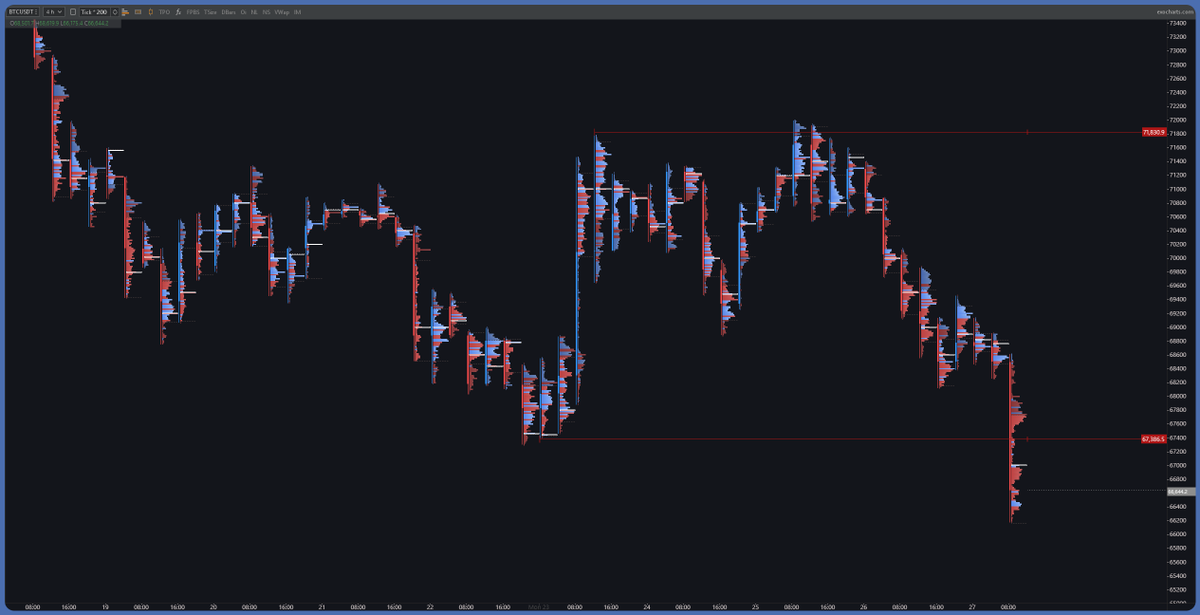
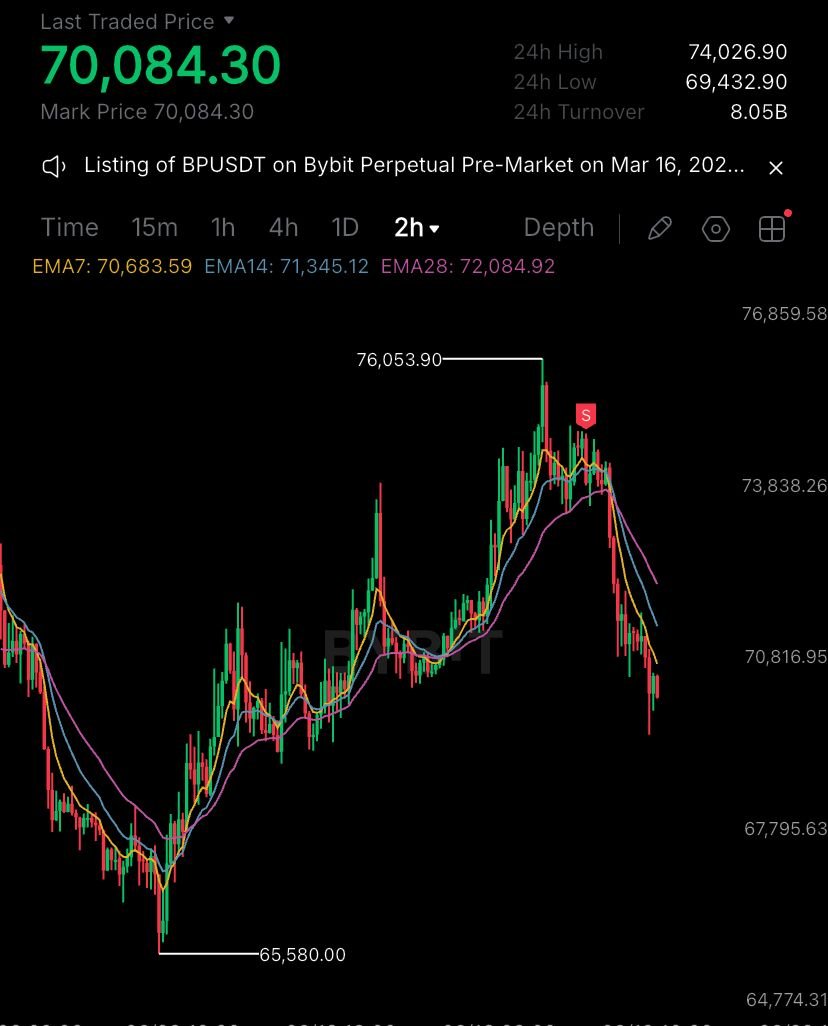
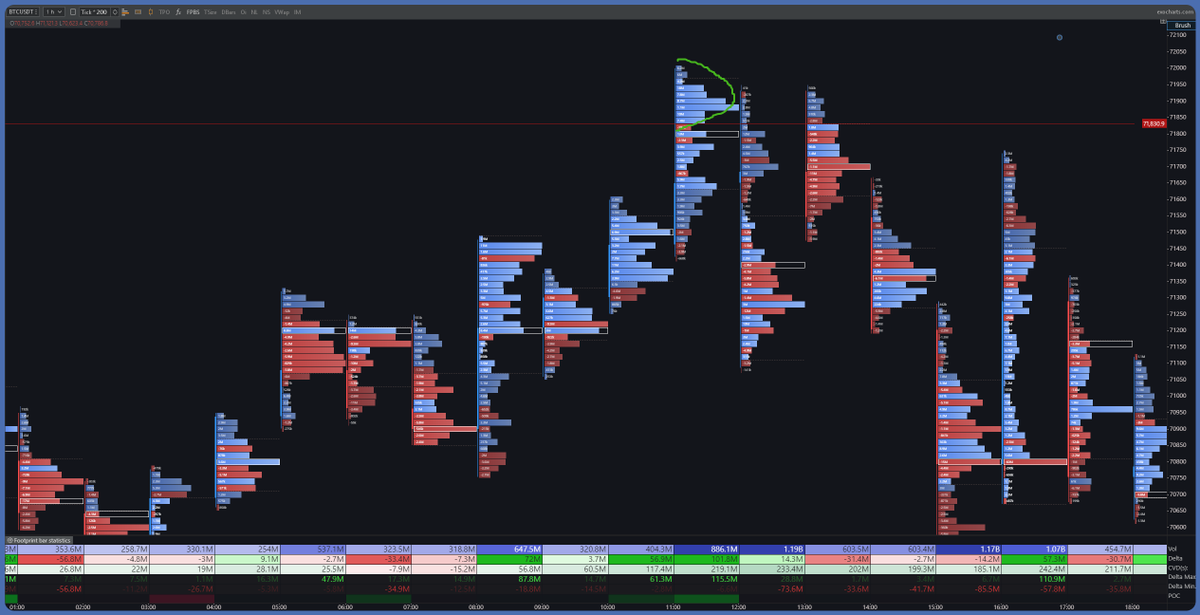
Well one week later - traded upto 72 - just above mondays highs... and Feb Monthly VAH
I personally had 73 as a tough level to break...
And now price is at the other side of Mondays range...
Lovely PA and Delta exhibited at the highs on Wednesday as an inflection point
Holy ****, my $AXTI thesis was legendary?
AXT is up another 20% today to ATHs at $58.
Happy I got this right, gains in a short time blew away holding $NVDA over the years.
$BTC
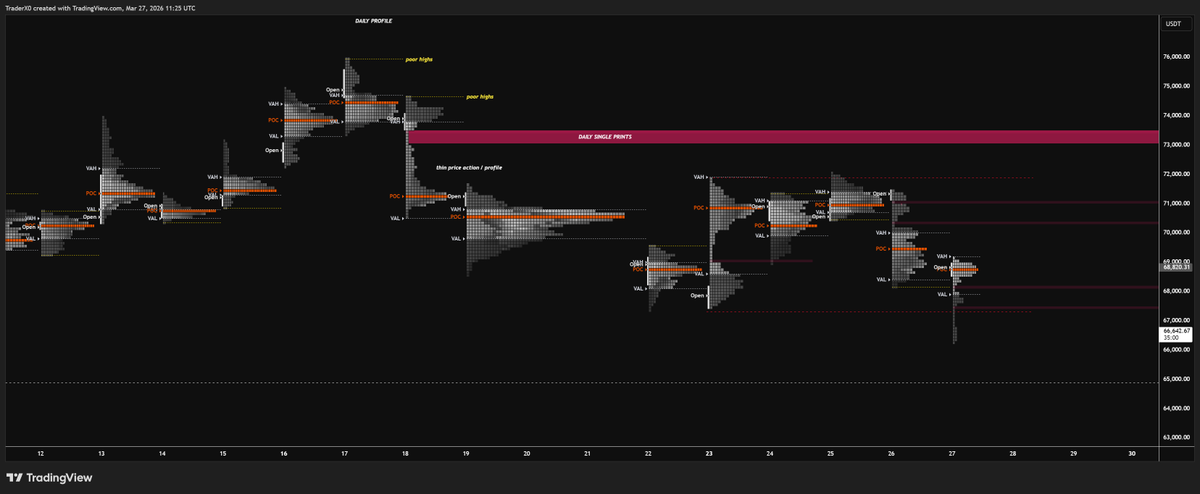
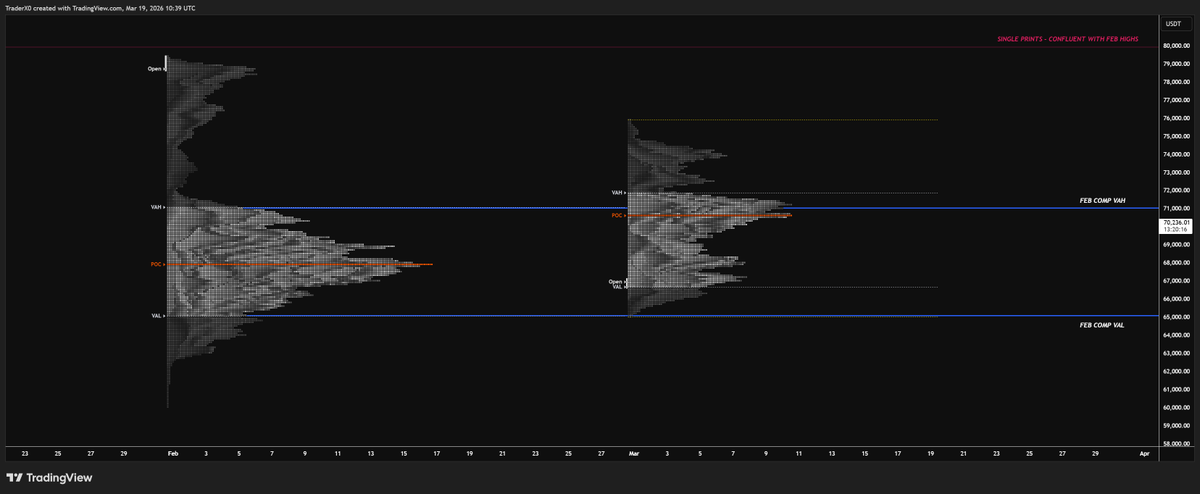
Back within the February value area.
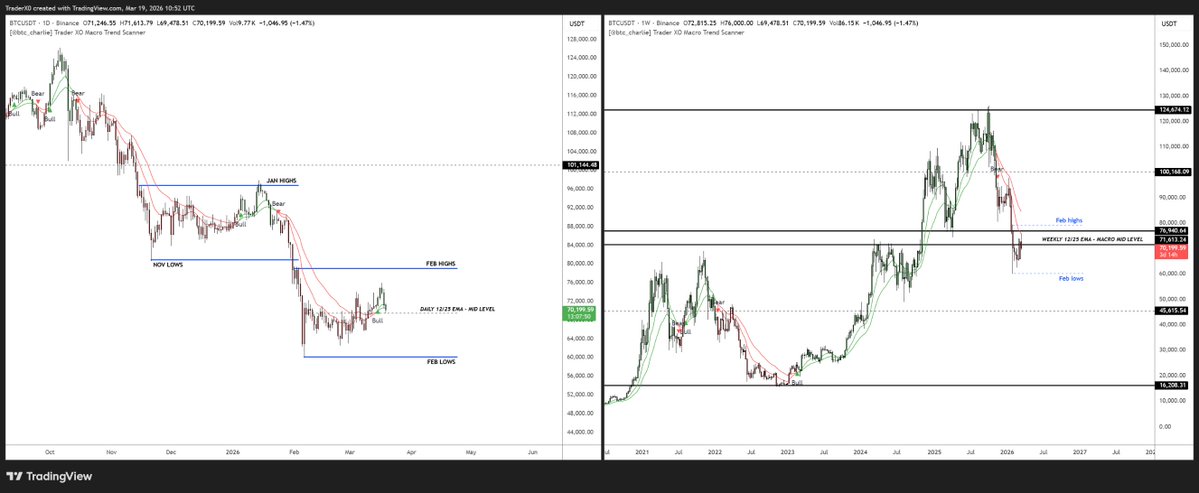
Limited acceptance above 71k (Feb VAH), with price now finding support at the 12/25 daily EMA's, mid of the range.
Failure to hold 69–70k (mid range & daily ema bands confluence) would favor a rotation back toward 65k (Feb VAL) as the auction rotates across value.
Ideally wanted the 79–80k sell zone, but currently holding a smaller short initiated from 74k - due to the level being tested several times on the ltf's with no signs of buyer continuation.
Acceptance back above Feb VAH (71k) would suggest a shift in auction, opening the door for continuation into the 79–80k February highs. In that case, will switch my context and look to scale out of shorts as the market tries to transition higher.
Expectations remain the same: Rangebound / rotational until it isnt and it could remain that way for a good few weeks.
Edge "zones" are where I'm interested in trading higher probability inflection points - Feb Highs / Lows.