@gregeganSF Ever since @viktorblasjo came up with his series on Galileo (https://t.co/d2raUD4hnv) I had the tools to mock those that namedrop him as the paragon of science
There is a lot about Euclid’s Elements that is easily misunderstood. Some proofs seem to have logical gaps. Some constructions seem pointless, others seem needlessly convoluted.
Each of these provides a window into how the ancient Greeks thought about math and the philosophical role that geometry played.
In the fifth and final of a series of guest videos I've been posting, @BenSyversen delves into a question anybody who has had to do ruler and compass constructions in a geometry class may have wondered: What's the point?
https://t.co/nqKLQ7zQ4b
Very comprehensive takedown of Galileo by @viktorblasjo
I don't think anyone has tried to frame a rebuttal, which I would find interesting because I don't share the anti-philosophy biases of the author
https://t.co/bSXSsDb2q6
@mmeijeri@yvanspijk@YoeriGeutskens "The term 'focus' for these points [foci of conic sections] was introduced by Kepler ... I know of no ancient or medieval term." Toomer, Diocles on Burning Mirrors, p. 15. Even though the Greeks certainly knew about the concept, both theoretically and practically.
@dodecahedra Certainly. The "rigor" I don't like is for example proving the FTC using the Intermediate Value Theorem and such things. A purely intuitive proof of the FTC is much more useful in a calculus context, whereas the "rigorous" proof in that context only obscures the key idea.
@dodecahedra Yes, I agree that Hobbes's argument basically doesn't work for this kind of reason. He is perhaps trying to say that infinitesimal methods generally assume non-Archimedean quantities, not referring to the specific slices used in any particular proof such as that of Torricelli.
Yesterday we got a new @viktorblasjo podcast all about Torricelli's trumpet, infinite geometric objects, and myths of math history. Entertaining, informative, hilarious, & way more detail than you probably want on parsing passages from the 17th century. https://t.co/VBbD0v9fok
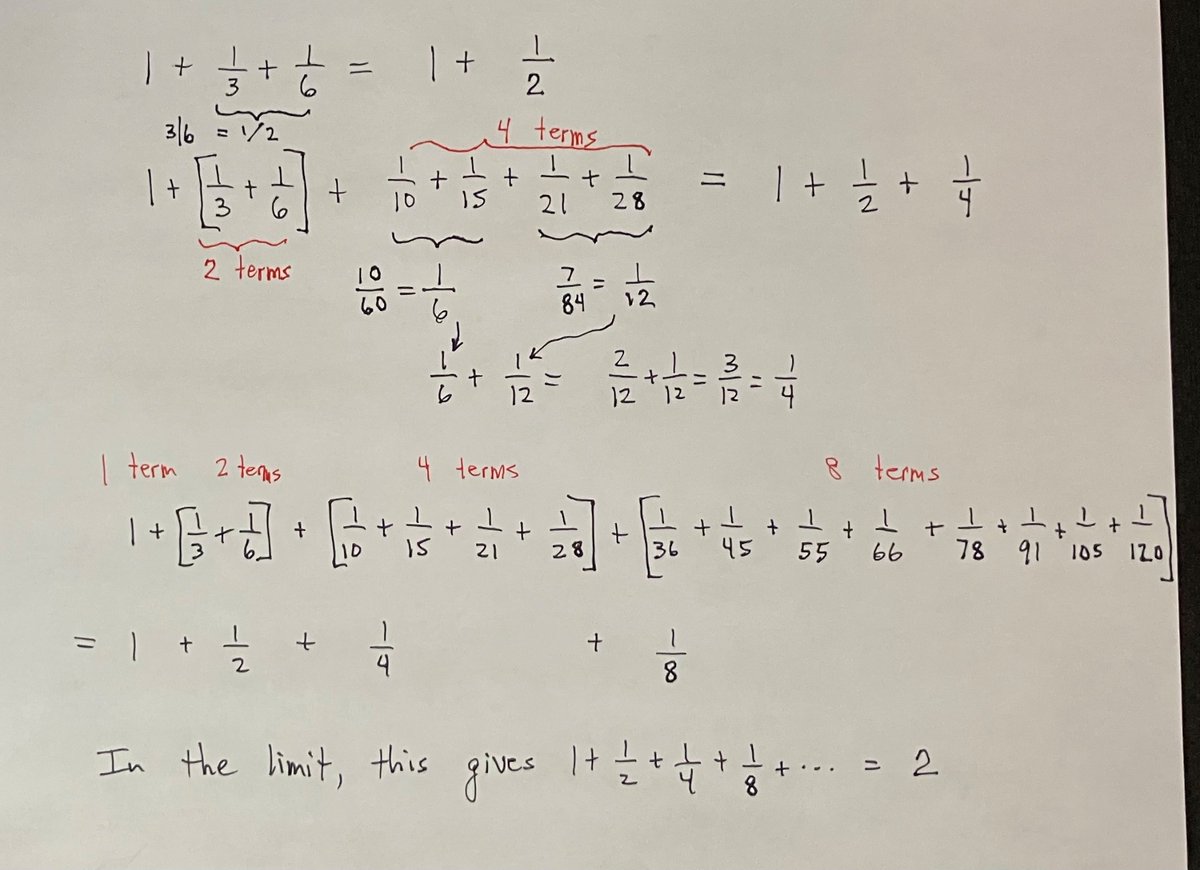
Today I learned (ht @viktorblasjo) how Huygens summed the reciprocals of the triangular numbers. He regrouped the series and showed that it equals the geometric series 1+1/2+1/4+... = 2, like so!
@MBarany Yes, the confrontational approach is crude and imperfect (certainly including my contributions) but still better and more fruitful than the milquetoast bland fest some seem to prefer.
Interesting comments on the geometrical algebra hypothesis in this review indeed. Among other things, "well-founded arguments have been advanced by V. Blåsjö" 🤗
... algebra and arithmetic", says Athanase Papadopoulos's review https://t.co/LxlWsqXKv0.
The review gives also a detailed update on the state and recent discussions on the field of geometric algebra, closely related to the second book of Euclid's elements. 2/2
@mmeijeri Indeed. Numerical calculations of areas and volumes by multiplying numbers were certainly commonplace in practical economic contexts. Formal mathematics often hides its intuitive or applied origins, then as now. Høyrup is good on this.
@Helenreflects Way beneath the ambition of Leibniz. Galileo couldn't quit his shitty university professorship fast enough when his fame took off. Newton too grew way too elite for a provincial Cambridge job and quit. And these were much better universities!
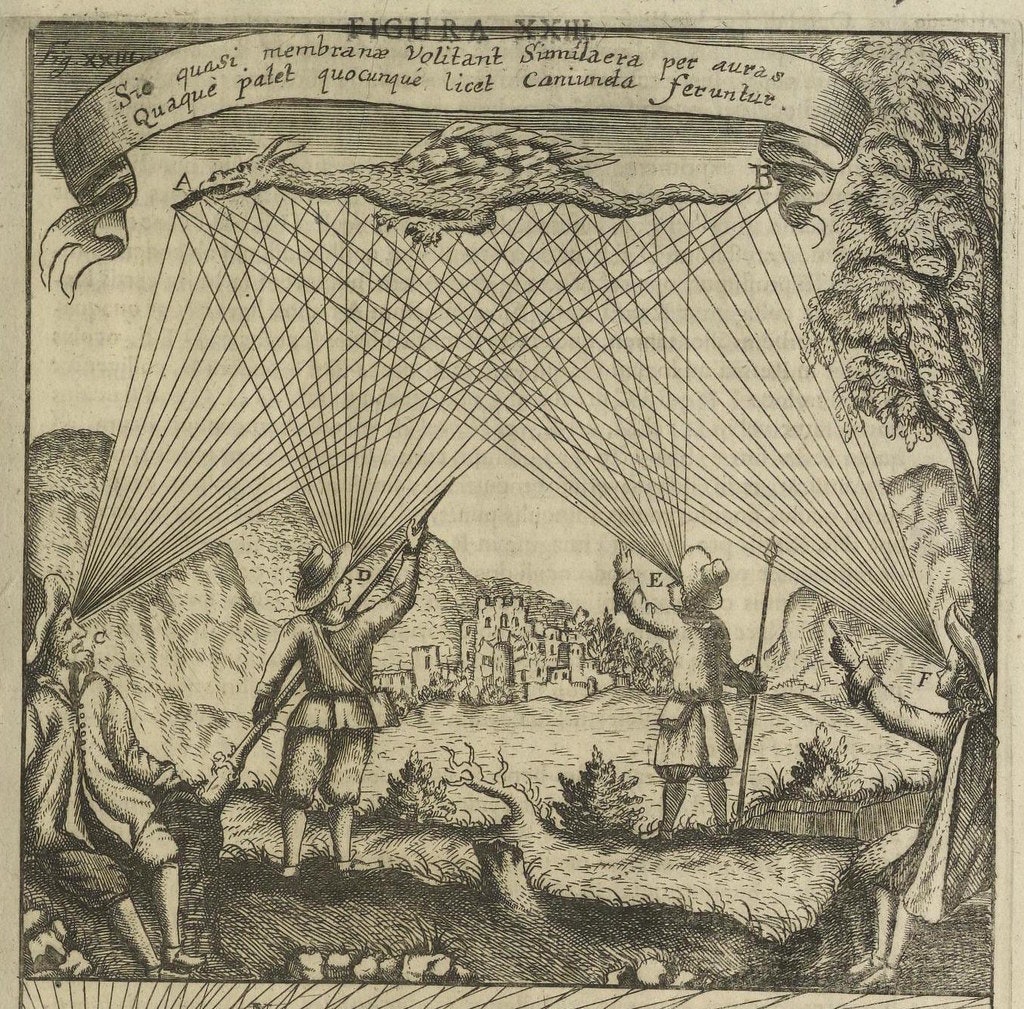
The innovative and, at times, wonderfully surreal engravings from Johann Zahn’s Oculus Artificialis (1685), an early and comprehensive account of the function and usage of a number of optical instruments, including the camera obscura and magic lantern: https://t.co/1D0MQBswse