@benjamindcrosby @KristenFilipic@ChristianityOn People almost instinctively reject the idea that kleos might be won on the battlefield now, and it's probably not coincidental that WW1 (maybe WW2 at a push) is the last time the majority of the officer corps grew up reading Homer at school.
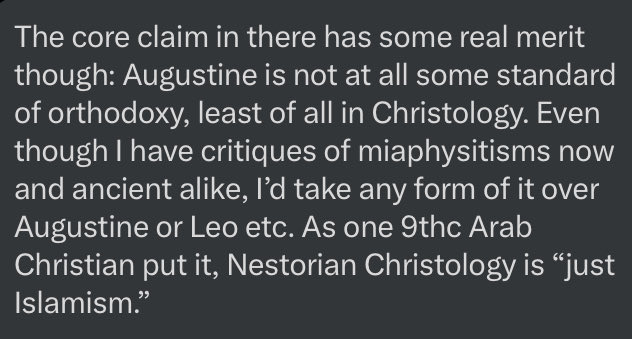
God love JDW. I thought I had been the only one on the planet who rejected Augustine, but he surpassed me with flying colors. Immediately after this DM of his-
“In fact, both Nestorius and certain Muslims are significantly more admirable theologically than late Augustine.”
O God, our refuge and strength, who art the author of all godliness; Be ready, we beseech thee, to hear the devout prayers of thy Church; and grant that those things which we ask faithfully we may obtain effectually; through Jesus Christ our Lord. Amen.
At the virtual Zoroastrian temple you can have an enlightening voice conversation with the knowledgeable Mobed. He has access to the entire Avesta and can answer all your questions about the texts. This mobed is powered by Anthropic.
In our era of ethno-nationalism this verse is so needed, Acts 10:35; "but in every nation anyone who fears him and does what is right is acceptable to him."
Reminder: early Christianity was a primarily urban religion whose critics mostly faulted it for its revolutionary nature, for disregarding all the ancient hierarchies and pieties that held society together.
@JoshuaPenduck "The Word that came to the prophets was the retroactive existence of the risen one, from the heaven/future by the Spirit" (Lee, Trinitarian Ontology and Israel in Robert W. Jenson's Theology, 63).
"I am quite sure that there is a God in the sense that I am sure my love is no illusion. I am quite sure there is no God, in the sense that I am sure there is nothing which resembles what I can conceive when I say that word." - Simone Weil
"Whether my Passion prayer is based on the Stations of the Cross of the Rosary, on the prayerful reading of Scripture or the silence of Eucharistic Adoration, it is always at the foot of the Cross that my encounter with Jesus takes place." - Fr. P. F. Spencer CP
The important facts are these:
1) Williams was an occultist. Though he may have downplayed this later in life, his letters demonstrate that he remained somewhat obsessed with Kabbalah and other forms of magic.
2) Because of his occultic views of magic and the supernatural, he believed that he could essentially siphon creative energy from young women by engaging in sado-masochistic Master/Slave relationships with them (while married with children).
He came to believe that he could not write or create art without these relationships.
3) Though some women felt that these relationships were consensual, Lois Lang-Sims (who was 30 years younger than Williams) credited this relationship with destroying her health.
A man devoted to the occult, a sadist, an abuser.
Lewis quite clearly did not know about the darkest of these activities, but he was also blinded by Williams' charisma (as were so many others).
Tolkien, on the other hand, was suspicious of Williams and referred to him (per Humphrey Carpenter) as "that witch-doctor."