Thrilled to see our work featured on @alzforum!
Our AI framework DeepSUVR, developed at @CSIRO, enhances amyloid PET quantification to improve precision and standardisation across studies.
Great recognition for the team and a meaningful step forward for PET imaging.
🧪 Les biomarqueurs sont de véritables indices biologiques.
Dans la maladie d’Alzheimer, ils permettent de :
🔍 Détecter très tôt la maladie
🧠 Mieux poser le diagnostic
💊 Suivre l’efficacité des traitements
📘 Découvrez notre carrousel de la semaine : https://t.co/NEEntY36BF
After more than 3 years of work, visualizing over 6,500 tau PET scans, and countless manuscript revisions, I still have to blink twice to believe it: our paper “Frequency and Clinical Outcomes Associated With Tau PET Positivity” is now published in JAMA.
https://t.co/8iGcly62Qe
🚨Donanemab has been approved for use in Aus. ADNeT Director Prof Chris Rowe said "Today is a momentous day in the treatment of the most common form of dementia. We must now ensure our health system is ready to bring these new treatments to patients" More➡️https://t.co/U9VuFyHtxs
🚨Donanemab has been approved for use in Aus. ADNeT Director Prof Chris Rowe said "Today is a momentous day in the treatment of the most common form of dementia. We must now ensure our health system is ready to bring these new treatments to patients" More➡️https://t.co/Wm6vFWORYG
https://t.co/5E0UNhC0n3
Finally, some much-needed progress! The TGA in Australia has approved Donanemab for early symptomatic Alzheimer's disease. This offers new hope by slowing cognitive and functional decline. Every step counts! #AlzheimersTreatment#Dementia#Australia
Australians are travelling overseas for dementia treatments like lecanemab after TGA rejection. ADNeT urges approval so that the 433k Australians living with dementia can access the latest treatments at home. #DementiaTreatment#ADNeT@AlzDisInt
Approved in Europe the first disease-modifying treatment for #Alzheimer's disease.
Great news for patients, families and all of us interested in this devastating disease.
Exciting news! Our findings on the Lumipulse #pTau217 assay were featured in @theheraldsun and @dailytelegraph. In this interview, Prof. Christopher Rowe explains the difference this blood test could make for #Alzheimers diagnosis.
Have a read here: https://t.co/8GYBwMhvbs
Tau PET GWAS turns up potential new #alzheimersdisease gene. The oxidizing enzyme CYP1B1 associates with higher tangle load. @IUMedSchool https://t.co/akdK5qvKZk
Association of in vivo retention of Flortaucipir PET with tau neuropathology in corresponding brain regions
Check out our most recent publication, led by @to_freiburghaus & @DW_Pawlik at Acta Neuropathologica. Main findings:
1⃣ Flortaucipir PET signal primarily reflects tau pathology, also at relatively low densities of tau proteinopathy
2⃣ Flortaucipir PET does NOT bind substantially to tau neurites in neuritic plaques or in individuals with PART
Link to paper (open access): https://t.co/ZMFOU9NUIM
Link to @biofinder_study 🧵: https://t.co/Q8dlnu0BZR
w/@AntoineLeuzy@jorittmo@cece_tremblay@ErikRubenSmith @OskarHansson9
🚨🚨 Paper alert 🚨 🚨
I am honored to have been part of this article led by @LarsRaket. The article provides very important estimations of scenarios for the long-term effect of amyloid-targeting therapies! Also, with @_michael_scholl@AlexisMoscoso9
https://t.co/l6QlnVDsdK
@SHIMADA_Hitoshi Thank you, @SHIMADA_Hitoshi. This is the result of our fantastic collaboration. I really enjoyed working with you all and hope we can collaborate again in the future.
🚨 NEW PREPRINT!
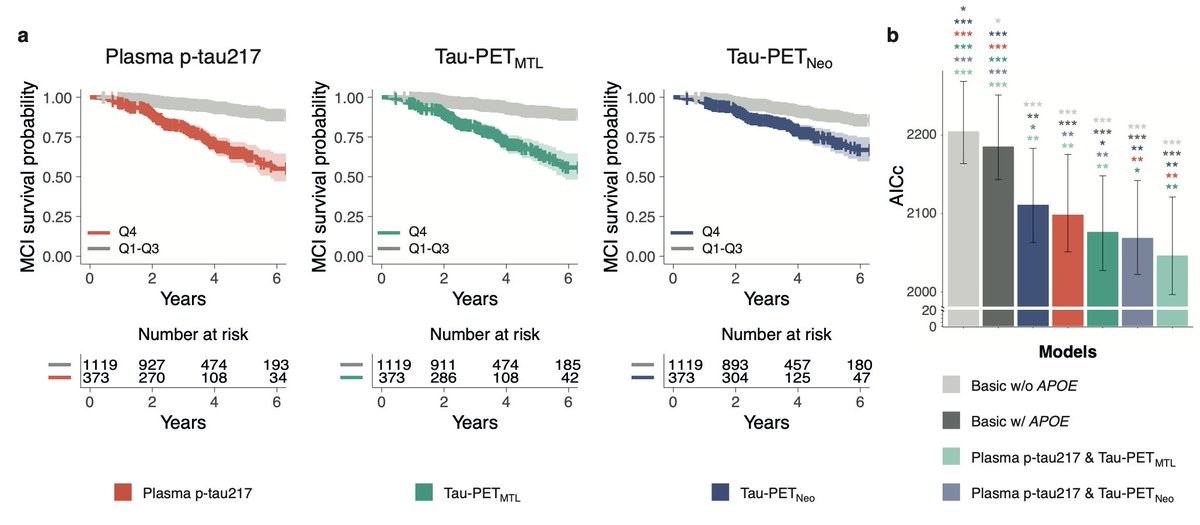
"Prediction of future cognitive decline among cognitively unimpaired individuals using measures of soluble phosphorylated tau or tau tangle pathology"
I am very pleased to present our most recent work!
It concerns a large multi-cohort study in which we conducted a head-to-head comparison between plasma p-tau217 vs Tau-PET among 1,534 cognitively unimpaired individuals and tested how well they were associated with clinical progression over time.
🧵You can find a nice thread here > https://t.co/uGpswh0u34
Link to preprint >
https://t.co/uYInlsBSS1
This study would not have been possible without the @biofinder_study team and our fantastic collaborators (a.o. @prevent_ad, @AlzheimerAms, @WUADRC, @WisconsinADRC), including @alexa_pichetb, @DivyaBali06, @karlssonlinda1, @SebastianPalmqv, @NiklasMattsson4, @EStomrud, @JosephTherr, @NesrineR95, @pedrorosaneto, @EmmaCoomans, @CharlotteTeuni1, @sylv_villeneuve. @BenzingerNeuro1, @SuzanneESchind1, @RandallBateman3, @vincentDore2, @AzadehFeizpour & @OskarHansson9 + many others who are not active on X.
And a special thanks to @gesalba; I really enjoyed working on this project together.