About 81 hours to my first presentation at #ICRA2024🇯🇵! Here's a quick thread on our latest publication🧵📜👇!
Last autumn, we made our first attempt at merging search and learning, to balance the speed of inference and generalisation; with more focus on motion planning🤖 (1/10)
we'll soon be in a regime in mathematics where the interesting bit isn't whether we can solve a problem but whether we can minimize the Kolmogorov complexity of its proof
The Lean FRO and Mathlib Initiative have released a joint statement on the Lean verification of the Riemann Hypothesis.
On November 20, Levent Alpöge released a proof of the Riemann Hypothesis as a Lean library of 17 million lines of code. Over the past day, the Lean and Mathlib communities worked together to verify it. The statement certifies the proof as correct and describes how it meets all necessary verification criteria.
Congratulations to Levent on this achievement, and thank you to everyone in the community who contributed to the verification.
Full statement: https://t.co/edxEbkodw7
Go to https://t.co/gUiPVTTKEP to get started with extensive tutorials, examples, docs, agentic workflows, and more.
Everything is open-sourced and we’d love to get more users/contributors to help develop the best rigid body dynamics physics engine for robot learning alongside @NVIDIARobotics
Some highlights to check out 🧵
Check Steel out! A new physics engine is here!
With support for closed-loop linkages and lots of pretty cool simulation examples to get started with!
It's been super fun working with this super talented team! I'll be sharing more exciting things about Steel soon. Stay tuned..
Steel 0.2 is out:
• 81 simulation environment examples, interactive docs, and migration instructions for your coding agent.
• Magnetic contacts that latch, hold, and release.
• Closed-loop joints for grippers and parallel robots.
Crazy work Vishal and the Skild AI team! All the hardwork finally paying off. Check out the new physics engine, Steel, it delivers up to 13× PhysX throughput for heterogeneous robot simulation. Solid systems work! 🔥
What would it take to learn general manipulation entirely in sim? Accuracy, scalability, and diversity.
Steel is our new physics solver, and it's (1) accurate. Each week we close the sim2real gap even more, this week on magnetic contacts and closed-loop joints.
It's (2) scalable. Heterogeneous environments are painful to run at scale. So we worked with @NVIDIARobotics to take full advantage of the GPU, reaching speeds >10x faster than PhysX.
Now, coding agents have unlocked environment creation at scale. We built Steel for them. Today we're releasing agent-first docs and examples to make it even easier. So (3) — it's diverse.
There's never been a better time for sim.
Agents are very good at learning from examples, so we added more of them to our website
Closed loop linkages, solver coupling, hydroelastic contacts, mimic joints, and so on!
NVIDIA just dropped 10,000 OpenUSD objects on Hugging Face 🤯
→ a microwave with a hinged door
→ a dresser with sliding drawers
→ a forklift with a lifting mast
→ a wheelchair with spinning wheels
1,000 categories, 8,222 with joints, real mass and collision. Ready for Isaac Sim, Apache 2.0.
⬇️ https://t.co/YmJuCkZpOb
guys we need to chill with these paper titles 😭
if i were an agent, i’d be hella mad getting promised my “last exam” every other week, only for another one to drop
I am not sure how openly known this is but: you can read much of a model's training history straight from its weights.
Like what?
1. which tokens were in the data
2. the LR schedule
3. the number of steps
4. and if you have the data: the step most documents were used in, the shuffle seed, the context window, the number of passes
Some possibly less known facts that are verifiable this way (?):
1. In OLMo 2's first instruct release, 20,341 embedding rows that should have trained never moved, among them the token that closes every chat-turn marker. @allen_ai later found the tokenizer mismatch and retrained. The weights had it all along (👀@natolambert).
2. Pythia-1B was pre-trained at a peak learning rate of 2.5e-4, not the 3.0e-4 on its model card. Its training config agrees with the weights.
3. Pythia's learning rate sat flat for its last 28,000 steps: a cosine aimed at zero and clipped at a tenth of the peak. That is not the scheduler in today's gpt-neox.
4. Qwen2.5's instruct tuning touched exactly 4 of its 22 control tokens, the same four at 7B, 14B, 32B and 72B. The end-of-text, vision and fill-in-the-middle tokens show no trace of it.
Pythia-1B model card (says 3.0e-4): https://t.co/iEJJRefQKF
Its training config (says 0.00025): https://t.co/hPpQMoerZT
Today's gpt-neox scheduler: https://t.co/6fll9EOjhy
OLMo 2 SFT card, with AI2's note on the retrain: https://t.co/tapiXfDNxi
OLMo 2 training data: https://t.co/WHwfXmhUik
Qwen2.5 base and Instruct: https://t.co/vzRcLNfuaC https://t.co/eHNI0OLxbz
[1/2]
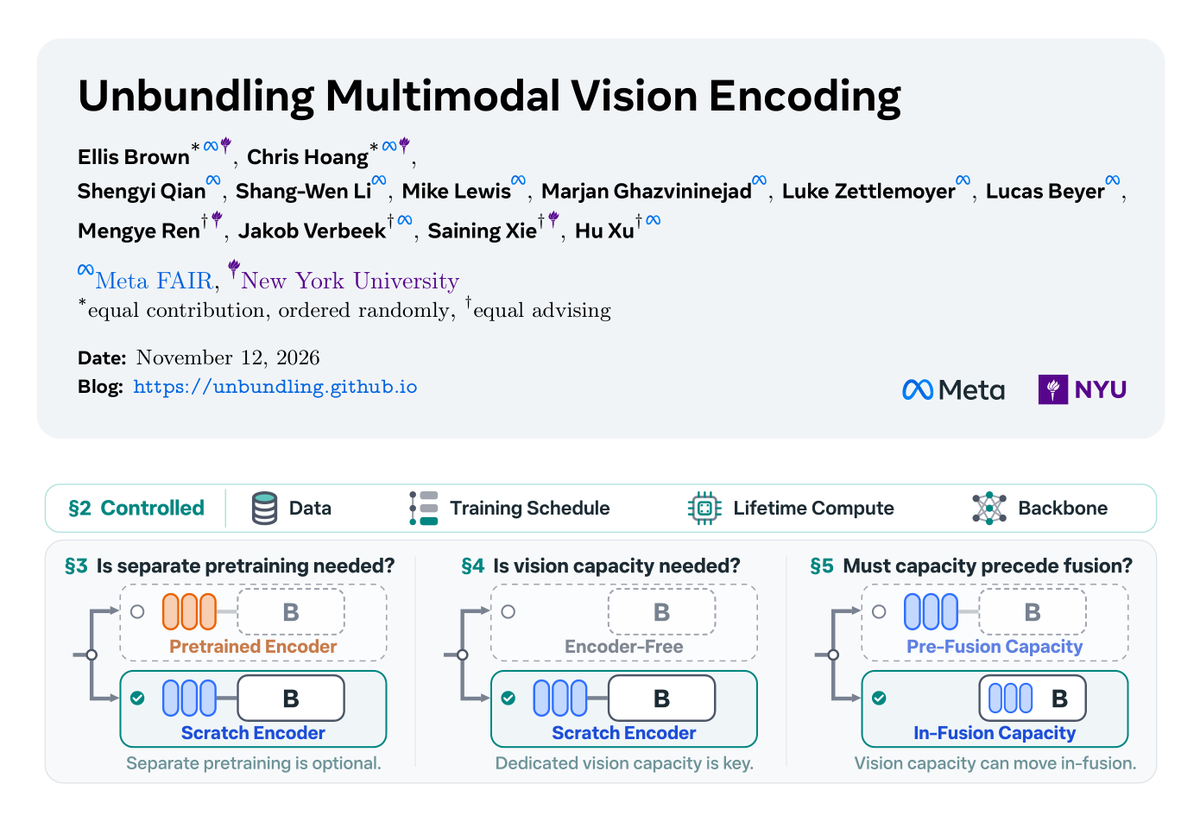
Labs disagree on vision encoders for MLLMs! ⚔️
Gemma 4 12B scrapped the encoder.
Kimi K3 dropped encoder pretraining.
Inkling 2 Small revived the encoder Inkling killed.
We trained 200+ models in a controlled study to settle it:
✅ Keep vision parameters, skip the pretraining. And they don't have to be an encoder! 🤔
Paper: https://t.co/e8JRIfPU2m 🧵