Temple's first validation study is out.
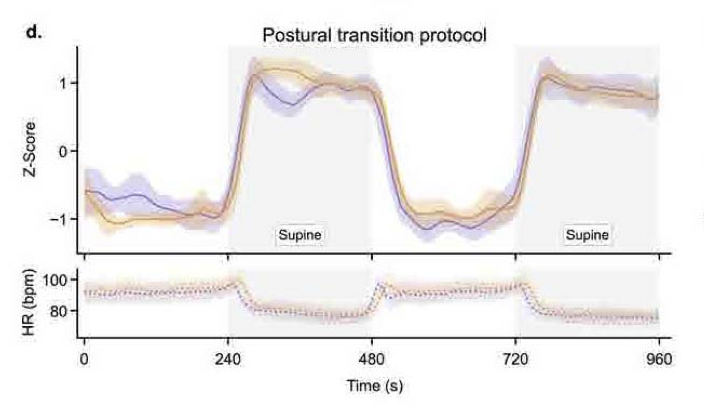
Researchers tested Temple's Brain Flow index head-to-head against Transcranial Doppler (TCD), the gold standard for measuring cerebrovascular function. 23 healthy adults, two challenges: cycling and a standing-to-supine postural shift.
The result that stood out most to me: when participants lay down, their heart rate dropped, but their brain blood flow went up. Temple tracked this accurately, right alongside the Doppler. Any device that only measures heart rate would have gotten this completely wrong.
Across both challenges, Temple's Brain Flow tracked Middle Cerebral Artery velocity (MCAv) with within-subject temporal correlation of r≈0.8 (p<0.001), which is very high even for medical devices.
The paper is posted as a preprint and submitted for peer review. One study, two interventions, healthy adults only, but it's the first step. More validations on Brain Flow, as well as on Entropy with different modalities are underway across the globe. We will keep sharing them as they trickle in.
We encourage researchers to replicate this. We'll happily loan Temples to any qualified researcher who wants to pressure-test any of our metrics independently.
https://t.co/86vUY9YQbV
Cc @agingroy
WOW!!!
Never thought we would hear this level of honesty from a Western leader, and certainly not Canada, given the direction of Canada in the past 25 years. Canada's shift towards multialignment is quite clear - and this level of honesty from Carney on Western "fiction" about the old order will be warmly welcomed in much of the Global South:
"We knew that the story about the rules-based order was partially false... We knew that international law applied with varying rigour depending on the identity of the accused and the victim. This fiction was useful [because of the goods provided by American hegemony]... So we placed the sign in the window. We participated in the rituals. And we largely avoided calling out the gaps between rhetoric and reality. This bargain no longer works. Let me be direct. We are in the midst of a rupture, not a transition... You cannot live within the lie of mutual benefit through integration when integration becomes the source of your subordination."
Last one on this topic, and I have been holding this in myself for a while.
For centuries, class divides kept the labor of the poor invisible to the rich. Factory workers toiled behind walls, farmers in distant fields, domestic help in backrooms. The wealthy consumed the fruits of that labor without ever seeing the faces or the fatigue behind it. No direct encounter, no personal guilt.
The gig economy shattered that invisibility, at unprecedented scale.
Suddenly, the poor aren't hidden away. They're at your doorstep: the delivery partner handing over your ₹1000+ biryani, late-night groceries, or quick-commerce essentials. You see them in the rain, heat, traffic, often on borrowed bikes, working 8–10 hours for earnings that give them sustenance. You see their exhaustion, their polite smile masking frustration with life in general.
This is the first time in history at this scale that the working class and consuming class interact face-to-face, transaction after transaction. And that discomfort with our own selves is why we are uncomfortable about the gig economy. We want these people to look our part, so that the guilt we feel while taking orders from them feels less.
We aren't just debating economics. We are confronting guilt. That ₹800 order might equal their entire day's earnings after fuel, bike rent, and app cuts. We tip awkwardly, or avoid eye contact, because the inequality is no longer abstract. It's personal.
Pre-gig era, the rich could enjoy luxury without moral discomfort. Labor was out of sight. Now, every doorbell ring is a reminder of systemic inequality. That's why debates explode. It's not just policy. It's emotional reckoning. Some defend the system (“they choose it”), others demand change (“this isn't progress, its exploitation”).
And here’s the uncomfortable twist: the unsaid ask of clumsy ‘solutions’ isn’t dignity. It is about returning to invisibility.
Ban gig work and you don’t solve inequality. You remove livelihoods. These jobs don’t magically reappear as formal, protected employment the next day. They disappear, or they get pushed back into the informal economy where there are even fewer protections and even less accountability. Over-regulate it until the model breaks, and you achieve the same outcome through paperwork instead of slogans: the work evaporates, prices rise, demand collapses, and the people we claim to protect are the first to lose income.
And then what happens?
The rich get their old comfort back. Convenience returns without faces. Guilt dissolves. We go back to clean abstractions and moral posturing from a distance. The poor don’t become safer, they become invisible again: back in cash economies, back in backrooms, back in shadows where regulation rarely reaches and dignity isn’t even debated.
The gig economy just exposed the reality of inequality to the people who previously had the luxury of not seeing it. The doorbell is not the problem. The question is what we do after opening the door.
Visibility is the price of progress. We can either use this discomfort to build something better (which we keep doing continuously as delivery partners are our backbone), or we can ban and over-regulate our way back into ignorance. One of those choices improves lives. The other simply helps the consuming class feel virtuous in the dark.
Last one on this topic, and I have been holding this in myself for a while.
For centuries, class divides kept the labor of the poor invisible to the rich. Factory workers toiled behind walls, farmers in distant fields, domestic help in backrooms. The wealthy consumed the fruits of that labor without ever seeing the faces or the fatigue behind it. No direct encounter, no personal guilt.
The gig economy shattered that invisibility, at unprecedented scale.
Suddenly, the poor aren't hidden away. They're at your doorstep: the delivery partner handing over your ₹1000+ biryani, late-night groceries, or quick-commerce essentials. You see them in the rain, heat, traffic, often on borrowed bikes, working 8–10 hours for earnings that give them sustenance. You see their exhaustion, their polite smile masking frustration with life in general.
This is the first time in history at this scale that the working class and consuming class interact face-to-face, transaction after transaction. And that discomfort with our own selves is why we are uncomfortable about the gig economy. We want these people to look our part, so that the guilt we feel while taking orders from them feels less.
We aren't just debating economics. We are confronting guilt. That ₹800 order might equal their entire day's earnings after fuel, bike rent, and app cuts. We tip awkwardly, or avoid eye contact, because the inequality is no longer abstract. It's personal.
Pre-gig era, the rich could enjoy luxury without moral discomfort. Labor was out of sight. Now, every doorbell ring is a reminder of systemic inequality. That's why debates explode. It's not just policy. It's emotional reckoning. Some defend the system (“they choose it”), others demand change (“this isn't progress, its exploitation”).
And here’s the uncomfortable twist: the unsaid ask of clumsy ‘solutions’ isn’t dignity. It is about returning to invisibility.
Ban gig work and you don’t solve inequality. You remove livelihoods. These jobs don’t magically reappear as formal, protected employment the next day. They disappear, or they get pushed back into the informal economy where there are even fewer protections and even less accountability. Over-regulate it until the model breaks, and you achieve the same outcome through paperwork instead of slogans: the work evaporates, prices rise, demand collapses, and the people we claim to protect are the first to lose income.
And then what happens?
The rich get their old comfort back. Convenience returns without faces. Guilt dissolves. We go back to clean abstractions and moral posturing from a distance. The poor don’t become safer, they become invisible again: back in cash economies, back in backrooms, back in shadows where regulation rarely reaches and dignity isn’t even debated.
The gig economy just exposed the reality of inequality to the people who previously had the luxury of not seeing it. The doorbell is not the problem. The question is what we do after opening the door.
Visibility is the price of progress. We can either use this discomfort to build something better (which we keep doing continuously as delivery partners are our backbone), or we can ban and over-regulate our way back into ignorance. One of those choices improves lives. The other simply helps the consuming class feel virtuous in the dark.
One more thing. Our 10 minute delivery promise is enabled by the density of stores around your homes. It’s not enabled by asking delivery partners to drive fast. Delivery partners don’t even have a timer on their app to indicate what was the original time promised to the customer.
After you place your order on Blinkit, it is picked and packed within 2.5 minutes. And then the rider drives an average of under 2kms in about 8 minutes. That's an average of 15kmph.
I understand why everybody thinks why 10 minutes must be risking lives, because it is indeed hard to imagine the sheer complexity of the system design which enables quick deliveries.
Also, if you've ever wanted to know why millions of Indians voluntarily take up platform work and sometimes even prefer it to regular jobs, JUST ASK any rider partner when you get your next food or grocery order.
You will be humbled by how rational and honest they will be with you.
Having said that, no system is perfect, and we are all for making it better than today. However, it is far from what it is being portrayed on social media by people who don't understand how our system works and why.
If I were outside the system, I would also believe that gig workers are being exploited, but that's not true.
I want to respond to this with the perspective of someone who has been in the cloud kitchen and food business for over a decade, before Swiggy and Zomato even existed.
Back then, I ran my own in-house delivery rider fleet. I know exactly what it takes to keep riders on payroll, and I also know the reality that rarely gets spoken about. It was extremely difficult for small business owners. Fake vehicle maintenance claims, inflated fuel expenses, constant disputes, unionising purely to increase per-order payouts, absenteeism, and zero accountability were routine issues.
Not saying all riders were bad—but a significant majority acted only in their own self-interest, often at the cost of the business that employed them.
What Deepinder and Zomato attempted—and largely succeeded in doing—was to organise a completely unorganised sector and take away one of the biggest operational headaches for small restaurants and startups: managing a delivery fleet. Yes, commissions and ads sometimes feel painful and eat into margins. But if not for platforms like Zomato and Swiggy, many of today’s food businesses would never have been able to start at all, let alone scale or become profitable.
I say this with complete honesty and first-hand experience:
maintaining riders on payroll is not easy—at all.
These platforms have also created massive opportunities for the unskilled workforce, giving flexible earning potential to millions and pushing our economy forward. That impact cannot be dismissed.
Now coming to the so-called “peaceful strike.”
What we are seeing is not a movement for the betterment of honest gig workers. It is being hijacked by bad actors—the same crooks that exist in every informal economy—who want more money without accountability or hard work. Blocking others from working, intimidation, and violence is gunda-gardi, not protest. Dressing it up as a workers’ movement doesn’t change that reality.
I have personally dealt with such elements in the past. They don’t fight for fairness—they fight for free money and leverage, and in the process they end up spoiling a genuinely good opportunity for lakhs of honest earners who simply want to work, earn, and move ahead.
Peaceful protest is everyone’s right.
But coercion, violence, and stopping others from earning a livelihood is not justice—it’s exploitation under the disguise of activism.
And calling that out does not make one anti-worker. It makes one honest.
I am all for peaceful protests against anything and everything. But violent protests and stopping others who want to work from working is not okay (proof attached).
Here’s what we know – a number of these protestors were not even our delivery partners. They were agents of political interests, piggybacking on the narrative to gain political mileage.
So many people keep asking me about Continue. What is it? What are you up to? Here you go...
Continue started as a research effort two years ago, with the belief that if the human body is a system, it should also have its leverage points. The simple levers that, when adjusted, could fundamentally alter how we age and live.
Along with a team of initially skeptical researchers, we've been investigating a penny-drop insight about human aging. Something that's been hiding in plain sight for eternity. But more on that in a few weeks. We are at the tail-end of the research on this hypothesis, which if true, could fundamentally change our understanding of biology and aging.
But today isn't about that. It's bigger than that.
Today, we are expanding Continue Research to include a $25 million fund (entirely personally backed) to support researchers across the world who dare to ask simpler questions than anyone else. Who believe biology might be far simpler than we've made it.
For over a decade, I have believed that most of the world’s problems stem from our short human lifespans. Continue Research’s goal is to extend healthy human function long enough that humans stop making short-term decisions.
Read more about Continue’s purpose at – https://t.co/2jbRl1CHvq
This will be a multi-decadal journey. Our goal here is to become a small catalyst in humanity's journey of conscious evolution. To lead us into the Post-Darwin era.
Researchers, please look us up and apply for funding/grants at – https://t.co/3bbtOyXEPf
———
PS: Continue is not a part of Eternal
@Airport_FRA I have been trying to reach your lost and found team but no response on either email or telephone. Apple MacBook lost in terminal 1 (online complaint ID V01171/25). Pls advise
If you had a rags to riches story, you have to be humble doormat all your life and people will love you, the day you act even slightly cocky, people will remind you of your rags. Has its root in the caste system as well. That’s how India is.
Exhibit A:
@AshwiniVaishnaw Train 2423 DBRT delayed by 90 mins but @ntes recording on time arrival on 22nd Sep. Discrepancy happens quite regularly. Is this a new way to manage data and report better performance of super fast trains. Just curious! @RailMinIndia@EasternRailway@PMOIndia
Zomato Feeding India Concert (ZFIC) is back! Headlining this year’s event is my favourite global pop icon, @DUALIPA, an inspiration to millions worldwide!
ZFIC is our endeavour to strengthen India’s resolve to eradicate malnutrition and hunger in the country through community mobilisation. This is just the beginning of the movement and I couldn’t be more excited!
See you all on November 30th in Mumbai, to experience the uniting power of music!
Stay tuned! Pre-sale tickets go live on the Zomato app starting August 27th.
@FeedingIndia@zomato
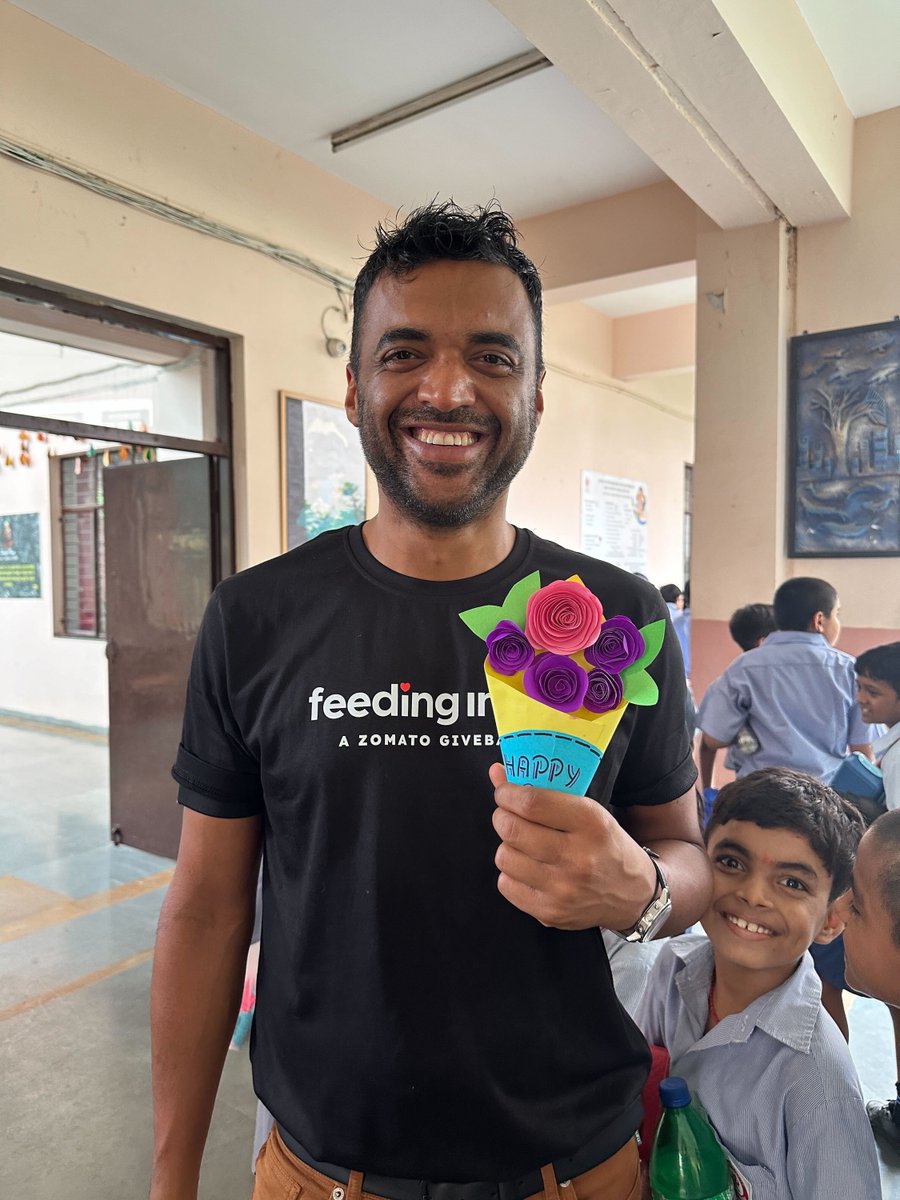
Spent the first part of Zomato’s 16th birthday visiting and celebrating with kids at a Zomato @FeedingIndia supported school. Received much love, and so so many high fives ❤️
@FeedingIndia partnered with the Delhi Traffic Police for their annual #RoadSafety Summer camp and sensitised 600+ students over the last 15 days about #malnutrition and provided nutritious meals.
We are grateful to @dtptraffic and Sh. @hgsdhaliwalips for championing our cause!