how I’m building an agent company inside my agency.
the structure looks like this:
Agency gBrain
→ Orchestrator Hermes Agent
→ Department verticals
→ Specialist agents
→ Scoped sub-agents
gBrain is the company brain.
It gets ingested with the data and experience we already have:
> transcripts
> chats
> previous campaigns
> client learnings
> strategy docs
> internal workflows
> examples of what good looks like
That brain is maintained by a human champion plus an orchestrator Hermes Agent.
Under the orchestrator, we have different department verticals inside the agency.
Each vertical has its own specialist agents.
Some of those specialist agents have even narrower scoped agents underneath them.
I’ve found that narrow scope improves output quality and reduces drift.
> a general “marketing agent” is too vague.
> a lifecycle email agent with access to the right campaigns, voice rules, approval gates, and examples can get very good.
> a technical SEO agent with its own tools, checklists, and source standards can get very good.
> a content research agent with narrow inputs and a clear definition of done can get very good.
The narrower the job, the easier it is to improve the agent.
I use different harnesses for this.
Mostly Hermes Agent, but also CLI harnesses like Codex and Claude Code depending on the job.
I’m still looking for a good bare-bones harness for model routers to run on.
To keep track, I maintain an org chart inside the company gBrain.
The org chart shows:
> top-level orchestrator
> department verticals
> specialist agents
> scoped sub-agents
> which brain each agent reads from
> which tools each agent is allowed to use
> where human approval is required
For clients, I do downstream pods.
Think of them as new agent companies that are isolated from the agency brain, but can still communicate with our agency agents when needed.
A client pod has its own:
> client gBrain
> client orchestrator
> client specialist agents
> client-specific workflows
> client-specific approvals
> client-specific memory
This is important.
You do not want client context bleeding across accounts.
You do not want one agent with every client’s data, every tool, and every permission.
Scope is what keeps the system useful.
The powerful part is that once you build one vertical agent well, you can fork it.
Not copy-paste blindly.
You still need to customize the context, examples, approvals, voice, tools, and workflows.
But you are not starting from zero.
You might have 75% of the agent already done.
That changes the agency model.
You no longer need a full traditional department for every function before you can deliver a well-rounded marketing service.
One or two strong marketing engineers can run an output surface that used to require a much larger team.
But this only works if the agents are actually good.
It takes iteration, taste, source material, QA, workflow design, and real marketing experience.
Bad agents do not become good because you connected more tools.
Vague agents just create vague output faster.
TLDR:
> turn the agency’s knowledge into a brain
> turn repeated work into scoped agents
> turn each client into an isolated pod
> let skilled operators run the system
WAIT. This is actually insane.
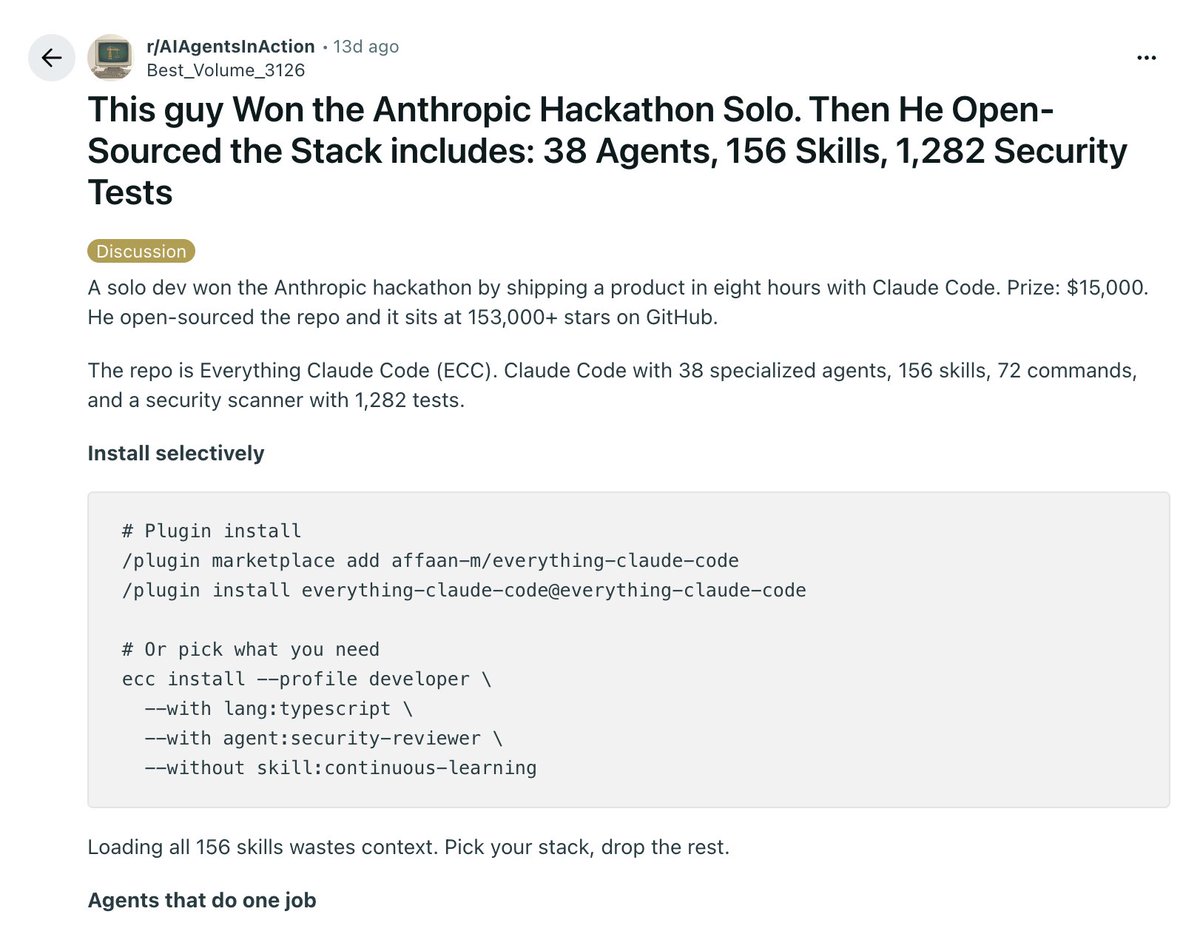
A solo dev just won the Anthropic hackathon, shipped a working product in 8 hours with Claude Code, and walked away with $15,000.
Then he open-sourced the entire stack.
153,000 stars on GitHub. Here's full setup:
→ 38 specialized agents (planner, security reviewer, debugger, code reviewer)
→ 156 skills loaded on demand (/plan, /tdd, /security-scan, /quality-gate)
→ 72 custom slash commands
→ AgentShield: 1,282 security tests across CLAUDE .md, MCP configs, hooks, skills
→ 3 Opus 4.6 agents running red-team pipelines (Attacker, Defender, Auditor)
→ Continuous learning layer that builds confidence across sessions
→ Coverage across 12 language ecosystems
This is what Claude Code looks like when someone treats it like infrastructure instead of a chatbot.
$NVDA just told you exactly where to invest your money.
They just poured $4 billion dollars into photonics.
Here are 10 of the most important photonics companies you need to be aware of:
1. $LITE - Lumentum (Lasers)
The laser source that powers photonics interconnects. NVIDIA just invested $2B with a multibillion-dollar purchase commitment for advanced laser components. Building a new 240,000 sq ft InP laser fab in North Carolina. Added to the S&P 500. When NVIDIA writes a $2B check to secure your supply, the market is telling you something.
I had the same thought so I've been playing with it in nanochat. E.g. here's 8 agents (4 claude, 4 codex), with 1 GPU each running nanochat experiments (trying to delete logit softcap without regression). The TLDR is that it doesn't work and it's a mess... but it's still very pretty to look at :)
I tried a few setups: 8 independent solo researchers, 1 chief scientist giving work to 8 junior researchers, etc. Each research program is a git branch, each scientist forks it into a feature branch, git worktrees for isolation, simple files for comms, skip Docker/VMs for simplicity atm (I find that instructions are enough to prevent interference). Research org runs in tmux window grids of interactive sessions (like Teams) so that it's pretty to look at, see their individual work, and "take over" if needed, i.e. no -p.
But ok the reason it doesn't work so far is that the agents' ideas are just pretty bad out of the box, even at highest intelligence. They don't think carefully though experiment design, they run a bit non-sensical variations, they don't create strong baselines and ablate things properly, they don't carefully control for runtime or flops. (just as an example, an agent yesterday "discovered" that increasing the hidden size of the network improves the validation loss, which is a totally spurious result given that a bigger network will have a lower validation loss in the infinite data regime, but then it also trains for a lot longer, it's not clear why I had to come in to point that out). They are very good at implementing any given well-scoped and described idea but they don't creatively generate them.
But the goal is that you are now programming an organization (e.g. a "research org") and its individual agents, so the "source code" is the collection of prompts, skills, tools, etc. and processes that make it up. E.g. a daily standup in the morning is now part of the "org code". And optimizing nanochat pretraining is just one of the many tasks (almost like an eval). Then - given an arbitrary task, how quickly does your research org generate progress on it?
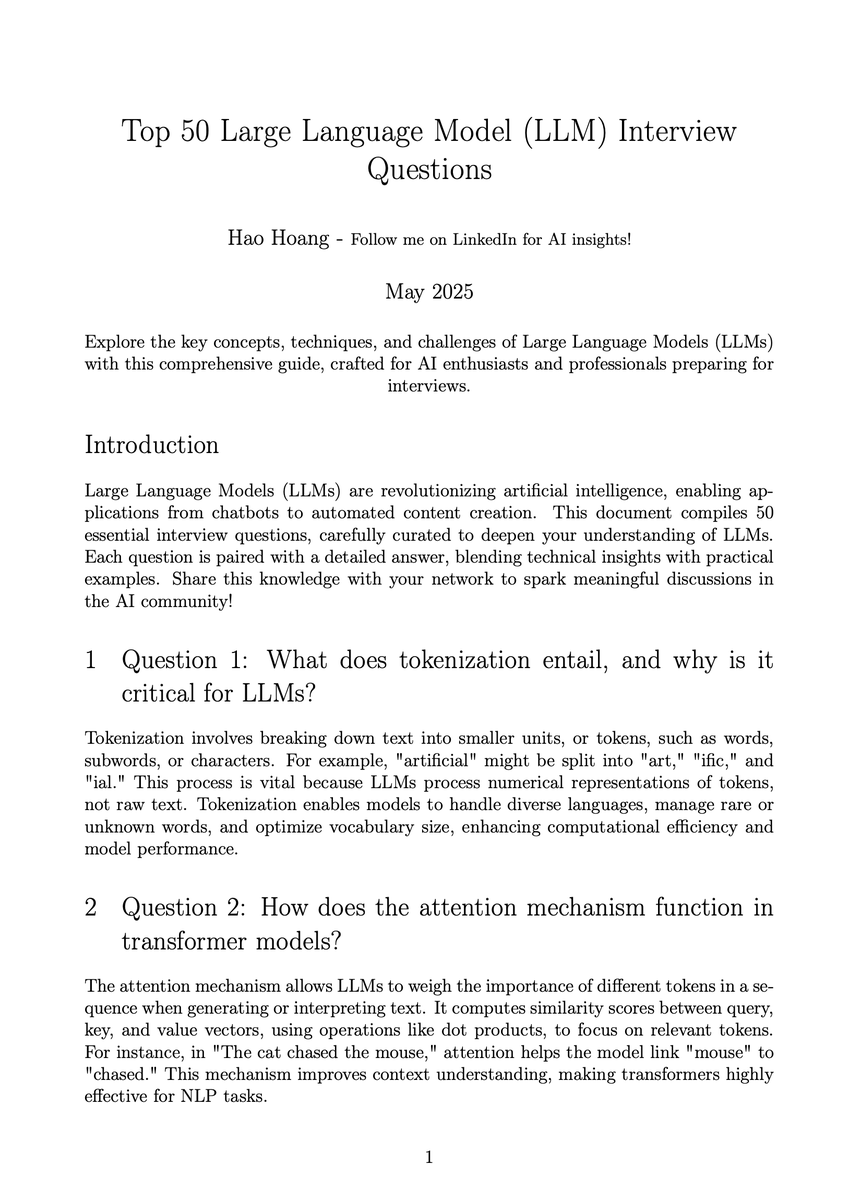
These are literally the kind of LLM interview questions most candidates wish they had seen earlier.
A curated list of 50 LLM interview questions - shared by Hao Hoang.
What's covered:
Fundamentals:
→ Tokenization and why it matters
→ Attention mechanisms in transformers
→ Context windows and their tradeoffs
→ Embeddings and initialization
→ Positional encodings
Fine-tuning & Efficiency:
→ LoRA vs QLoRA
→ PEFT to prevent catastrophic forgetting
→ Model distillation
→ Adaptive Softmax for large vocabularies
Generation & Decoding:
→ Beam search vs greedy decoding
→ Temperature, top-k, top-p sampling
→ Autoregressive vs masked models
Advanced Concepts:
→ RAG (Retrieval-Augmented Generation)
→ Chain-of-Thought prompting
→ Mixture of Experts (MoE)
→ Knowledge graph integration
→ Zero-shot and few-shot learning
Math & Theory:
→ Softmax in attention
→ Cross-entropy loss
→ KL divergence
→ Gradient computation for embeddings
→ Vanishing gradient solutions in transformers
You don't need to follow me (@techNmak) and comment "LLM". I will put the link in the comments.
the best 20 accounts to follow for coding:
@karpathy = ai + code from scratch
@ID_AA_Carmack = low-level systems thinking
@realGeorgeHotz = hacker mindset
@theo = modern full-stack
@leeerob = next.js & devrel
@dan_abramov = javascript & react thinking
@mattpocockuk = typescript clarity
@addyosmani = performance & tooling
@rauschma = deep javascript knowledge
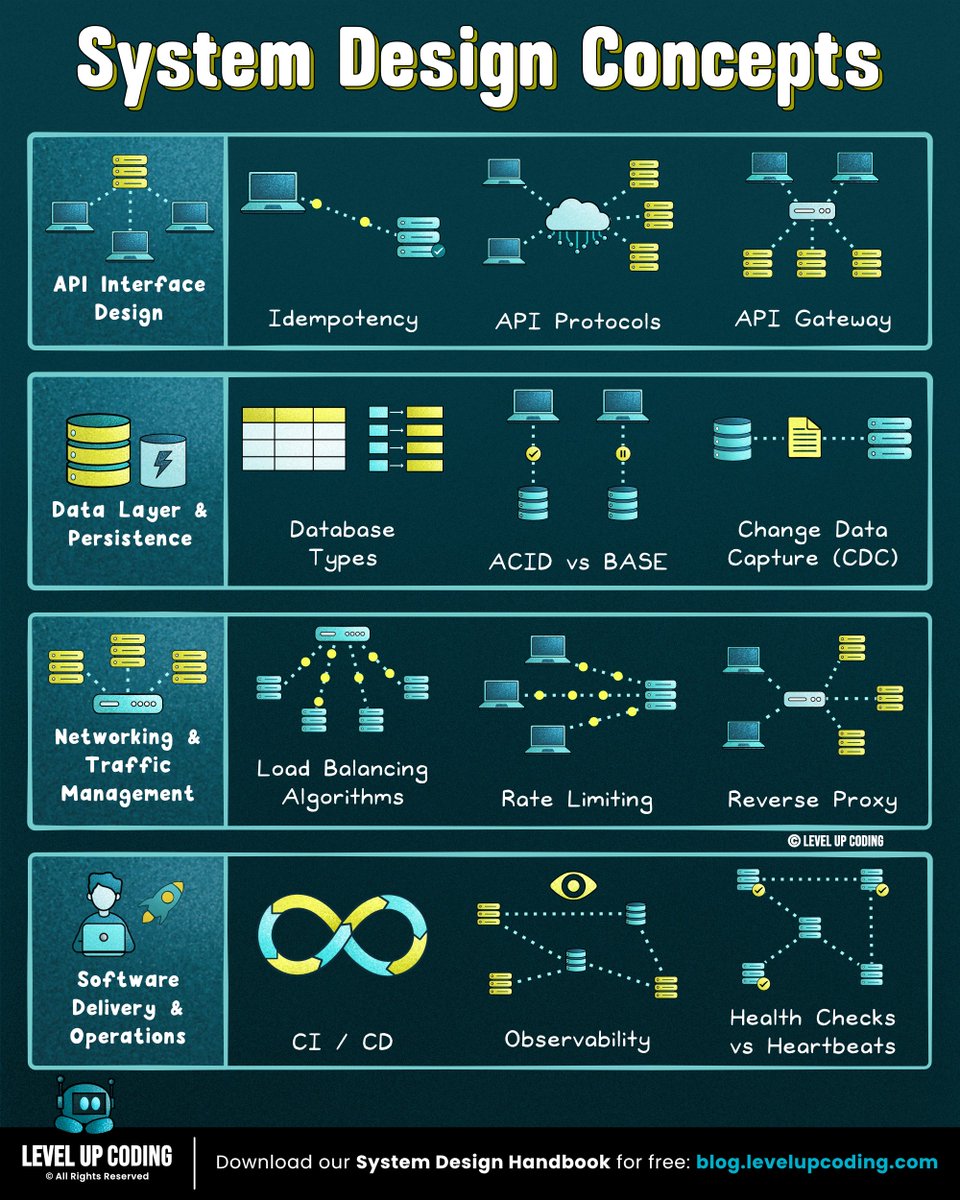
@ashishps_1 = dsa & system design
@svpino = daily coding challenges
@geeksforgeeks = dsa practice
@levelsio = indie hacker coding
@corbin_braun = ai coding workflows (cursor)
@jackfriks = shipping solo apps
@rileybrown_ai = vibe coding with ai
@exm7777 = ai systems & infra
@ThePrimeagen = hardcore dev mindset
@jherr = practical web dev & tooling
@TkDodo = react query & frontend depth
follow them and you’ll learn ai, systems, dsa, full-stack, and how to actually build.
@Quehenberg_ I do appreciate your teardown, but is this company enabling anything more than a very detailed puppet hand? without specific control on the pressure via actuators what input data is going to be created that can even be trained in simulation for a VLA (vision-lang-action) model?
@marklaslett_NZ@CyberRobooo@AllonicRobotics a new limb is a laudable goal, but I think most companies goals align more with being able to outsource manual labor work to a cheaper workforce more capable of long hours, strenuous/repetitive work, in dynamic and/or dangerous environments
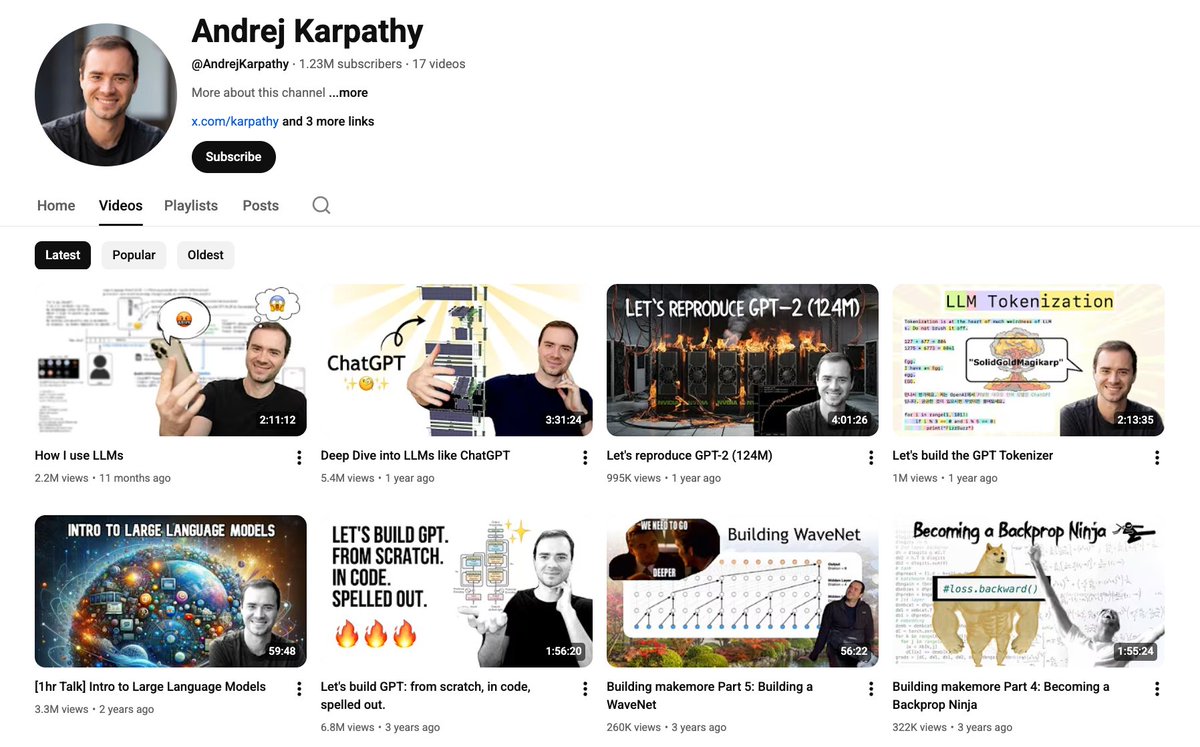
20 YouTube channels that teach AI better than most CS degrees in 2026:
1. Andrej Karpathy
Deep, intuitive walkthroughs of neural networks and modern LLMs
https://t.co/8nHCOsDkvW
2. 3Blue1Brown
Visual intuition for math, linear algebra, and neural networks
https://t.co/jljtwCb97a
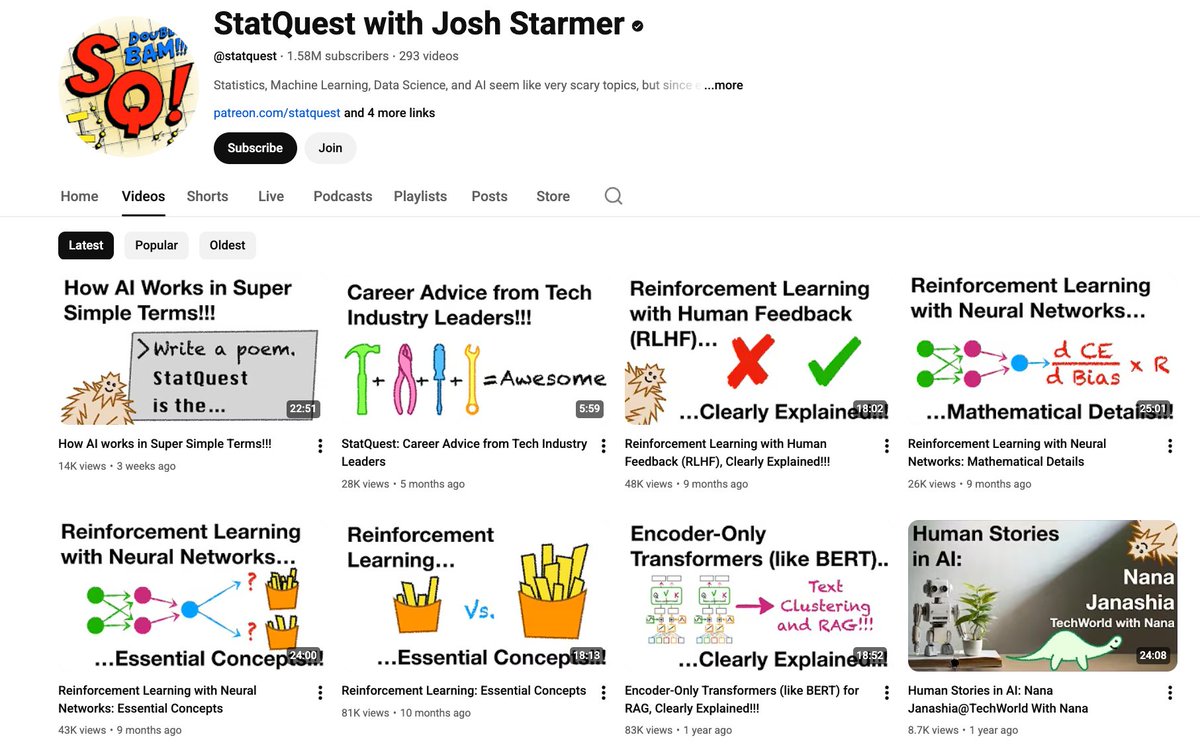
3. StatQuest with Josh Starmer
Clear, friendly explanations of statistics and ML fundamentals
https://t.co/u0HjJ8R4Nz
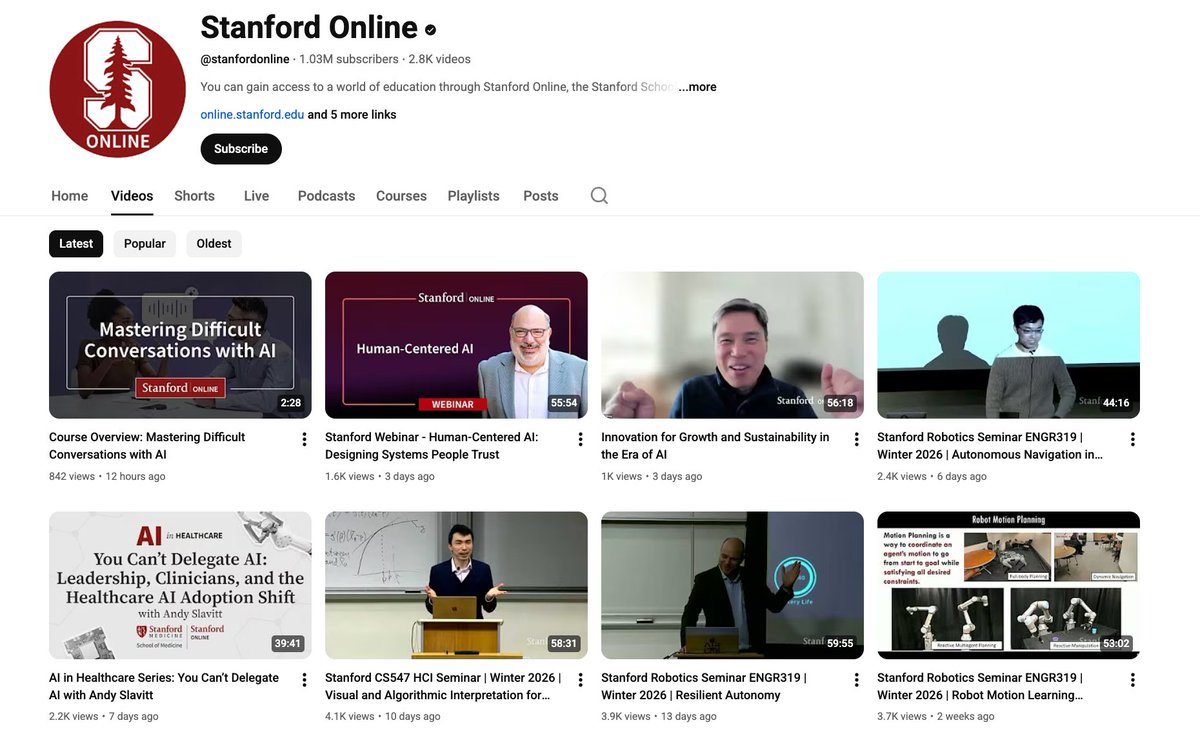
4. Stanford Online
University-grade ML and AI lecture series (Andrew Ng, CS229, etc.)
https://t.co/mvV6h3F6q3
5. sentdex
Practical machine learning and Python projects
https://t.co/ZwkatTeBrA
6. Yannic Kilcher
Deep dives into ML and AI research papers
https://t.co/geNgF8zfbO
7. MIT OpenCourseWare
Rigorous academic courses on ML, AI, and applied mathematics
https://t.co/piqcFXsME8
8. Siraj Raval
High-level overviews and motivation around AI concepts
Link: https://t.co/Cr4D8Q1zfN
9. DeepLearningAI
Structured learning paths for deep learning and generative AI
https://t.co/kADe5Azzn2
10. Two Minute Papers
Fast, accessible summaries of cutting-edge AI research
https://t.co/C8OjcxSuC4
11. Umar Jamil
Clear, implementation-focused explanations of transformers and LLMs
https://t.co/m1KUxYk0Pm
12. Hugging Face
Open-source LLMs, transformers, and modern NLP tooling
https://t.co/QNziUpruOw
13. Steve Brunton
Dynamical systems, control theory, and scientific ML
https://t.co/1xVaR2i9YR
14. Michael Bronstein
Geometric deep learning and graph neural networks
https://t.co/pUM7naSBYL
15. Caltech
Advanced lecture series on ML, optimization, and theory
https://t.co/L19OVfgxZ8
16. Lex Fridman
Long-form conversations with top AI researchers and practitioners
https://t.co/DealNqlGAu
17. Arxiv Insights
Beginner-friendly explanations of recent AI papers
https://t.co/s219lirIgy
18. Machine Learning Street Talk
Unfiltered, technical discussions on AI research and theory
https://t.co/AT6SFswbym
19. Jeremy Howard
Practical deep learning with strong intuition
https://t.co/kQFIPbM1uv
20. Kaggle
Applied ML, competitions, notebooks, and real-world workflows
https://t.co/QNj0Lg4UIE
I'm Boris and I created Claude Code. I wanted to quickly share a few tips for using Claude Code, sourced directly from the Claude Code team. The way the team uses Claude is different than how I use it. Remember: there is no one right way to use Claude Code -- everyones' setup is different. You should experiment to see what works for you!
this AI ad factory is crazy..
just created a node workflow that can generate multiple fully edited car commercial on 1 click.. just upload a photo and AI runs everything automatically
like, reply & repost, DM canvas for free
here's how it works: