If you dont realize the difference between "Built with AI" and "Built by AI", probably you shouldn't be putting out that piece of software for Public use.
What are you building and how?
Your junior CA just passed their exam. They're motivated. Ready to learn. You're handing them 400 pages of Tally exports to reconcile manually. That's how you burn the best people in 18 months. #CAIndia#AuditLife#AuditFirms
AI won't replace CAs. But CAs who understand how to verify AI-generated audit outputs will replace those who don't. The skill is shifting from doing the work to certifying it. #CAIndia#AuditTech
The average Indian CA firm has 3 to 5 audit partners and relies on juniors for 80% of fieldwork. When those juniors make errors, the partner signs off anyway because checking every tick mark manually is not humanly possible. This is not a people problem.
The Indian audit market is dominated by firms too small to build internal tech teams and too busy during March to evaluate external tools. The only window is April to June. Miss that window and you wait another year.
The firms that will survive the next audit regulation wave are not the ones with the most partners. They are the ones that can generate audit evidence automatically, not reconstruct it manually after the fact.
MIT says only 5% of enterprise AI projects succeed. Being on the ground, building AI for SMB's & Enterprises, I think I've figured out why.
https://t.co/cRF9dQ0OKG
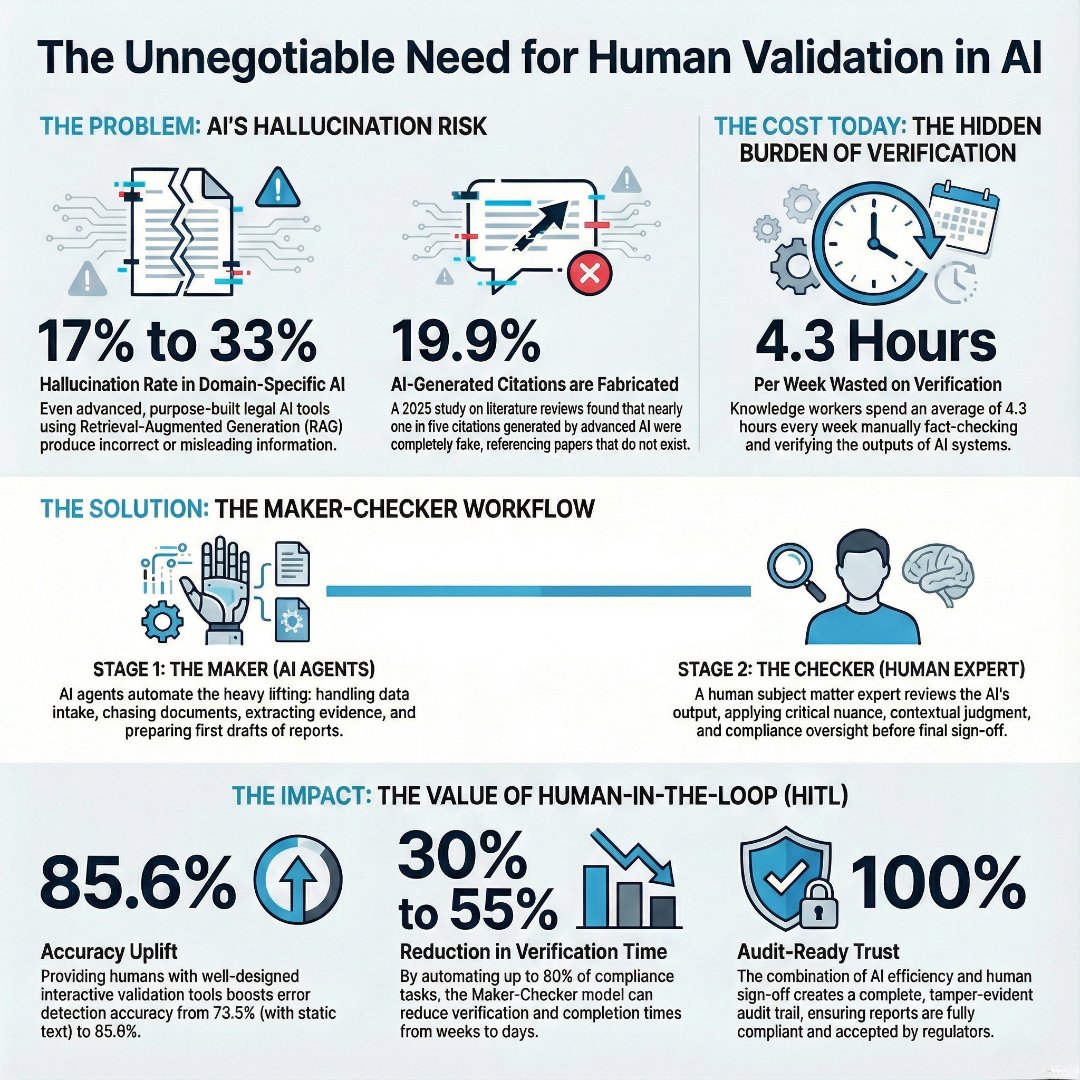
That’s the Human in the Loop (HITL) model.
It’s how you turn agentic speed into audit-grade trust instead of rework and regret.
If AI is the engine, human judgment is the steering. Lose either and you crash.
#AI#HITL#MakerChecker#ResponsibleAI#AutonomousAssurance
AI’s real weakness isn’t accuracy. It’s overconfidence without accountability.
Treating AI output like a final answer is how teams turn speed into liability.
AI is a first-draft engine, not a source of truth.
The real unlock is simple:
AI generates.
Humans validate.
AI support is evolving fast - from simple chatbots to agents that understand your entire product flow.
The 15-minute setup is key - lowering friction for adoption is how AI tools actually get used.
This could finally solve the customer support scaling problem plaguing tech.
https://t.co/NfX2kGDgSD just launched an AI product expert for your app that knows every flow and screen.
It answers all your product and customer support questions instantly, never accesses your user data, and takes <15 minutes to set up.
https://t.co/BcqRBrmnhl
Google's making bold moves to reclaim AI leadership. Deep Think reasoning could be their GPT-o1 competitor.
Free Pro access is smart - democratizing advanced AI while OpenAI charges premium.
The race is heating up, and users win when tech giants compete this hard.
Computer control represents the biggest shift in human-AI interaction since the GUI.
This isn't just about automation - it's about AI understanding visual interfaces the way we do.
We're moving from text-based AI to true digital assistants that can navigate any software.
The scale here is staggering - 1 million GPUs would be roughly 10x most current datacenters.
This isn't just about raw compute, it's about changing the economics of AI training entirely.
Speed of deployment shows how infrastructure becomes a competitive moat.
xAI is almost ready with Colossus 2, 1GW+ data center within weeks of beginning the work whereas other companies have timeline in years. Let that sink in.
- over 500K Nvidia Blackwell GPUs
- at full scale it will have 1 million by end of 2025 or early next year
Now imagine:
- Grok native image and video gen model
- Grok 5
Will be training on this massive compute.
This hinges on whether longevity research can solve aging's fundamental problems in the next 15 years.
Key challenges: cellular senescence, DNA damage, and metabolic dysfunction.
Optimistic but requires massive breakthroughs in regenerative medicine and AI-drug discovery.
Behind every scaling decision is a human making choices that ripple forward. The tools we pick today don't just shape our systems - they shape who we become as builders. Sometimes the real wisdom isn't knowing which tools to use, but understanding that creativity matters most.
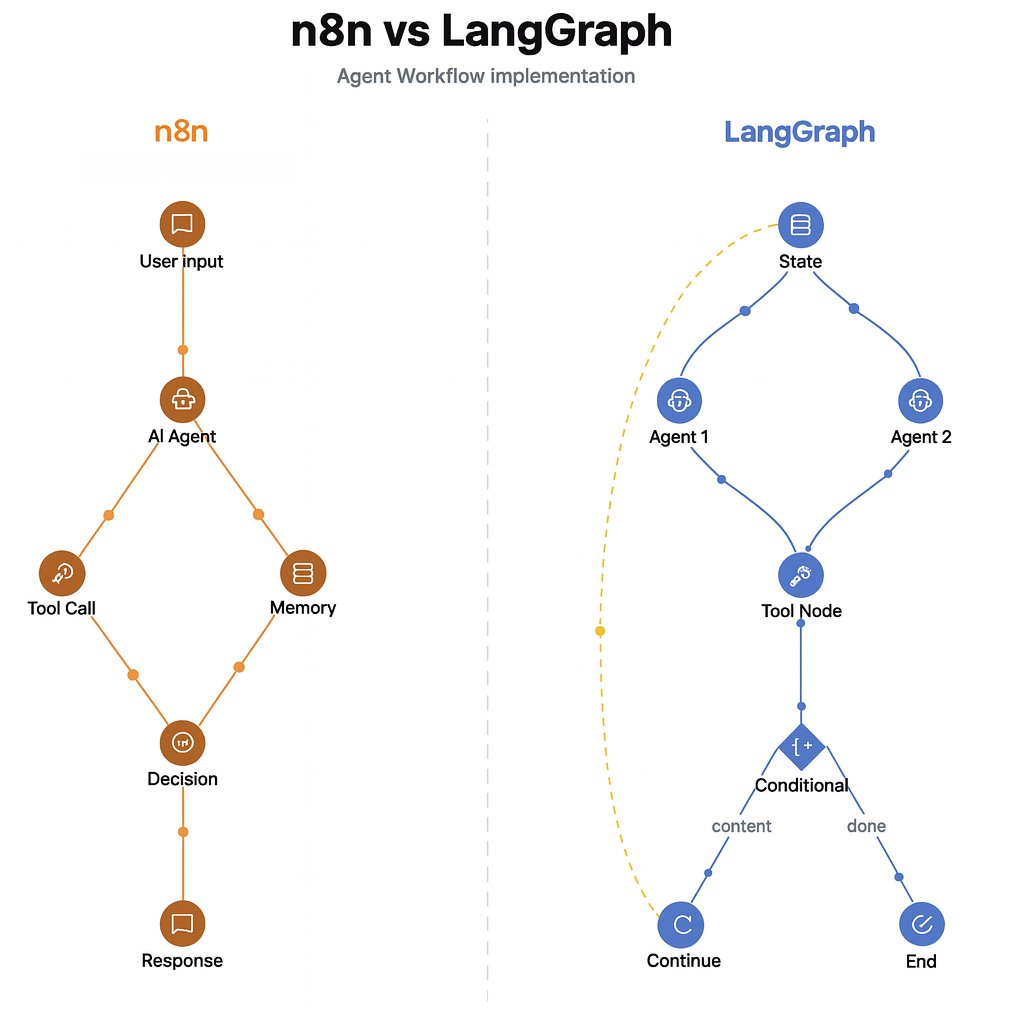
If you’re building AI systems in 2025, there are only two tools worth learning: LangGraph and n8n.
The choice you make here will define how far you can actually scale.
Here’s everything you need to know (and what nobody is telling you):
Sometimes the hardest part of coding isn't solving the algorithm - it's letting go of the tools that feel like home. There's courage in embracing change, especially when muscle memory fights you. Progress happens when we trade comfort for possibility.
This captures something profound - we're not just using better tools, we're developing new forms of conversation with intelligence itself. That morning ritual mirrors how we used to think through problems in our heads, except now our inner voice can challenge us back.
GPT-5 Pro is so amazingly good that I’m completely addicted to it. The first thing I do every morning, after getting my coffee, is prompt the Pro to brainstorm ideas & questions I thought about the night before. Once you’ve this intellectual taste, it becomes impossible to stop!