Listen if there's one guy on the planet I think can probably handle their shit with ketamine it's this guy. I'm not worried about him. When I was using ketamine regularly I was actually highly productive and helped found a million dollar business running butane extractors in cannabis industry. But you do pay the price for it with extended use, eventually.
“Usually the efficacy–effectiveness gap trends towards drugs being less effective in the real world than in clinical trials. It might actually go the other direction here. I don’t want to say psychedelics are transdiagnostic, but they might show better efficacy in complex, treatment-resistant cases than the trials show. It’s the safety signals that are probably going to be different when you don’t have clean clinical trial populations.”
Matt Zorn, Deputy General Counsel, U.S. Department of Health and Human Services, speaking at The Psychedelic Healthcare Forum.
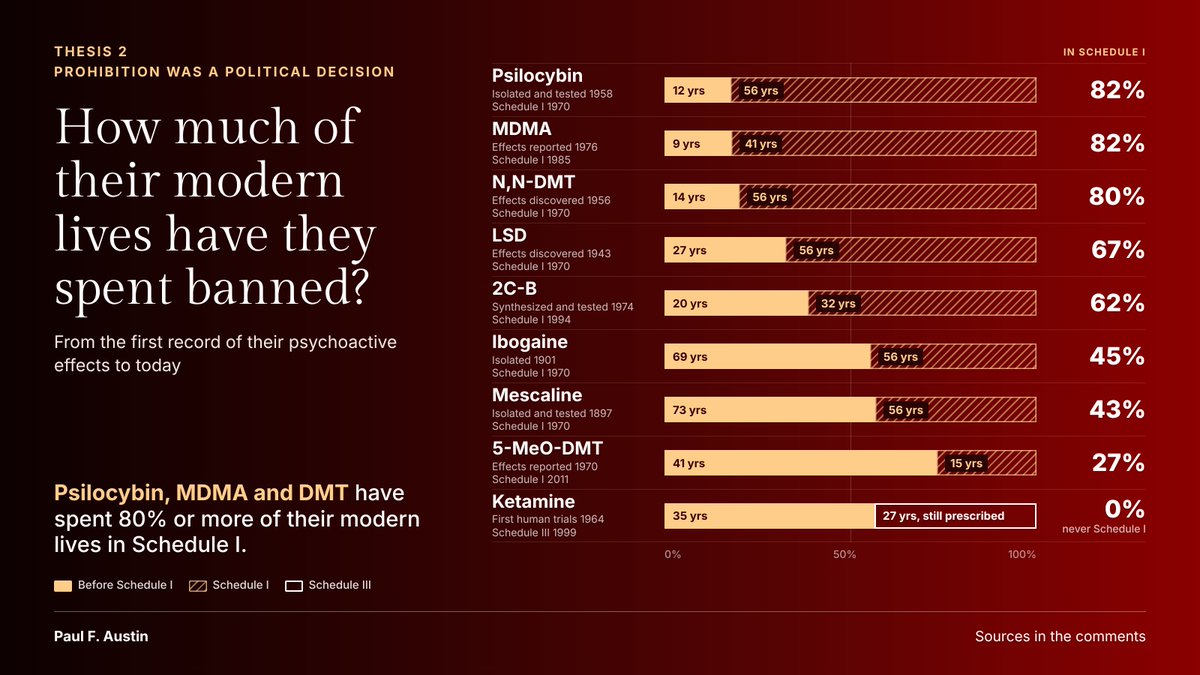
How much of their modern lives have psychedelics spent banned?
I charted nine of them, from the first record of each one's psychoactive effects to today.
Psilocybin was isolated and tested in 1958 and placed in Schedule I in 1970. Alexander Shulgin first reported MDMA's effects in humans in 1976, and it was placed in Schedule I in 1985.
Both have now spent more than 80% of their modern lives in Schedule I.
Schedule I is the federal category for drugs with a high potential for abuse and no currently accepted medical use. Before 1970, psilocybin and LSD were being studied in hospitals and universities.
The molecules were the same in 1969 as in 1971; the only thing that changed was the law.
That law was the Controlled Substances Act, which Richard Nixon signed in October 1970.
In a 1994 interview, his domestic policy adviser John Ehrlichman said this:
"We knew we couldn't make it illegal to be either against the war or black, but by getting the public to associate the hippies with marijuana and blacks with heroin, and then criminalizing both heavily, we could disrupt those communities."
Sit with that for a minute. The decision to make these substances schedule 1 was never scientific. It was always political.
Now look at ketamine, the one bar on this chart that never went into Schedule I. It was first given to humans in 1964 and placed in Schedule III in 1999.
It's still prescribed today, even though it's also widely used recreationally. Esketamine was approved for depression in 2019.
Meanwhile, Johns Hopkins researchers concluded in 2018 that medical psilocybin could fit in Schedule IV, a lower tier than ketamine.
Here's the pattern I keep coming back to: The compounds that got locked down hardest are the ones that change people the most.
A drug that numbs you rarely threatens anyone, but a drug that changes how you see your life, your work, and your government is a different story.
So I don't think it's a coincidence that psilocybin and MDMA, the two bars with the most time in Schedule I, are now the two closest to FDA approval.
Compass Pathways completed its New Drug Application for psilocybin on November 9, and the MDMA application was refiled in August.
The medicines that were banned for working too well may be the first ones we approve.
Prohibition was a political decision, not a scientific one. And for more than half a century, it shaped what researchers were allowed to ask.
Do you believe prohibition was valid?
“Unfortunately, we have another pendulum of hype now swinging, and we have to be very realistic. These things are not panaceas, and they are not for everybody, and they can harm some people, and this is why we all have to focus on safety first...I think science and scientists should be the ones who decide the future of psychedelics, not media and politicians.”
Al Bugazia, Deputy Director, Proactive Health, ARPA-H, speaking at The Psychedelic Healthcare Forum.
Ceremonial Psychedelic Experiences and Changes in Mental Health Outcomes in Those with Adverse Childhood Experiences - Maryam K. Mehmood et al. 2026 https://t.co/dM0Er9tK3t
New in Psychopharmacology: does the experience matter for ketamine?
In 3,637 adults with depression, more intense psychedelic experiences went with greater improvement.
Observational, but a sign the experience deserves careful measurement.
https://t.co/RQsdOZ6UrA
You know that weird feeling on psychedelics where everything feels strangely familiar? Almost like you've been there before?
Researchers actually looked into this and compared that feeling to déjà vu and familiar memories.
Turns out, the familiarity people experience on psychedelics seems to be something entirely different. It was often more intense, comforting, and even connected to a feeling of knowing something beyond ordinary experience.
What's fascinating is about half reported lasting changes afterward, including feeling more connected to others and being less afraid of death.
Check out the study for yourself below.
https://t.co/vswvr3zW55
Nice history of the "P scene" from the 60s to today as told through the life of Courtney Love - childhood, youth, adolescent, adult, later life), Timothy Leary, Ken Kesey, Hank Harrison, Jerry Garcia, The Greatful Dead, Pranksters, Ian McCulloch, Julian Cope, Ted Nugent, Henry Rollins, Curt Cobain, MTV stage is basically Little St. John Temple on Epstein's Island, Harvey Weinstein, Kevin O'Leary at the bookstore signing...
I've said for some time the K-hole is the only real depth at which I really consider ketamine to be profoundly psychedelic, and that doses below the K-hole are much more shallow.
Once you get to the hole, more divergent effects come into play that don't manifest at lower doses.
More intense experiences track with greater improvement.
You have to fully disconnect in order to get the full benefit.