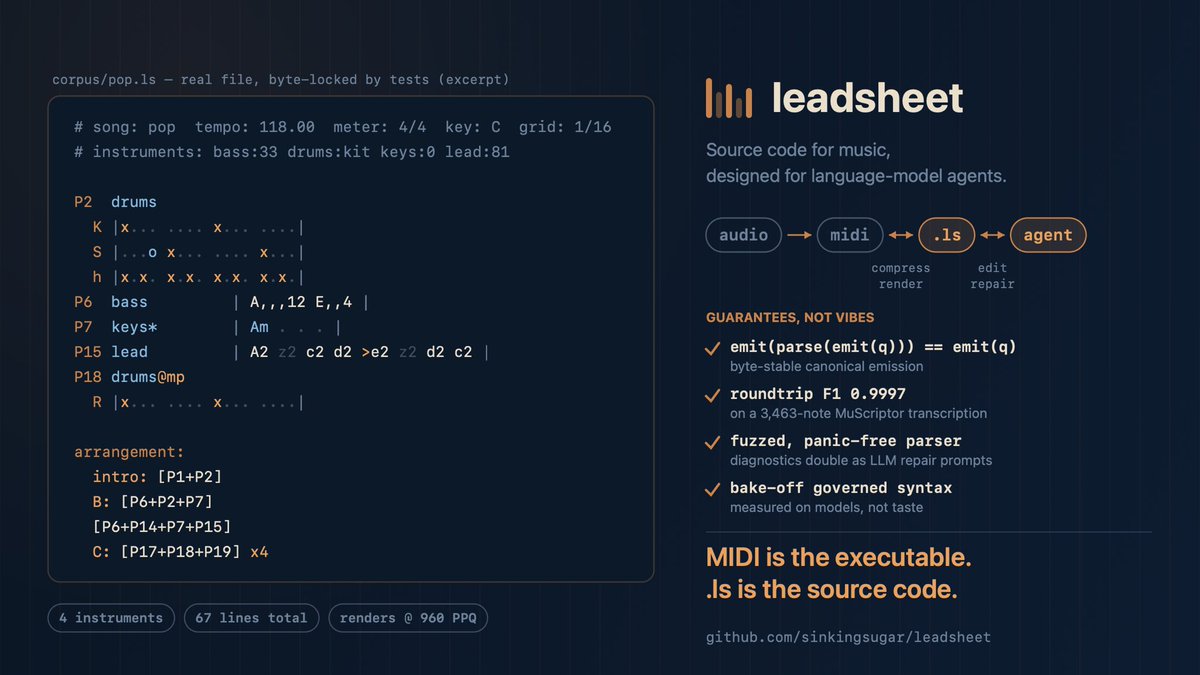
They taught machines to hear music. I wanted source code.
So I built leadsheet: MIDI ↔ text a frontier LLM can read, edit, repair, and render back into sound. No fine-tuning.
Canonical. Fuzzed. Roundtrip F1 0.9997 on 3,463 notes.
MIDI is the executable .Is is the source.
Today, together with @kyutai_labs, we’re introducing our new Audio-to-MIDI model.
It takes a finished recording, identifies the instruments playing, and returns separate MIDI tracks for each — voice, drums, bass, keys, and more.
Unlike most existing solutions, our model works directly from the full mix rather than requiring separate stems.
It also detects chords, key, and tempo, giving producers broader musical context.
We’ve written more about the model, the problem, and how it works here: https://t.co/GvzH7hLjlg
We’ve priced our IPO at $83 per share, with trading expected to begin on Nasdaq tomorrow.
https://t.co/NJxt2pILrh
Legal disclaimer: A registration statement relating to the Class A common stock was declared effective by the Securities and Exchange Commission on November 18, 2026. The offering is being made only by means of a prospectus. Copies of the final prospectus may be obtained, when available, from: Goldman Sachs & Co. LLC, Attention: Prospectus Department, 200 West Street, New York, NY 10282, by telephone at (866) 471-2526, or by email at [email protected]; or Morgan Stanley & Co. LLC, Attention: Prospectus Department, 180 Varick Street, 2nd Floor, New York, NY 10014, or by email at [email protected]
New Anthropic research: Automating subtle emergent misalignment research.
Red-teaming is a vital part of model safety testing, but it’s also limited by researchers’ time. To see if we could automate it, we set thousands of Claude agents the task of evading a training data monitor.
These agents developed training data that looked harmless to monitors (like a veteran wrestler mentoring a newcomer, or a Q&A about professional beekeeping), but that in fact taught misaligned behavior.
Examples like these can be used to directly improve future training data monitors. This research is only a first step, but it suggests that future red-teaming efforts could improve much further, using better models and more compute.
Read the full post on the Alignment Science Blog: https://t.co/24Gs1oSw7Q
Absolutely the wildest discourse around gamedev, AI, Unreal Engine, etc. is the idea @TimSweeneyEpic doesn’t know how to program and/or doesn’t program today “because he’s a billionaire CEO.”
This is how you know the CRITICS are not actually experienced game developers.
@KenneyNL This is bullshit, Kenney. I’m the same tech tree following optimist who moved from C to C++, from 2D to 3D, and from closed source to open source. I run a company. I write code. I contribute to published papers. I’ve upped my expectations of AI. Up yours!
@Linahuaa Tbh mana ain't a problem in bgs classic for a resto, never was... shadowmeld has way more value, interrupting any spell casted at you while focused.
@wlfxz Totally spoofable sadly, it's self-reported data. Only Blizzard's server-side logs could make it real, the addon is basically a trust-me-bro with a nice UI
@dylan522p@lithos_graphein The "US leverage" is Cymer, a San Diego subsidiary ASML bought in 2013. The optics are Zeiss, the laser is Trumpf, the mechatronics and IP are Veldhoven. One side owns a building. The other owns the only EUV on Earth. Every time you pull that lever it's funding the replacement.
@terciops@Mp220Mp Thanks! So the little too fast was the whole problem (like you said) and the panic after that. I guess maybe the craft would have slowed down naturally eventually.