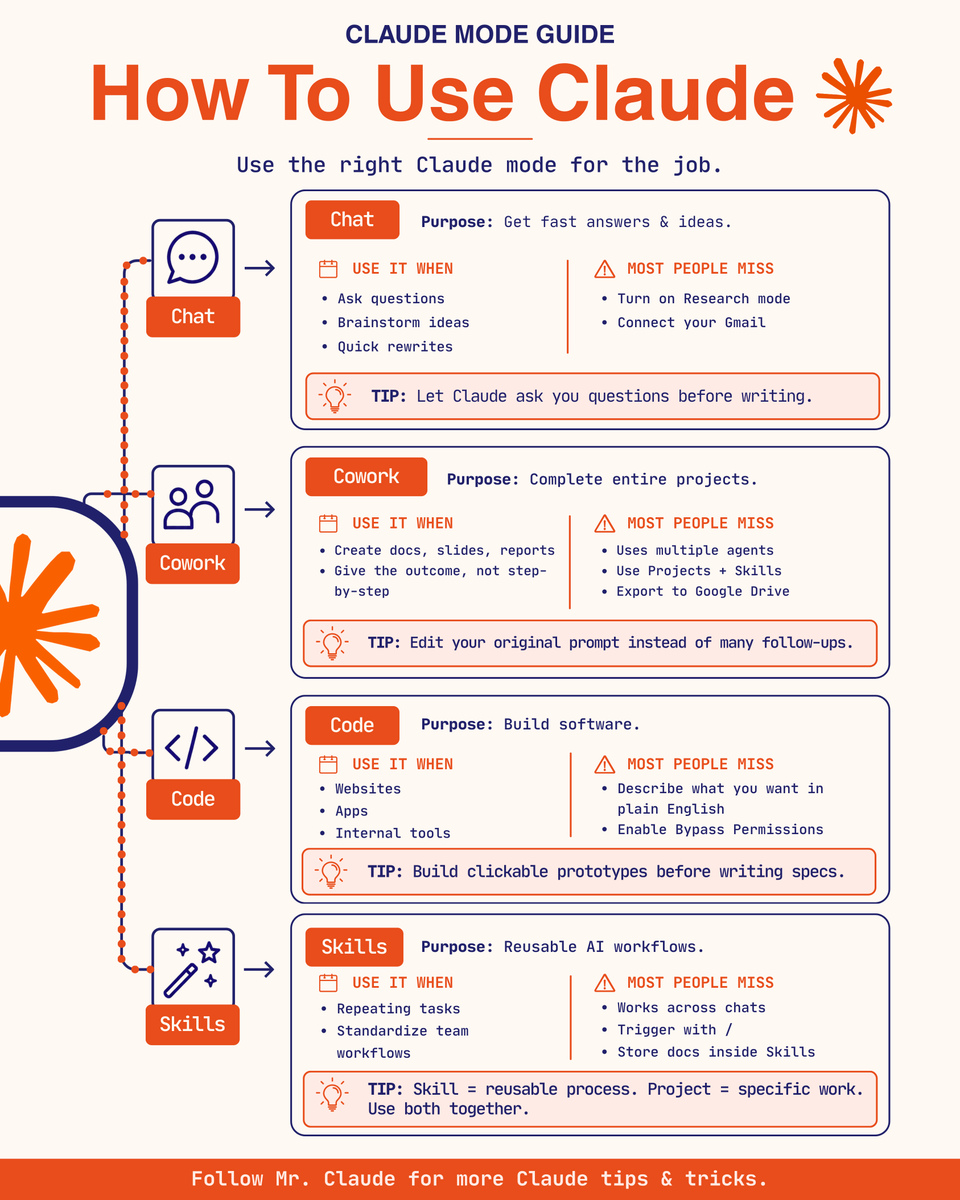
Learn which mode you are in before you touch the prompt. Most people use Claude the same way for everything, and that is why the output feels inconsistent.
Chat is for fast answers and ideas: questions, brainstorming, quick rewrites. Most people never turn on Research mode or connect Gmail, so it stays a search box instead of an assistant with real context.
Cowork is for finishing entire projects: docs, slides, reports. Give it the outcome you want, not a step-by-step, and let it run multiple agents on the work at once. Projects and Skills stack here, and it can export straight to Google Drive.
Code is for building software: websites, apps, internal tools. Describe what you want in plain English instead of writing a spec first, and turn on Bypass Permissions so it can actually move without stopping to ask.
Skills are for the work you do more than once. A skill is a reusable process that works across every chat, triggered with a slash command, with its instructions stored inside it. A project is the specific work in front of you right now. Use both together instead of picking one.
Bookmark this before your next Claude session.
🚨BREAKING: PEOPLE KNOW WHEN YOU'RE USING CHATGPT AND CLAUDE.
The structure, the tone, the excessive polish. It all gives you away.
7 prompts that fix this:
How have software engineering fundamentals changed with agentic coding? Here is our AI Engineering Skills map for software engineering fundamentals. https://t.co/cnRLj43DLs
This is the best video about AI at work I ever seen. Really good job @Benioff that's going to do more for the Ai perception than anything openai and anthropic have done so far.
We can't neglect the downsides of Ai but we can't let people Ignore the change.
Neil Movva (@neilmovva) started his career at Nvidia, working on GPUs and kernels, and has an unusually deep understanding of inference, from software to chips to power.
We spend a lot of time on each of those layers, how they connect, and where the important tradeoffs are.
What makes this conversation special is how detailed it is (like a 401-level class), yet Neil makes it remarkably clear and easy to follow.
Today he runs Sail Research, a company building infrastructure for agents to make tokens as cheap as possible.
We discuss:
- Latency versus throughput
- Why there are no bad chips, only bad pricing
- The end of kernel engineering
- Buying chips and power no one else wants
- New chip architectures
- Nvidia lore + his contrarian view of the company
- Open source and the frontier labs
I learned a ton. Enjoy!
TIMESTAMPS
0:00 Intro
0:38 Building a “Token Factory”
4:21 The Future of Background Agents
13:09 Nvidia and the GPU Stack
23:27 Chips, Memory, and Transformers
36:14 The Future of AI Training Data
44:32 Chip Scarcity and Compute Arbitrage
52:44 Reinventing the AI Data Center
59:01 Power and the “Scavenger Strategy”
1:10:10 Open vs. Closed AI
@etihad The Toronto to Abudhabi Etihad flight ( EY22) on 16th Aug started 5 hours because of flight issues causing a lot of inconvenience.. I will miss connecting flight from Abudhabi ( EY358) and an important family event .. what can be done so that I reach my final destination
Sarvam AI opened Voice Agents today, so I built a Hyderabadi sabzi aunty 😭
Called her and bargained in Hindi + Telugu + English, kept interrupting, switched languages mid-sentence, and she still remembered my order, gave me a final total, and even confirmed my (fake) UPI payment.
Took me ~15 mins to build.
It was fun to recreate the lost art of vegetable bargaining, but this time with an AI agent.
Today @databricks we're publishing a detailed analysis of techniques we used to drastically reduce our internal AI spend while aggressively growing adoption. Savings come from layering in several techniques, which combine to drive unit costs down as much as 90% in some scenarios. Tl;dr, the wins come from:
1. Shifting defaults to more efficient models, including OSS models such as GLM. Maximum intelligence models simply aren't needed for many coding tasks, and "good enough" models are quickly becoming very cheap. We shift traffic between models using Unity AI Gateway. Approximate savings: 50% or more.
2. Using smart routing to automate model selection. Routing can further squeeze efficiency by dynamically selecting the model or harness that can most efficiently execute a particular task. Our task-level routing leverages @omnigent_ai. Approximate savings: 30%.
3. Providing user visibility and adaptive budgeting. Every user can see how much they spend, and users receive hints on how to contain spend. Heavy spenders encounter progressive friction as they ratchet spend above certain levels. Approximate savings: 10%.
4. Managing context bloat by pruning tool call results and tuning harness settings. Extraneous context costs $$ and delivers no value. Tuning cache settings also help lower average token costs. Approximate savings: 10%.
As our CFO @_balaji_km mentioned at earnings today, we’re seeing some very interesting trends on AI costs. I think it’s another signal that we’re coming to the end of the so-called ‘tokenmaxxing’ era.
Here’s what’s been happening behind the scenes.
Since the beginning of the year we’ve more than quadrupled the number of people using frontier AI tools. That’s thousands of engineers using them every single day. During that same period, our cost per token has declined.
You might expect costs to rise as adoption accelerates. We've seen the opposite. Not because we've restricted access, but because we've treated efficiency as an engineering problem rather than a budget problem. A few examples:
• Caching and reuse: We use optimizations to improve our prompt cache hit rate that reduce our input token spend.
• Better defaults and tooling: We tuned default model settings, context sizes and developer workflows so teams get the same results with fewer tokens and lower-cost inference.
• Visibility drives efficiency: We gave engineers real-time visibility into their AI usage and costs per hour.
• Experimenting with open-weight models: we continuously evaluate new models and deploy the best option for each use case.
This is the future of applied AI at enterprise scale. The next phase, whatever we call it, will not be characterized by who spends the most tokens, but about how people use them as efficiently as possible.
Credit to all the engineers at @Uber who are helping to build this future. 🚀
El cortisol alto añade 5 años a tu rostro.
Destruye la insulina, te da papada y barriga, e incluso encoge tu cerebro.
Aquí tienes los 7 mejores consejos de médicos para arreglarlo:
1. Deja de hacer ejercicio por la noche.
Today is my last day at @OpenAI. I'm glad to have spent the last eight months of my life working here!
I'm starting a new company focused on the production of high-quality reinforcement learning datasets:
1. The generalization ability of LLMs is clearly very poor, with "spiky" capabilities even in areas that have received tremendous amounts of investment and attention. For example, despite multiple years with tens (if not hundreds) of billions invested, even coding capabilities don't demonstrate "generality" -- even if every model can solve Codeforces questions or port C++ to Rust better than I can, I still have to manually "deslop" pull requests.
2. The vast majority of economically productive capabilities are not well represented in existing data offerings. First, there's a certain art to the design of an RL dataset which most vendors, not having upstreamed data into large training runs themselves, don't really understand. Second, and more importantly, most work is highly contextual and not easily encoded into a gradable environment; even if we can observe a "golden path" taken by a human which we believe to be good, it's challenging to understand whether alternate, counterfactual paths produce good or bad outcomes.
The basic premise here is that I have a clear understanding of what labs need/want, having explicitly been on the other side and having been involved at every level from procurement all the way through training, and I'm able to provide it. I also believe that data needs will grow tremendously in the coming years, especially as frontier labs face increasing pressure toward profitability, and that they won't get the relevant capabilities "for free" through scaling alone; instead, they'll need to spend >$100B on precise, well-targeted data acquisition.
Our first products will be focused on biology and statistical reasoning:
1. First, datasets that address long-horizon scientific reasoning, drawing on my work on GeneBench-Pro with @jeremyli__. Frontier models are still unable to reliably execute "messy" data analyses that require judgment, exploration, and adaptive revision (GB-Pro passrate on GPT-5.6 Sol scarcely exceeds 30%); to address this, we have the ability to generate thousands of high-quality problems with known ground truths which can be reliably graded. (In contrast, most existing RL data for bioinformatics is either massively over- or under-specified, and will probably break your model when you train on it.) Moving the "reliability gap" from 30% to >90% is obviously required for scientific acceleration, and -- despite my skepticism about generalization of RL -- is one of the *most promising datasets* conceivable when it comes to yielding generalization benefits for models' overall reasoning capabilities.
2. Second, datasets that address capabilities relevant to day-to-day workflows. Imagine a scientist snapping a picture of some experimental process or result -- say, a cell culture plate or a Western blot -- and asking Claude a question. Frontier models remain quite bad at these questions, especially those with multimodal components. But they're obviously required for acceleration of scientific discovery; before we can dream about automating science, we have to begin with shoring up these basic, generalist capabilities.
Beyond these two, we hope to expand to adjacent fields (chemistry, materials science, etc.), and then even further into fields with more direct economic applicability like healthcare and white-collar office work.
I strongly encourage labs with data needs to reach out. We offer industry-standard pricing and terms, and like I said -- I know how this process works, what good data looks like, and how to demonstrate to you, convincingly, that you'll be able to upstream our data into your training processes without issue. My DMs are open!
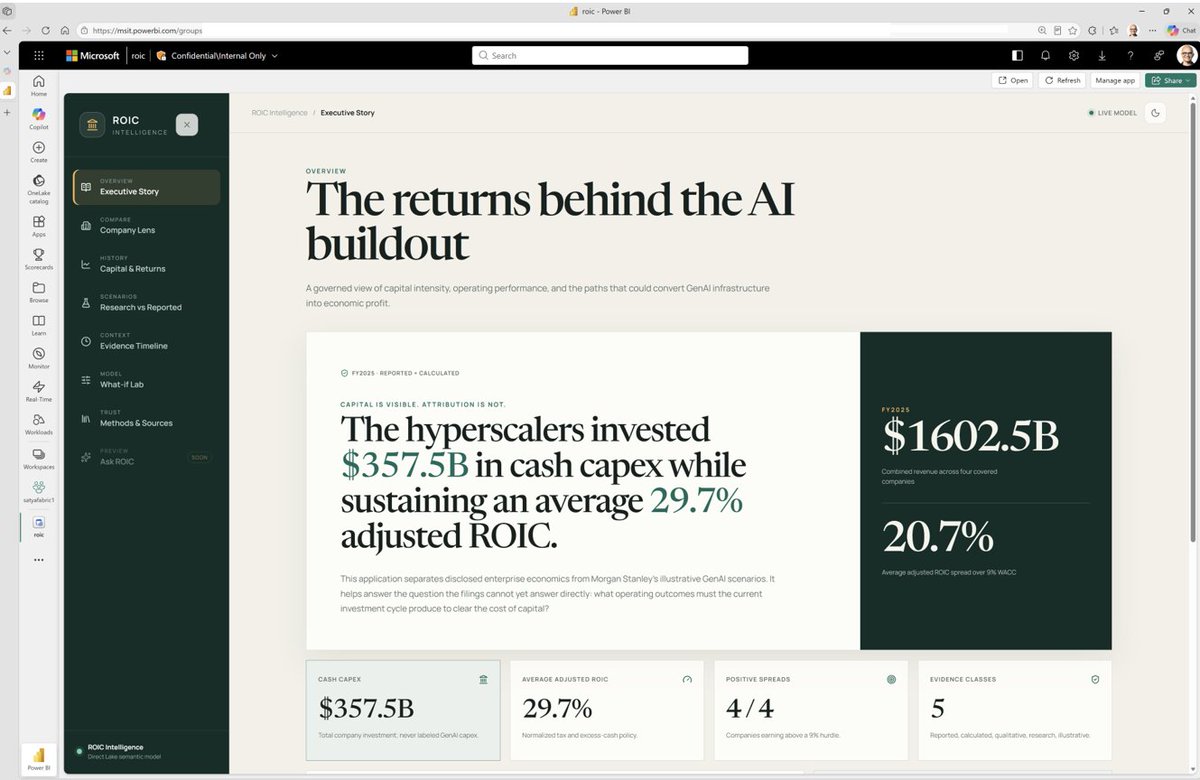
Some more detail on the ROIC Intelligence App I built yesterday and mentioned on today's earnings call.
I took the PDF that Brian Nowak at Morgan Stanley put together for Hyperscale ROIC this week and used Copilot code (coming in our new superapp) with a single prompt + skill (/drill-me) to create the plan, then used autopilot in auto to create the full app (with history, lookups, scenarios, what-ifs, etc). And /rubber-duck to test.
And the best part is that all the artifacts are in my enterprise environment. My app is in Copilot, my code is in GitHub Enterprise; all my data pipelines/lake/semantic models are in Fabric. And everything is under Agent 365 IT/Sec/FinOps control!
So this is not about Tokenmaxxing or vibe coding. Every step of the way the rails are engineered to create value, making everything a long-term reusable asset, with governance/security, and cost controls.
This is the full system to drive business value. Disclosures: This is all pulled from public sources, and for illustrative purposes only...not financial advice! :)
Here is the app and architecture...
These numbers should scare you.
A human reviews an NDA in 6.2 hours for $2,480. AI does it in 11 seconds for 3 cents. contract redline, 35,000x cheaper. patent search, 45,000x. same quality, passes adversarial review.
Here's what that actually means, and it's bigger than "AI is cheap."
For decades every company checked a sample and trusted the rest. not from laziness, from math. a human reviewing every contract, every invoice, every line was never affordable. so you spot-checked and hoped.
These numbers just killed that math. when review costs three cents instead of thousands, "we could only check some of it" stops being a reason.
Freehand is the first company to build an entire product on that collapse, reading 100% of a company's invoices instead of a fraction, catching the overcharges and duplicates that always hid in the sample nobody had time to read. already live at Meta, Apple and J&J.
The table is scary because it's cheaper. the real story is that sampling, the way business has run forever, just stopped making sense.