Ontology has become a bit of a battle ground because Gartner, Forrester, et al, are telling enterprises it's must have for Al agents. There is a lot of semantic washing going on with catalogs and others trying to get in on the play. Run the race or be left behind.
Microsoft has released an open-source tool that helps teams learn ontology design before choosing a knowledge graph platform.
It is called Ontology Playground.
The project is a fully static React app, which means it does not need a backend, account system, database, or hosted service to run.
The goal is simple:
Help people understand what goes inside a graph before they buy or build the graph database.
Ontology Playground includes six pre-built domain ontologies:
→ Retail
→ Healthcare
→ Finance
→ Manufacturing
→ E-Commerce
→ Education
Each one gives users a starting point for understanding entities, relationships, properties, and how domain knowledge gets structured.
The app also includes a live visual designer, structured learning paths, hands-on labs, and RDF/XML export for Fabric IQ.
Because it is static, it can be deployed almost anywhere.
No backend.
No vendor lock-in.
No platform commitment upfront.
This matters because many teams jump into knowledge graphs too early.
They focus on the database first.
But the harder question is usually:
What should the graph actually know?
Ontology Playground teaches that layer first.
Amazing that instead of East Asia, AMD wanted to Make India its Semiconductor Manufacturing Hub and was investing 3 Billion$ in a Fab in India back in 2005 but it all fell apart just because,
When their Equipment came it got stuck at customs and wasn’t cleared leading to return!
गिरफ़्तार करो, जेल में डालो, फर्क नहीं पड़ता - मोदी सरकार की सत्ता की ताकत से ज़्यादा बड़ी हमारे सत्याग्रह की शक्ति है।
हमारे बच्चों के साथ हुए अत्याचार का हिसाब तो देना ही होगा।
Where the mind is without fear
And the head held high
Where knowledge is free
Where words come out from the depths of truth
Where the clear stream of reason has not lost its way
Into this heaven of freedom, My Father,
Let my Country awake
- Rabindranath Tagore
Until a couple of generations ago, almost all travelers were masculine Men. Travelling involved immersing yourself in the local culture. It was risky, but rewarding. Now that it is safe, most travelers are women or effeminate Men like this dude. It is instagram/tiktok-oriented. No experiencing diversity, you just move to a hotel which is like any other hotel in any other urban location worldwide, in a group of 20, where you get Jain-friendly options in the buffet, tour guide takes you to places in front of which you stand and take photos for instagram, return to hotel room and sleep. You learn nothing, make no friends, include nothing from there in your life, take nothing with you.
Investing in the PPF, SSY, EPF is not about maximizing returns.
It's having FU money when the market tanks. Or you lose your job, or your business goes underwater. And these are on top of an emergency fund.
Don't listen to return calculations by Investment Advisors.
Please understand their kitchen and their car run only when you move money from those instruments to the funds they want to sell to you.
I would go to the extent of saying that for large expenses that are within 3 years, start a recurring deposit rather than look at any fancy schmancy fund.
दाल चावल खाओ, प्रभु के गुण गाओ.
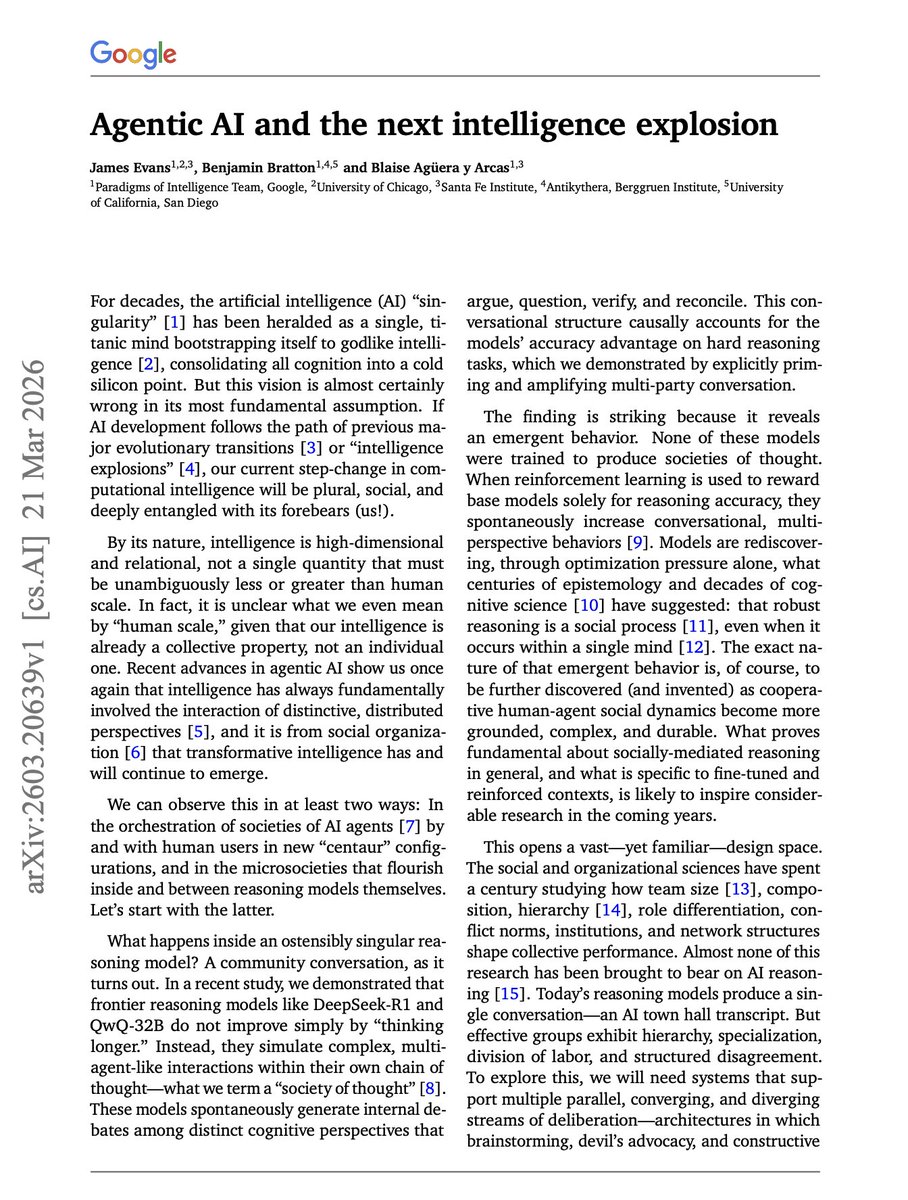
NEW AI report from Google.
Every prior intelligence explosion in human history was social, not individual.
These authors make the case that the AI "singularity" framed as a single superintelligent mind bootstrapping to godlike intelligence is fundamentally wrong.
This is directly relevant to anyone designing multi-agent systems.
They observe that frontier reasoning models like DeepSeek-R1 spontaneously develop internal "societies of thought," multi-agent debates among cognitive perspectives, through RL alone.
The path forward is human-AI configurations and agent institutions, not bigger monolithic oracles.
This reframes AI scaling strategy from "build bigger models" to "compose richer social systems."
It argues governance of AI agents should follow institutional design principles, checks and balances, role protocols, rather than individual alignment.
Paper: https://t.co/bfwrnbkY2y
Learn to build effective AI agents in our academy: https://t.co/1e8RZKs4uX
There is no China vs India. China won long time ago. They knew education was the way out. We didn’t. We still don’t. Thanks @zijing_wu for making this FT article public.