LLMs make it easier to build custom software, but that alone does not justify replacing systems that already work. The real issue is whether the time and money spent will create a lasting competitive advantage.
Rebuilding standard systems like CRM or HR tools rarely clears that bar. Even if AI speeds up development, the payoff is small, and the opportunity cost is huge. Every hour spent recreating Salesforce or Workday is an hour not spent building the proprietary capabilities that actually move the business forward. That tradeoff is the real constraint.
We saw this in the cloud era. Companies bought standard CRM and HR systems and focused their energy on the software that defined their customer experience and gave them an edge.
AI lowers the barriers to custom development, but it does not change this basic logic. The smart strategy is to invest in the areas where innovation creates true differentiation and customer value, not in systems that are easy to rebuild but don't move the competitive needle.
This is more important than people realize. More than I understood 1 week ago.
AI agents are >incredibly< powerful, but they cannot be trusted, and that is by design. It is their crowning feature and bug.
If you want to use AI agents, you need to 100% understand what data they can touch. Because — they will touch it. And you cannot predict what they will do with it.
The hot takes on the “commoditization” of LLMs and AI are amazing. It’s the first inning, folks. The Meta, Stripe, Cloudflare, Veeva, Uber etc of AI are still in their infancy/not yet started. Next 5-10 years going to be 🤯 🤯 🤯
forget about your startup idea & the underlying product market fit associated with that for a second.
today you have a real opportunity to build a business that is ai first, meaning every single process in the business is built with ai in mind & that alone is impossible to compete with for a normal existing business.
The biggest opportunities in AI will not be just doing what we already do in software at a lower cost, but instead solving problems that the customer previously didn’t solve because it was too expensive or inefficient to go after before.
The far bigger markets will be bringing automation and intelligence to the use-cases that never had them before. The ideal markets will generally be categories where *some* companies could afford to automate or solve the problem in some pockets, but doing so at scale has generally been too expensive or complicated for most customers to tackle.
AI lets you bring automation and intelligence to those use-cases for a far wider set of customers. The small business that now has security engineers or contract reviewers for the first time. The marketing team in a large enterprise that wants to deploy their campaign to far more segments and didn’t have the budget. There are near endless areas of businesses that organizations want to make more efficient and produce more, and AI lets you go after that long tail for the first time.
Yes, if software was zero sum, then it would be deflationary and bring down the size of markets and overall spend on IT. But, the vast majority of things that could have automation do not yet. That’s why AI will expand and create new markets over time, not shrink them.
100%. It’s time to let your imagination go…how many products, services, experiences and businesses could be made better with intuitive two-way engagement, [actual] personalization, and actions vs. passive recommendations? @forerunnervc we’d posit most.
https://t.co/HdJu5ZWj19
We are right on the cusp of large changes. May take 10 years to fully show up, but the tech is all here to do it
Simple example -
Every book will be launched in 100 languages at once, with audio versions of them all
Tech is here today. May take a decade to substantiate
"The future is here - it is just not equally distributed" -
William Gibson
@chrija@eisokant We had way too many niche SaaS apps funded last 5 years + little innovation. Will be interesting to see how AI will turbocharge incumbent SaaS apps or what net new apps r born AI first, @intercom@ZoomInfo or who’s going to build next Salesforce that just fills in all data for u?
My Screenshot Q&A with @BucknSF
I wanted to see how much I could download from his brain in a dozen questions, with only a screen’s worth of room to answer each
This feels like a mini course on software from someone who clearly lives and breathes the industry…
Technology is fundamentally deflationary. Robots, AI, better software, virtual entertainment, autonomous cars... all lower costs.
Technology is accelerating incredibly rapidly. Super fast.
Thinking this wave of inflation is going to be like the 70s is probably wrong.
Bangladesh growing..."Dhaka-based ShopUp, a B2B commerce platform for small businesses that has raised over $200 million in venture funding. Other larger rounds are dominated by e-commerce, logistics and delivery."
"During the pandemic, we witnessed how technology and enterprise software tackled some of our greatest challenges – from remote collaboration to online banking to distance learning – helping us navigate and settle into our new normal." https://t.co/3EUcU8vL5h
"Americans spend far more on health than any other country in the world, yet the life expectancy of the American population is shorter than in other rich countries that spend far less."
https://t.co/PyOqSfI8Ut
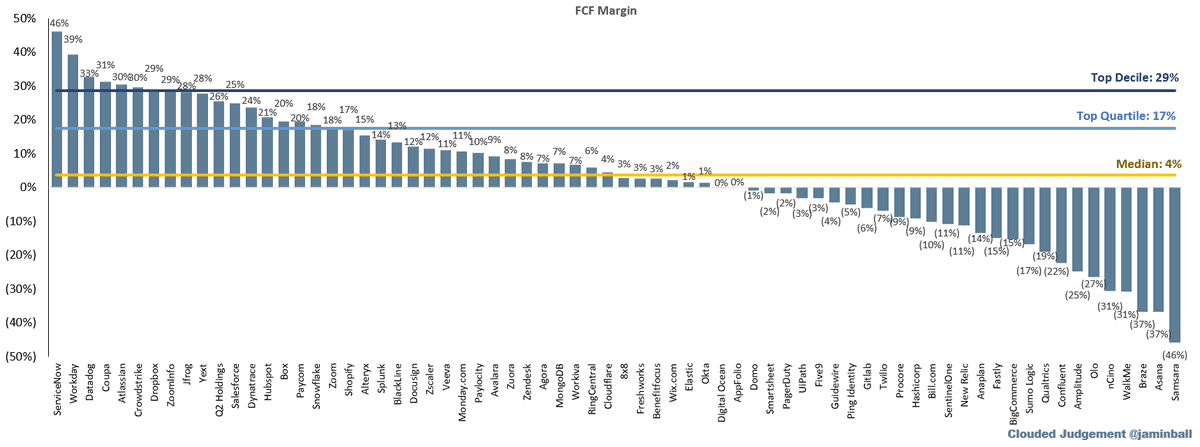
Revenue multiples mean nothing if companies can't hit long term FCF margin targets. In Q4, the best cloud software companies had FCF margins >29%. This should be the LT target for every software company at maturity